

Joe Bonamassa Broke a String on the First Bend at Buddy Guy's 90th. He Finished the Solo Anyway
Joe Bonamassa on stage at Radio City Music Hall in January 2015, more than a decade before his string snapped there at Buddy Guy's 90th. (He's playing a Les Paul here, not the white Strat from 2026.)
CC BY-SA 4.0. Photo: Dmileson / Wikimedia Commons
Joe Bonamassa snapped a string on the first bend at Buddy Guy's 90th birthday show at Radio City and finished on five. What happened, how pros like SRV handle it, and how to stop strings breaking.
At Radio City Music Hall, with half of modern blues guitar waiting in the wings, one of the most prepared players alive lost a string almost immediately and finished on five. Here's what happened, how the pros handle a snapped string, and how to keep it from happening to you.
There is a particular sound a guitar string makes when it lets go under tension. It isn't loud. Through a cranked amp it's more of a dull plink, followed by a sudden hole in the sound where a note used to be. Every guitarist knows it. Most of us hear it in a bedroom or a rehearsal space, swear, and reach for the string pack.
Joe Bonamassa heard it at Radio City Music Hall, in front of a sold-out room, at a concert built to honor Buddy Guy, with John Mayer, Derek Trucks and Billy Gibbons on the same bill.
"There's videos of me playing five strings on this guitar because I broke a string in the first bend," Bonamassa told Guitar World in an interview published October 16, 2026.
The first bend. Not the last chorus, not the closing jam. Right at the start, on one of the biggest blues stages of the year, he was down to five strings. And the remarkable part, according to people who have gone back through the footage, is that you would barely know.
The night: Buddy's Got the Blues

CC BY-SA 4.0. Photo: Frank Schulenburg / Wikimedia Commons
The show was billed as Buddy's Got the Blues: A 90th Birthday Concert Celebration, and it took place on Thursday, October 1, 2026, at Radio City Music Hall in New York. Buddy Guy was born on July 30, 1936, in Lettsworth, Louisiana, so he had actually turned 90 a couple of months earlier. Nobody in the building seemed to mind the delay.

CC BY-SA 4.0. Photo: Robbie Drexhage / Wikimedia Commons
The lineup announced in June by Blackbird Presents and Live Nation read like a roll call of everyone Guy has influenced, which is to say nearly everyone: John Mayer, Susan Tedeschi and Derek Trucks, Joe Bonamassa, Gary Clark Jr., Billy F Gibbons, Eric Gales, Kenny Wayne Shepherd, Jimmie Vaughan, Samantha Fish, Robert Randolph, Shemekia Copeland, Bobby Rush, Ally Venable and more. Drummer Steve Jordan served as music director. Eric Clapton was on the original bill, but Guitar World's live review reported that he was unable to perform because of illness. Christone "Kingfish" Ingram and Doyle Bramhall II also turned up.

CC BY 2.0. Photo: Alex G from Puteaux, France / Flickr via Wikimedia Commons
By every account it was a long, generous night. Guitar World's reviewer noted it was nearly 11 p.m. and Guy and Bobby Rush were still "piling one blues classic on top of another." The setlist compiled by the Tedeschi Trucks fan archive ttbase runs to more than 30 songs, from a seated acoustic opening with Guy, Trucks and Isaiah Sharkey to an everybody-on-stage "Got My Mojo Workin'" at the end. Gibbons played "Texas Flood" with Jimmie Vaughan. Mayer joined Tedeschi on "I've Got Dreams to Remember." Trucks and Tedeschi took "All Your Love" and "Messin' With the Kid."

CC BY 2.0. Photo: Carl Lender / Wikimedia Commons
Bonamassa's slot came in the first half. According to the published setlists and reviews, he led "A Man of Many Words," a song from Guy's catalog, and then teamed up with Eric Gales on Jimmy Reed's "Baby What You Want Me to Do." Glide Magazine called the Bonamassa and Gales pairing "a grooving version," and The Blues Magazine said Bonamassa "brought his precision" to his feature.
Precision is the right word, and it's what makes the string break interesting.

CC BY-SA 2.0. Photo: Chris Hakkens / Flickr via Wikimedia Commons
The moment itself
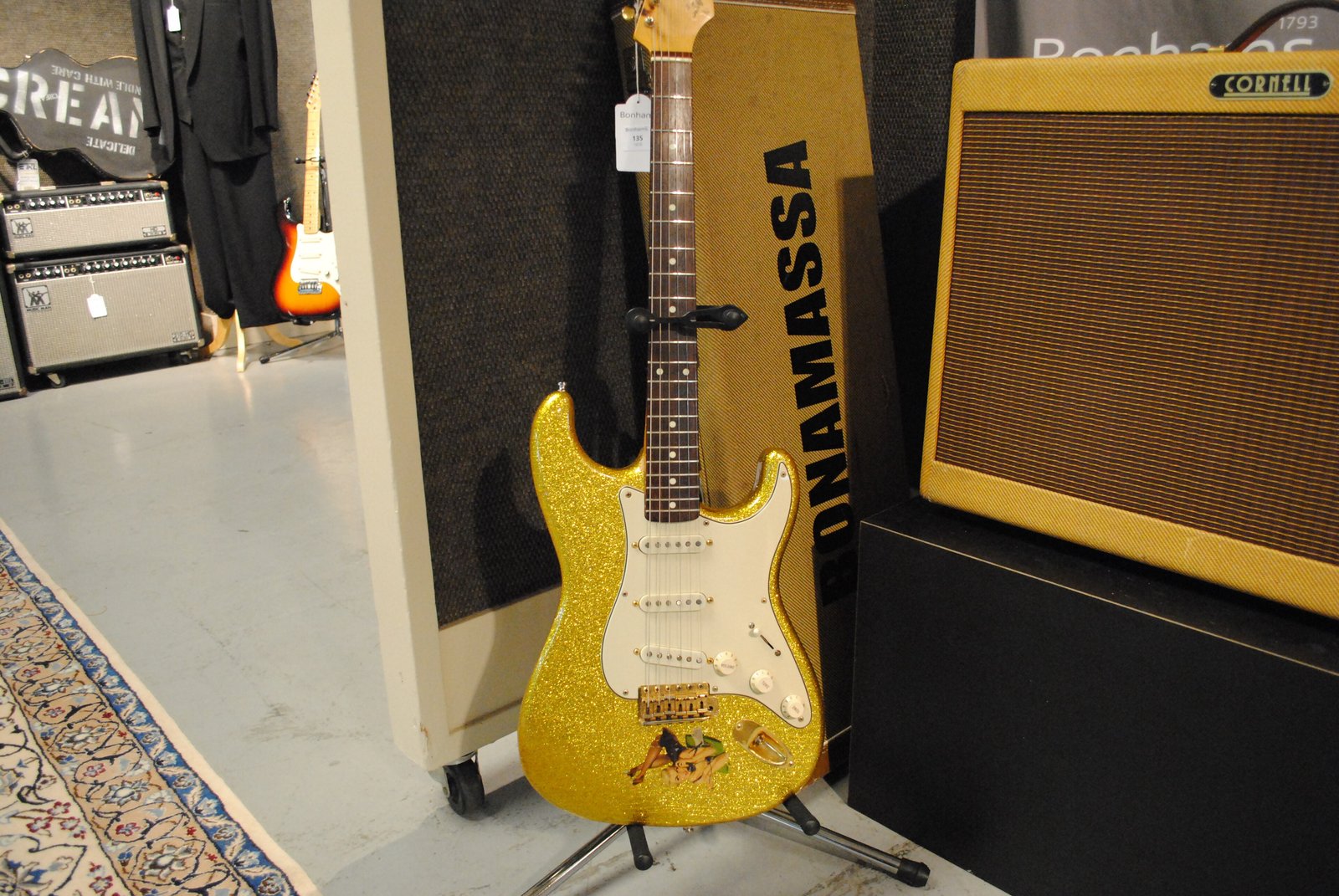
Guitar World reported that Bonamassa played a white Stratocaster for his set. He hasn't said publicly which song the string went on, only that it happened on the first bend. Phil Weller, who wrote up the interview, said that watching the footage, "there is no obvious moment where the string breaks," and that Bonamassa does well "not to let any panic he will have been feeling in that moment show on his face."
That fits with how Bonamassa works. He is famously over-prepared. He travels with a deep guitar collection, rehearses relentlessly and talks about gear like an archivist. A string break on a show like this is exactly the kind of variable he would normally have eliminated. Guitar World noted that it's something that "rarely happens to him these days."
CC BY 2.0. Photo: Deidre Woollard / Flickr via Wikimedia Commons
So what does a player like that do when it happens anyway? The same thing you should do. He kept playing.
Finishing a solo on five strings isn't magic. It's vocabulary. A blues player who knows the neck well can move a phrase over a string, play a bend one fret higher on the next string down, or shift to a position where the missing string isn't needed. Most blues soloing lives on the top three or four strings. Lose the high E and you can play the same licks on the B string a few frets up. Lose the B and the G string has to do the crying. The notes are all still on the fretboard; you just have to find them fast, without looking surprised.

CC BY 2.0. Photo: Alberto Cabello / Flickr via Wikimedia Commons
What Bonamassa didn't have was the one thing that would have made it easy: time. A guitar tech can swap a guitar between songs. In the middle of a solo, at a tribute show with a tight changeover schedule and a house band, there's no graceful exit. You play through it.
The clip people found afterward, posted on YouTube as "Joe Bonamassa killer guitar solo," is the best argument for practicing the boring stuff. Knowing every note on every string isn't theory homework. It's what lets you finish a solo at Radio City with a string flapping off the headstock.
How the pros handle a broken string live
Bonamassa joined a long list of players who have had a string go at the worst possible moment. Some of the most famous stories hold up. Some don't.
Stevie Ray Vaughan and the slickest swap on tape

CC BY-SA 4.0. Photo: Bbadventure / Wikimedia Commons
The gold standard is Stevie Ray Vaughan on Austin City Limits in 1989, playing "Look at Little Sister." Vaughan breaks his B string a few seconds into the solo, keeps going on the remaining strings, then signals to his guitar tech, René Martinez. Martinez walks out with a replacement Strat, and the two swap guitars during a break in the song while Vaughan keeps singing. Guitar World's Damian Fanelli wrote that Vaughan misses only "one or two" double stops during the exchange.
Two things make that clip work. The first is preparation: a second guitar was tuned, ready, and in the hands of a tech who was watching. The second is song choice. "Look at Little Sister" has stop-time breaks built into it, and Vaughan and Martinez used one of them. They didn't fight the song. They waited for a gap.

CC BY-SA 4.0. Photo: Dmileson / Wikimedia Commons
Vaughan is also the extreme case for why strings break. He played very heavy strings, tuned down a half step, and hit them as hard as anyone ever has. His fingertips were famously torn up, and the story that he used superglue to close the cuts so he could keep playing has been repeated for decades. If you play like that, strings break. The answer is a tech and a backup guitar, not a lighter touch.

Never Run Out of Strings Again.
Fresh USA-made strings delivered every month from the X Concepts String Club.
Midori and the three violins
The most dramatic version of the "keep going" story isn't from rock or blues at all. On July 26, 1986, a 14-year-old violinist named Midori was playing Leonard Bernstein's Serenade at Tanglewood, with Bernstein himself conducting. In the fifth movement, her E string broke. She turned to the concertmaster, Malcolm Lowe, who handed her his Stradivarius. Then the E string on that violin broke too. She switched again, to the associate concertmaster's Guadagnini, and finished the piece.
The New York Times put it on the front page under the headline "Girl, 14, Conquers Tanglewood With 3 Violins." Asked about it afterward, she said, "What could I do? My strings broke." That answer is the whole philosophy in one line. The audience doesn't care about the string. They care whether the music keeps going.
The Perlman story probably never happened
You may have heard the inspirational tale of Itzhak Perlman snapping a string at the start of a concerto and finishing the whole piece on three strings, then telling the audience it's the artist's job to make music with what's left. It's a lovely story. Snopes looked into it and found no review, recording or account from Perlman that backs it up. It's best treated as a parable, not history.
Prince: the break that might not have been
Prince's guitar solo at the end of "While My Guitar Gently Weeps" at the 2004 Rock and Roll Hall of Fame ceremony is one of the most watched guitar clips on the internet. Re-uploads often claim he snapped a string early in the solo and kept shredding. Look closely and the claim gets shaky; viewers have pointed out that the strings appear intact when he throws the guitar into the air at the end.
There's also an inside voice on this one. Takumi Suetsugu, Prince's longtime guitar tech, told fans at Paisley Park's Celebration 2017 that in the years he looked after Prince's guitars, Prince never once broke a string while playing. Fans do describe broken strings at a few earlier Prince shows, so it wasn't impossible. But the famous Hall of Fame break looks like internet folklore. The real lesson from Prince is the opposite one: his touch was so controlled that strings simply lasted.
Bonamassa's version
Bonamassa's moment sits somewhere between those examples. He had no tech handoff mid-solo like Vaughan, and no orchestra handing him instruments like Midori. He had a white Strat, five strings and a lot of vocabulary. That's the most common real-world scenario for anyone who gigs: you're on your own until the song ends.
Why guitar strings break

CC BY-SA 2.0. Photo: Joshua Wright / Flickr via Wikimedia Commons
A string breaking feels random, but it almost never is. A guitar string is a thin steel wire held at a lot of tension. The combined pull of a standard set of 10s on a Strat-style guitar is somewhere around 100 pounds. When a string fails, it's usually because one small spot along its length got weaker than the rest. Here are the usual causes.
1. Age and metal fatigue
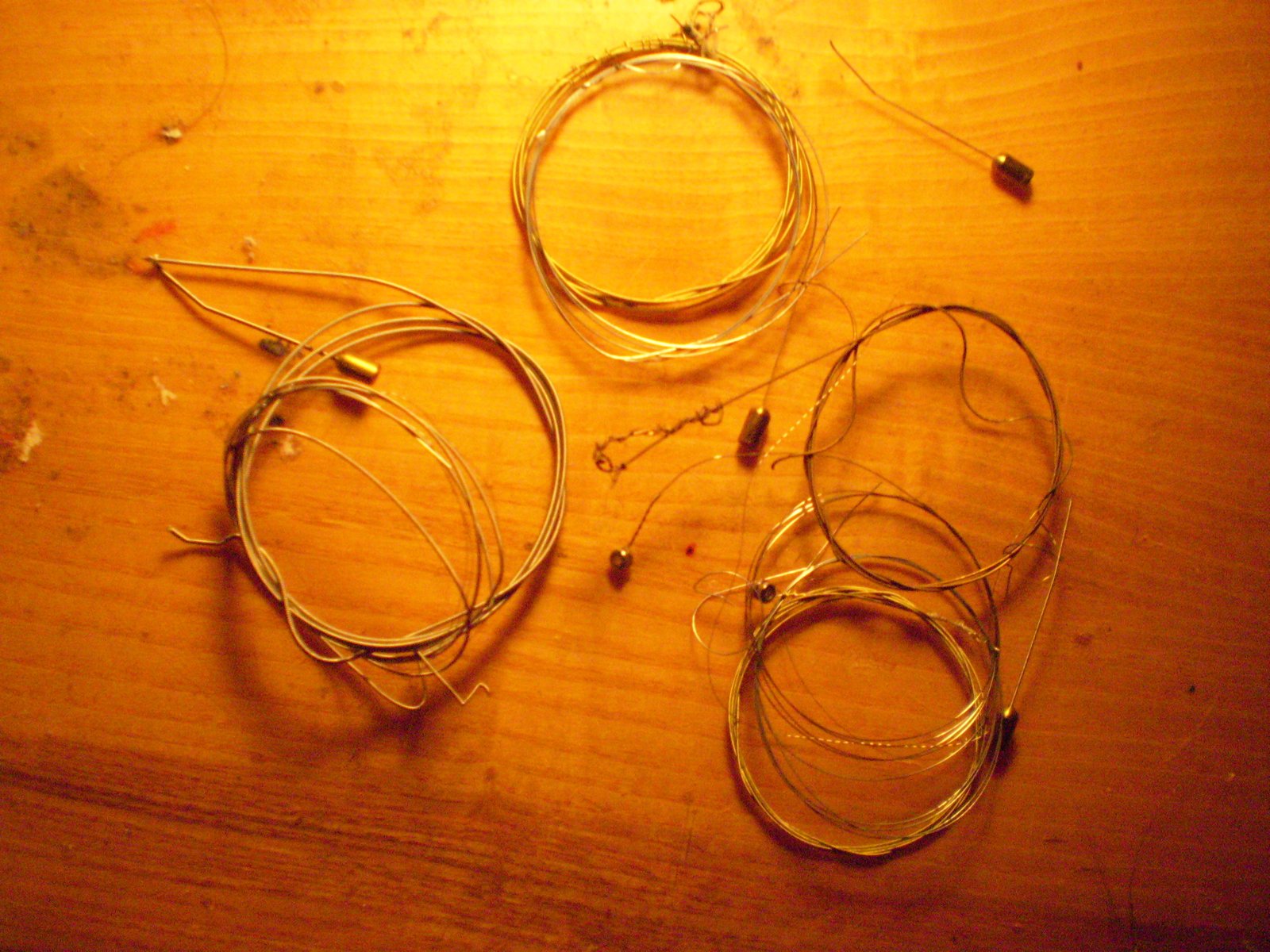
Every time you bend a note, you stretch the string a little and let it relax again. Do that thousands of times and the metal fatigues, especially at the points where the string touches the guitar. Old strings also lose their elasticity, which is why they sound dull and won't hold tune. A string that's been on the guitar for months is much more likely to fail on a hard bend than one that's a week old.
Public domain. Photo: Rottweiler / Wikimedia Commons
2. Corrosion from sweat and humidity
Your fingers leave behind moisture, salt and oils. On plain steel strings that shows up as dark spots or a gritty feel. On wound strings it gets trapped between the windings. Corrosion eats into the metal and creates weak points. Players with acidic sweat know this well: some people can kill a set in a week, while others get months out of the same strings. If your strings look discolored or feel rough, they're already weaker than they should be.
3. Bending, especially on plain strings
The G, B and high E strings on most sets are plain, unwound wire, and they're the ones blues and rock players bend hardest. A wide bend on the B or G string asks a lot of a thin wire, and repeated bends concentrate the stress right at the fret you're bending on and at the contact points on each end. It's no coincidence that Vaughan's famous break was a B string, or that so many breaks happen "on the first bend," when a tired string gets its biggest stress of the night.
4. Burrs and sharp edges at the saddle and nut
CC BY-SA 3.0. Photo: Rachmaninoff / Wikimedia Commons
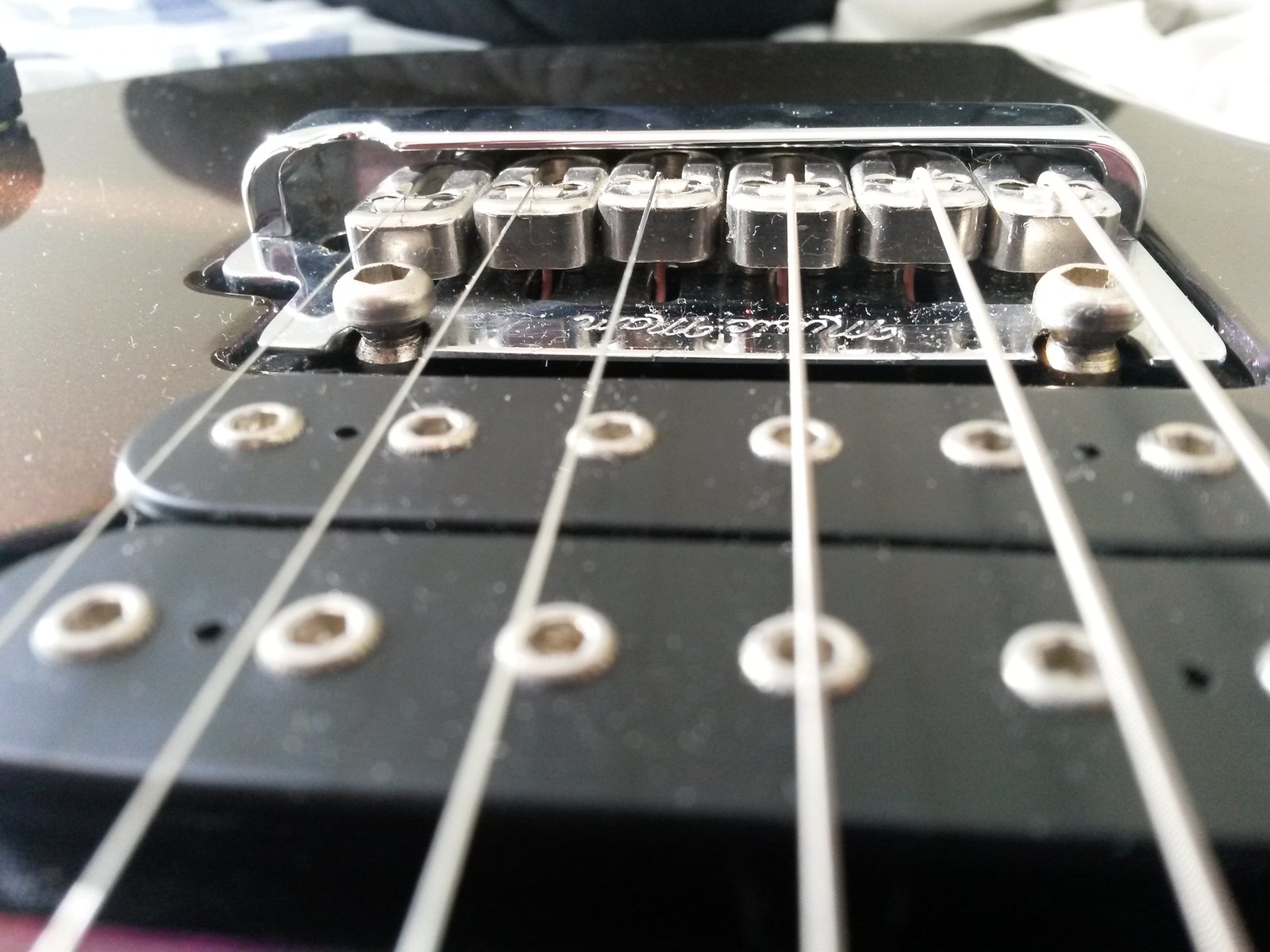
This is the cause players overlook most. If a string keeps breaking in the same place, look at where it breaks. A break right at the bridge saddle usually means a sharp edge or burr on the saddle, or a groove worn into it over time. Tremolo-equipped guitars, including many Strats, can develop sharp spots where the string bends over the saddle or where the ball end sits in the block. A break at the nut usually means the nut slot is too tight or has a rough edge, and the string pinches or catches there each time you tune or bend.
Every time you bend or use the whammy bar, the string slides a little across those contact points. A tiny burr acts like a file. Eventually it wins.

CC BY-SA 3.0. Photo: Cpm4 / Wikimedia Commons
5. Installation mistakes and tuning habits
Strings can also be damaged before you ever play them. A sharp kink near the ball end or at the tuning post creates a weak point. Too few wraps on the post, or wraps that cross over each other, can let the string slip or pinch. Tuning up far past pitch and coming back down, or accidentally grabbing the wrong tuning key and cranking a string well above pitch, can overstretch it. Those strings often break days later, at what feels like a random moment.
6. Heavy attack and pick choice
Players who dig in hard break more strings. Picking near the bridge, using a very stiff or sharp-edged pick, or attacking every note full force all add stress. That's not a reason to play timidly. It's a reason to change strings more often if that's your style.
How to prevent it: a practical checklist
You can't make string breaks impossible, but you can make them rare. Here is what working players actually do.
Change your strings on a schedule
How often depends on how much you play and how much you sweat, but some rough guidelines help:
- Gigging players: many change before every show or every few shows. At minimum, put a fresh set on before any gig that matters.
- Players who practice daily: every two to four weeks is a reasonable starting point.
- Casual players: every one to three months, or sooner if the strings look dull, feel rough or won't stay in tune.
A simple rule: if you can't remember when you last changed them, change them. And don't wait until the morning of a big gig. Change them the day before, so the new set has time to settle.
Stretch new strings properly
New strings stretch as they settle, which is why a fresh set keeps going flat for the first day. After you tune a new string to pitch, pull it gently away from the fretboard along its length, retune, and repeat two or three times. Don't yank. You're helping the string settle around the tuning post and at the bridge, not testing its breaking point. Stretched strings hold tune better and are less likely to fail under a hard bend later.
Check and smooth the contact points
If a string keeps breaking in the same spot, fix the spot. Look at the saddles and the nut slots under good light. A burr on a saddle can often be smoothed carefully with very fine sandpaper or a polishing cloth. A tight nut slot benefits from a touch of graphite (pencil lead works) or a nut lubricant so the string can slide instead of catching. If you're not comfortable working on the nut, a guitar tech can do it quickly and cheaply. While you're at it, our 15-minute guitar setup guide covers the other small adjustments that keep a guitar playing well.
Install strings carefully
CC BY-SA 4.0. Photo: Trude Bergheim Mikkelsen / Wikimedia Commons
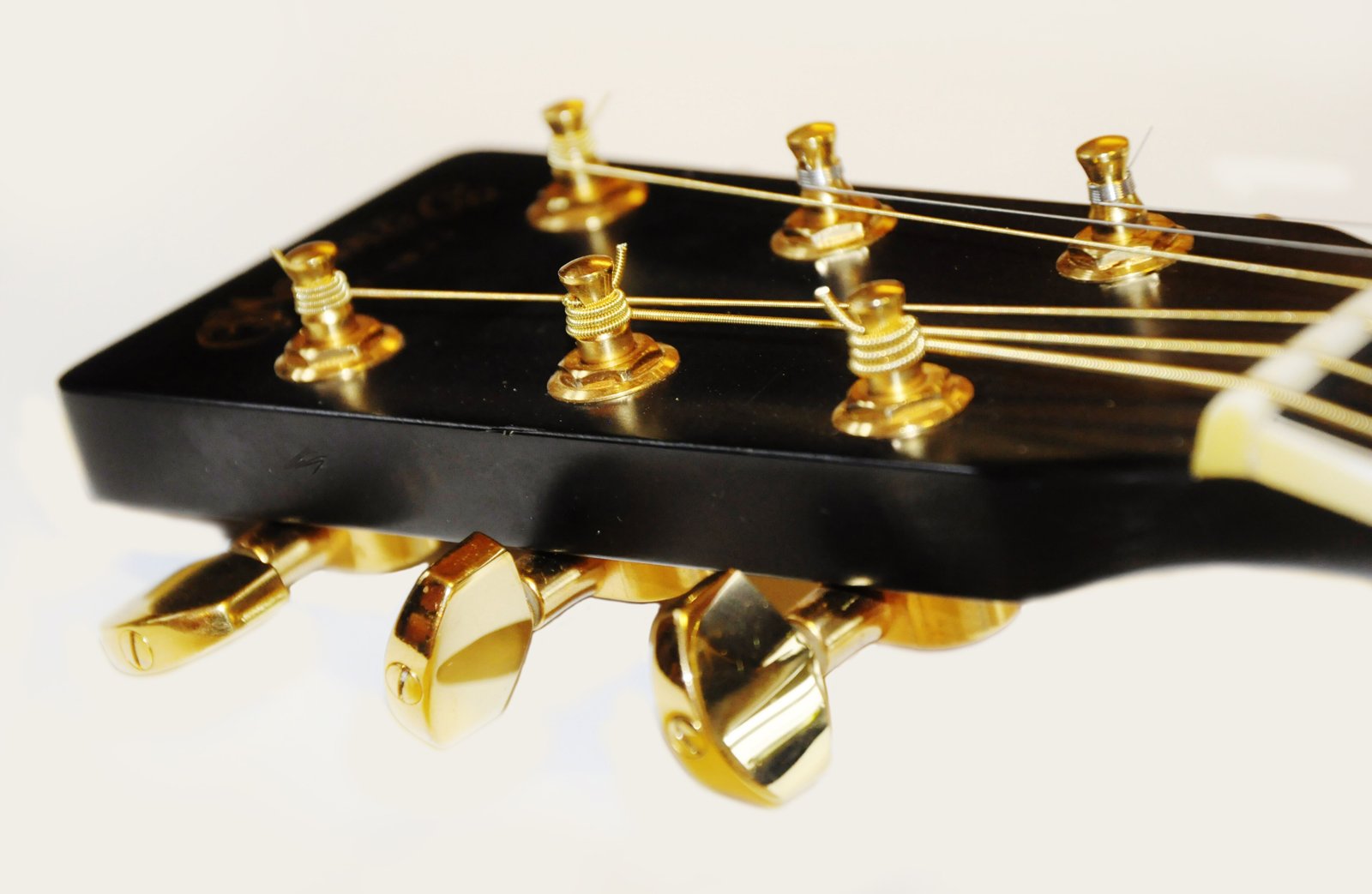
Avoid sharp kinks. Use enough wraps on the tuning post: more for plain strings, fewer for wound ones. Keep the wraps neat, winding downward so the string sits low on the post. Cut off the excess cleanly so you don't nick your fingers or the headstock. If you use a vibrato bridge, make sure the ball end is fully seated before you bring the string up to pitch. If you play a Floyd Rose, our guide to restringing a Floyd Rose walks through it step by step.
Wipe down after you play
This is the cheapest habit in guitar. Wiping your strings with a dry, clean cloth after every session removes sweat and oils before they cause corrosion. Wash your hands before you play, too. Both steps can noticeably extend string life.
Think about gauge
Heavier strings are thicker and can feel more durable, but they're also harder to bend, which tempts some players to bend more aggressively. Lighter strings bend easily but can be more fragile. There's no universal right answer, but if you break high strings often, it's worth trying a slightly different gauge. Our guide to 9s vs 10s vs 11s breaks down the trade-offs.
Have a backup plan for the stage
The pros don't avoid string breaks entirely. They plan for them.
- A backup guitar, tuned and on a stand. If you gig without a tech, keep it within reach and make sure it's in tune before the set starts.
- Know your vocabulary. Practice soloing with one string "missing." Pick a string, pretend it's gone, and play through a blues progression without it. It's a great exercise for learning the neck, and it's exactly what saved Bonamassa at Radio City.
- Know your bridge. On a guitar with a floating tremolo, losing one string reduces the tension pulling against the springs, and the other strings can go sharp. If you play a floating trem, practice the quick bends and adjustments you'd need to finish a song that way, or consider blocking or decking the bridge for gigs where you can't swap guitars.
- Use the song's structure. Like Vaughan and Martinez, wait for a break, a turnaround or the end of a section to swap guitars. Don't fight the song.
- Keep spare strings and a string winder in your case. If you have a few minutes between songs or sets, you can replace a single string quickly.
- Stay calm. Midori's line is still the best advice: what could she do? Keep playing.
The real lesson from Radio City
The funny thing about Bonamassa's story is that it's reassuring. Here's a player with every advantage, a deep collection of guitars, a professional crew and decades of experience, and a string still went on the first bend at one of the biggest shows of his year. It happens to everyone.
What separated him from a panicked amateur wasn't luck. It was knowing the instrument well enough to keep going and keeping his face neutral while he did it. The audience at Radio City got a great solo. Most of them never knew anything was wrong.
For the rest of us, the takeaway is simpler. Fresh strings, clean contact points and a little preparation prevent most breaks. Knowing the neck handles the rest.
If you want to read more about the players in this story, start with our longer look at whether Joe Bonamassa is the last great blues guitar hero, his Tone Master '59 Twin JB Edition, and our tribute to Buddy Guy, the last great blues giant. We've also covered Eric Gales' career, style and gear, Billy Gibbons, why John Mayer is a better guitarist than you think, and Stevie Ray Vaughan's tone, decoded.
Never get caught with old strings again
Most string breaks start with a set that should have been changed weeks ago. The fix is easy to know and easy to forget: put fresh strings on before the old ones fail.
That's why we started X Concepts String Club. Every month, a fresh set of X Concepts strings arrives at your door, so you're never digging through a drawer for a half-used pack or putting off a change because you're out. When the new set shows up, you change your strings. Simple.
Keep playing, not hunting for strings. Join the X Concepts String Club.
Sources: Guitar World interview with Joe Bonamassa by Phil Weller (October 16, 2026); Guitar World live review by Jackson Maxwell (October 2, 2026); Glide Magazine show review by Shawn Donohue (October 3, 2026); The Blues Magazine live review (October 2, 2026); ttbase setlist for October 1, 2026; Blackbird Presents event announcement (June 23, 2026); Guitar World, "Stevie Ray Vaughan Breaks a String, Swaps Guitar (Almost) Without Missing a Beat" (2016); The New York Times, "Girl, 14, Conquers Tanglewood With 3 Violins" (July 28, 1986) and follow-up (July 29, 1986); Boston Symphony Orchestra Bernstein profile; Snopes, "Itzhak Perlman Three Strings"; People of Paisley Park, "Nothing But Net" (2017).
Experience-driven coverage, not algorithm bait.
- 20+ years of guitar playing experience
- Real-world retail experience at Guitar Center
- Thousands of hours testing guitars, amps, and pedals
- A community of 50,000+ guitar enthusiasts across platforms
- Partnerships with Fender, DistroKid, TrueFire, Card Chords, and Enya
- Editorial standards published openly — see how we test gear
The Modern Guitar Magazine. Delivered to your inbox.
No spam. No gimmicks. Just great guitar content — stories, tones, iconic solos, and honest gear takes. Every week.
Ask GP
3 free questions a dayStill curious? Ask GP about this story.
Your personal classic-rock and guitar guide — ask anything about Joe Bonamassa Broke a String.
Discussion (0)
Sign in to join the discussion.
Sign in to commentLoading comments…
Discover another guitar story
Swipe through our latest features, breaking news and iconic solos — one story at a time.
Open Swipe →More Guitar News

Joe Bonamassa: The Last Great Blues Guitar Hero?
From opening for B.B. King at age twelve to becoming one of the biggest names in modern blues, Joe Bonamassa has spent his career keeping the blues alive for a new generation of guitar players.

Joe Bonamassa's First Digital Signature Amp: Fender's Tone Master '59 Twin-Amp JB Edition
The blues-rock guitarist whose vintage collection borders on a museum just put his name on an all-digital amplifier — and says it's tighter, punchier and better than his originals.

Tone Decoded: Joe Bonamassa Finally Embraces Amp Modeling — What the Fender Tone Master Says About the Future of Guitar Tone
One of guitar's biggest tube amp advocates has put a digital Fender Tone Master amp in his touring rig. Here's what it means for the future of guitar tone.

Buddy Guy: The Last Great Blues Giant Still Teaching the World How to Play with Feeling
At 90, Buddy Guy is still the loudest, most fearless voice in electric blues — the guitarist who taught Clapton, Hendrix, SRV, Jeff Beck and John Mayer that feeling always beats flash.

Eric Gales: The Left-Handed Guitar Powerhouse Who Turned the Blues Inside Out
From a Memphis prodigy signed at 16 to one of the most electrifying blues guitarists alive, Eric Gales plays a right-handed guitar flipped upside down — and turns the entire blues vocabulary inside out in the process.
9s vs 10s vs 11s: What Really Happens When You Change Guitar String Gauge?
String gauge changes tension, feel, setup and tuning stability far more than it changes tone. Here's what really happens when you move between 9s, 10s and 11s — and how to pick the right set.