
The Gibson Explorer History: How Gibson's 1958 Flop Became Hard Rock's Sharpest Silhouette
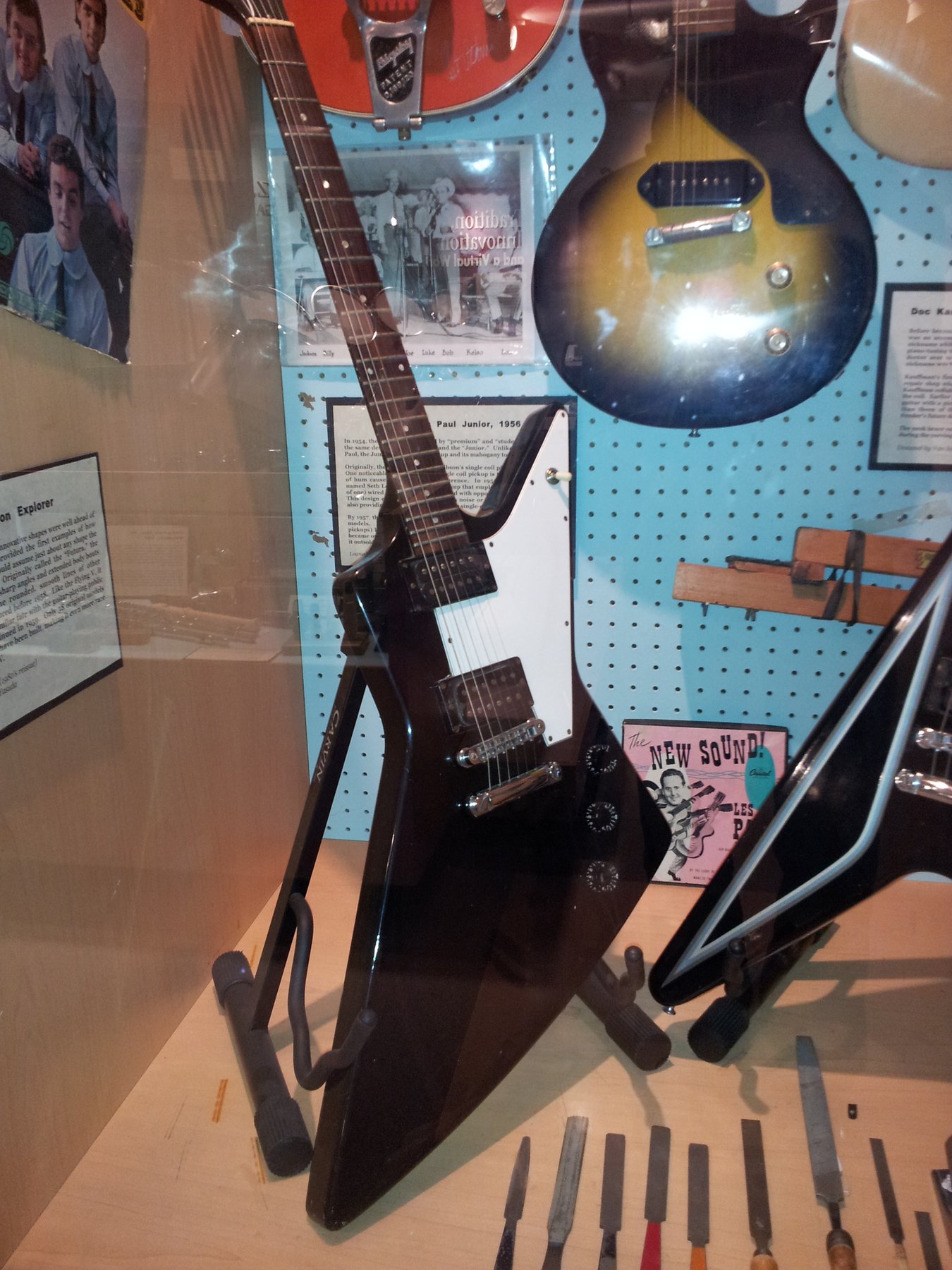
A black Gibson Explorer on display at the Museum of Making Music in Carlsbad, California.
Gibson shipped just 22 Explorers in 1958–59 and shelved the design. Here's how the most radical shape of the Modernistic era became hard rock and metal's sharpest silhouette.
Some guitars arrive and get it right on day one. The Telecaster did. The Stratocaster did. The Les Paul took a few years and a sunburst to find its footing, but it never stopped selling to someone.
The Gibson Explorer did not get it right on day one. On day one it barely got anything at all. Gibson shipped a few dozen of them, dealers didn't know what to do with them, players looked at the shape and laughed, and within a handful of years the whole thing was quietly shelved. A guitar that would go on to define the look of heavy metal spent its first decade as a punchline and a pile of leftover bodies in a Kalamazoo storeroom.
Then the world caught up. The same zig-zag outline that confused Eisenhower-era music stores turned out to be exactly what the 1970s and '80s were looking for: loud, aggressive, a little dangerous, and impossible to mistake for anything else from the back of an arena. Today an original 1958 korina Explorer is one of the most valuable production guitars on earth, and the shape has been copied, chopped, sued over and reinvented more times than anyone can count.
This is how the Explorer went from Gibson's most embarrassing commercial failure to one of its most important designs.
Kalamazoo, 1957: Gibson Gets Nervous
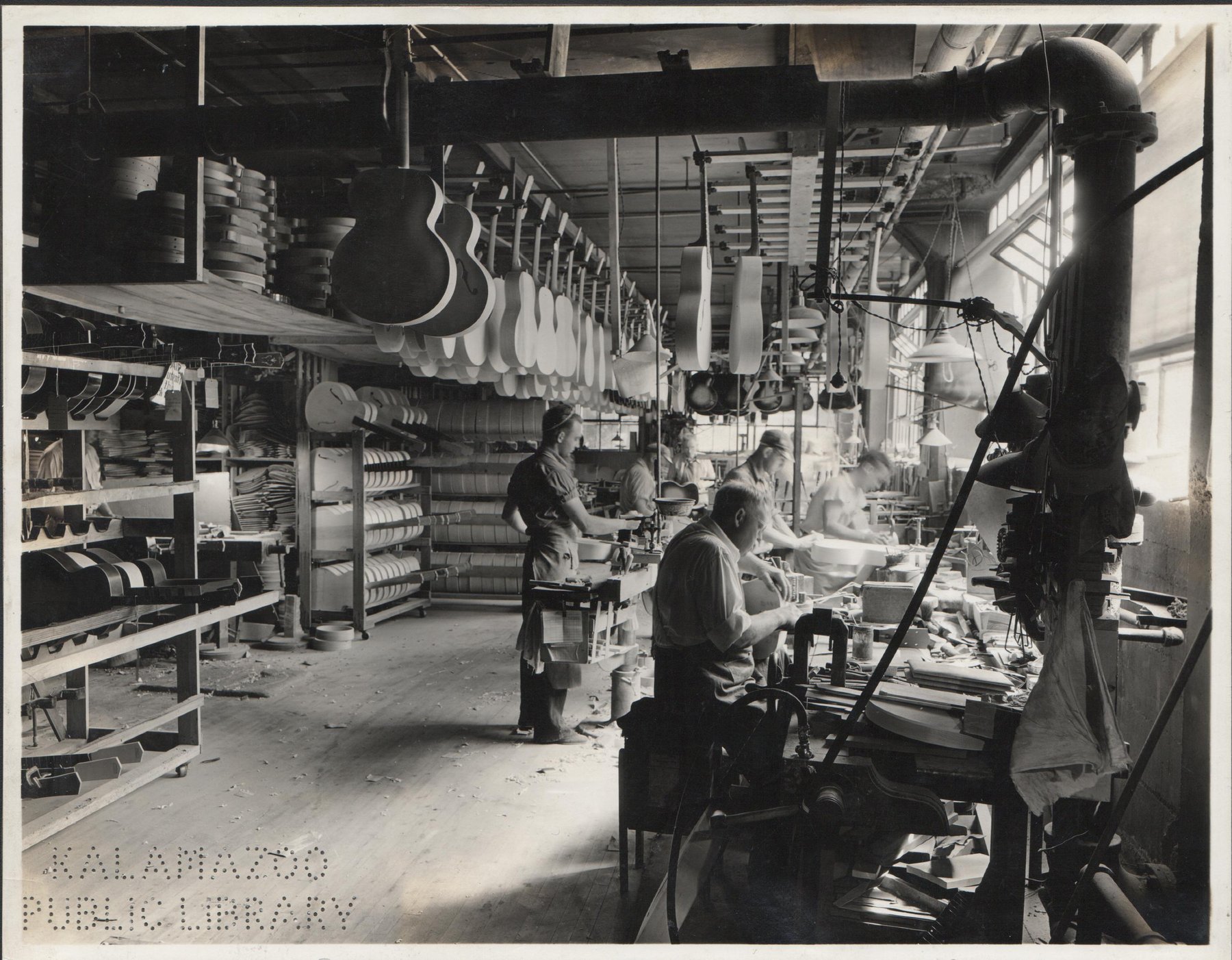
To understand why Gibson built something as wild as the Explorer, you have to picture the company's mood in the mid-1950s.
Gibson was the old guard. It had built mandolins, archtops and jazz boxes for half a century out of its factory in Kalamazoo, Michigan. Under company president Ted McCarty it had made the jump to solidbodies with the Les Paul in 1952, and the archtop-inspired Les Paul was a fine, dignified instrument. But dignified was the problem. Out in California, Leo Fender was building guitars that looked like the future: contoured, brightly finished, tied to the same hot-rod and space-age culture that was selling cars with tailfins. Fender felt young. Gibson felt like your dad's guitar.
McCarty's answer was to go further than Fender had. Instead of nudging the traditional guitar shape, Gibson would throw it out completely. The result was a trio of designs that later collectors would call the "Modernistic" series: the Flying V, the Explorer, and a third, even stranger shape that eventually became known as the Moderne.
The thinking was simple. If players wanted modern, Gibson would give them something so modern it looked like it had been designed for a rocket ship.
The Futura Prototype and the 1958 Patent
Gibson showed a prototype of the new shape at the 1957 NAMM convention, the music industry's big trade show. That early guitar was later known as the Futura. It had the body outline we'd now recognize as an Explorer, but it had no controls on it and wore a V-shaped headstock. It was, in effect, a concept car: a sculpture designed to get dealers talking.
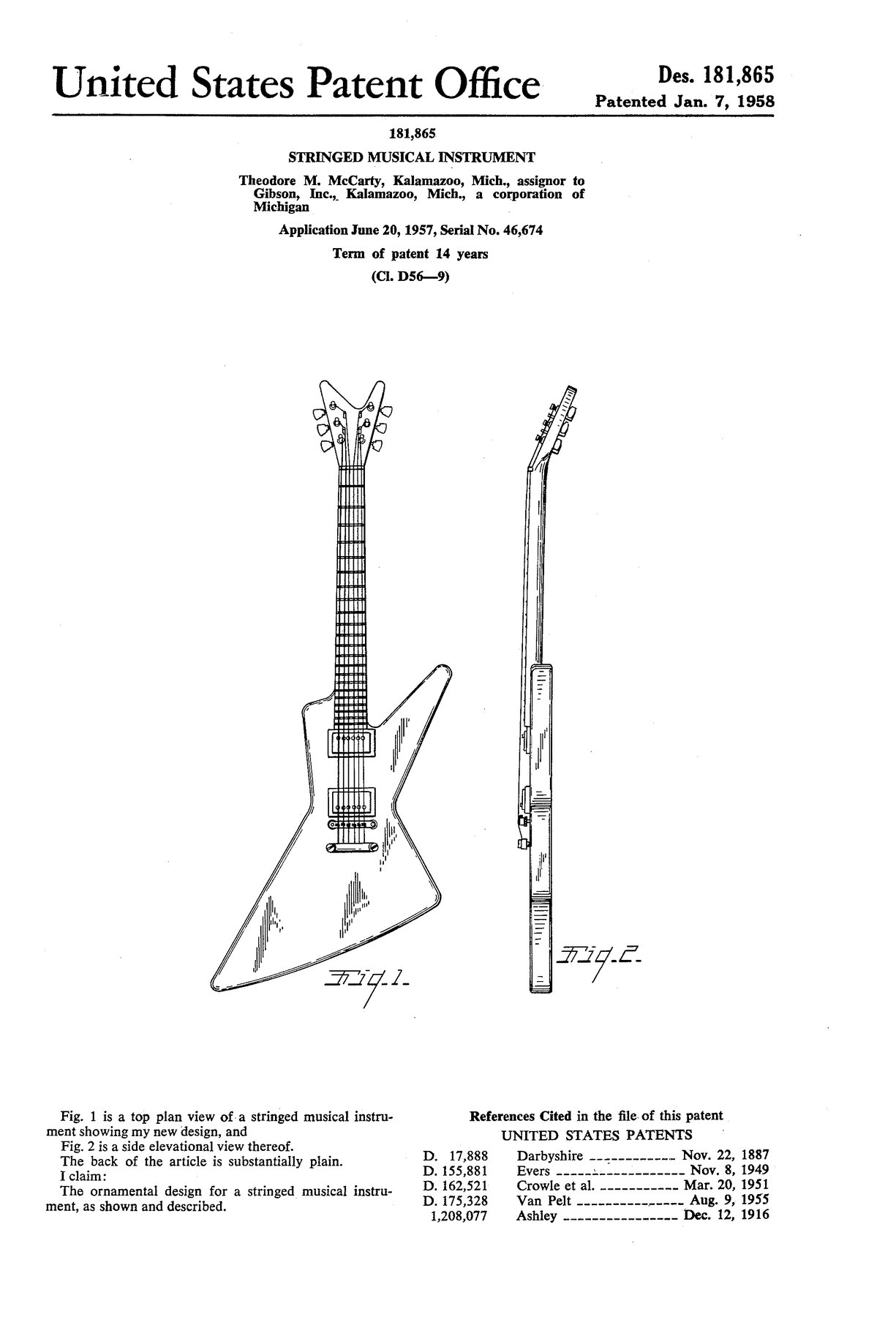
Gibson protected the idea legally, too. U.S. Design Patent Des. 181,865, patented on January 7, 1958, lists Theodore M. McCarty of Kalamazoo as the inventor and Gibson as the assignee. The patent drawing is about as clean a statement of intent as you'll ever see from a guitar company: a body made of hard angles and long straight lines, with an offset waist and a lower horn that juts out like a blade. No curves where curves were expected. No nod to the violin family at all.
It is worth pausing on just how radical that drawing was. Almost every electric guitar before it, Fenders included, still borrowed its basic logic from acoustic instruments: an upper bout, a waist, a lower bout. The Explorer kept a rough sense of where your arm and leg go, but it built that sense out of geometry instead of curves. It looked less like a guitar and more like a piece of mid-century furniture or a fin off a jet.
Korina: The Wood That Made It Glow
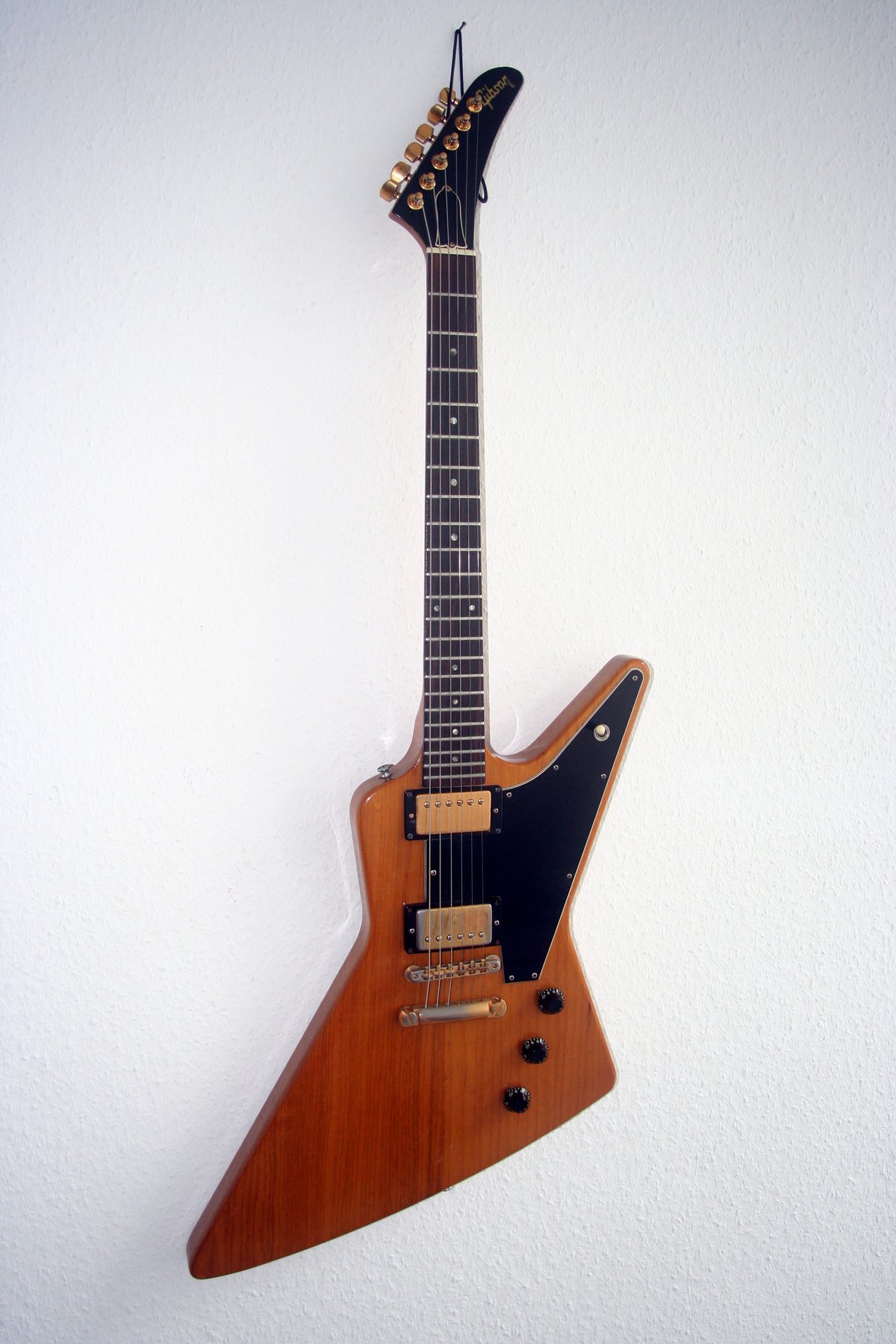
When the Explorer reached production in 1958, Gibson built it from korina, a trade name for limba, a light-colored African hardwood. Korina was a deliberate choice. It's relatively light, it's resonant, and in a natural finish it has a golden, almost luminous look that made the new shape pop on a store wall.
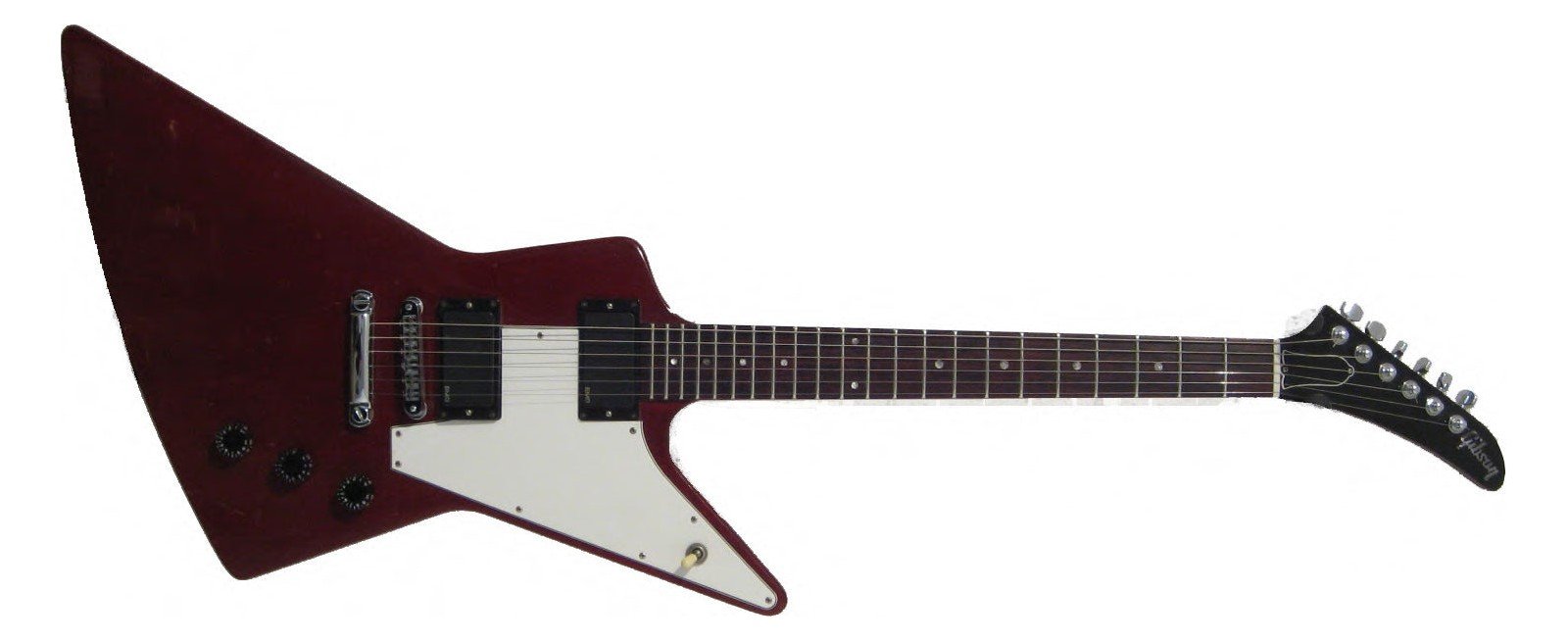
The original Explorers were not toys. They had a set neck, two humbucking pickups (Gibson's then-new noise-cancelling Patent Applied For design), a Tune-o-matic bridge and a stopbar tailpiece. In other words, they had the same serious hardware Gibson was putting on its top-of-the-line solidbodies. The only thing radical about them was how they looked. Underneath, this was a proper Gibson rock machine, a decade before anyone was really playing rock music on one.
That korina recipe matters for the rest of the story. When collectors and players talk about "the '58 Explorer," they are talking about that blonde, glowing, slightly alien guitar, and nearly every reissue since has been measured against it.
Two Headstocks, One Hockey Stick
The Futura prototype's V-shaped headstock didn't survive for long. The very earliest Explorers built between 1957 and the spring of 1958 carried a distinctive "split" headstock, shaped a bit like a forked V, with tuners in a conventional three-a-side layout.
After those first few guitars, Gibson switched to the headstock that became the Explorer's other trademark: a long, drooping blade with all six tuners in a row along one side. Players have called it the "hockey stick" and the "banana" ever since.
That headstock deserves its own footnote in guitar history. A couple of decades later, builders like Grover Jackson and companies like Kramer borrowed the drooped, six-in-line idea, and it helped launch what's often called the pointy-headstock era of the 1980s. If you've ever played a Jackson with a pointed headstock, you're holding a distant descendant of a Gibson idea from 1958.
The Flop: 22 Guitars and a Pile of Bodies
Here's where the bold plan ran into reality.
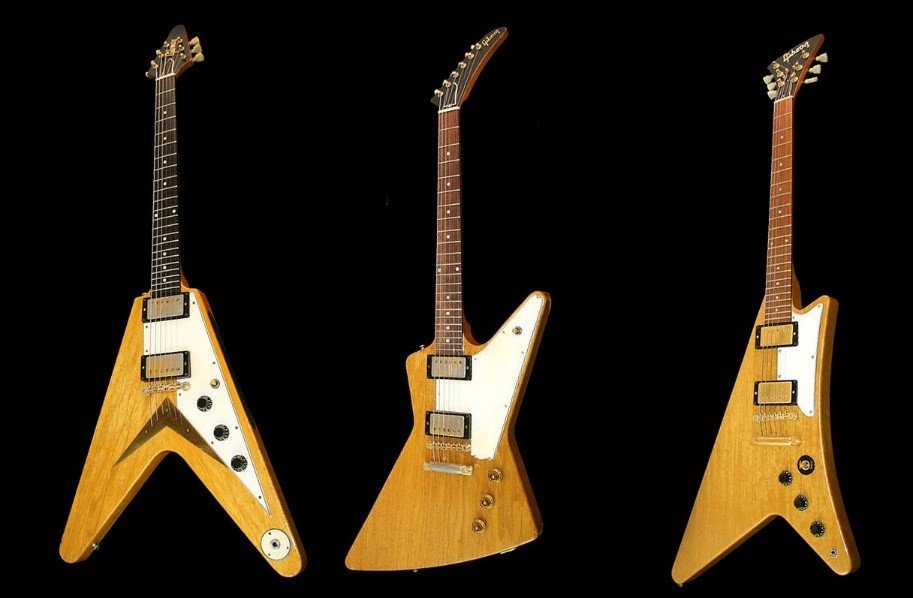
Dealers and players in 1958 simply did not want the Explorer. Shipping figures commonly cited from Gibson's records show 19 Explorers in 1958 and just 3 in 1959. That's 22 guitars in the model's first two years. For comparison, that's roughly what a busy guitar shop moves in a weekend today.
The Flying V didn't exactly set the world on fire either, but it did noticeably better than the Explorer. And the Moderne, the third design in the group, never shipped at all during the 1950s. It existed as a drawing and a legend until Gibson finally put a version into production in 1982.
Why did the Explorer flop so hard? A few reasons stack up:
- It was early. In 1958 the electric guitar's biggest customers were country, jazz and early rock and roll players. The Explorer looked like it was built for a stage show that hadn't been invented yet.
- It was awkward. The long body and straight lines made it a different experience to hold, especially sitting down. A lot of players wanted to like it and didn't.
- It wasn't cheap. It carried Gibson's premium hardware, so it wasn't an impulse buy.
- It scared dealers. A music store owner in 1958 had to imagine a customer walking in and asking for that. Most couldn't.
Gibson stopped making the original. But the story doesn't end neatly: an unknown, small number of leftover Explorer bodies were later completed with 1960s nickel hardware and sold around 1963. Then the model disappeared from the catalog entirely.
Why the Failure Made It a Legend
Here's the irony. Because so few original Explorers were built, the ones that survived became extraordinarily rare. As of 2011, only 38 examples of the 1958–59 korina Explorer were known to exist, and Vintage Guitar magazine's Top 25 list that year ranked it at number four among the most valuable production guitars, with an estimated value between $250,000 and $300,000.
In other words, the market spent the late '50s refusing to buy the Explorer and the next 50 years wishing it had. Rarity, a futuristic look and a great origin story make a powerful mix, and the Explorer has all three.
That scarcity also explains why a lot of early "Explorer players" were really players of modified or later guitars. If you wanted an Explorer in 1970, you either got very lucky, paid a fortune, or bought something that was trying very hard to look like one.
Clapton, Collins and the Original Believers

Before the Explorer became a metal icon, a few high-profile players kept the original idea alive.
Eric Clapton owned and played a 1958 Explorer, and he modified it in a way that later became a model of its own. Clapton's guitar had a shortened bass-side "tail," which made it more comfortable to sit with and play. In 2001 Gibson produced limited editions based on that guitar, called the Explorer Clapton Cut. Clapton's Explorer helped prove that the shape could be a serious player's instrument and not just a novelty.
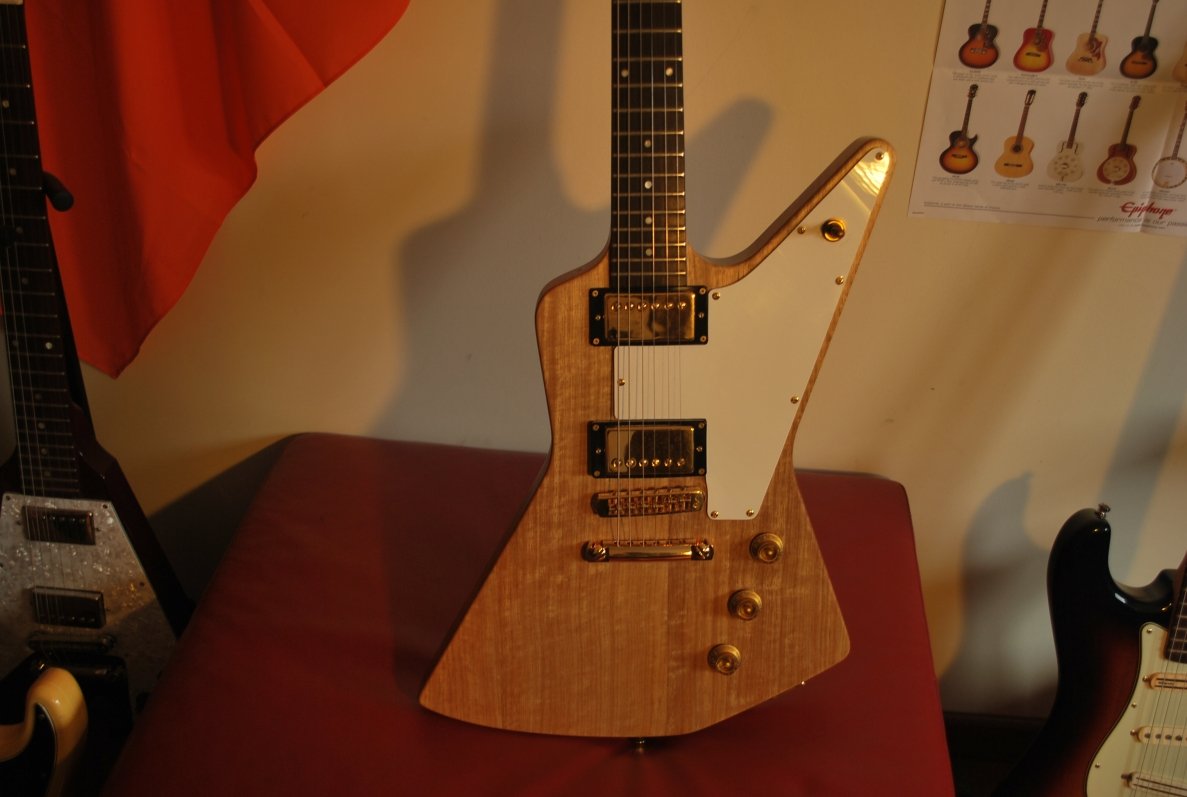
Allen Collins of Lynyrd Skynyrd made the Explorer part of Southern rock. Watching Collins play an Explorer next to the Les Pauls and Strats in Skynyrd's guitar army showed just how well the shape worked on a big stage: it was readable from a mile away and it hit like a hammer. Gibson paid tribute in 2003 with a limited-edition Allen Collins Explorer made from African limba, with an aged finish, a Maestro vibrola and classic humbuckers.
These players mattered because they gave the Explorer something it had never had in 1958: credibility. They didn't play it as a gimmick. They played it because it sounded like a Gibson and looked like nothing else.
Hamer, Ibanez and the Copy Wars
By the mid-1970s, Gibson had a problem it hadn't expected: other companies were selling its old idea.
Hamer Guitars, a small American builder, introduced the Hamer Standard in 1974. It was an Explorer tribute with a mahogany body, a highly figured maple top and usually a cherry sunburst finish, often without a pickguard. Hard rock players liked it, and Cheap Trick's Rick Nielsen was among the musicians who helped make Hamer famous. Hamer's success is widely credited as one of the reasons Gibson decided to bring its own Explorer back.
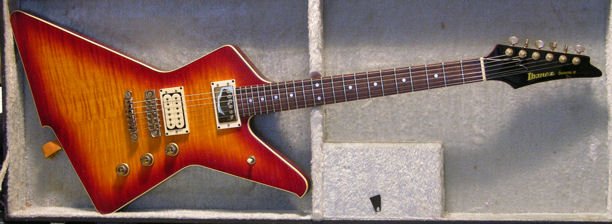
Ibanez, meanwhile, launched the Destroyer in the 1970s. The early Destroyers were close copies of the 1958 Explorer, finished to look like natural korina. Around 1981 Ibanez changed the shape, creating a body that was still clearly inspired by the Explorer but with altered lines around the treble horn and back edge, plus a different headstock. The Destroyer has its own rock history, too. In an April 1980 interview with Guitar Player, Eddie Van Halen described his "shark guitar" as "one of the first Ibanez Destroyers [shaped like Gibson Explorer] made out of Korina wood," and admitted: "I made the mistake of taking a chainsaw to it and putting a bunch of weird stuff on it."
The Explorer outline became so common that legal fights followed for decades. Gibson sued Jackson Guitars over its Kelly model, a sleeker, beveled guitar with a very similar outline. More recently, Gibson pursued Dean Guitars in court over several of its body shapes, including the Explorer-style Dean Z. Gibson holds U.S. trademarks covering the Explorer name, its headstock design and its body shape. Whatever you think of the lawsuits, they're a backhanded compliment: nobody fights that hard over a shape that doesn't sell.
1976: The Comeback
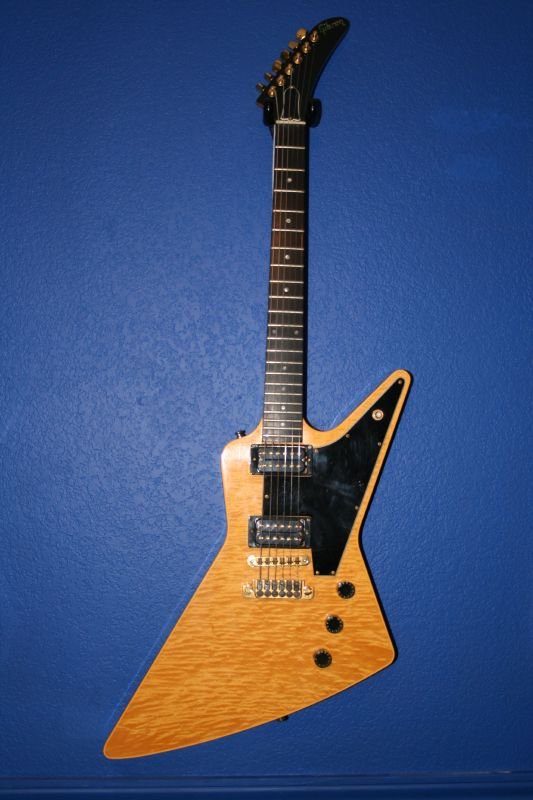
In 1976 Gibson finally put the Explorer back into production. The first comeback model was a "Limited Edition" Explorer made from mahogany with gold hardware. It was no longer korina, but it had the shape, the hockey-stick headstock and the Gibson humbucker attitude, and this time the world was ready.
The timing was perfect. Arena rock was booming. Bands played to tens of thousands of people at a time, and a guitar's silhouette mattered almost as much as its sound. A Les Paul looks like a Les Paul from the front row; an Explorer looks like an Explorer from the parking lot.
The Edge of U2 is one of the clearest examples of how the revived Explorer changed music. Premier Guitar's Rig Rundown with his team says he bought a 1976 Gibson Explorer on a family trip to the United States in 1978, at 17, and that the guitar "was there for the birth of U2." Recalling that shop visit in an interview with Chas de Whalley, quoted by Gibson, he said: "Then I picked up the Explorer, with its strange shape, and there seemed to be so much more variety in the sounds I could get from it." He added: "My style is based on a lot of broken chords and picking, and the Explorer seems to be quite the perfect guitar for it." In his own note for a Christie's auction of one of his backup '76 Explorers, the Edge called it "one of the backup instruments for my main 1976 reissue Explorer." In his hands, the Explorer became a tool for chiming, delayed, ringing parts on a band that wasn't playing blues-rock at all. That's a useful reminder that the shape doesn't dictate the music. The Explorer is a Gibson with two humbuckers and a big, solid body: it can do far more than metal.
The Wild Years: Explorer II, E/2 and Designer Series

Once the Explorer was back, Gibson treated it like a playground. The late '70s and early '80s produced some of the most interesting and confusing Explorer variants ever made:
- Explorer II / E-II (1979–1983): A straight-edged body with cream binding, a mahogany back with a figured or flamed maple top in cherry or tobacco burst finishes, ebony fretboards, gold hardware, a TP-6 fine-tuner tailpiece and high-output pickups. Tom Morello's Explorer II, now one of the most recognizable guitars in modern rock, comes from this era.
- E/2 Explorer (from 1979): Often confused with the Explorer II, the E/2 used a five-piece walnut and maple laminated body with contoured, curved edges. Gibson offered it with a range of hardware and pickup combinations.
- Explorer CMT and "The Explorer" (1981–1984): Maple-necked, maple-bodied versions with bound figured maple tops and high-output "Dirty Fingers" pickups, sometimes with a factory Kahler tremolo.
- Explorer III (1984–1985): An alder-bodied version with three P-90 single-coil pickups, a very different flavor from the classic two-humbucker setup.
- Designer Series (1984–1985): Factory-painted Explorers and Flying Vs with geometric and "Artist Original" graphics, as unashamedly '80s as a guitar can get.
Between 1984 and 1987 the standard Explorer moved around constantly. Bodies were mahogany or alder, necks were maple or mahogany, fretboards were rosewood or ebony, pickups were rear-loaded, pickguards disappeared, and the control knobs sometimes moved from a straight line into a triangle. For collectors, it's a maze. For players, it's a reminder that the mid-'80s Explorer was being shaped by a market that wanted speed, output and flash.
Tom Morello's guitar deserves a special note. The Explorer II is not a typical "riff guitar" in the metal sense in his hands. It's a noise machine, a rhythm cannon and a sound-effects lab all in one. It shows the Explorer's real secret: once you get past the shape, it's a stable, sturdy, sustain-heavy platform that can take whatever a player throws at it.
Metal Claims the Shape

If one player made the Explorer shape the universal symbol of heavy metal rhythm guitar, it's James Hetfield. Over Metallica's career Hetfield has played Explorer-style guitars from several makers, including Gibson and ESP, and the outline has become as much a part of the band's visual identity as the logo itself. When you picture Hetfield locking into a downpicked riff, there's a very good chance you're picturing a pointed, angular guitar hanging low.
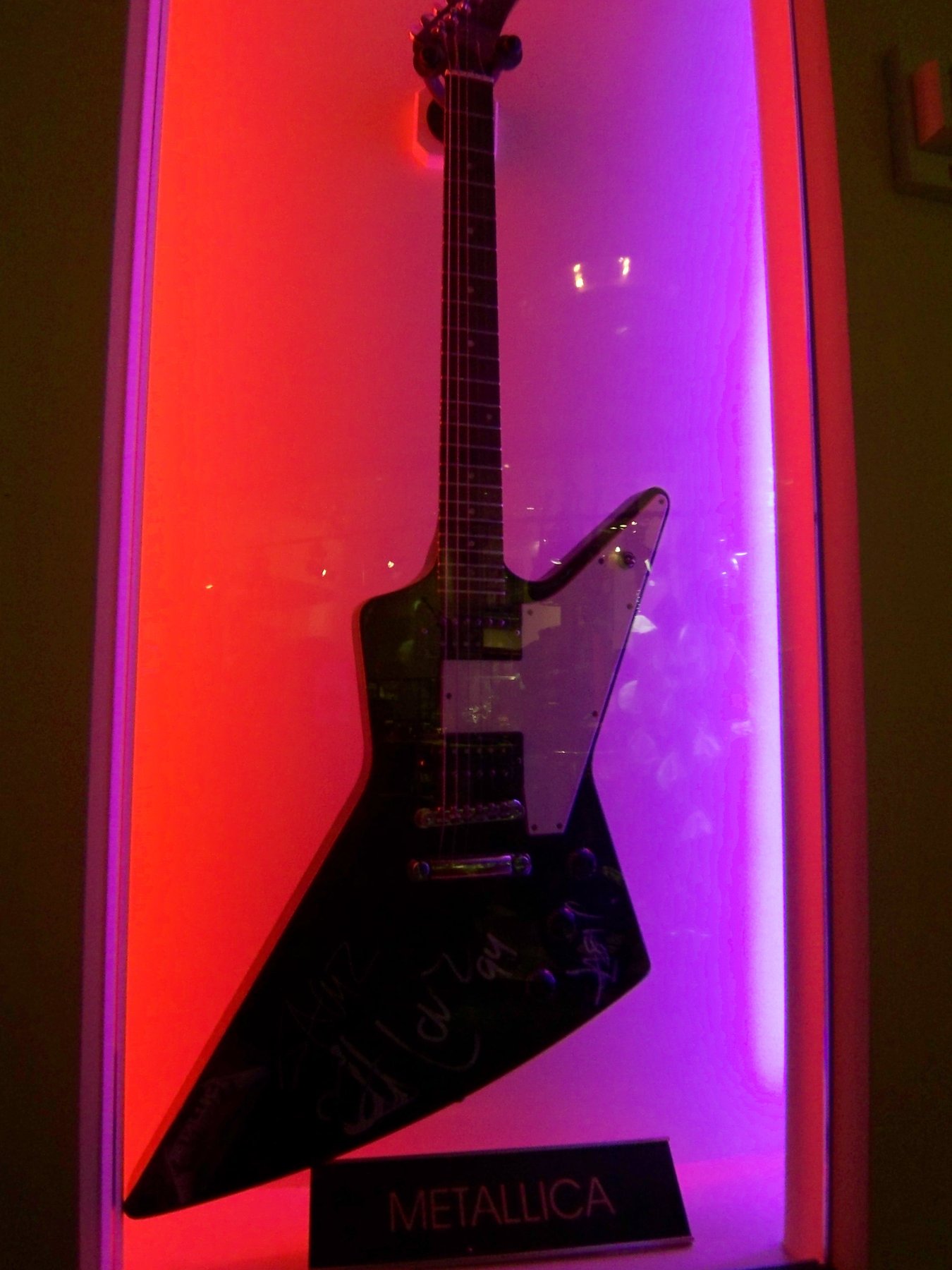
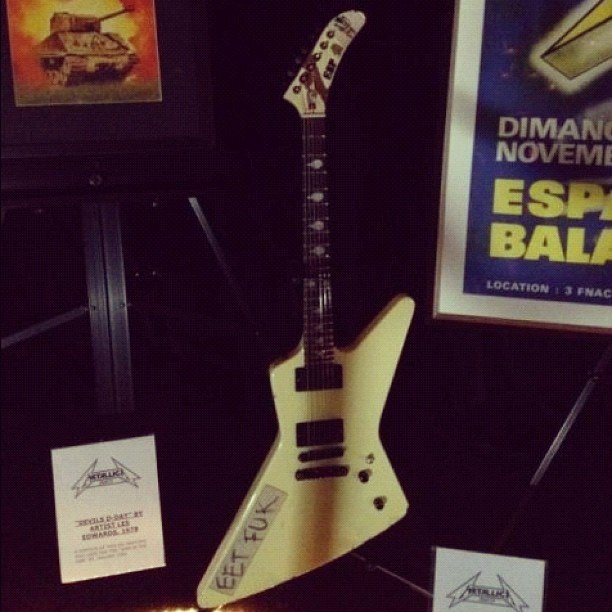
Why did the Explorer fit metal so well? A few reasons are practical, not just visual:
- Big body, big sound. The Explorer has a lot of wood. That mass helps with sustain and gives palm-muted riffs a solid, heavy feel.
- It balances on a strap. For a standing player, the long lower horn and body shape can sit well against the body, and the guitar can be slung low.
- It reads from a distance. In a stadium, an Explorer's outline cuts through lights and smoke. Fans recognize it instantly.
- It looks aggressive. Metal is a visual genre as much as a musical one, and the Explorer looks like a weapon.
The metal connection kept going long after the thrash era. Gibson built Trivium's Matt Heafy a white seven-string Explorer and then announced a production version with active EMG pickups, a 24.75-inch scale and no fret markers. Scorpions guitarist Matthias Jabs helped design the Explorer 90, a smaller body at roughly 90 percent of the regular size. And in 2022, Halestorm's Lzzy Hale, who became Gibson's first female brand ambassador in 2021, launched the Explorerbird, the first Gibson to pair an Explorer body and neck with a Firebird headstock.
The Modern Explorer: Retro, Reverse and Back in the Lineup
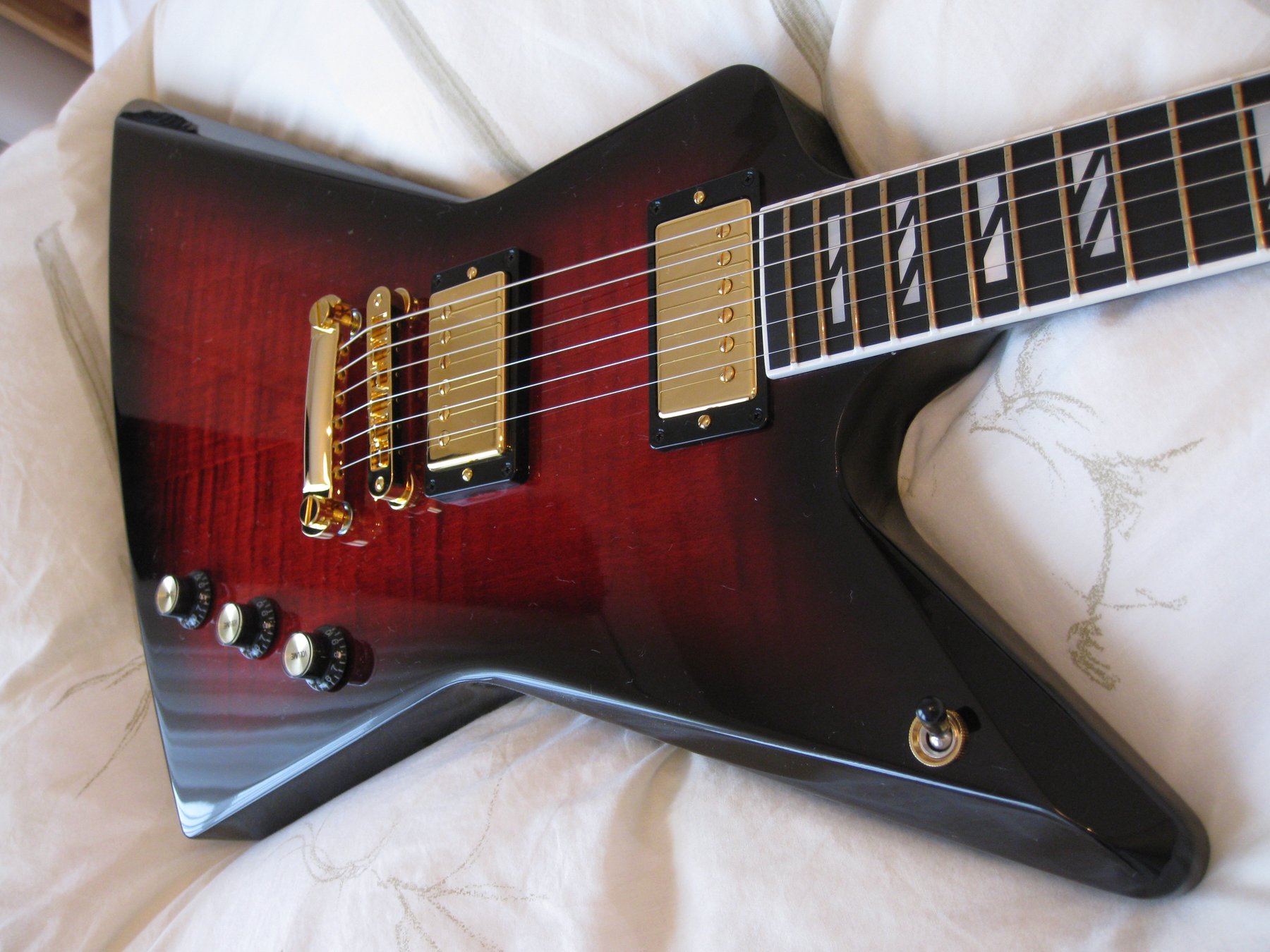
The Explorer's 50th birthday in 2008 brought some of its most interesting variations. The 50-Year Commemorative Explorer used a solid mahogany body with an AA maple top and a "new retro" body with rounded edges. The Reverse Explorer flipped the body shape and used a carbon-fiber-look pickguard and inlays with a McCarty-era headstock. Each was limited to 1,000 guitars as part of Gibson's Guitar of the Month program. The same year brought the Robot Explorer, a self-tuning version with a red metallic finish.
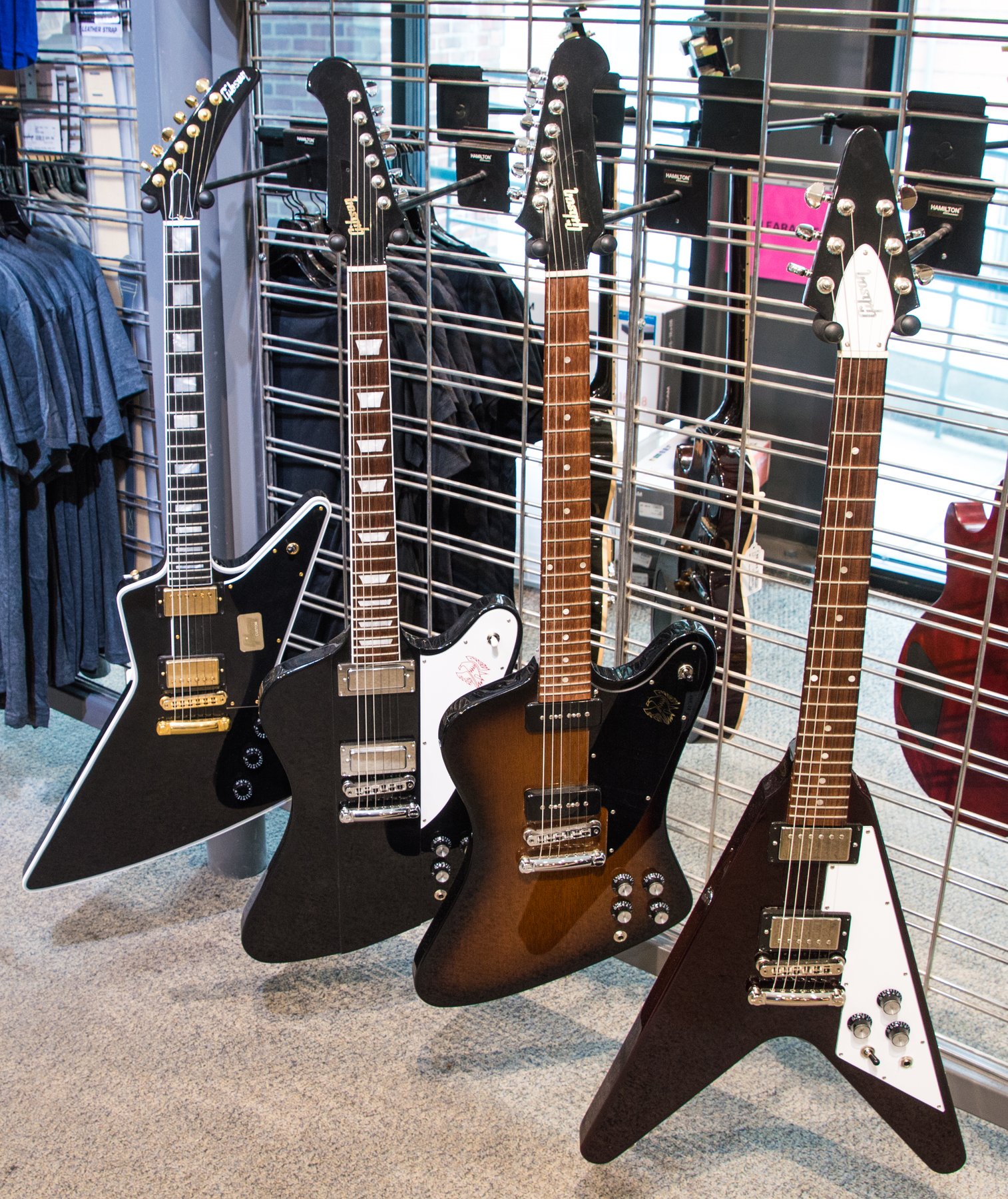
The following years kept the experiments coming: the Tribal Explorer with tribal graphics and a Kahler-style tremolo in 2009, the Holy Explorer with holes cut straight through the body, a limited 120th Anniversary edition in 2014, and the Explorer's return to Gibson's standard lineup in 2016 after several stretches when it had come and gone.
Gibson also kept paying tribute to the original. In 2001 it built limited runs of the Explorer Split Headstock, a careful recreation of the 1958 korina Explorer with the forked headstock found only on the very earliest examples. Epiphone, Gibson's more affordable brand, has offered Explorers in several flavors over the years, including korina versions and an Explorer bass.
Playing an Explorer: What It's Actually Like
If you've never picked one up, here's the honest version.
Standing up, it's great. The Explorer hangs well on a strap, the long upper horn helps it feel balanced, and the body gives you a big, stable platform for your picking arm. Players who stand for every gig tend to fall in love with it.
Sitting down takes practice. The lower horn and the long tail make it less natural on your leg than a Les Paul or a Strat. That's the exact problem Clapton's "cut" solved, and it's why so many players say the Explorer is a stage guitar first.
It's a big case. An Explorer case is wide. Measure your car trunk and your closet before you buy one, because it won't fit everywhere a normal guitar does.
The sound is pure Gibson. Strip away the shape and a standard Explorer is a mahogany-bodied, set-neck, two-humbucker guitar with Gibson's familiar 24.75-inch scale. It sounds thick, warm and powerful. Clean, it has a full, round voice. With gain, it has the midrange punch and sustain that made it a natural fit for hard rock and metal. The Edge proved it can chime; Hetfield proved it can crush.
Tone-chasing tip: If you want that classic Explorer rhythm sound, start with the bridge humbucker, a medium-gain amp setting rather than a scooped one, and keep your mids up. The Explorer already has plenty of low-end weight, so you rarely need to crank the bass to get a big sound. For cleaner, Edge-style parts, try the neck or middle position with a dotted-eighth delay and a little less gain than you think you need.
Why the Explorer Still Matters
The Explorer story is one of the best lessons in guitar history about being too early.
In 1958, Gibson took a real risk. It hired no famous artist, followed no market demand and copied nobody. It just decided that an electric guitar didn't have to look like the instruments that came before it. The market said no, loudly. Gibson listened, pulled the guitar and moved on.
But the idea didn't die. It survived in a handful of rare originals, in Clapton's modified guitar and Allen Collins's Southern rock attack, in Hamer and Ibanez tributes, and in the dreams of a generation of players who wanted their guitar to look the way their music sounded. When Gibson brought the Explorer back in 1976, it wasn't selling a new idea. It was finally selling an old one to people who were ready for it.
Today the Explorer outline is everywhere: on metal stages, in indie bands, on the walls of every guitar shop and in a court record or two. It's one of only a few guitar shapes that most people recognize instantly even if they've never played a note. That's an incredible legacy for a guitar that sold 22 copies in its first two years.
Some guitars are right on day one. The Explorer was right about 20 years later, and it has been right ever since.
Which Explorer player made you want one? Tell us in Guitar Talk, and read our Gibson Flying V history for the other half of Gibson's 1958 gamble.
Plugged Gear Co. may earn a commission from qualifying purchases.
Experience-driven coverage, not algorithm bait.
- 20+ years of guitar playing experience
- Real-world retail experience at Guitar Center
- Thousands of hours testing guitars, amps, and pedals
- A community of 50,000+ guitar enthusiasts across platforms
- Partnerships with Fender, DistroKid, TrueFire, Card Chords, and Enya
- Editorial standards published openly — see how we test gear
The Modern Guitar Magazine. Delivered to your inbox.
No spam. No gimmicks. Just great guitar content — stories, tones, iconic solos, and honest gear takes. Every week.
Ask GP
3 free questions a dayStill curious? Ask GP about this story.
Your personal classic-rock and guitar guide — ask anything about The Gibson Explorer History.
Discussion (0)
Sign in to join the discussion.
Sign in to commentLoading comments…
Discover another guitar story
Swipe through our latest features, breaking news and iconic solos — one story at a time.
Open Swipe →More Guitar News
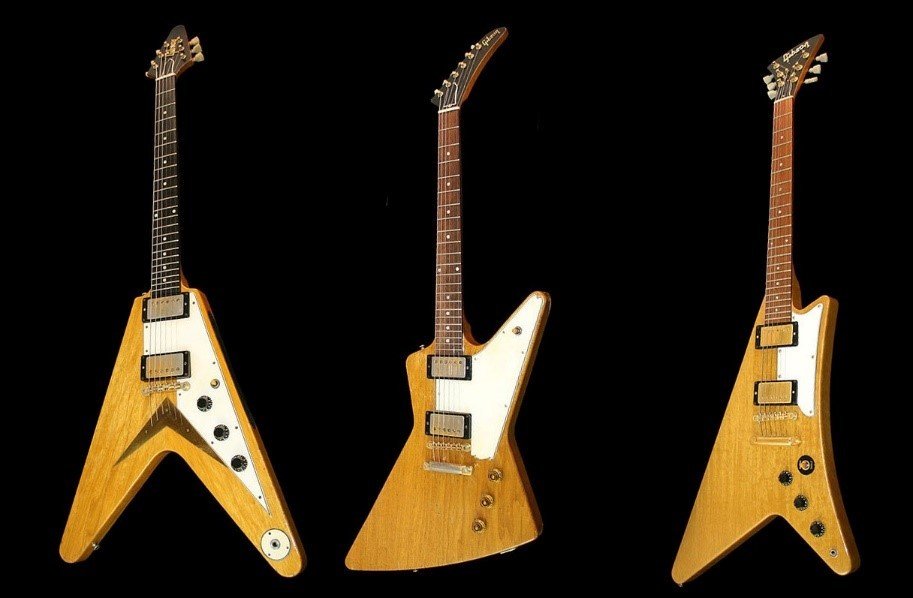
Gibson Flying V History: From 98-Guitar Flop to Metal's Favorite Shape
Gibson made fewer than a hundred Flying Vs in 1958–59 and nearly gave up on the shape. Here's how a futuristic flop became the guitar of blues kings, Hendrix, UFO, Judas Priest and Metallica, and which V to buy today.
Gibson's 1957–1960 P.A.F. Reissue Sets Split the Holy-Grail Humbucker Into Four Distinct Voices
The Gibson Pickup Shop's new 1957–1960 P.A.F. Reissue Sets split the classic humbucker into four voices, from Alnico 5 bite to Alnico 2 warmth. Specs, prices and how to choose.
Humbuckers vs. Single-Coils: Which Pickup Is Right for You?
Humbuckers roar, single-coils sparkle. Here’s how pickups actually work, what they sound like, and the easy way to choose the right set for your guitar, genre, and budget.