Gibson Flying V History: From 98-Guitar Flop to Metal's Favorite Shape
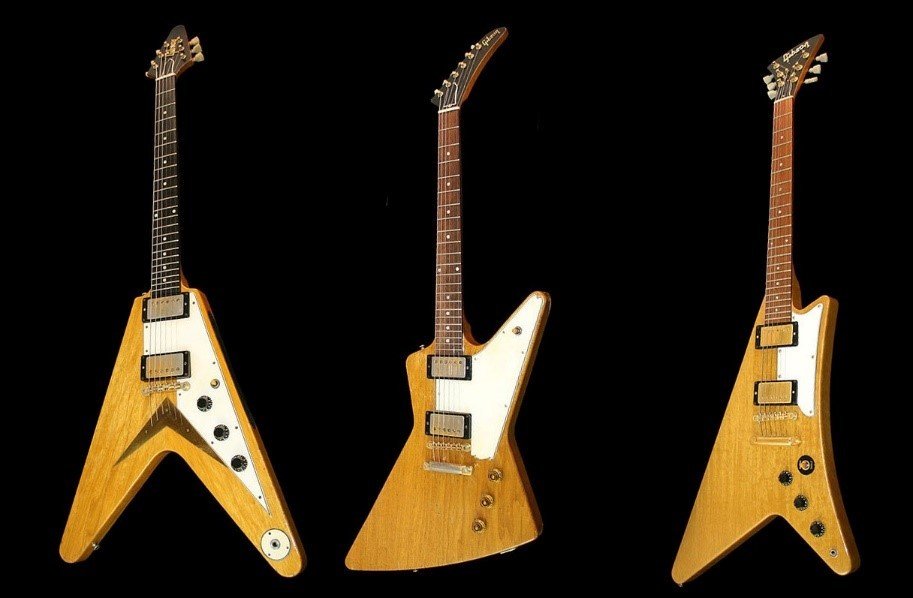
Korina-style Gibson Flying V, Explorer and Moderne guitars side by side: the three shapes of Gibson's late-'50s "Modernistic" idea.
Photo: Jérôme Fischer (Jerrock.com), CC BY-SA 3.0, via Wikimedia Commons
Gibson made fewer than a hundred Flying Vs in 1958–59 and nearly gave up on the shape. Here's how a futuristic flop became the guitar of blues kings, Hendrix, UFO, Judas Priest and Metallica, and which V to buy today.
In 1958 Gibson made a guitar that looked like an arrowhead from a sci-fi film. Dealers didn't want it, players laughed at it, and Gibson shipped fewer than a hundred before it quietly let the model go.
Today the Flying V is one of the most recognized shapes in rock. Blues players made it cool, Jimi Hendrix painted one, and British hard rock and then metal adopted it. Gibson and Epiphone now sell more than a dozen versions of it, from a $699 Epiphone to a five-figure korina reissue.
Here's how the Flying V went from Gibson's biggest embarrassment of the 1950s to a design nearly every major guitar brand has copied, and what the different versions are actually like to play.
1957: Gibson Decides to Look Like the Future
In the mid-'50s, Gibson had a problem it couldn't solve with better wood or better pickups. Fender's Telecaster and Stratocaster looked new. Gibson's guitars, even the Les Paul, looked like the archtops your father played.
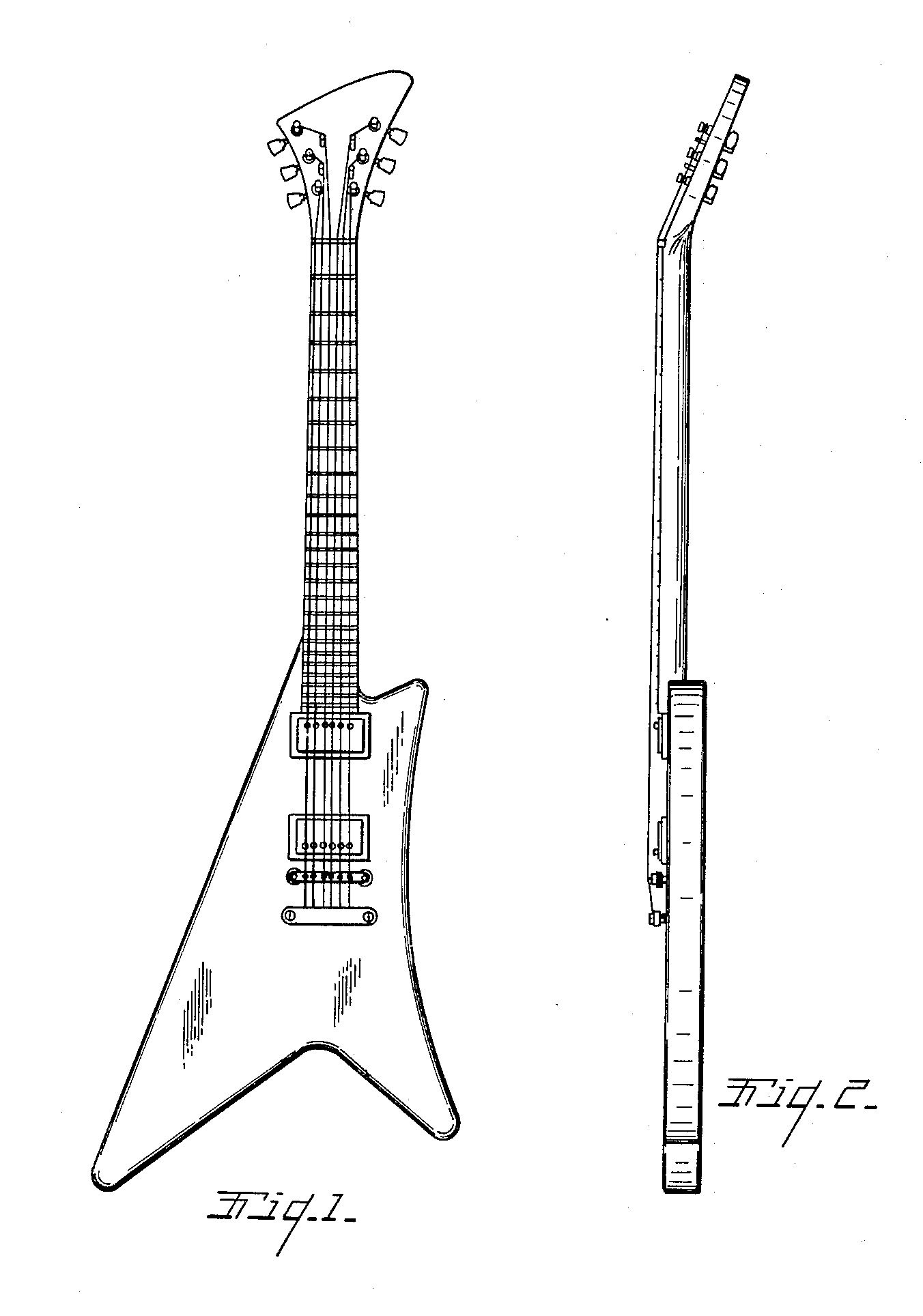
Gibson president Ted McCarty wanted to fix that image. The company's answer was a set of three radical, angular solidbodies that collectors now call the "Modernistic" line. Gibson filed design patents for the shapes in mid-1957, and they were granted in January 1958.
Who actually drew the Flying V is still argued about. Wikipedia and Gibson's own story credit McCarty. Historian Tony Bacon has reported that engineer Seth Lover sketched the V and came up with the name, and other accounts say McCarty used outside designers as well. What everyone agrees on is that McCarty pushed the project and put Gibson's name on it.
The three designs were:
- The Flying V, a pointed V with the neck coming out of the point.
- The Futura, an angular "offset Z" shape that became the Explorer.
- The Moderne, a lopsided shape with a sloped upper edge that, as far as anyone can prove, never got past the prototype stage.
Korina: The Wood That Made It Different
The early Flying V prototypes were reportedly made of mahogany, like a Les Paul Junior. They were too heavy for such a big, pointy body. Gibson switched to korina, a trade name for African limba (Terminalia superba). It's lighter in weight and in color than mahogany, with an open grain that looks almost golden under a natural finish.
That light, pale wood was part of the sales pitch. Gibson's Wilbur Marker later told Guitar Player: "No one else had a korina guitar... That was the novelty of the thing."
The 1958 Flying V was a serious instrument under the space-age styling:
- Korina body and neck, glued together
- 22-fret rosewood fingerboard with dot inlays and a 24.75" scale
- Two PAF humbuckers, the same pickups as a '58 Les Paul Standard
- A Tune-o-matic bridge, with strings anchored through the body in a V-shaped plate
- Gold-plated hardware
- Three knobs in a line (two volumes and a tone)
- A rubber strip along the lower edge, so the guitar wouldn't slide off your leg when you sat down
That last detail tells you Gibson knew the V would be awkward to sit with. It wasn't wrong.
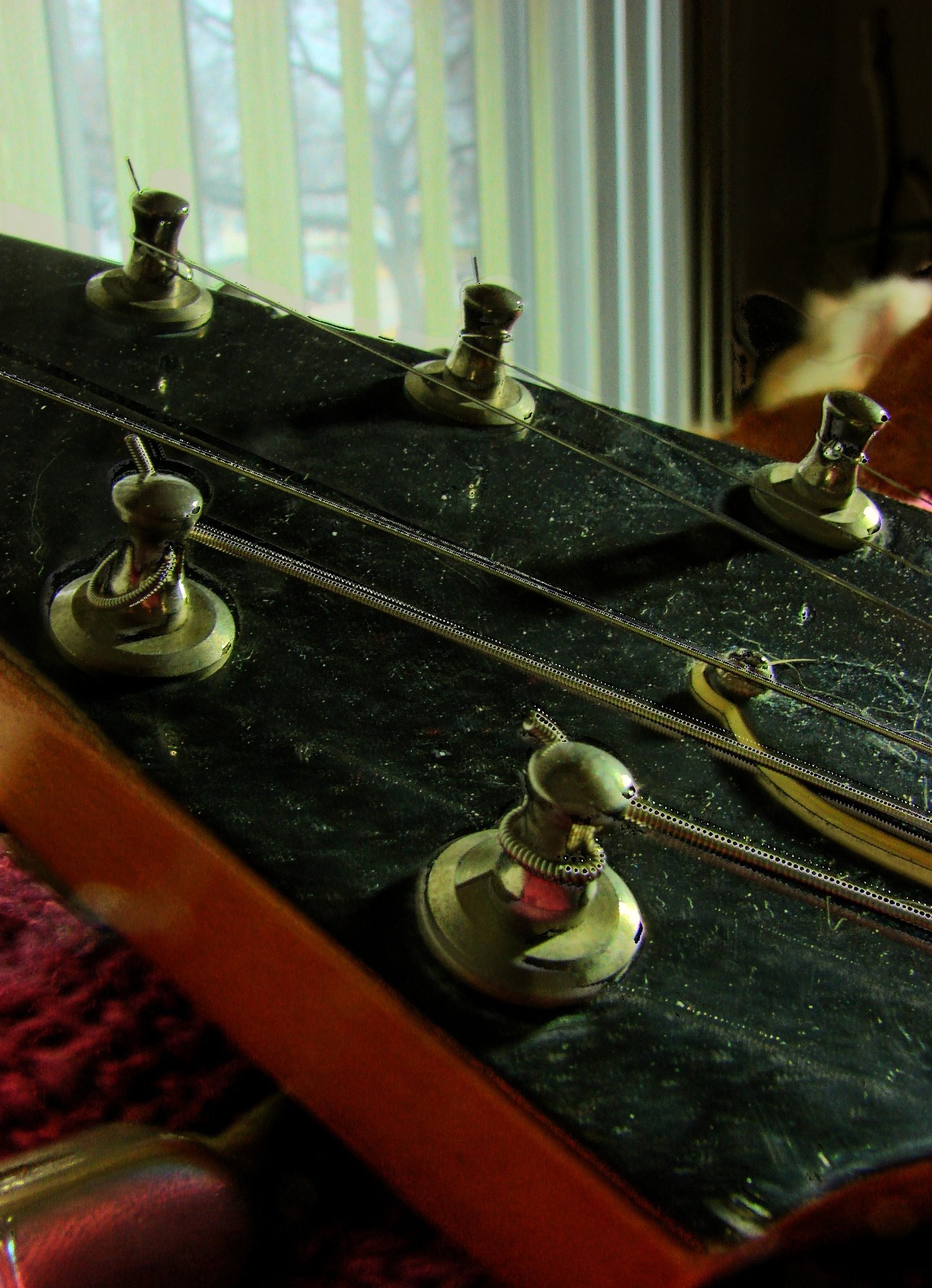
The headstock was new too. Instead of Gibson's usual "open book" shape, the V had a narrow, pointed headstock that echoed the body. It became as much a part of the look as the body itself.
1958–59: Ninety-Eight Guitars
The Flying V was in Gibson's 1958 price list at $247.50. That was the same price as a Les Paul Standard, which put it at the expensive end of Gibson's solidbody range. Gibson showed it at the NAMM trade show in Chicago in July 1958.
Dealers mostly didn't know what to do with it. In the late '50s the people buying electric guitars were mainly country, jazz and dance-band players, and very few of them wanted to walk on stage with an arrowhead.
Gibson's shipping logs tell the story. They show 81 Flying Vs shipped in 1958 and 17 in 1959: 98 in total. In 1958 alone, Gibson shipped more than 2,400 Les Paul Juniors.
The Explorer did even worse. Gibson's ledgers show 19 Explorers in 1958 and just 3 in 1959, and some of the earliest had a forked, "Futura"-style headstock. The Moderne is even more mysterious. Collectors have argued for decades over whether any were made in the '50s, but no confirmed example has ever surfaced, which has made it the "holy grail" of collectible Gibsons.
That wasn't quite the end of the korina V. Gibson had leftover bodies and parts, and around 1962–63 it assembled roughly 20 more Flying Vs from them, many with nickel hardware instead of gold. Collectors still argue over exact totals because some shipping records from that period are missing.
Today, original '58–'59 korina Vs are among the most valuable production electric guitars in the world. For the story of what one very famous early V is worth now, see our coverage of Lonnie Mack's "Number 7" Flying V selling at auction.
The Players Who Wouldn't Let It Die
A guitar can flop in the shops and still find its people. The Flying V found a handful of them, and they turned out to matter more than the sales figures.
Lonnie Mack
Lonnie Mack bought one of the very first Vs as a teenager. It became "Number 7," and he played it on his 1963 instrumental hits "Memphis" and "Wham!". Those records made him one of the first electric guitar heroes of the '60s and influenced players from Stevie Ray Vaughan to Duane Allman. We covered Mack's guitar in detail in our Number 7 auction story, so here we'll just say that Mack was the first player to make the Flying V sound like something you'd want to own.
Albert King and "Lucy"
Albert King is the player who made the Flying V a blues guitar. He bought a korina V around 1959 and named it "Lucy," a nod to B.B. King's Lucille.
King was left-handed but played a right-handed guitar flipped over, with the low E string at the bottom. He bent strings by pulling down instead of pushing up, which helped give him huge, vocal bends that sounded like no one else. He also used unusual tunings. The big body and the long, easy reach to the upper frets suited his style well.
His original korina V eventually left his hands, and it is now owned by actor Steven Seagal. King went on to play a run of other Vs: a 1960s mahogany Gibson, a custom V built by luthier Dan Erlewine in the early '70s, and later Vs by other builders. Nearly every photo of King on stage shows a V.
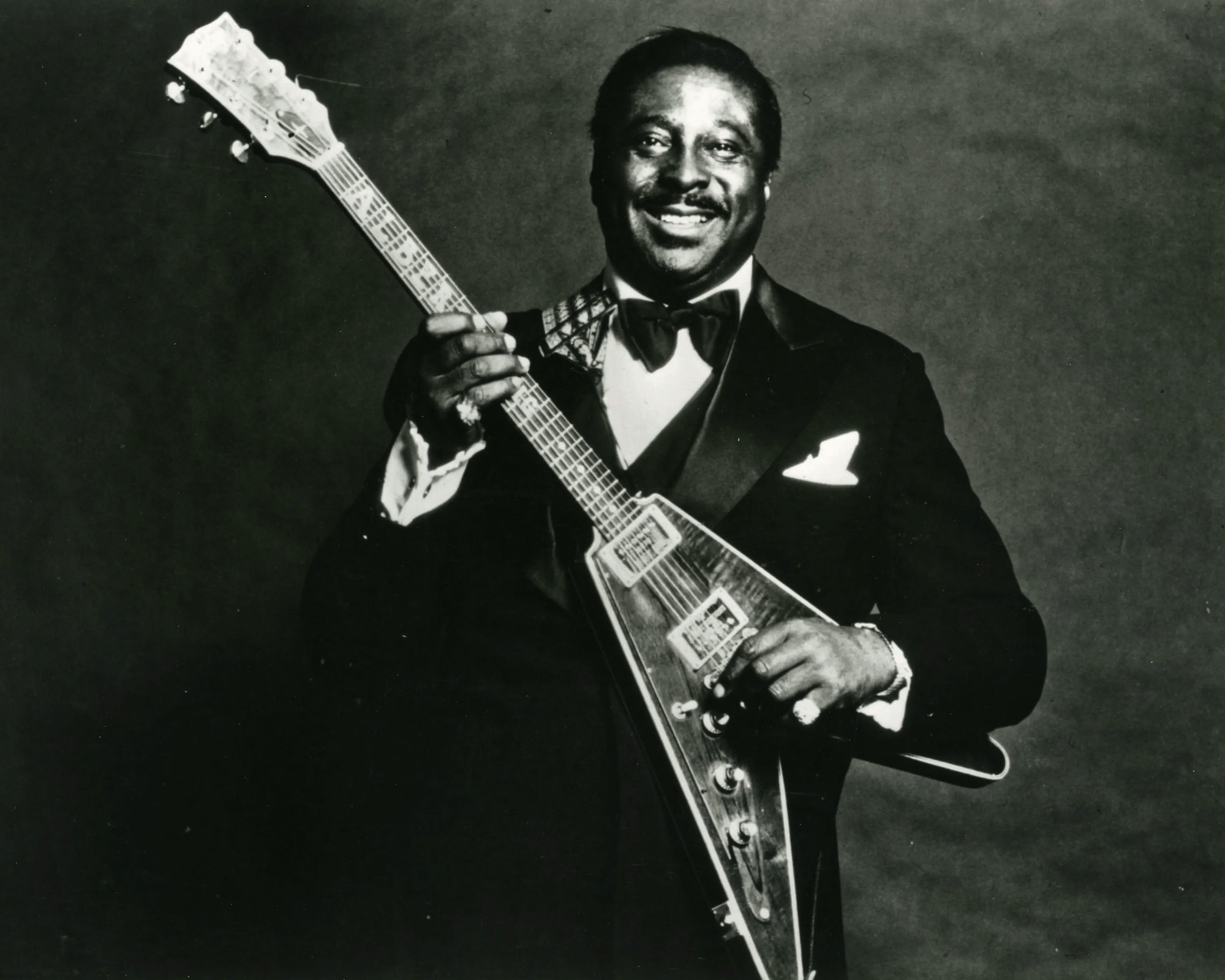
King's 1960s Stax records, including Born Under a Bad Sign, made his sound a blueprint for rock guitarists. Eric Clapton, Jimi Hendrix and Stevie Ray Vaughan all learned from him, and a lot of them noticed the guitar.
Dave Davies and the British Invasion
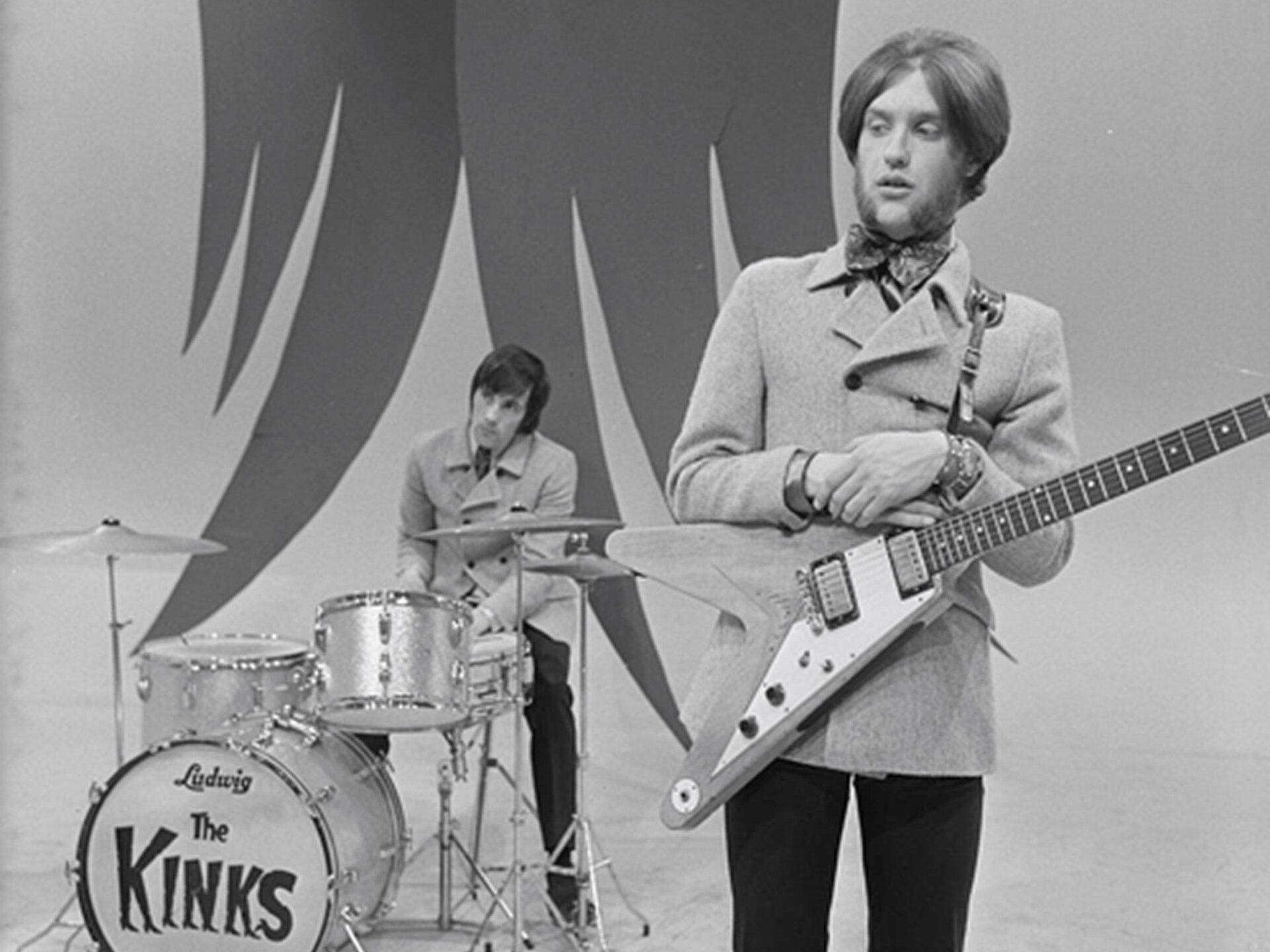
In 1965, on the Kinks' first US tour, Dave Davies lost his guitar in transit and bought a 1958 korina Flying V as a replacement. He brought it back to Britain, which meant that one of the rarest guitars Gibson ever made turned up on British TV with one of the loudest bands of the decade.
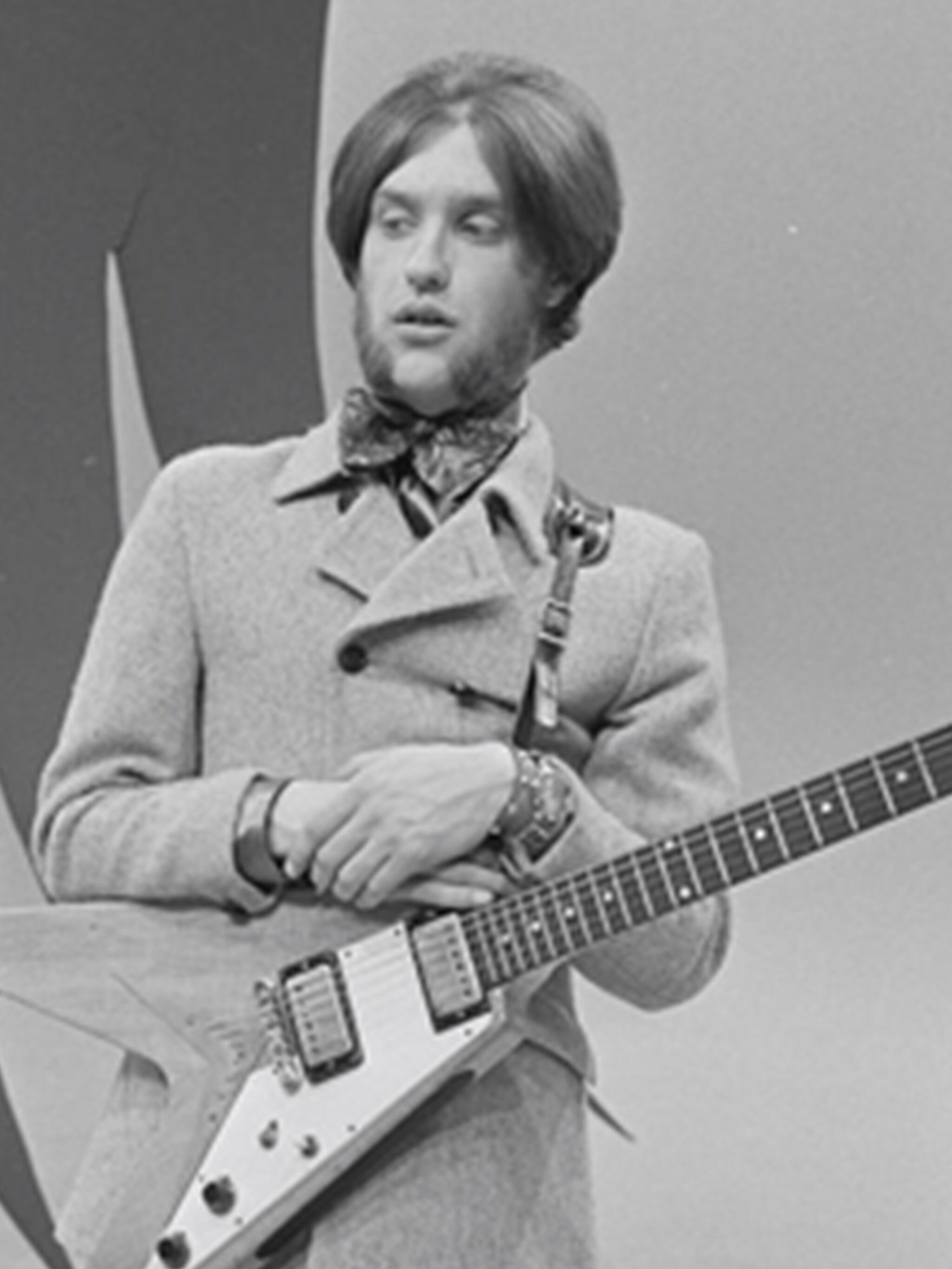
Davies had already helped invent the distorted rock power chord on "You Really Got Me." Seeing him with a V helped young British players think of it as a rock guitar, not a novelty.
1967: The Mahogany Reissue
By the mid-'60s, demand for the V was growing, mainly because of players like King and Davies. Gibson brought it back in 1967, but it wasn't a copy of the '58.
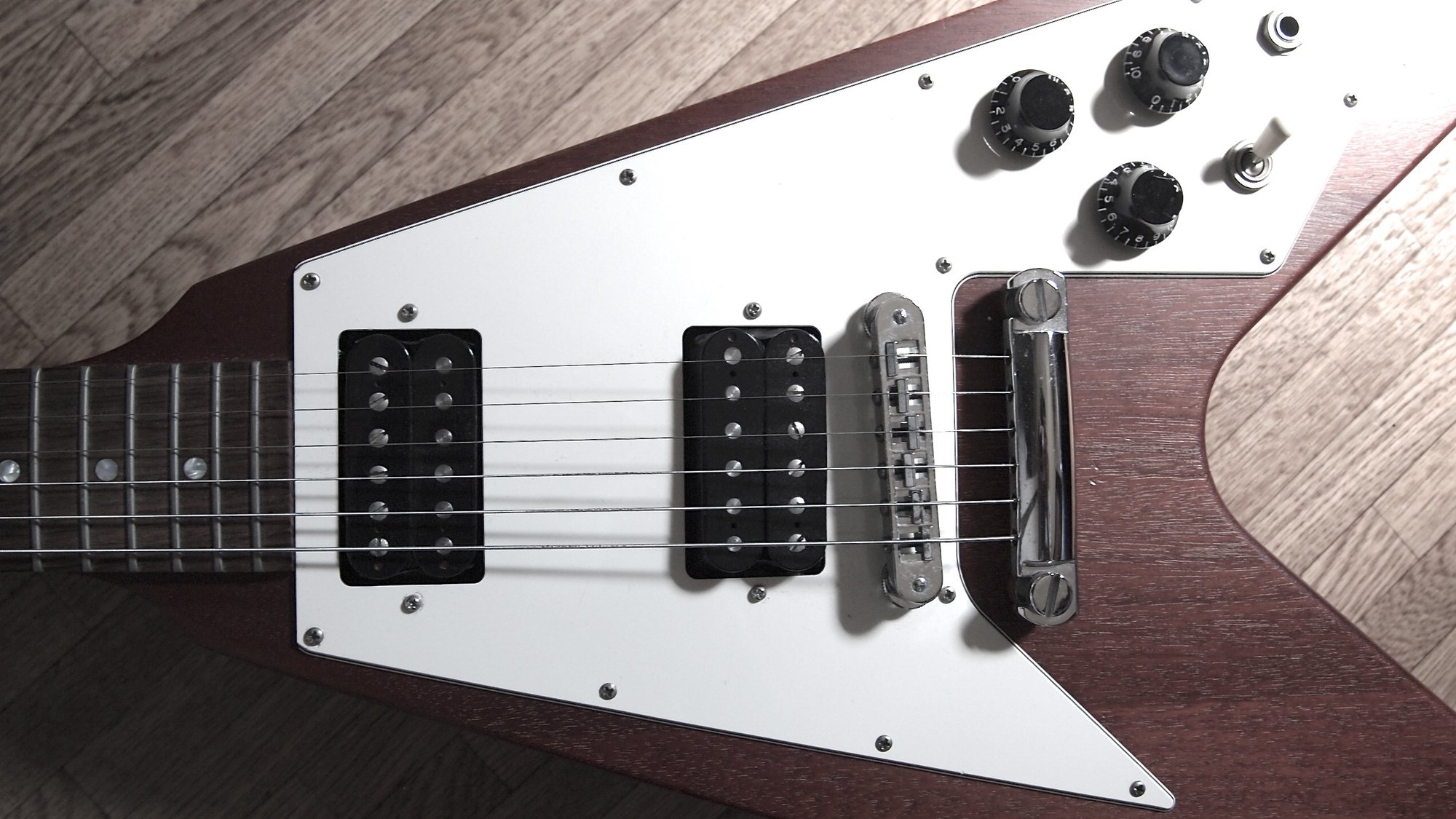
The new V was made of mahogany, not korina. It had a much bigger pickguard that covered most of the body, the knobs were arranged in a triangle rather than a straight line, and the strings no longer went through the body. Most had a Maestro Vibrola tailpiece, which mounted on top of the guitar. Some later ones had a stop-tail.
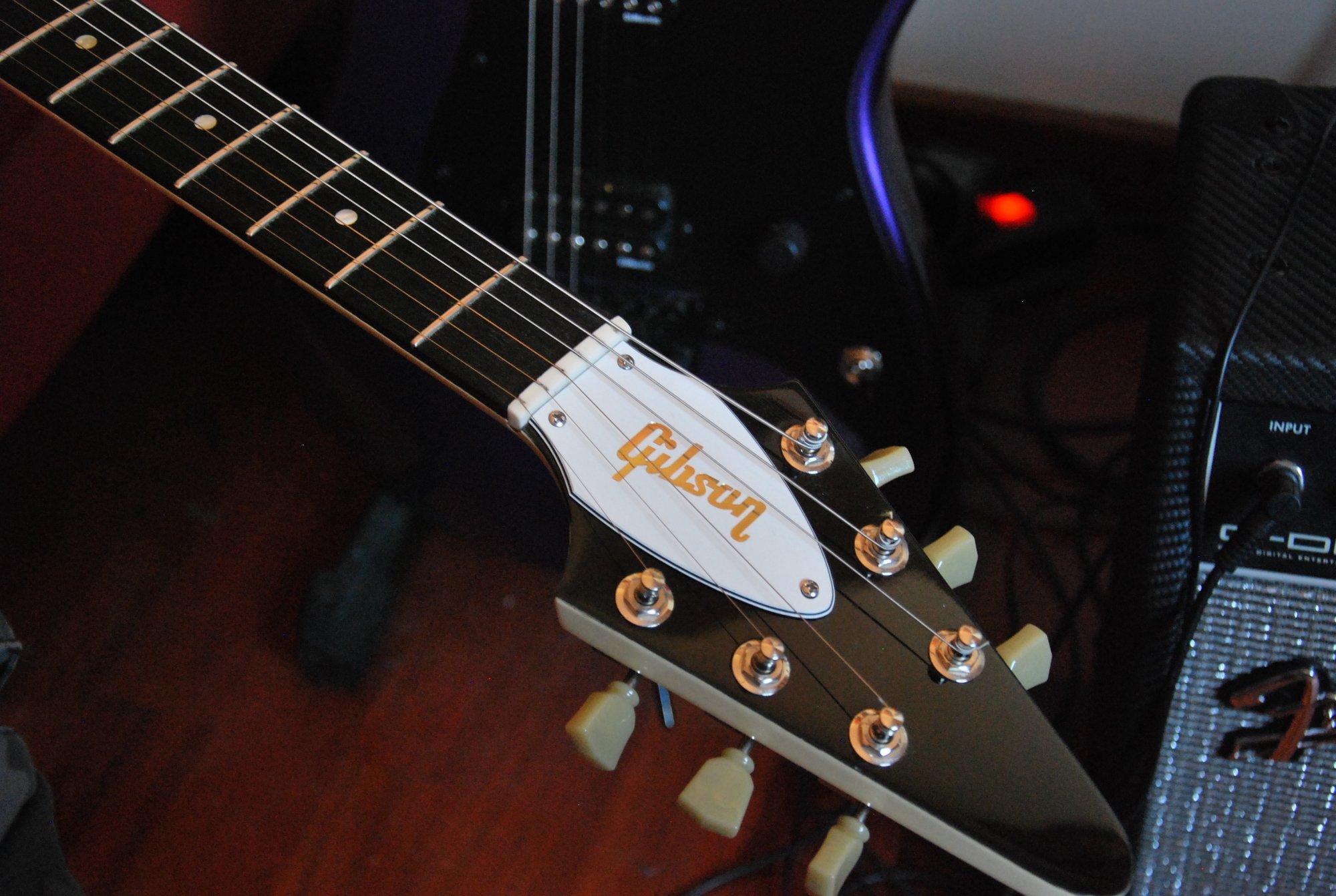
It was still a small run. Gibson's shipping figures show just over 100 in 1967, and sources disagree on exact totals for the late '60s. But it reached the right people.
Jimi Hendrix's Flying Vs
Most people think of Jimi Hendrix with a white Stratocaster, but he played Flying Vs throughout his career.
His most famous was a 1967 mahogany V in sunburst. Hendrix, who was left-handed, played it flipped over and restrung, and modified the nut and strap button to suit. He painted it himself with psychedelic patterns. The guitar is now known as the "Love Drops" V.
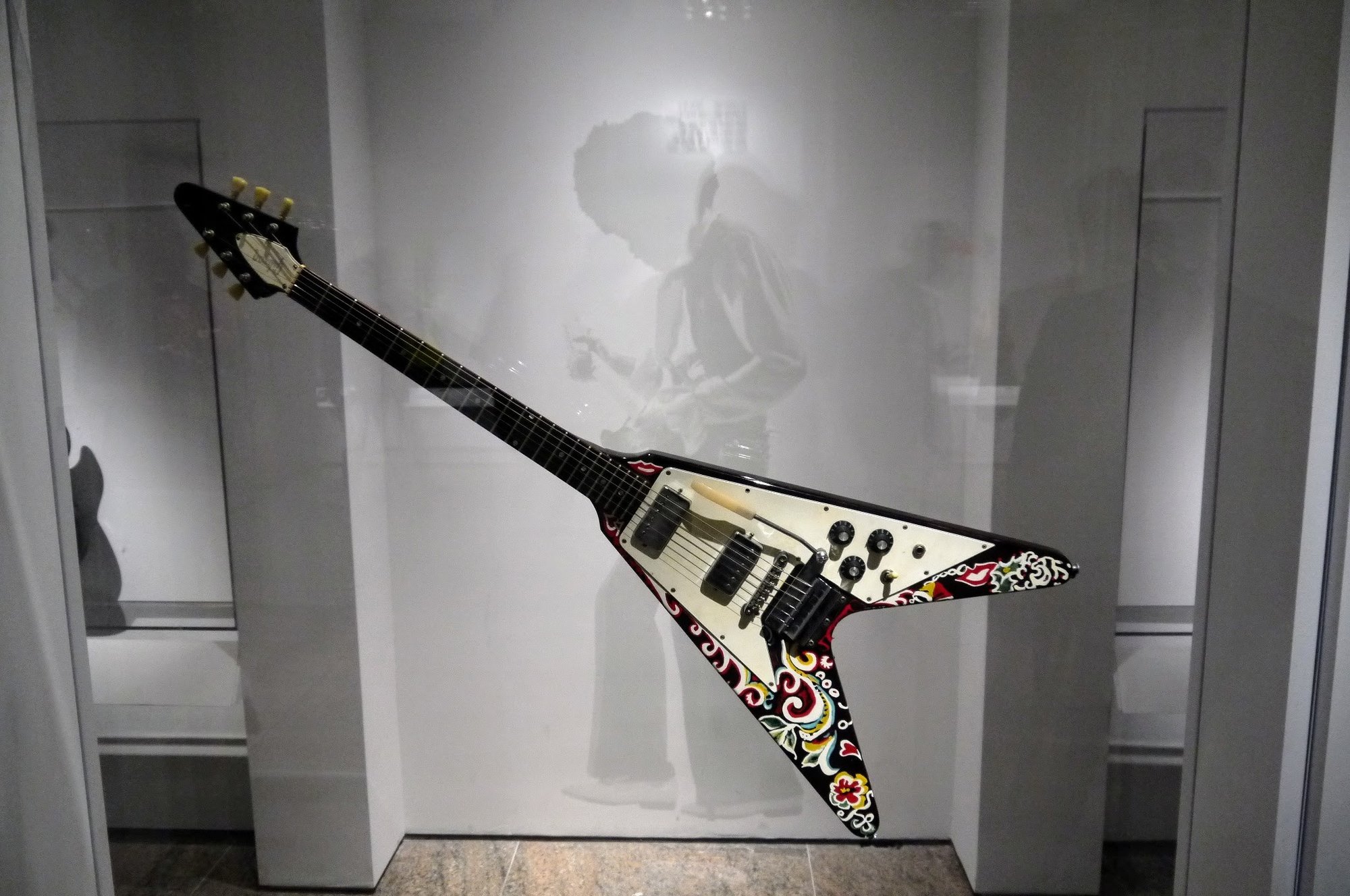
According to the Metropolitan Museum of Art, Hendrix played it a lot between 1967 and 1969. He probably used it on his 1967 BBC radio sessions, and it is believed to be the guitar on the Electric Ladyland solo for "All Along the Watchtower." In early 1969 he gave it away to a friend, guitarist Mick Cox.
Hendrix then had Gibson make a true left-handed V for him. It had an ebony fingerboard, split-diamond inlays, gold hardware and a Vibrola tailpiece. He played it during the Band of Gypsys era and at his famous Isle of Wight Festival show on August 31, 1970, weeks before he died.
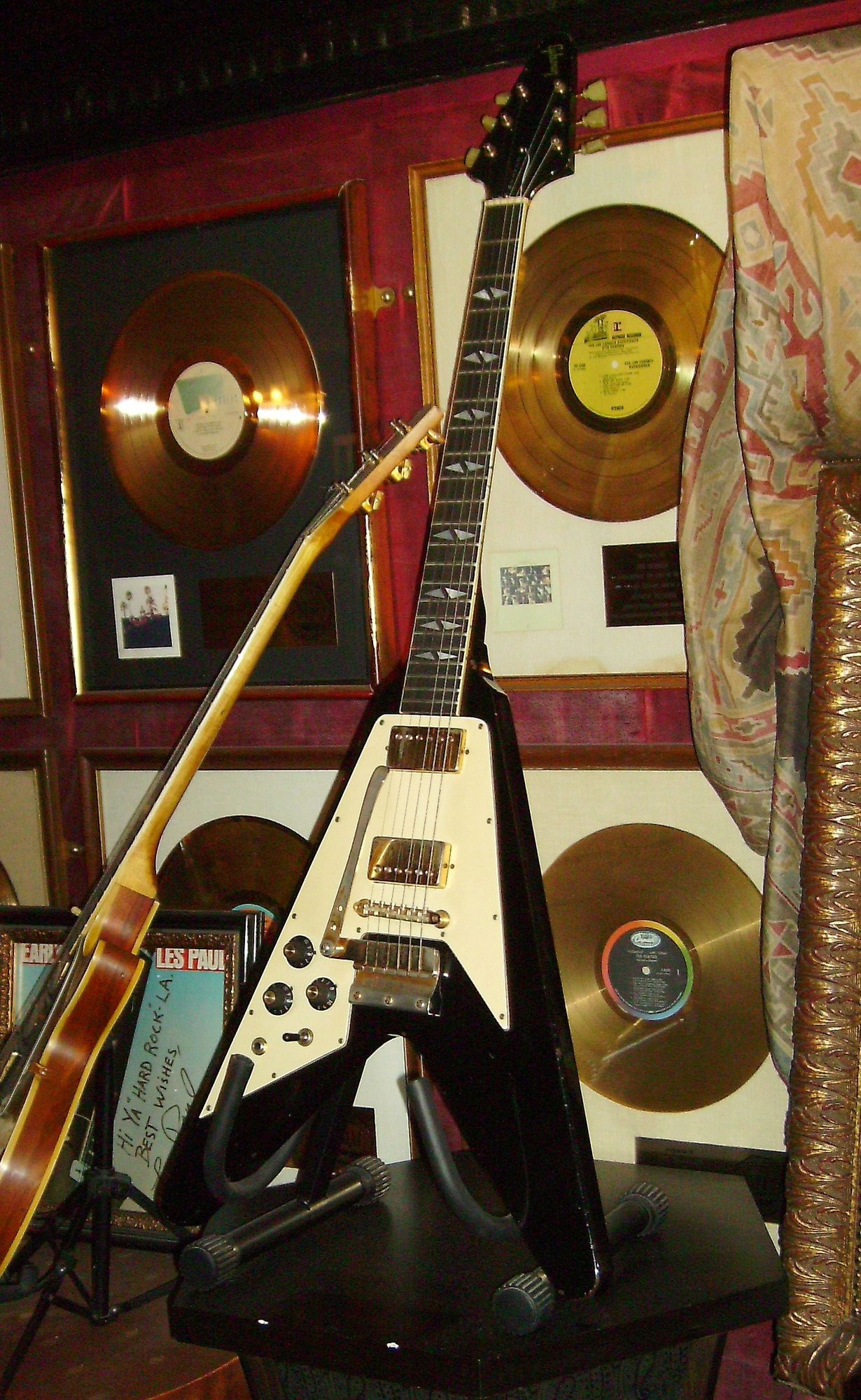
Hendrix showed that the V wasn't just a stage gimmick. It could sound warm, vocal and huge. For more Hendrix guitar history, see our histories of "Purple Haze" and "Foxey Lady."
The '70s: Medallions, Reissues and British Rock
Gibson made a limited 1971 Medallion Flying V, with a numbered medallion on the top, in a run of about 350. Then in 1975 the V went back into regular production in several finishes, and this time it stayed. An Explorer reissue followed around 1976, partly because smaller companies such as Hamer were selling their own Explorer-style guitars.
That timing was good. A new kind of British rock band was about to make the V its signature guitar.
Andy Powell and Wishbone Ash
Andy Powell of Wishbone Ash bought one of two unsold 1967 Vs at the Orange music shop in London in the early '70s, according to the band's own account. He described the neck as thin and "blade-like." That V was his main guitar on Argus (1972), which put twin harmonized lead guitars at the center of British rock.

Powell has played Vs ever since. Argus's twin-lead sound fed directly into the next wave of British bands, and Powell himself has claimed he helped influence players like K.K. Downing and the Schenker brothers.
Michael Schenker and UFO
Michael Schenker's Flying V started out as his older brother's. Rudolf Schenker, who went on to co-found Scorpions, bought a Flying V in Hamburg (according to Guitar World, a 1971 Medallion). Michael borrowed it as a teenager and never really gave it back.
Michael took the V to UFO in the '70s and recorded some of the most influential hard rock guitar of the decade. Songs like "Rock Bottom," and the solos on UFO's live album Strangers in the Night, became required learning for future metal players. Over the years the guitar went from cherry to black to his famous black-and-white split finish.
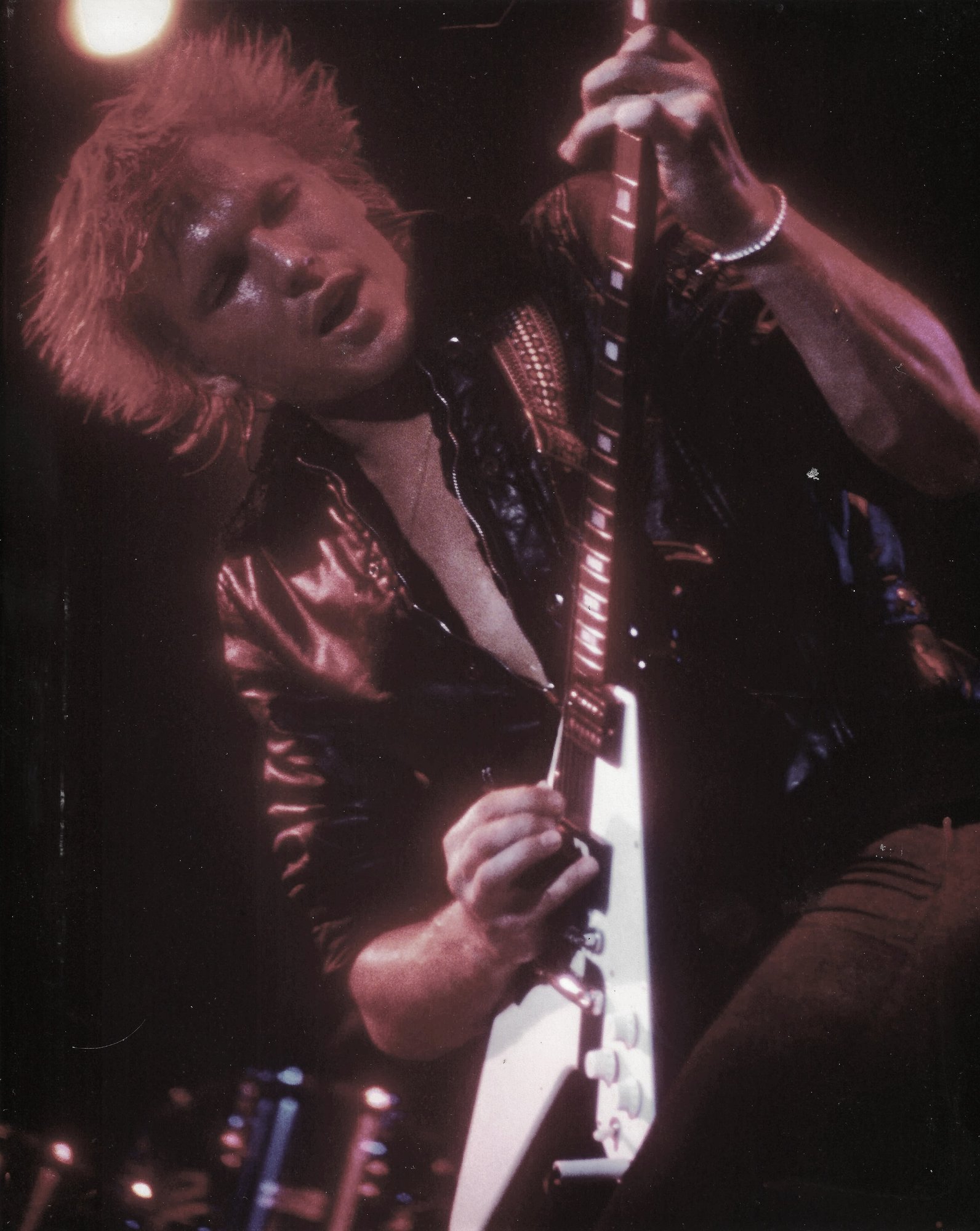
Schenker's sound was a Flying V into a Marshall, usually with a wah pedal left partly open (half-cocked) as a fixed filter instead of being rocked back and forth. That gave his leads a vocal, midrange-heavy tone that cuts through a band. Gibson Custom has since made a limited 1971 Flying V Collector's Edition based on his guitar.
Want Schenker's cocked-wah lead tone? Set a wah partly forward, leave it there, and play into a crunchy amp. Any standard wah pedal will do.
K.K. Downing and Judas Priest
In Birmingham, K.K. Downing saw a 1967 Flying V in a music shop and traded in his Gibson SG to get it. Alongside Glenn Tipton, Downing and his V became part of Judas Priest's leather-and-studs image. It's prominent on the cover of the band's 1979 live album Unleashed in the East.
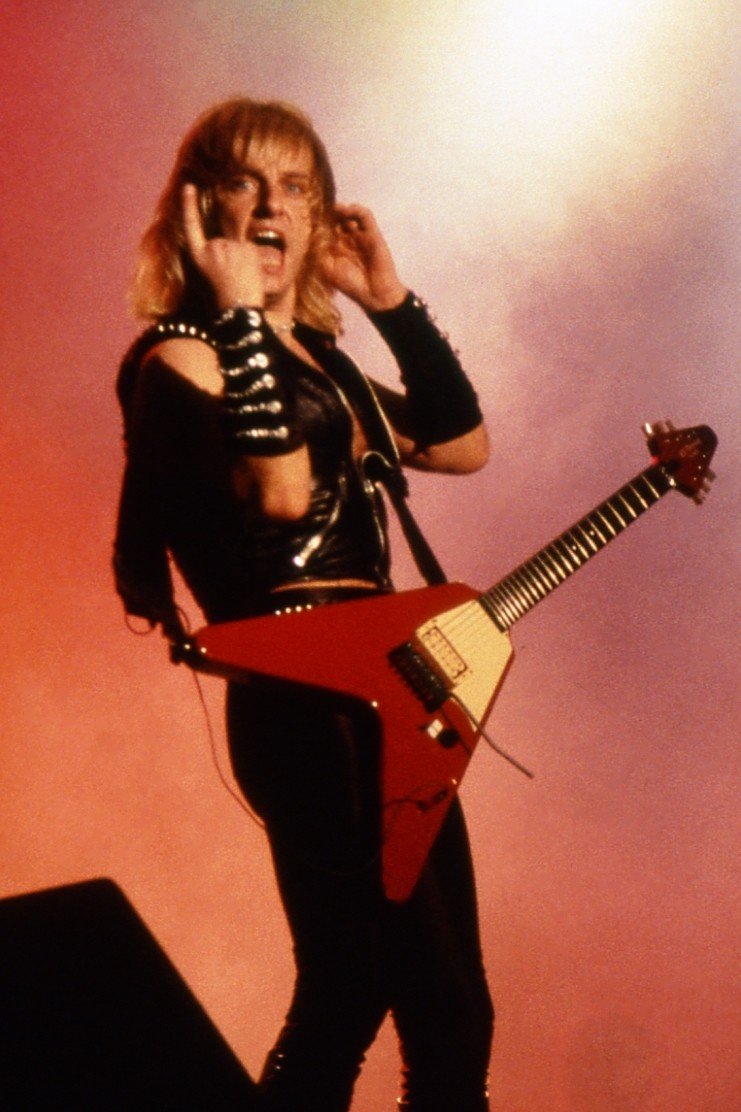
By the early '80s Downing was playing Hamer Vs as well as Gibsons. Even so, Judas Priest helped lock in the idea that a heavy metal guitarist should play a V.
The '80s: Metal Makes the V Its Own
Randy Rhoads and the Pointy Revolution
Randy Rhoads never made a Gibson Flying V his signature guitar, but he did more than almost anyone to make V shapes part of '80s metal. Rhoads was influenced by Michael Schenker, and after joining Ozzy Osbourne he played a custom polka-dot V built by Karl Sandoval. He then worked with Grover Jackson on an asymmetrical, sharper V. It became the Jackson Rhoads, one of the guitars that launched Jackson as a brand.
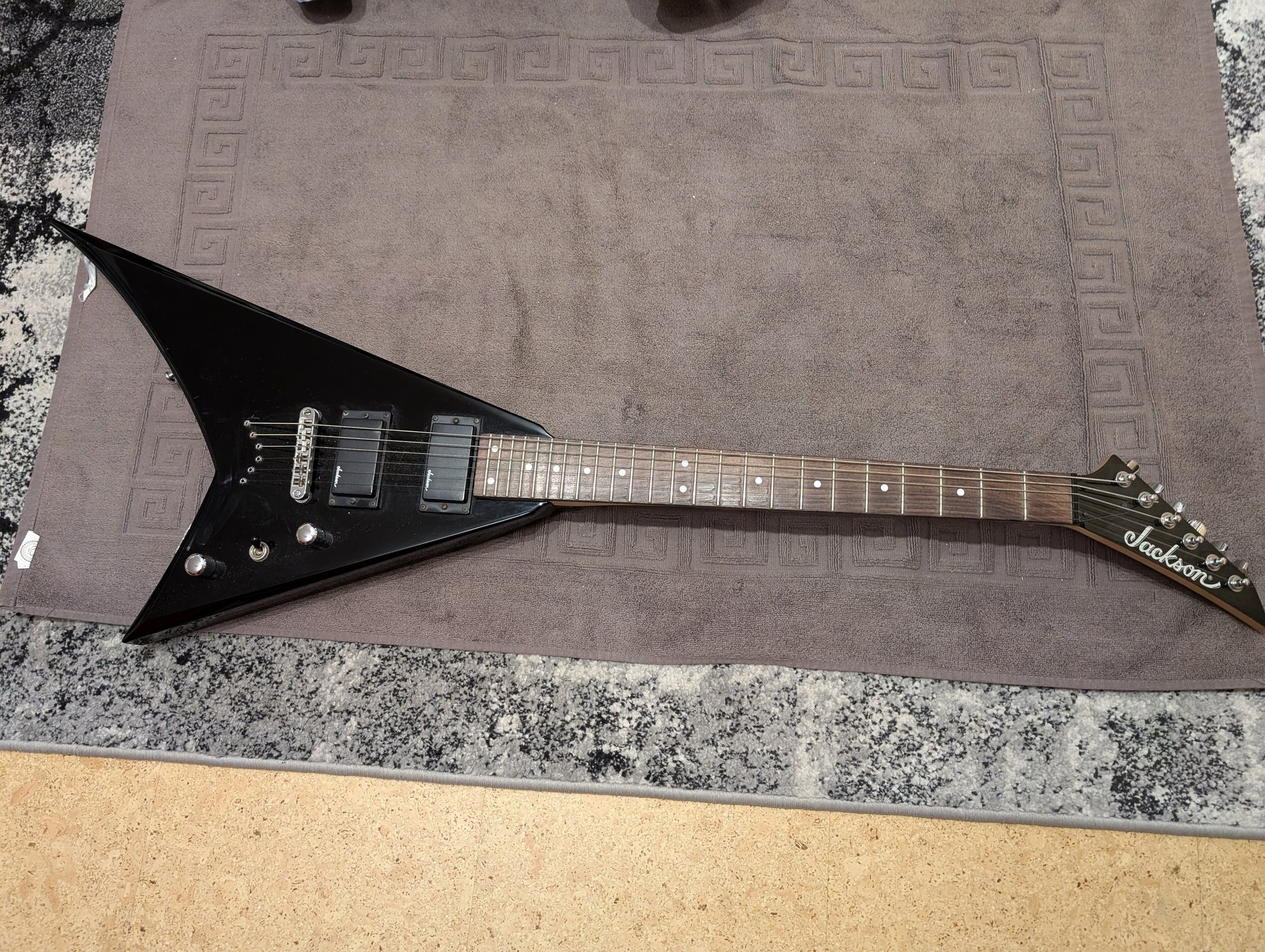
After Rhoads, every metal guitar company needed a V. To learn more about him, read Why Randy Rhoads Is Still Ahead of His Time and our "Crazy Train" History of the Riff.
Kirk Hammett, James Hetfield and Metallica
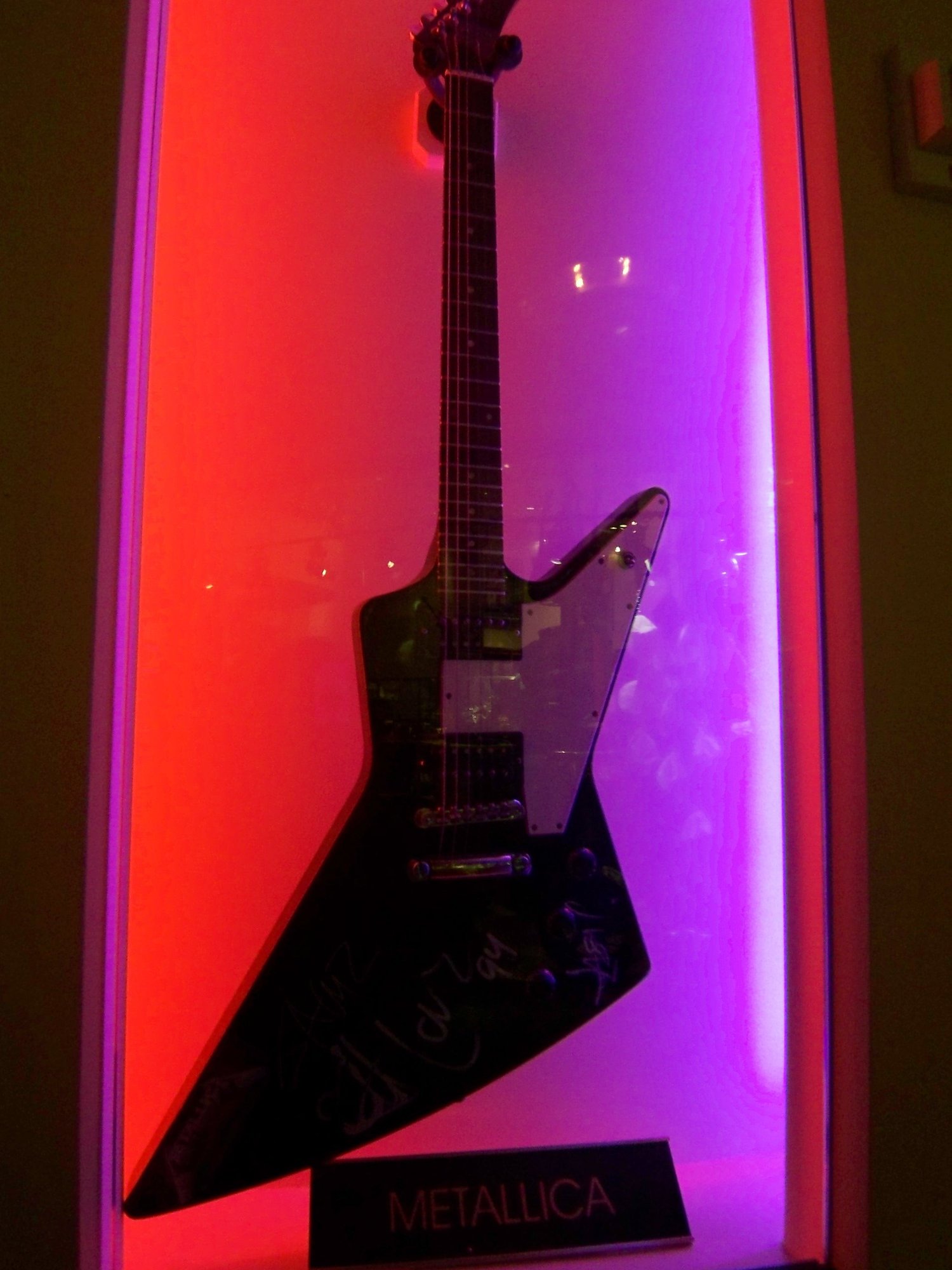
Metallica's early records show how V shapes and Explorers had become metal standards. Kirk Hammett's first Gibson was a black 1979 Flying V, which he used heavily on early Metallica records and later loaded with EMG pickups. Gibson Custom made a limited run of replicas, and Epiphone released a cheaper Kirk Hammett 1979 Flying V.
James Hetfield started with a cheap V copy and then a Jackson V. He's best known for Explorer-shaped guitars. In other words, the Flying V's 1958 sibling finally found its audience decades after Gibson first made it.
Dimebag and the Dean ML
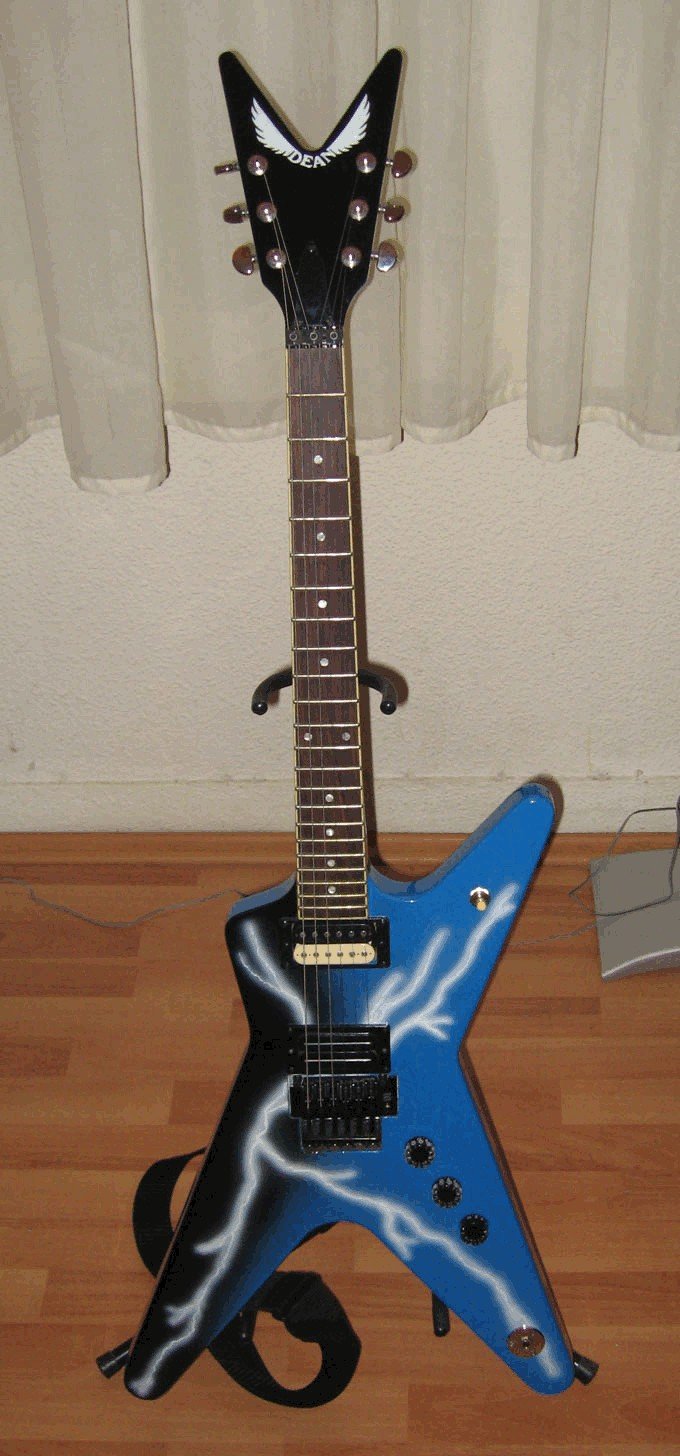
Even guitars that aren't Flying Vs owe a lot to the 1958 designs. Dean Zelinsky's Dean ML, introduced in 1977, is basically a Flying V and an Explorer combined. Dimebag Darrell's "Dean from Hell" ML became one of the most famous guitars in '90s metal, on the cover of Pantera's Cowboys from Hell.
For more on that sound, read our Dimebag Tone Decoded piece.
Throughout the '80s, Gibson kept experimenting with the shape. The Flying V2 (1979–82) had a curved, sculpted body, and there were V basses, Vs with locking tremolos and limited versions like the 2007 Reverse Flying V. You can find the best players of that era in our Best '80s metal guitarists list.
Korina vs. Mahogany: Does It Matter?
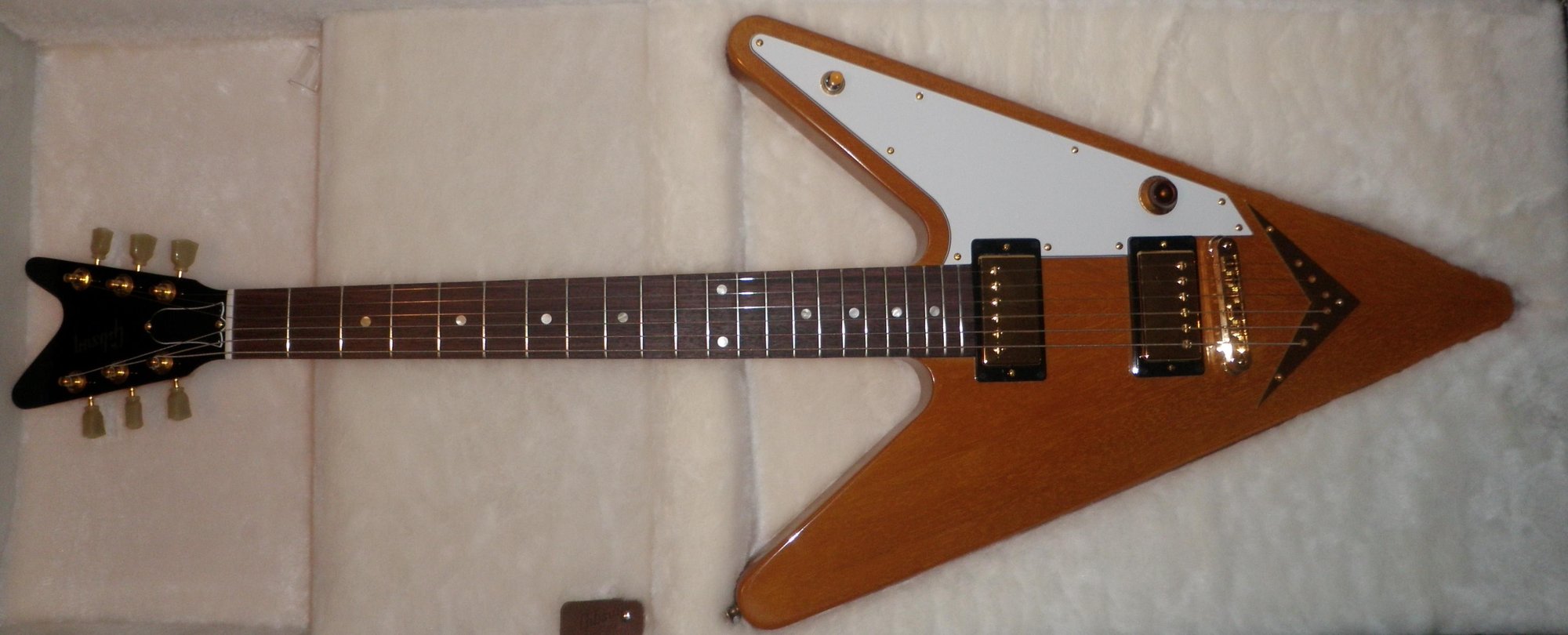
Most Flying Vs today are mahogany. Korina versions cost more and are mainly found in Gibson's Custom Shop and in a few Epiphone Inspired by Gibson models.
Gibson's own product copy describes mahogany as "somewhat warmer" than "slightly brighter Korina." That matches what most players report: korina Vs tend to sound a little more open and airy, with a clearer top end, while mahogany Vs have a thicker midrange.
The difference is smaller than the difference between pickups, amps or how hard you pick. A Flying V's sound comes from its humbuckers and its build: a fairly thin, flat body with less wood than a Les Paul. Most Vs sound brighter and lighter than a Les Paul with the same pickups, and less raw than an SG.
What a Flying V Is Like to Play
If you've never played a V, these are the things that will surprise you.
- Sitting down takes practice. On a normal guitar, you rest the body on your right leg. A V has no waist, so it slides off. Most players either sit with the lower "leg" of the V between their thighs, like a classical guitarist, or use a strap even when seated. The rubber strip on the original '58 was Gibson's attempt to fix this.
- Standing up is great. With a strap, a V hangs well and is easy to see and reach. Some lighter Vs can tip toward the headstock (neck dive), so try one on a strap before you buy.
- Upper-fret access is excellent. With no upper horn in the way, your hand has a clear path to the top of the neck. That's part of why lead players love it.
- The neck can vary a lot. A '58-style reissue neck is chunkier. The current Flying V 70s has Gibson's slimmer SlimTaper profile. Andy Powell's late-'60s V was famously thin.
- Cases and stands are awkward. Standard cases, gig bags and stands don't fit a V. Budget for the right case, and use a stand that holds the neck, not one that cradles the body.
The Flying V Range in 2026
Gibson and Epiphone now offer a wide range of Vs. These are US list prices from gibson.com and epiphone.com, checked on November 4, 2026 (prices and stock change often).
| Model | Body | Key features | Price (checked Nov 4, 2026) | ||
|---|---|---|---|---|---|
| Original 1958–59 korina V | Korina | 2 PAFs, string-through, gold hardware, 3 knobs in a line, rubber leg strip | Collector market only (98 shipped) | ||
| 1967 mahogany reissue (original) | Mahogany | Large pickguard, triangle knobs, Maestro Vibrola or stop-tail | Vintage market only | ||
| Gibson Flying V 70s | Mahogany | 70s Tribute humbuckers, SlimTaper neck, bound rosewood board | $2,499 | ||
| Gibson Flying V 80s | Mahogany | Based on mid-'80s Vs, 80s Tribute humbuckers | $2,499 | ||
| Gibson Custom 1971 Medallion Flying V Reissue | Mahogany | Thinner body than a '58, medallion on the top | $4,999 | ||
| Gibson Custom 1958 Mahogany Flying V Reissue | Mahogany | '58 shape and hardware in mahogany | $5,499 (sold out when checked) | ||
| Gibson Custom 1958 Korina Flying V Reissue | Korina | String-through, ABR-1 bridge, Custombucker pickups | $9,999 | ||
| Epiphone Flying V / Flying V 70s | Mahogany | Epiphone humbuckers, 70s-style styling | $699 | ||
| Epiphone IGC 1958 Korina Flying V | Korina | Korina body and neck, Gibson Burstbucker pickups | $1,299 (sold out when checked) | ||
| Epiphone Kirk Hammett 1979 Flying V | Mahogany | Modeled on Hammett's black 1979 V | $1,299 (sold out when checked) |
If you're just curious about the shape, an Epiphone Flying V is the cheapest way in, and it'll show you quickly whether you can live with sitting down with a V. The Gibson 70s and 80s models are the main US-made Vs, and the choice between them is mostly about feel and look. The 70s model is closer to the classic UFO-era V, and the 80s model has a more aggressive, '80s metal flavor. The Custom Shop korina reissue is for players who want the closest thing to a '58 without a six-figure budget.
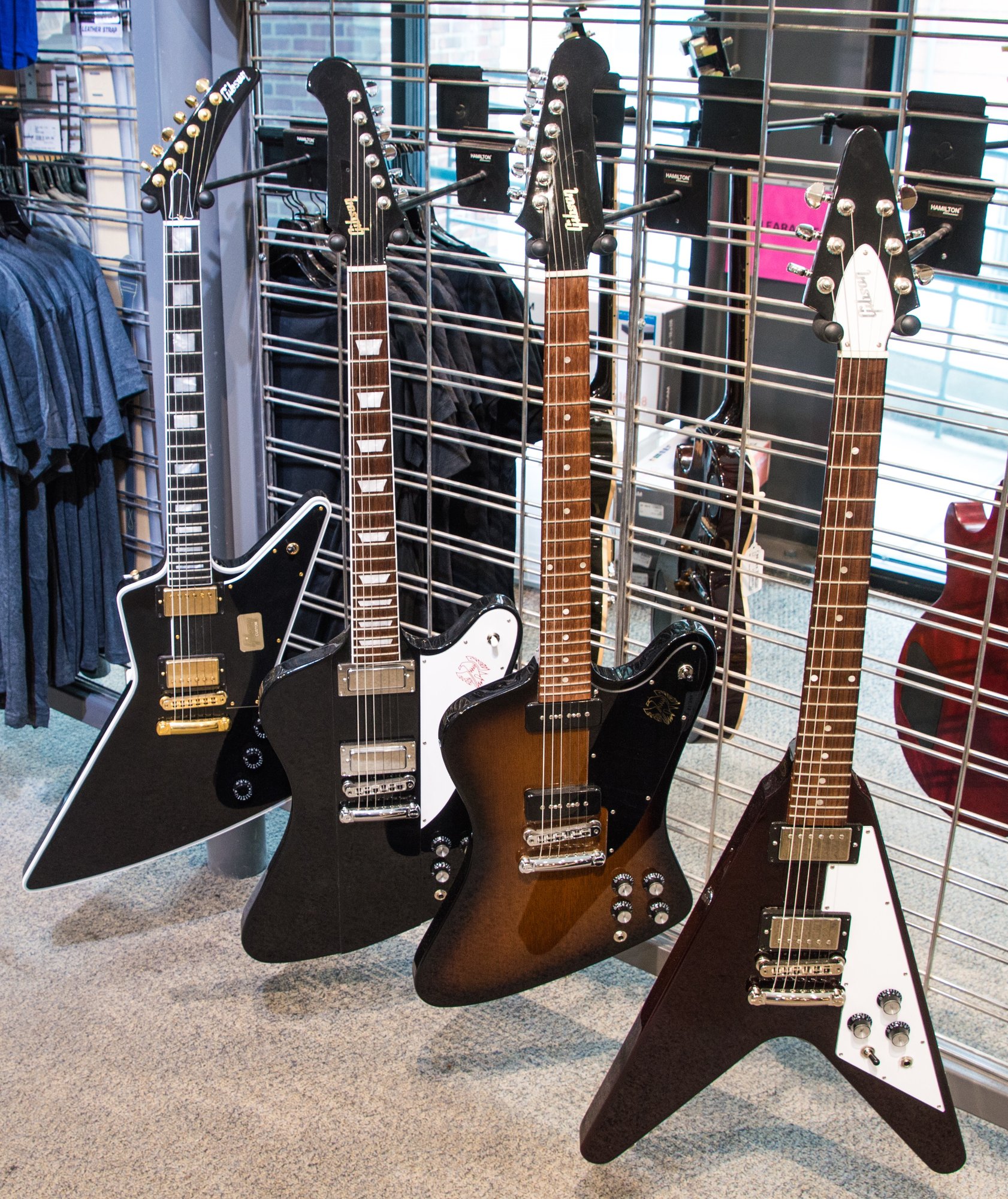
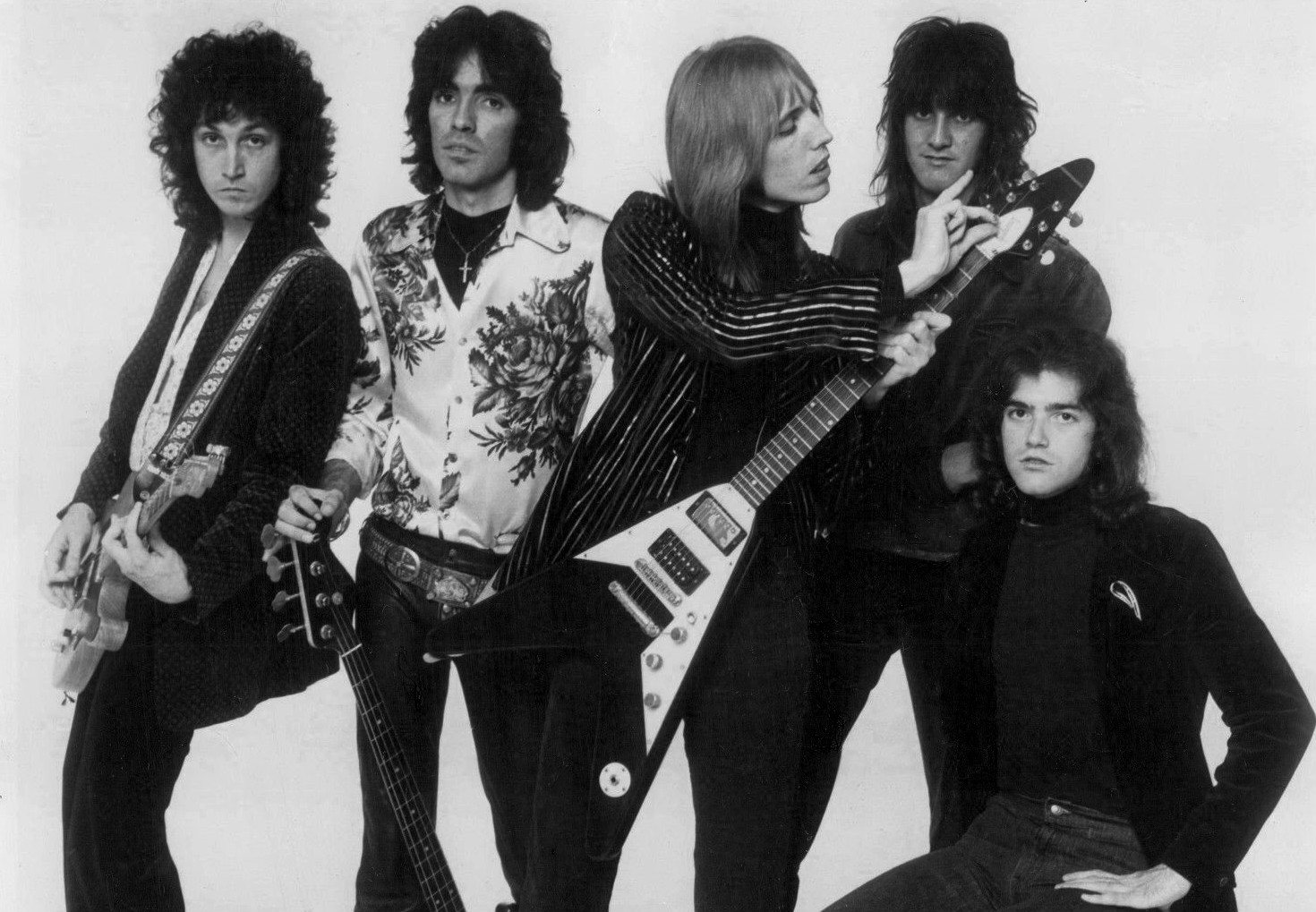
Limited editions keep coming too. Gibson's recent runs include the sold-out Tom Petty Flying V 50th Anniversary, and it has used the V shape for experiments like the DES Ghost Burst series. For other options, our Best Guitars for Metal 2026 guide covers V-shaped guitars from other brands.
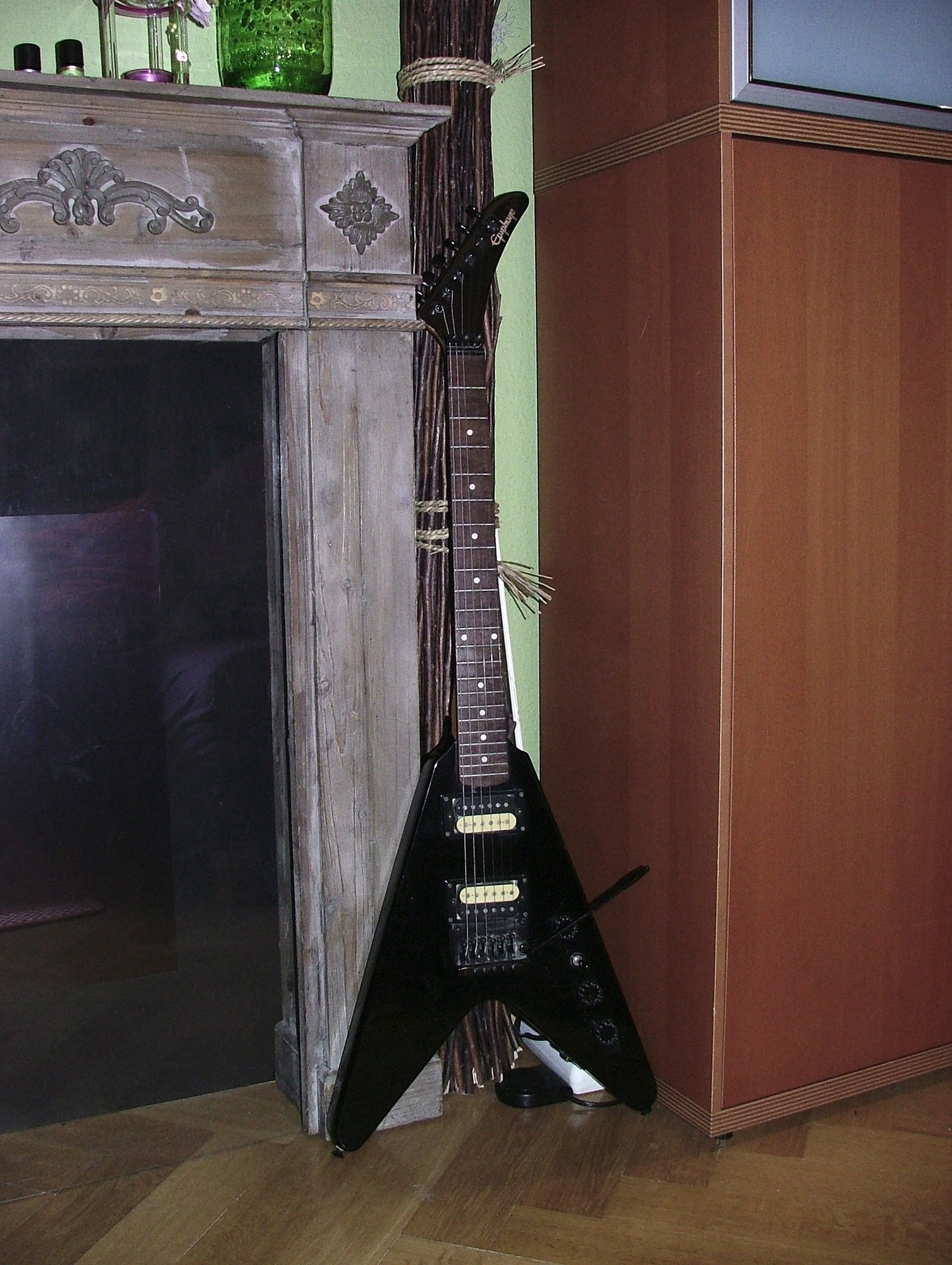
Want to try the shape without spending Gibson money? An Epiphone Flying V is the easiest way to see whether a V suits you. See the Shop this gear block below for Epiphone V models listed on Plugged Gear Co.
Quick buying tips
- Try it on a strap first. Check neck dive and how it sits against your body.
- Check the headstock. Like other Gibsons with angled headstocks, a V can crack if it falls. Look for repairs on used ones.
- Look at the points. The tips of the "wings" pick up dings quickly. Small chips are normal on used Vs and can bring the price down.
- Get the right case. Make sure a used V comes with its case, because replacements cost more than you'd think.
TGP Lessons, powered by Guitar Tricks (affiliate link, clearly labeled) > If you want to learn the riffs that made the V famous, our free Rock Rhythm guide is a good start. For a structured video course, our lessons partner Guitar Tricks offers a 14-day free trial, and our Guitar Tricks review explains what you get. Disclosure: TGP earns a commission if you sign up through this link, at no extra cost to you.
Why the Flying V Won in the End
The Flying V failed in 1958 because it was ahead of its audience. It arrived in a world of jazz, country and dance bands, and Gibson sold fewer than a hundred.
It survived because of the guitarists who chose it anyway. Lonnie Mack and Albert King showed it could sound great. Dave Davies and Hendrix put it in front of a rock audience. Andy Powell, Michael Schenker and K.K. Downing made it the guitar of '70s British hard rock, and Randy Rhoads, Kirk Hammett and a generation of metal players made the V shape part of the genre.
For players today, the takeaway is simple: buy a V for the feel, not just the look. If you play mostly standing up, love the upper frets and want a lighter, more open humbucker sound than a Les Paul, a V might be the best Gibson for you. If you play mostly sitting down, try one for an hour before you decide.
Which Flying V player got you hooked: Albert King, Hendrix, Schenker, K.K. Downing, Hammett, or someone else? Tell us in Guitar Talk.
Shop this gear
- Epiphone Prophecy Flying V, Obsidian Storm SatinCompare prices at Plugged Gear Co.

- Epiphone Prophecy Flying V, Orchid Bloom SatinCompare prices at Plugged Gear Co.

- Fender Tread-Light Wah Pedal — Black with BrownCompare prices at Plugged Gear Co.

Plugged Gear Co. may earn a commission from qualifying purchases.
Experience-driven coverage, not algorithm bait.
- 20+ years of guitar playing experience
- Real-world retail experience at Guitar Center
- Thousands of hours testing guitars, amps, and pedals
- A community of 50,000+ guitar enthusiasts across platforms
- Partnerships with Fender, DistroKid, TrueFire, Card Chords, and Enya
- Editorial standards published openly — see how we test gear
The Modern Guitar Magazine. Delivered to your inbox.
No spam. No gimmicks. Just great guitar content — stories, tones, iconic solos, and honest gear takes. Every week.
Ask GP
3 free questions a dayStill curious? Ask GP about this story.
Your personal classic-rock and guitar guide — ask anything about Gibson Flying V History.
Discussion (0)
Sign in to join the discussion.
Sign in to commentLoading comments…
Discover another guitar story
Swipe through our latest features, breaking news and iconic solos — one story at a time.
Open Swipe →More Guitar News
Lonnie Mack's "Number 7" Just Sold for $550,000. The Man Who Played It Mattered More
Lonnie Mack's 1958 Flying V and Magnatone rig just sold for $550,000. Here's why the man behind "Memphis" and "Wham!" still matters to every lead guitarist.
Gibson's Tom Petty Flying V Marks 50 Years of the Heartbreakers
Gibson is celebrating 50 years of Tom Petty and the Heartbreakers with a 250-piece Flying V in five finishes. Here are the specs, the price, why it's a V, and where to find one.
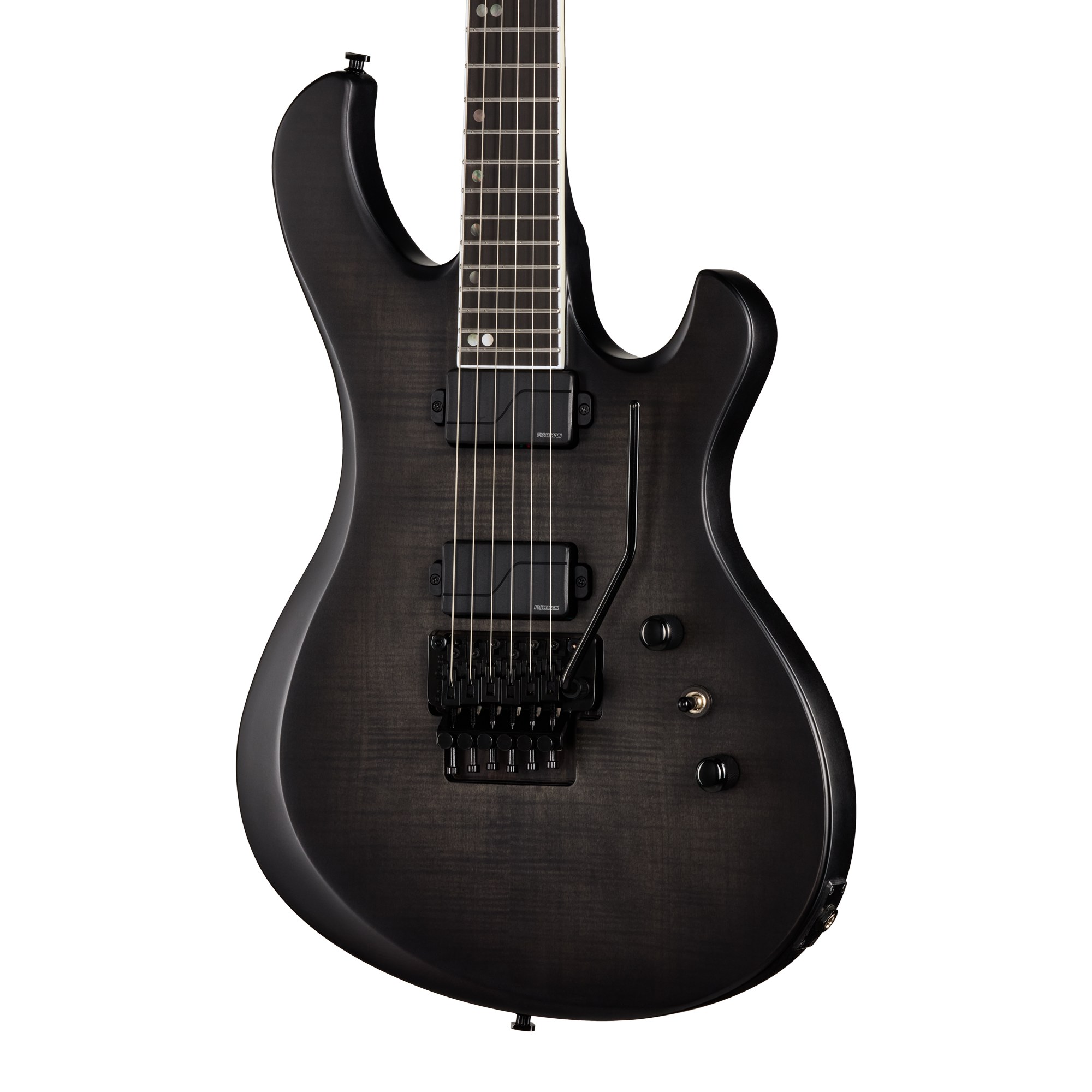
Epiphone Rebuilds the Prophecy Series: First Victory, 27" Les Paul Baritone, Custom Fishman Fluence
Epiphone's rebuilt Prophecy Series adds a first Victory FR and 27" Les Paul Baritone with custom Fishman Fluence pickups at $1,499. Full specs, finishes and who it's for.