
The RAT Started With the Wrong Resistor: The Real ProCo RAT History
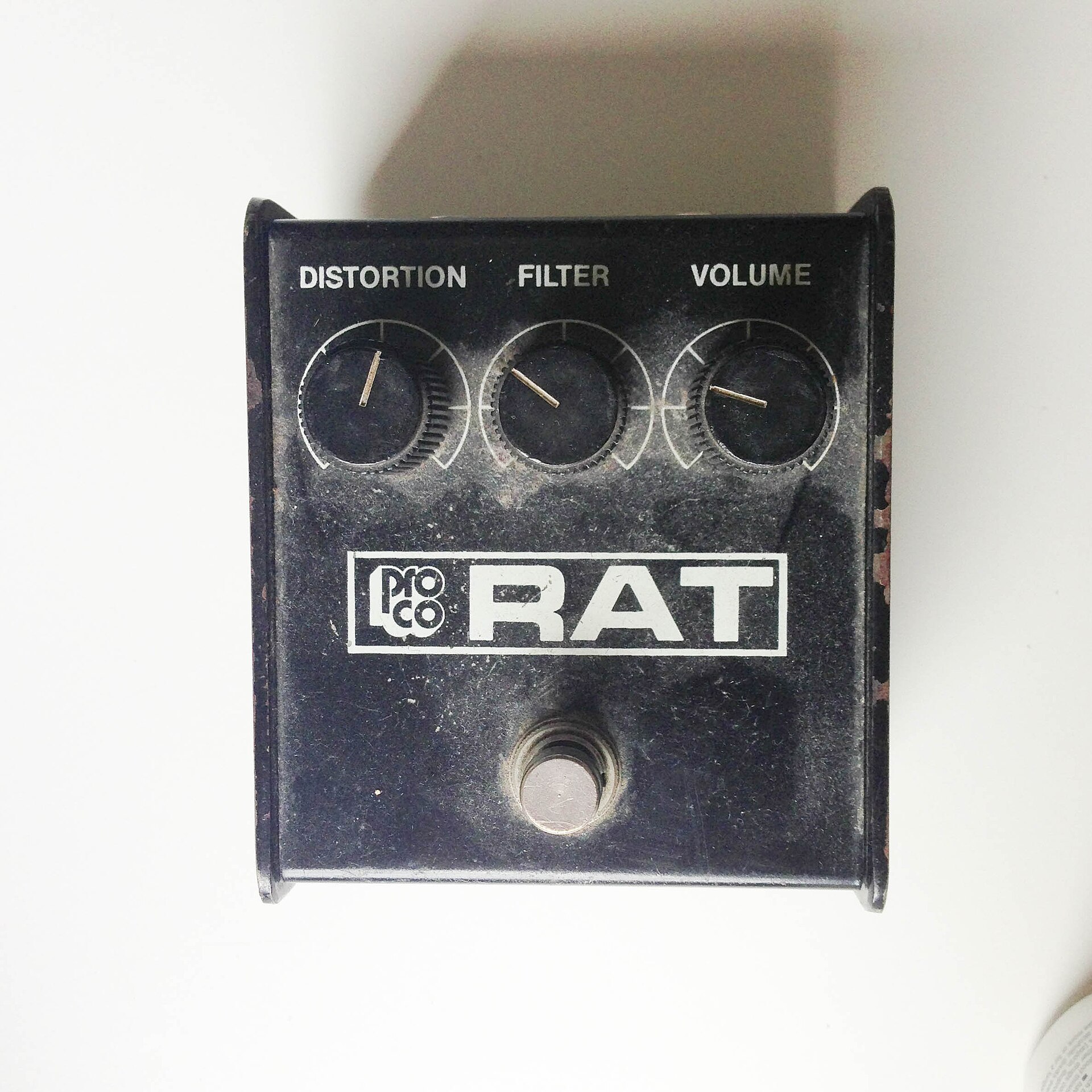
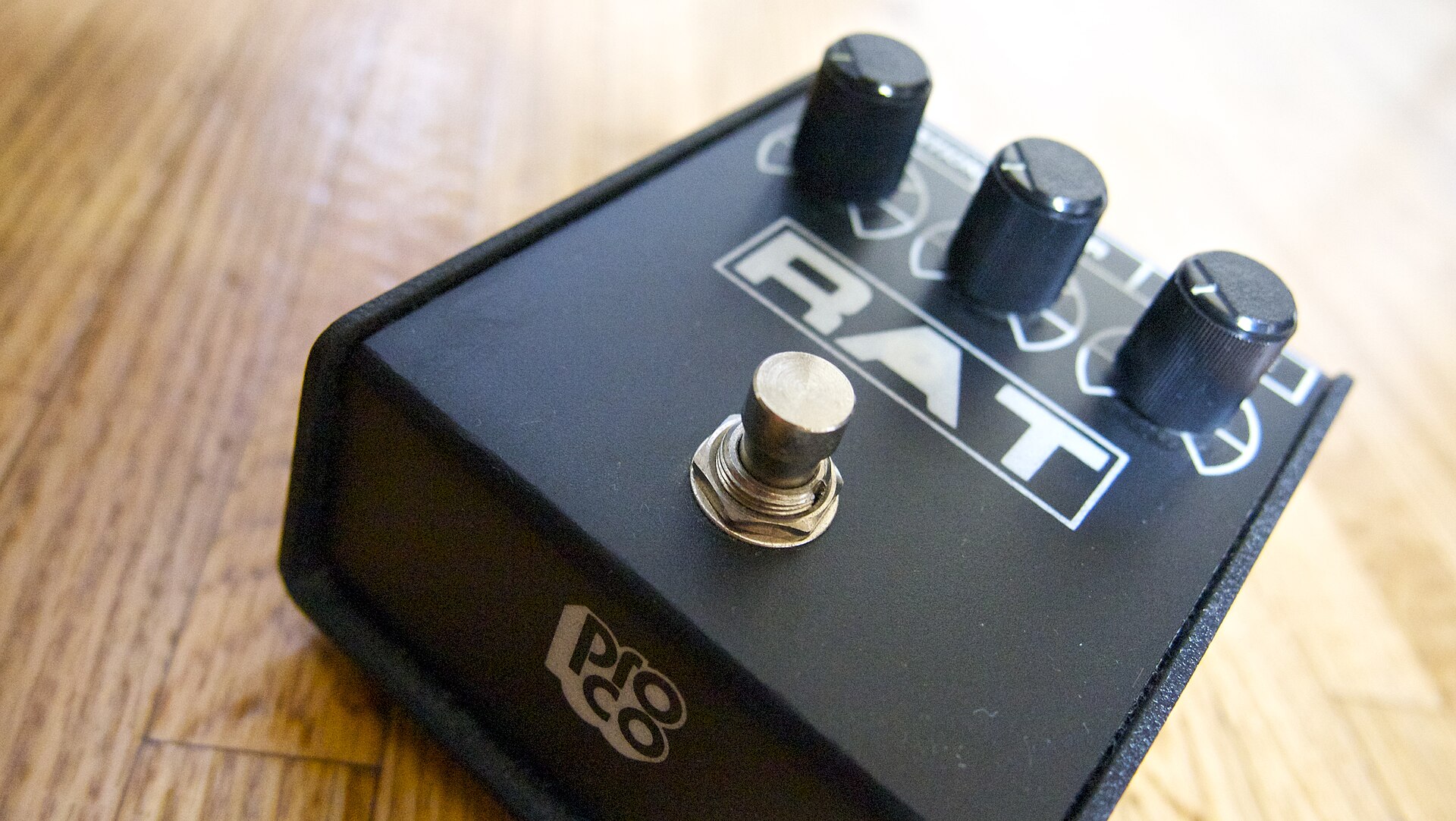
A ProCo RAT distortion pedal: Distortion, Filter, and Volume, the same three controls since 1981. (Illustrative photo.)
CC BY 2.0 (https://creativecommons.org/licenses/by/2.0/). Photo: David Hilowitz from San Antonio, USA / Flickr via Wikimedia Commons. Source: https://commons.wikimedia.org/wiki/File:ProCo_RAT_Distortion_Pedal_(2015-04-21_by_David_Hilowitz).jpg
The ProCo RAT was born from a wrong resistor in a Kalamazoo basement. Here's how it went from 11 hand-built boxes to Beck, Nevermind, and your pedalboard.
The ProCo RAT exists because an engineer in a damp Kalamazoo basement grabbed the wrong resistor. Scott Burnham meant to solder in a 470-ohm part and used a 47-ohm one instead. The op-amp in his homemade distortion circuit suddenly had about ten times the gain it was supposed to, and it started clipping in a way he'd never heard from a pedal.
He kept the mistake. Eleven hand-built boxes later, ProCo Sound put it into production in 1979, and the RAT went on to Jeff Beck's live rig, Kill 'Em All, Nevermind, and a remarkable number of jazz gigs. It is still in production, it still costs less than most boutique overdrives, and its circuit has barely changed since 1981. This is the ProCo RAT history that matters to guitar players: where it came from, why it sounds the way it does, which version is which, and which myths you can stop worrying about.
Kalamazoo, 1974: A Cable Company in a Guitar Town
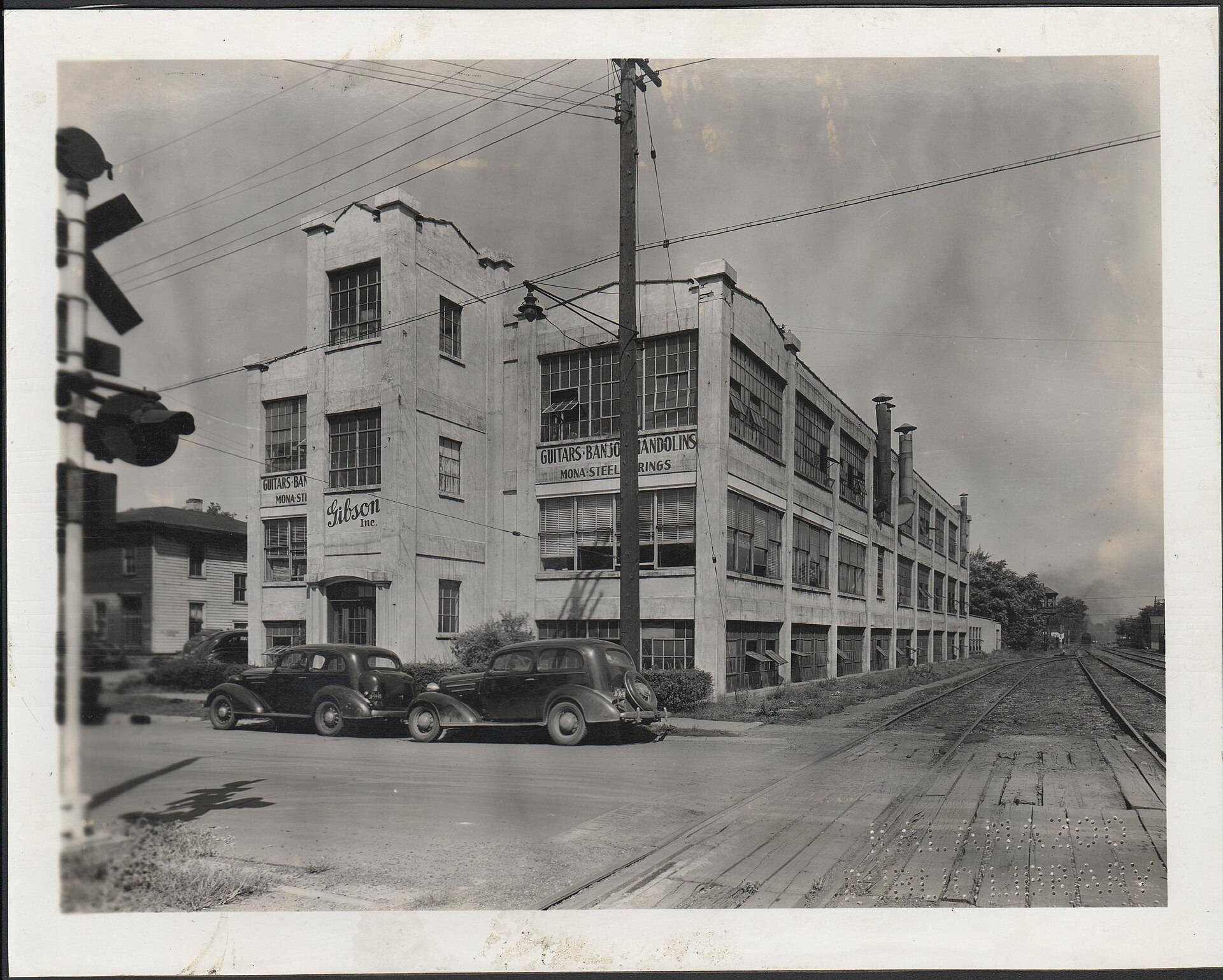
Kalamazoo, Michigan, was already guitar country. Gibson had built instruments on Parsons Street since 1917 and would keep doing so until it closed the Kalamazoo plant in 1984. The town also sat halfway between Chicago and Detroit, so touring bands passed through, and Josh Scott of JHS Pedals points out that the college-town drinking age of 18 kept the club scene busy.
Public domain (per the Commons file page). Photo: Mamie Austin, 1941. Source: https://commons.wikimedia.org/wiki/File:Gibson,_Inc.,_1941_(25934759386).jpg
ProCo Sound came out of a failure. According to Scott's detailed history of the RAT, a local business called the Sound Factory, a cluster of music shops and services under one roof, closed in 1974. The next day Charlie Wicks, who had run the store's retail side, started ProCo Sound Inc. The new company made microphone and guitar cables, stage snakes, and speaker cabinets built in collaboration with Electro-Voice. It built a national reputation on quality and service, and it kept the laid-back, slightly bohemian culture of the Sound Factory days.

CC BY-SA 4.0 (https://creativecommons.org/licenses/by-sa/4.0/). Photo: Brob2104 / Wikimedia Commons. Source: https://commons.wikimedia.org/wiki/File:Kalamazoo_Skyline.jpg
That culture shows up in the job titles. Burnham's official title, per both Scott and The New York Times, was "Hippie in Charge of Technology." Wicks's own nickname, printed on later RAT circuit boards, was "Captain of the Universe."
The Hippie in Charge of Technology
Burnham was a guitarist. He and fellow ProCo engineer Steve Kiraly, known around the shop as "Uncle Steve," had spent years repairing and hot-rodding other companies' fuzz and distortion boxes, and Burnham didn't like what he found inside them.
"There was always a need to get a really good, raunchy distortion sound without it being too loud," he told Scott. "I listened to all of the distortion boxes that were out there and I didn't like any of them, and for some reason I thought, 'Maybe I can do something better.'"
He did that work downstairs. The showroom was on the ground floor, and Burnham's bench was in the basement. "Yes, there were literally rats down there," he told the Times in 2012. "I had started thinking about what would make a killer distortion pedal." His goal, as the Times put it, was a box that captured the sound of a stadium-rock amp cranked to the limit.
Kiraly's exact contribution to the first design isn't fully documented, though he's credited as a co-developer. Scott describes him as a brilliant engineer and problem solver who, unlike Burnham, wasn't a guitarist. His fingerprints are clearer on a later RAT, as you'll see.
The 47-Ohm Accident
Here's what actually happened inside the box. The RAT is built around an op-amp, a tiny integrated-circuit amplifier, set up as a gain stage. A resistor-and-capacitor leg in that stage helps set how much the op-amp amplifies. Burnham's circuit called for 470 ohms there. He installed 47.
That pushed the op-amp far past what it could cleanly deliver, so the chip itself began to distort before the signal ever reached the clipping diodes that follow it. Scott describes the result as an op-amp "run at such a high rate of gain that it distorts before the hard clipping distortion is ever started," which gives the RAT its dense, harmonically rich grind. Burnham told Scott it was a distortion sound he'd literally never heard before.
Author Pagan Kennedy, who wrote the Times piece and later the book Inventology, described the moment more poetically: the machine "began shrieking and moaning," and the sound was "beautiful, haunting, ugly, and full of soul."
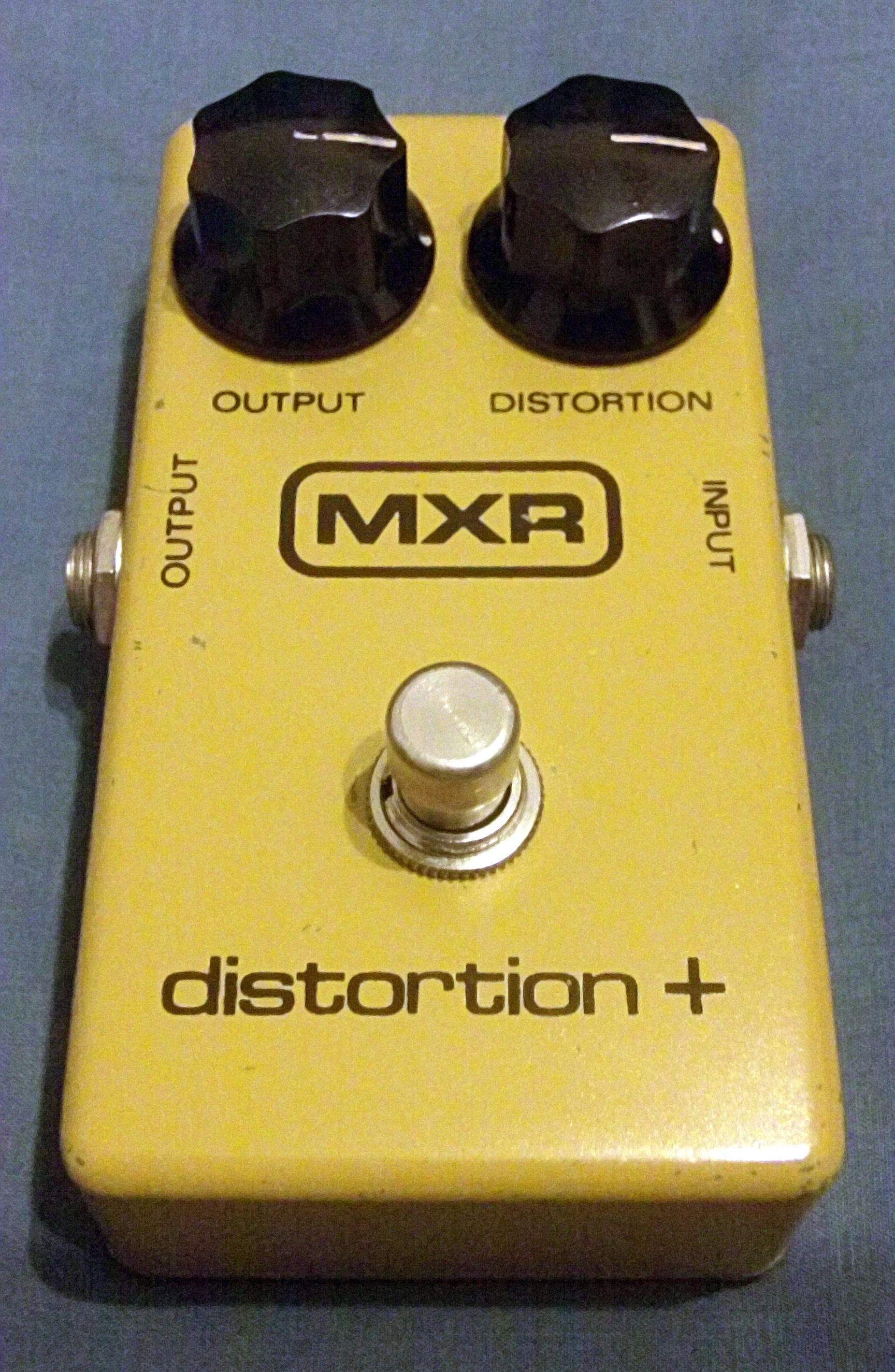
Timing matters here. The mid-to-late 1970s was when hard-clipping distortion first moved into small boxes, with the MXR Distortion+ and the DOD 250 appearing in the same era and the Boss DS-1 arriving in 1978. The RAT wasn't first to that idea. It was the one with an extra layer of op-amp grit and, as it turned out, a far more useful tone control.
CC BY-SA 3.0 (https://creativecommons.org/licenses/by-sa/3.0/). Photo: tpeck111 / Wikimedia Commons. Source: https://commons.wikimedia.org/wiki/File:1979_MXR_Distortion_%2B.jpg
From Bud Box to Big Box
The first RATs weren't a product line. They were custom builds in off-the-shelf Bud Industries project boxes, hand-drilled and finished in black crinkle paint, which is why collectors call them "Bud Box" RATs.
The usual story says Burnham built twelve of them in 1978. Scott, who examined surviving units with collector Dana Osmun, says the real count is twelve circuits in eleven pedals: ten single RATs and one double RAT built for a customer named Tom Taylor. Burnham has also dated a Bud Box loaned to a Kalamazoo museum exhibit to 1977, so the very first one may be older than the legend says. ProCo's own website, for what it's worth, still says twelve.
Those boxes sold well enough, on a made-to-order basis, that Wicks agreed to put the RAT in ProCo's 1979 catalog. The production version moved into a larger wraparound steel enclosure, which is why the earliest production units are now called "Big Box" RATs. A few details from that first year:
- The "Fringe Logo" RAT (early 1979) had a cartoonish rat tail curling off the R and decorative fringe on the lettering. Scott reports that hundreds were labeled with leftover serial-number stickers from the Systech 4001 Flanger, a product from a company that had previously occupied the same building.
- The logo got cleaned up by mid-1979. Scott's interviews with ex-employees suggest this was classic Wicks, who liked to change a product's look on the fly, and that Burnham found the fringe logo childish.
- Knobs changed three times in 1979, from fluted plastic to black metal to the plain black plastic knob with a white line that RAT owners know today.
- The middle knob said "Tone," not "Filter." It brightened the sound as you turned it clockwise.
That last detail is the only real circuit change in the RAT's first decade. Around 1981, ProCo swapped two connections on the tone pot so the knob worked in reverse, darkening the sound as you turn it up, and relabeled it "Filter." The filter itself was unchanged. Scott's best guess is that players complained the pedal was too bright on some rigs. Either way, the circuit you buy in a RAT2 today is essentially the 1981 circuit.
How a RAT Actually Works
You don't need a schematic to use a RAT, but knowing its three stages explains almost every complaint and every compliment the pedal gets.
CC BY 2.0 (https://creativecommons.org/licenses/by/2.0/). Photo: Shunichi Kouroki / Wikimedia Commons. Source: https://commons.wikimedia.org/wiki/File:Proco_RAT2_rear_panel.jpg
1. The op-amp gain stage. The Distortion knob sets how hard the op-amp is pushed. At low settings it's a mild boost. Past about two-thirds, the chip is overdriving itself, which is where the RAT gets its broken-up, almost fuzzy texture. 2. The clipping diodes. A pair of silicon diodes shunts anything above a certain voltage to ground. That's hard clipping, and it's why the RAT sounds more aggressive and less amp-like than a Tube Screamer, which clips inside the op-amp's feedback loop. 3. The Filter. After the clipping, a simple low-pass filter rolls off treble. Fully counterclockwise, almost everything gets through and the pedal is at its brightest. Turn it clockwise and it gets darker and smoother. Wikipedia's write-up, based on Guitar.com's analysis, puts the filter's range down to a cutoff of roughly 500 Hz at full rotation.
Two traits come out of that design. First, the RAT trims low end, so it's midrange-forward. Chris Gill makes the case in Guitar World that this is a feature, not a bug: "tones that sound big in isolation inevitably get lost on stage." Second, the slow original op-amp couldn't amplify the very highest frequencies as much as the rest of the signal, which helps the RAT avoid the fizzy top end of many high-gain boxes.
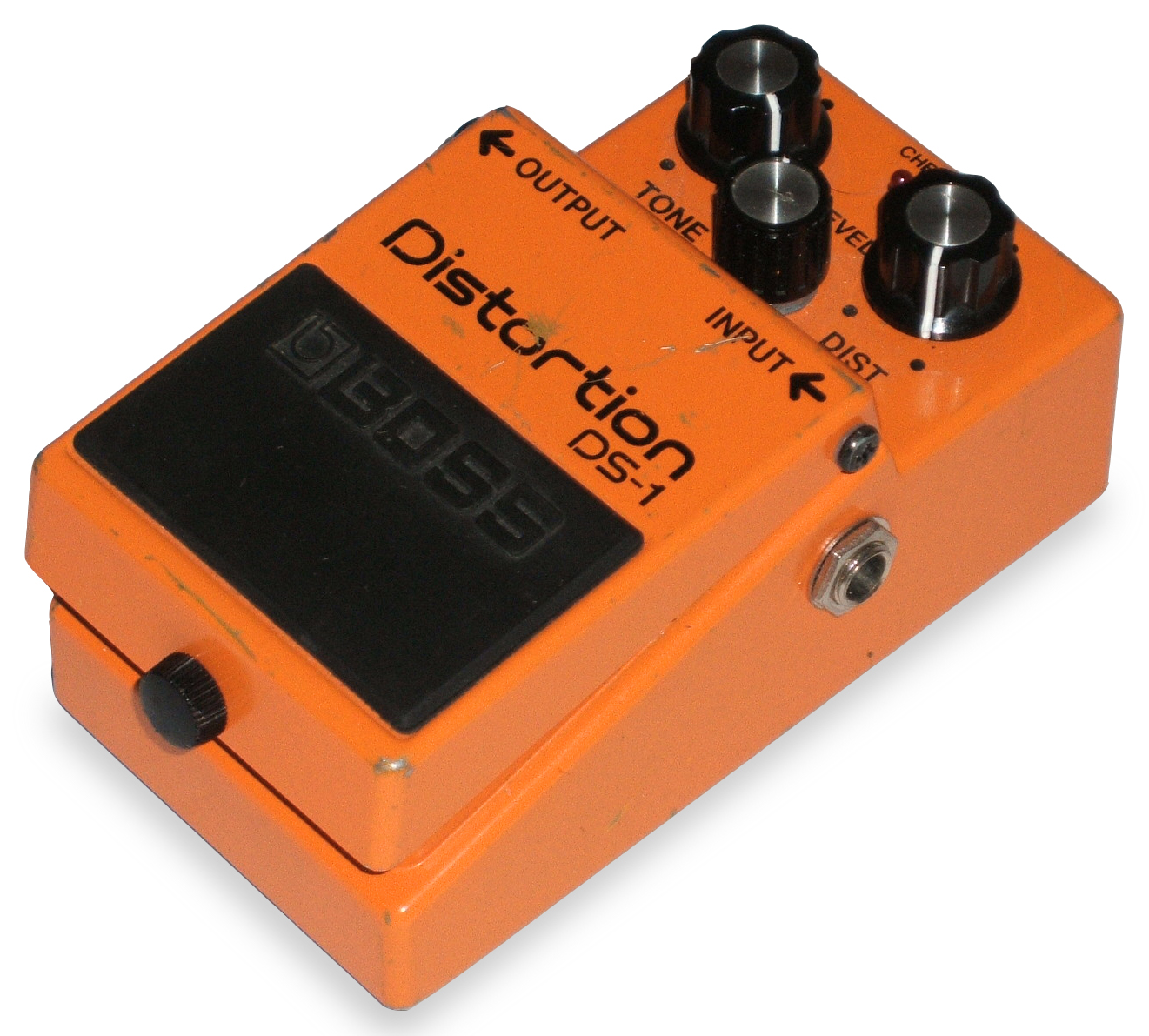
Guitar Player's Dave Hunter notes the RAT and the Boss DS-1 are close relatives on paper, but players hear a difference in how they respond: the DS-1 compresses more as gain goes up, while the RAT stays raw and immediate almost to the end of the dial.
CC BY 2.5 (https://creativecommons.org/licenses/by/2.5/). Photo: Matt Eason / Wikimedia Commons. Source: https://commons.wikimedia.org/wiki/File:Boss-DS-1.jpg
The 1980s: Shrinking to Survive
By the early '80s the Big Box RAT had a problem. Boss, Ibanez, DOD, and MXR were all selling pedals in enclosures about half its size, and Scott writes that RAT sales dropped far enough that the pedal was nearly discontinued.
ProCo's answer in 1984 was a smaller box with a new block logo, white with black text knocked out of it. That's the "White Face" RAT. The white ink smeared and clogged the printing screens, so in 1986 ProCo switched to a thin white outline on a black face, the "Black Face" RAT. Neither change touched the circuit, despite decades of forum arguments that the White Face sounds better.
The real upgrade came in 1988 with the RAT2. It added a status LED, using a switching trick Scott credits to Kiraly that let a standard footswitch also turn an LED on and off. (Scott calls it a design many later pedal builders, himself included, went on to use.) The silkscreened graphics were replaced by a glow-in-the-dark Mylar overlay. Scott Corstange, one of the RAT2's engineers, told Scott how frustrating it was when customers swore the new version sounded different, and joked about "how that LED turning on really changed the signal path."
CC BY 2.0 (https://creativecommons.org/licenses/by/2.0/). Photo: Shunichi Kouroki / Wikimedia Commons. Source: https://commons.wikimedia.org/wiki/File:Proco_RAT2_angled_view.jpg
Jeff Beck, Vernon Reid, and Kill 'Em All
The RAT's 1980s reputation was built by players who could have used anything.
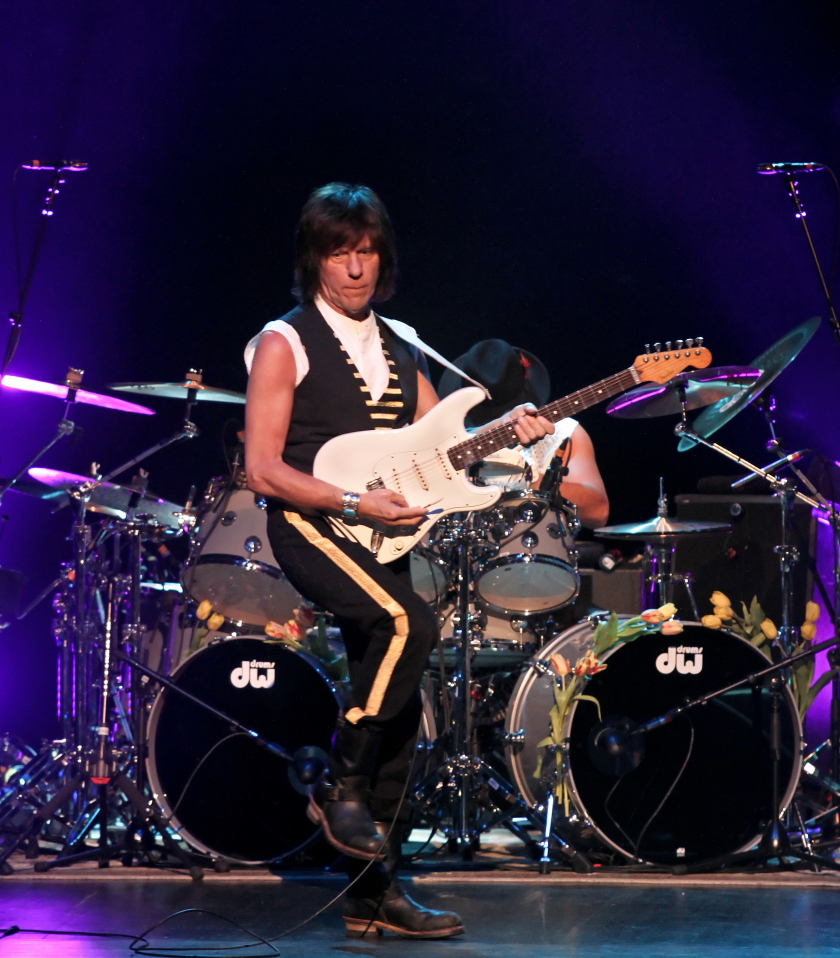
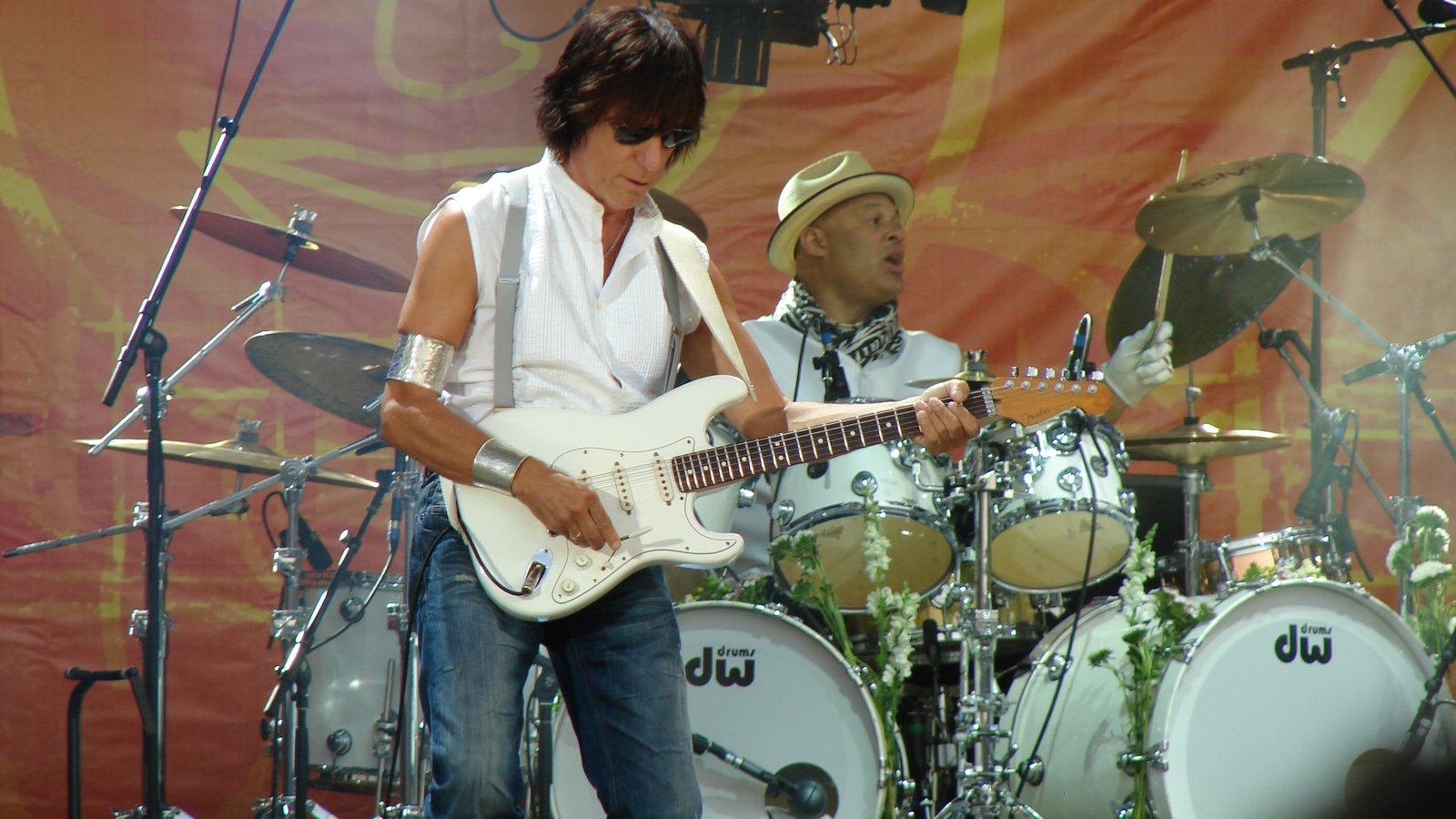
Jeff Beck is the name Burnham cared about most. "The biggest thrill was in 1985, when I saw a picture of Jeff Beck using my pedal," he told the Times. Gill writes that Beck used a RAT live from the mid-'80s until 1999, and on the 1989 album Jeff Beck's Guitar Shop.
CC BY 2.0 (https://creativecommons.org/licenses/by/2.0/). Photo: Craig ONeal / Flickr via Wikimedia Commons. Source: https://commons.wikimedia.org/wiki/File:Jeff_Beck_2011.jpg
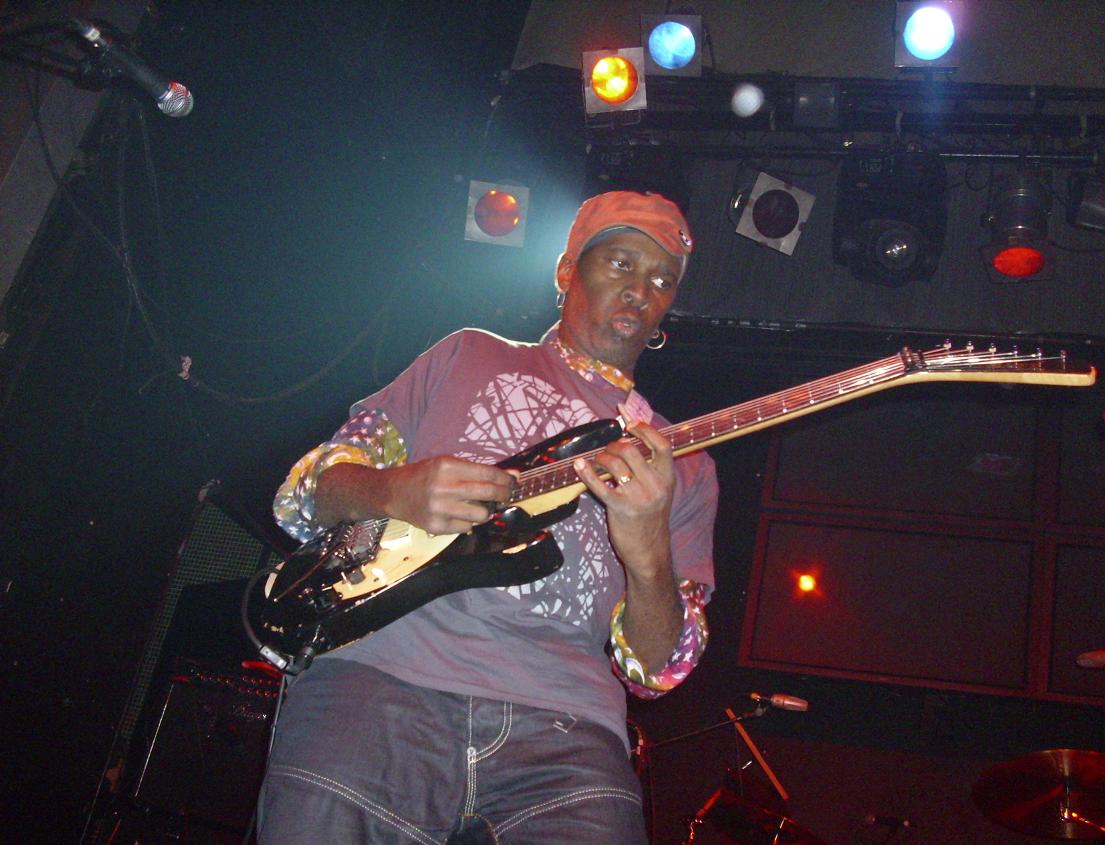
Vernon Reid of Living Colour was a Big Box RAT user. Quoted in Eilon Paz's book Stompbox, Reid remembered the reaction when the pedal hit: "People were freaking out. Hard-rock dudes, metal dudes, funk dudes, everybody. It was insane." He described it as delivering amplifier-like overdrive, but even more extreme, and said it could make a clean Fender amp sound like a Marshall or a Mesa/Boogie. That's the RAT's whole value proposition in one sentence.
CC BY 2.0 (https://creativecommons.org/licenses/by/2.0/). Photo: Mario from Madrid, Spain / Flickr via Wikimedia Commons. Source: https://commons.wikimedia.org/wiki/File:Living_Colour_-_Vernon_Reid_2008_in_Madrid.jpg
On the heavier side, Gill lists James Hetfield using a RAT on Metallica's 1983 debut, Kill 'Em All, and says the pedal became a common sight on hair-metal and thrash pedalboards through the decade. It also crossed into fusion and jazz, which is less obvious and more interesting. John Scofield, Bill Frisell, and Arto Lindsay all appear on Gill's list of RAT players, and the Wikipedia entry notes that Scofield is one of the few known for using its low-gain overdrive settings rather than its full roar.

CC BY 3.0 (https://creativecommons.org/licenses/by/3.0/). Photo: Harald Krichel / Wikimedia Commons. Source: https://commons.wikimedia.org/wiki/File:John_Scofield-8615.jpg
Grape's RATs: The Turbo and Everything After
If Burnham invented the RAT, Gerry Carpenter, known at ProCo as "Grape," spent the next 20 years reinventing it.
In 1989 Carpenter had a problem the standard RAT couldn't solve. He played through an already overdriven Marshall, and a stock RAT just piled on gain and clutter. Inspired by a Craig Anderton article on clipping diodes, he pulled the silicon diodes from a RAT2 and replaced them with two red 5mm LEDs straight from ProCo's parts bins. LEDs clip at a higher voltage, so the pedal had more headroom and output and could work as a loud, open boost with the Distortion knob low. Wicks liked it enough that the TurboRAT was on sale within about six months. It was also the first RAT in the sloped enclosure that every RAT now uses.
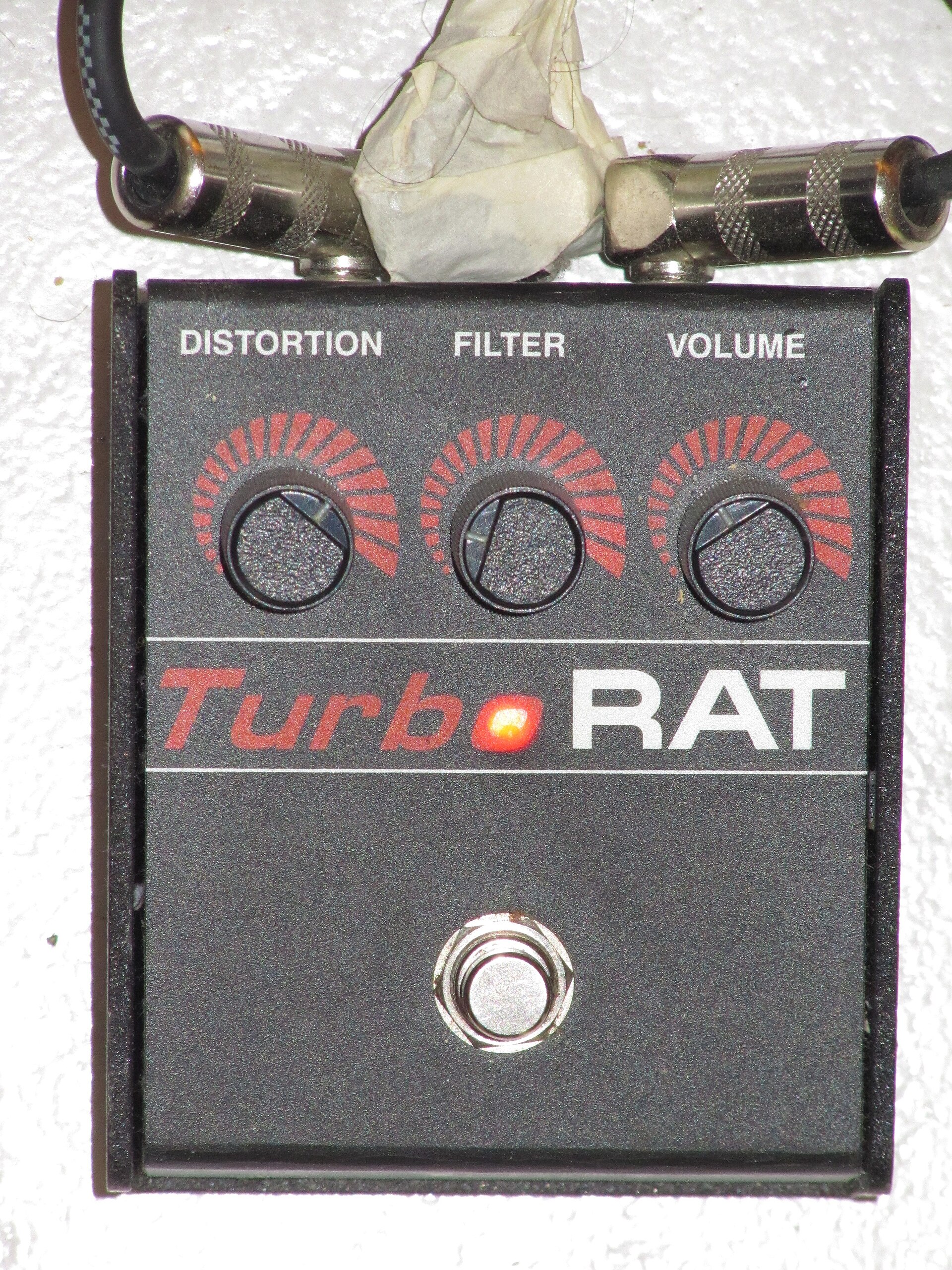
CC BY-SA 3.0 (https://creativecommons.org/licenses/by-sa/3.0/). Photo: Sky99 / Wikimedia Commons. Source: https://commons.wikimedia.org/wiki/File:GuitarEffect_Distorsion_Proco_TurboRat_1207.jpg
Carpenter's other work, by year:
- Vintage Reissue RAT (1991). A Big Box reissue made for the booming vintage market and, according to former employees Scott interviewed, partly to win back Burnham, who had come to dislike the newer versions.
- Roadkill and BRAT (late 1990s). Guitar Center asked for an exclusive RAT that would cost it only $15 per unit. Carpenter designed a plastic-and-PVC enclosure and the most heavily modified RAT circuit to date, adding an input buffer and Tube Screamer-style soft clipping alongside the usual hard clipping. Its knobs were labeled Headlights, Screech, and Splatter. When it sold below expectations, Wicks reused the leftover parts for the hot-pink BRAT.
- Deucetone (2002). Two stackable RAT circuits in one pedal, each with three clipping modes. It grew out of the R2DU, a rackmount double RAT from the late '80s that nobody at ProCo enjoyed building.
- You Dirty RAT (2004). The Deucetone's "Dirty RAT" mode in its own box, using germanium diodes (later Schottky diodes) for a more compressed, saturated sound. It's the opposite of the Turbo.
- Solo RAT (2006). The first four-knob RAT, with a three-way clipping switch and bass and treble controls labeled Scoop and Tone.
After Carpenter's era came the FAT RAT in 2014, which built common RAT mods into the pedal, including a bass-boosting "Fat" switch and a MOSFET clipping option. Its prototype was nicknamed the RAT Bastard. The surface-mount Lil' RAT followed in 2021, putting the RAT2 circuit in a 2-inch enclosure with no battery compartment.
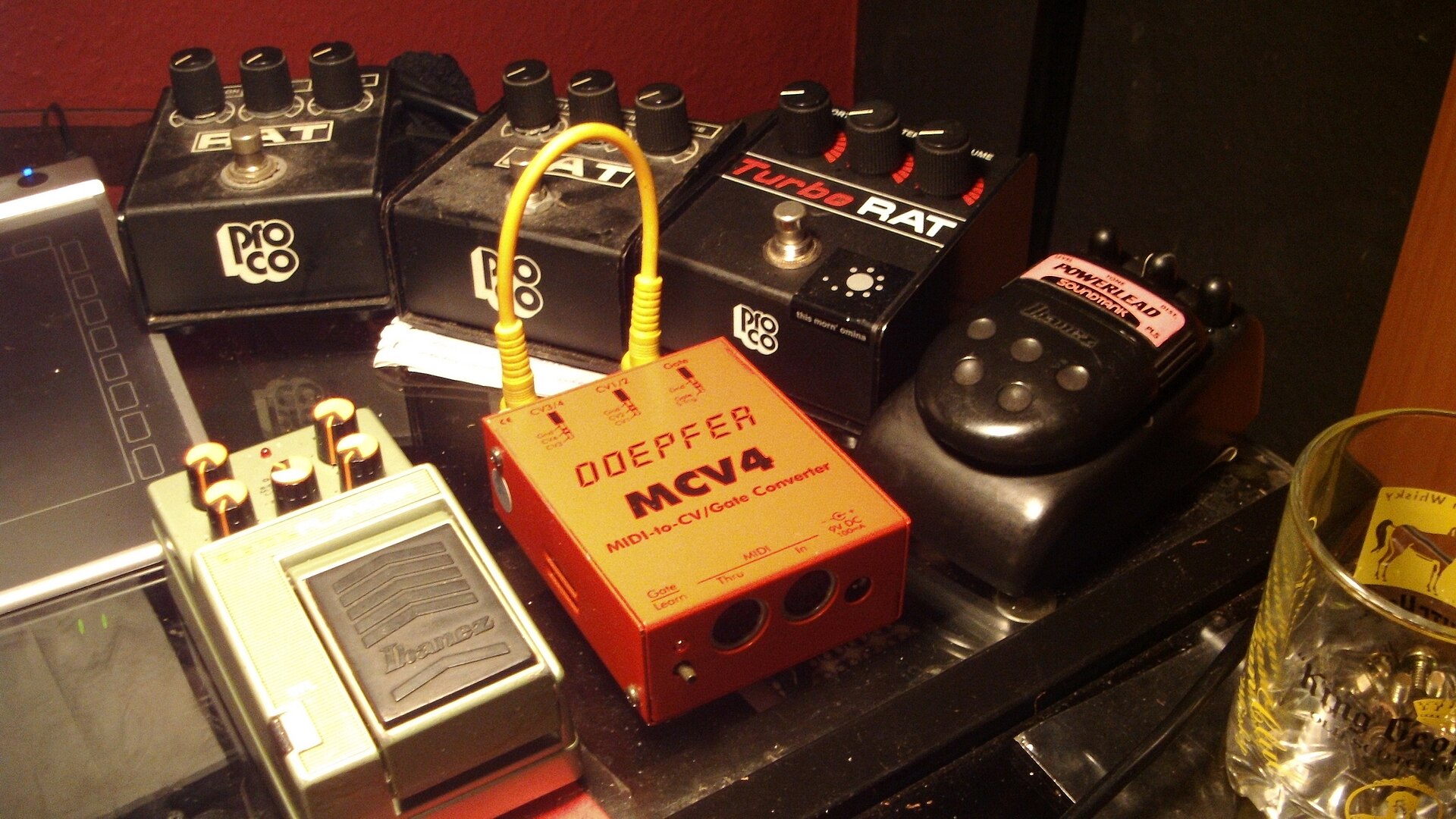
CC BY 2.0 (https://creativecommons.org/licenses/by/2.0/). Photo: Klara Kopf from Essen, Germany / Flickr via Wikimedia Commons. Source: https://commons.wikimedia.org/wiki/File:Stomp_boxes_-_ProCo_RAT_(x2),_ProCo_Turbo_RAT,_Ibanez_SoundTank_PL5_PowerLead,_Ibanez_PowerSeries_unknown,_Doepfer_MCV4_MIDI-to-CV_Gate_Converter_-_Doomsday_Studio_(2013-11-02_23.13.55_by_Klara_Kopf).jpg
Wicks died in 2010, the same year ProCo released a limited reissue of the 1985 White Face using new-old-stock LM308 chips. ProCo was acquired by RapCo soon afterward.
The Underground Years
ProCo's own slogan for the RAT is "The Sound of the Underground," and the '90s earned it.
Gill's list of alternative-era RAT players includes Kurt Cobain on Nevermind, Dave Grohl, Buzz Osborne of the Melvins, Thurston Moore and Kim Gordon of Sonic Youth, Graham Coxon of Blur, Frank Black of the Pixies, and Rivers Cuomo of Weezer. Cobain's documented live distortion was usually a Boss DS-1 and later a DS-2, so the RAT belongs to the Nevermind sessions specifically. That album credit also appears in Jim Berkenstadt and Charles R. Cross's book on the making of Nevermind.
CC BY-SA 4.0 (https://creativecommons.org/licenses/by-sa/4.0/). Photo: Jtcoutts / Wikimedia Commons. Source: https://commons.wikimedia.org/wiki/File:Thurston_Moore_Performing_2014.jpg
Grohl was still using one decades later: his RAT use is documented as late as the Foo Fighters' 2011 album Wasting Light, in Sound on Sound's feature on those sessions. Radiohead's Thom Yorke and Jonny Greenwood both appear in Dave Hunter's Rough Guide to Guitar and on JHS's list of RAT users. And the RAT reached classic-rock royalty too: builder Pete Cornish's documentation of David Gilmour's 1994 Pink Floyd touring rig includes one.
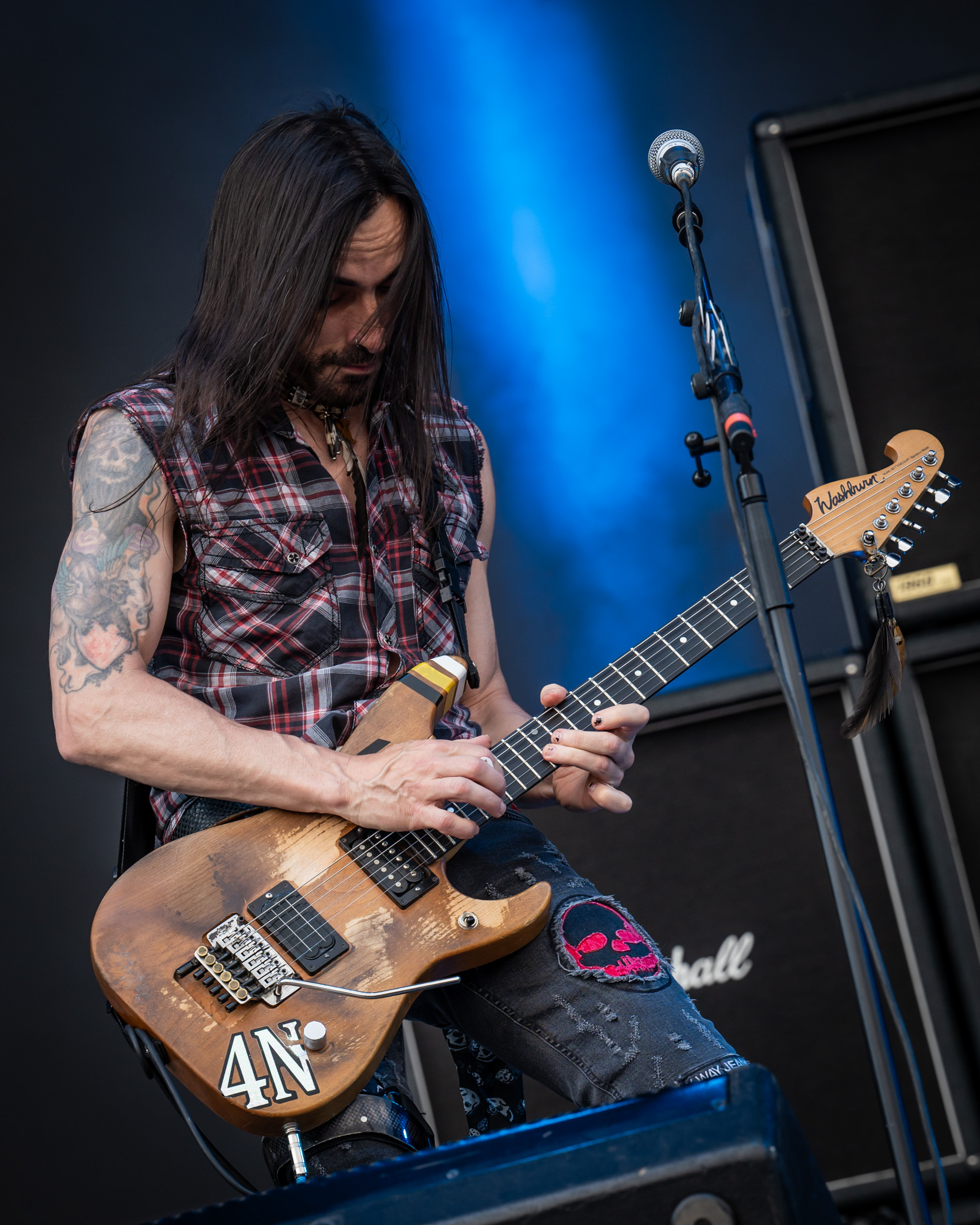
Then there's Nuno Bettencourt, the player who may be the strongest argument for the RAT as a rock lead pedal. As quoted on JHS's RAT history page, Bettencourt said he "can't go without a Rat when playing through any of [his] Marshall amps."
CC BY-SA 4.0 (https://creativecommons.org/licenses/by-sa/4.0/). Photo: SebastyneNet / Wikimedia Commons. Source: https://commons.wikimedia.org/wiki/File:Guitarist_Nuno_Bettencourt_at_South_Park_Festival_in_Tampere,_Finland,_June_2015_photo_03.jpg
RAT Myths You Can Stop Worrying About
The RAT has more folklore attached to it than almost any pedal outside the Klon. Three myths come up constantly.
"A real RAT needs an LM308 chip"
The original RATs used Motorola's LM308 op-amp. Former ProCo employee Bill Eaton told Scott that Texas Instruments declared the part obsolete in 1993, and that Carpenter worked out the replacement, the OP07DP, with RAT2s made after about 1996 using it. Other accounts, including Gill's, put the full changeover closer to 2005, so the exact date depends on who you ask.
What doesn't depend on who you ask is the sound. Scott published response graphs of the two chips in the RAT circuit that overlap almost completely, and argues that the real variable between any two RATs is ordinary parts tolerance in the pots and capacitors, often 5 to 20 percent. His advice is to turn the knobs a little, not to hunt for a chip. He also warns that much of the "new old stock" LM308 supply on the market is counterfeit.
"Tantalum capacitors made the old ones better"
Early RATs used tantalum capacitors. Burnham himself said they made no audible difference. According to Scott, Burnham only used them because he thought it was cool that NASA used them.
"Woodcutter RATs are magic"
Collectors pay extra for RATs carrying the quality-control sticker of a builder nicknamed "Woodcutter." He was real. His name was Doug Fetterolf, he was a schoolteacher who split logs on the side, and the nickname existed because there were several Dougs on the line. Former staff remember him as the fastest builder ProCo ever had. He also wasn't a guitarist, didn't design circuits, and built his RATs from the same parts kits as everyone else. A Woodcutter RAT is a RAT built quickly.
Gill sums up all three myths neatly: "a brand new $90 Rat could actually sound better than a $900 LM308/Woodcutter example."
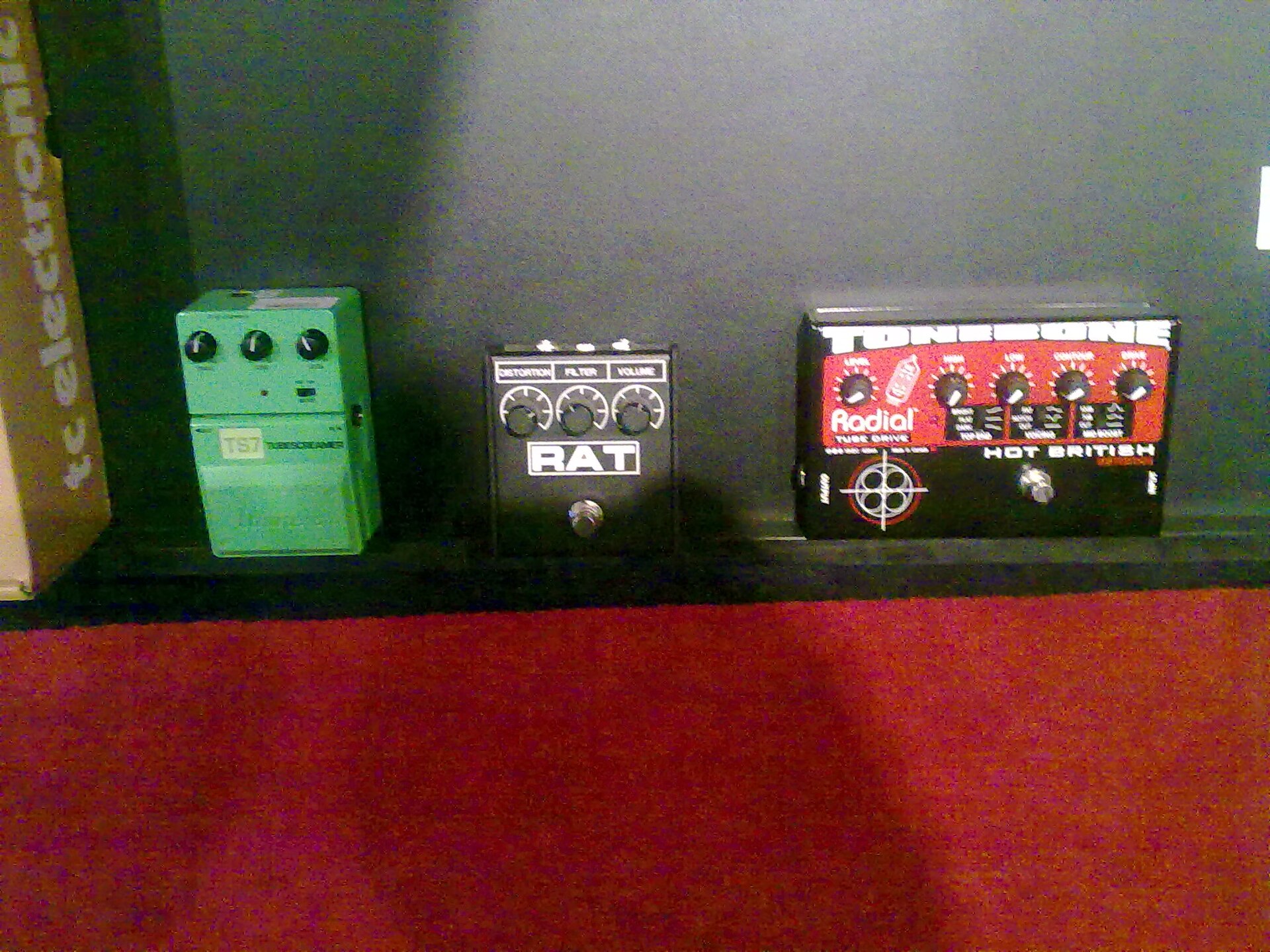
CC BY-SA 2.0 (https://creativecommons.org/licenses/by-sa/2.0/). Photo: Richie Adiyat / Flickr via Wikimedia Commons. Source: https://commons.wikimedia.org/wiki/File:Ibanez,_Proco,_Radial.jpg
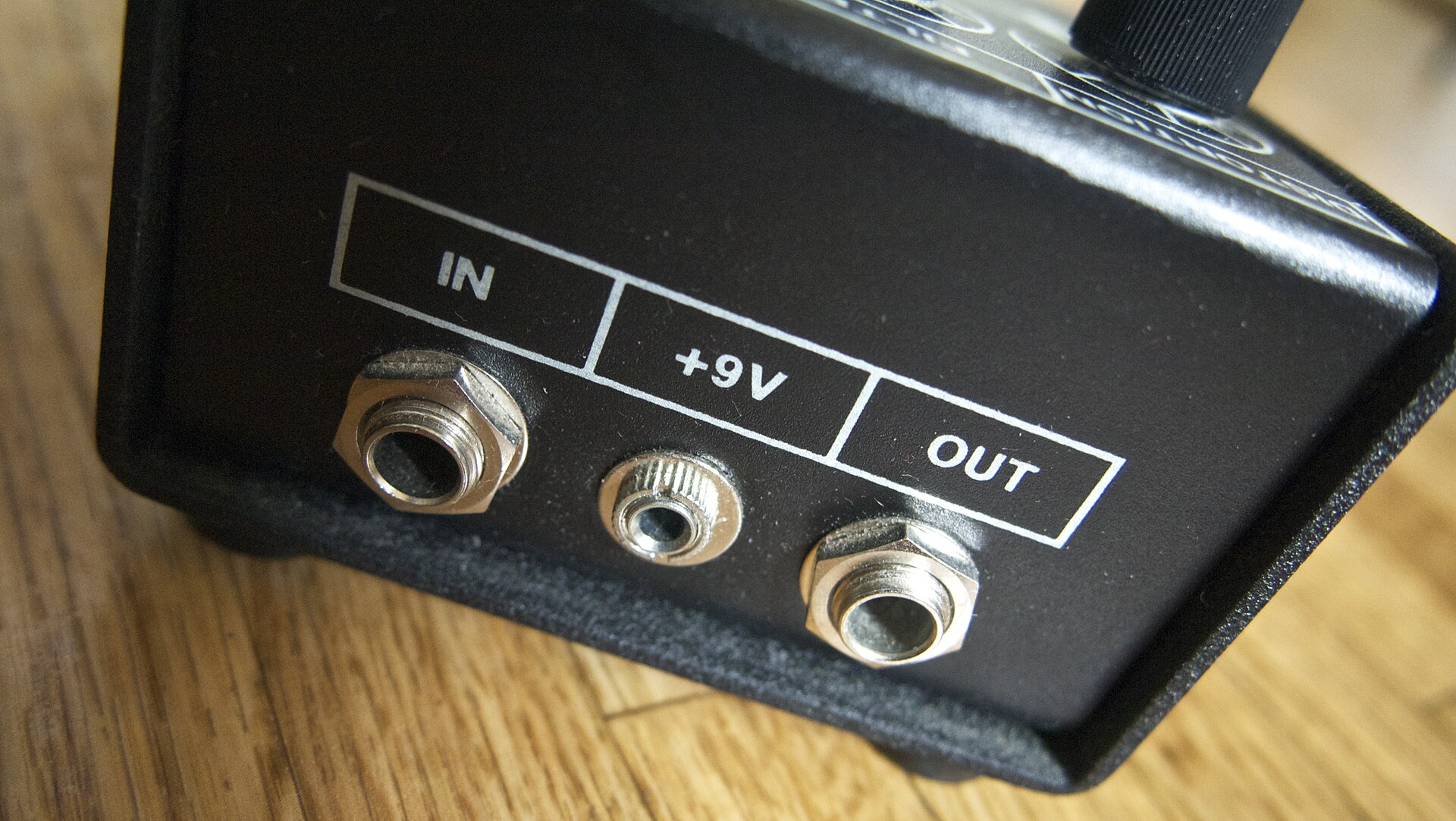
One more change worth knowing about. To keep up with demand, Wicks arranged for parts supplier Neutrik to build the RAT2 at its factory in China, and those units reached the market around 2008 in the sloped enclosure. Scott calls them well built and very hard to tell apart from vintage RATs by ear, with one practical caveat: their pots are prone to breaking during repairs or mods. Other RAT models stayed in U.S. production.
Which RAT Should You Buy?
Every version in this table uses the same basic architecture. The differences are mostly in clipping and features.
| Model | What's different | Best for | ||
|---|---|---|---|---|
| **RAT2** | The standard since 1988: silicon diodes, Filter control, LED | The classic sound, first-time RAT buyers | ||
| **Lil' RAT** | RAT2 circuit in a 2-inch box, surface-mount, no battery | Crowded pedalboards | ||
| **TurboRAT** | LED clipping, more output and headroom | Boosting an amp that's already crunchy, more open chords | ||
| **You Dirty RAT** | Germanium or Schottky clipping, more compression | Saturated leads and fuzzier textures | ||
| **FAT RAT** | Bass-boost switch, selectable clipping including MOSFET | Players who want several RAT flavors in one box | ||
| **Deucetone** | Two stackable RAT channels, each with clipping options | Rhythm and lead dirt from one pedal |
Vintage Big Box, White Face, and Black Face RATs are collector items. Buy one because you love the object, not because you expect a better sound.
The RAT is also among the most copied circuits in the business. Budget and boutique takes include the Mooer Black Secret, TC Electronic Magus Pro, JHS PackRat, Wampler Ratsbane, and ThorpyFX Warthog. A clone makes sense if you want built-in mods or a different footprint. If you just want the RAT sound, the RAT2 is already inexpensive.
Getting a Good Sound From a RAT
These are starting points based on how the circuit works and on the sources above. They aren't TGP test results.
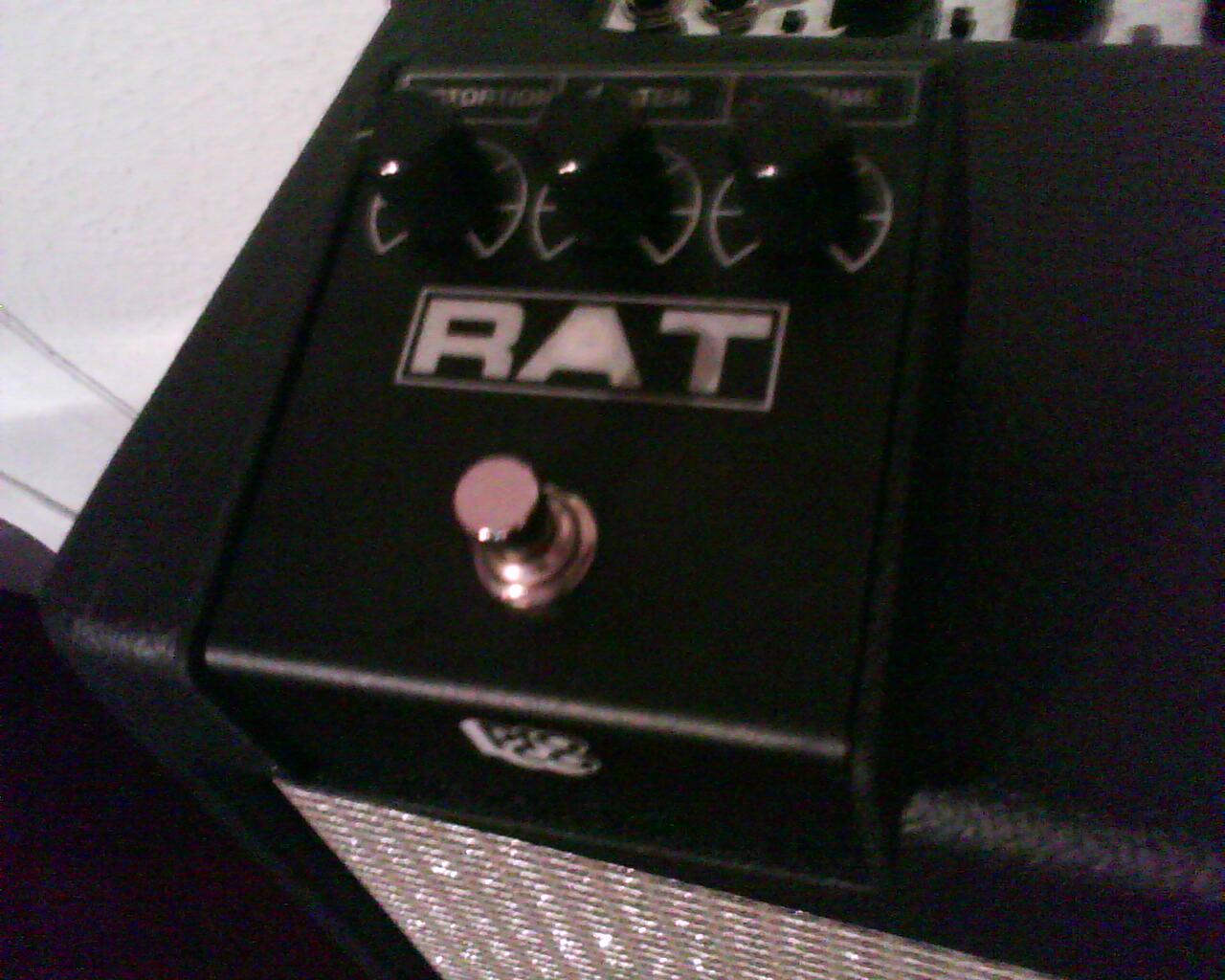
CC BY-SA 3.0 (https://creativecommons.org/licenses/by-sa/3.0/). Photo: Jazzman / Wikimedia Commons. Source: https://commons.wikimedia.org/wiki/File:Proco-rat.jpg
- Remember the Filter is backwards. Zero is brightest. If your RAT sounds harsh, turn the Filter up before you touch your amp's treble. Many players live somewhere between 10 and 2 o'clock.
- Use it as a preamp on a clean amp. That's the Vernon Reid trick. With a clean Fender-style amp, Distortion around halfway and Volume set to taste gives you a stack-like crunch without the stack.
- Watch the gain on an already dirty amp. Carpenter built the TurboRAT because a stock RAT cluttered his cranked Marshall. On a crunchy amp, try Distortion low and Volume high, or consider a Turbo.
- Don't fight the bass cut. The RAT's lean low end is what helps it cut through a band. If you play alone or want more weight, the FAT RAT's Fat switch or a little amp bass makes more sense than chasing a full-range sound from a stock RAT.
- Try the very low end of the Distortion knob. It's the least-used part of the RAT's range, and it's where players like Scofield found a warm overdrive that has nothing to do with metal.
The Takeaway
The ProCo RAT is one of guitar's best accidents. A 47-ohm resistor turned Burnham's experiment into an op-amp that distorts before the diodes even get the signal. A reversed tone pot gave it the Filter knob that makes it usable on almost any rig. And a cable company in Kalamazoo kept it affordable for more than four decades while the circuit barely changed.
If you've never owned one, buy a RAT2, set the Filter around noon, and spend an evening sweeping the Distortion knob from bottom to top. Somewhere along that sweep is an overdrive, a classic distortion, and a fuzz, and that range is why the same pedal could land on Guitar Shop, Kill 'Em All, and Nevermind.
*Is there a RAT on your board, and which version? Tell us in Guitar Talk, and if you're following our pedal history series, read The Ibanez Tube Screamer History next.*
Experience-driven coverage, not algorithm bait.
- 20+ years of guitar playing experience
- Real-world retail experience at Guitar Center
- Thousands of hours testing guitars, amps, and pedals
- A community of 50,000+ guitar enthusiasts across platforms
- Partnerships with Fender, DistroKid, TrueFire, Card Chords, and Enya
- Editorial standards published openly — see how we test gear
Ask GP
3 free questions a dayStill curious? Ask GP about this story.
Your personal classic-rock and guitar guide — ask anything about The RAT Started With the.
Discussion (0)
Sign in to join the discussion.
Sign in to commentLoading comments…
Discover another guitar story
Swipe through our latest features, breaking news and iconic solos — one story at a time.
Open Swipe →More Guitar News
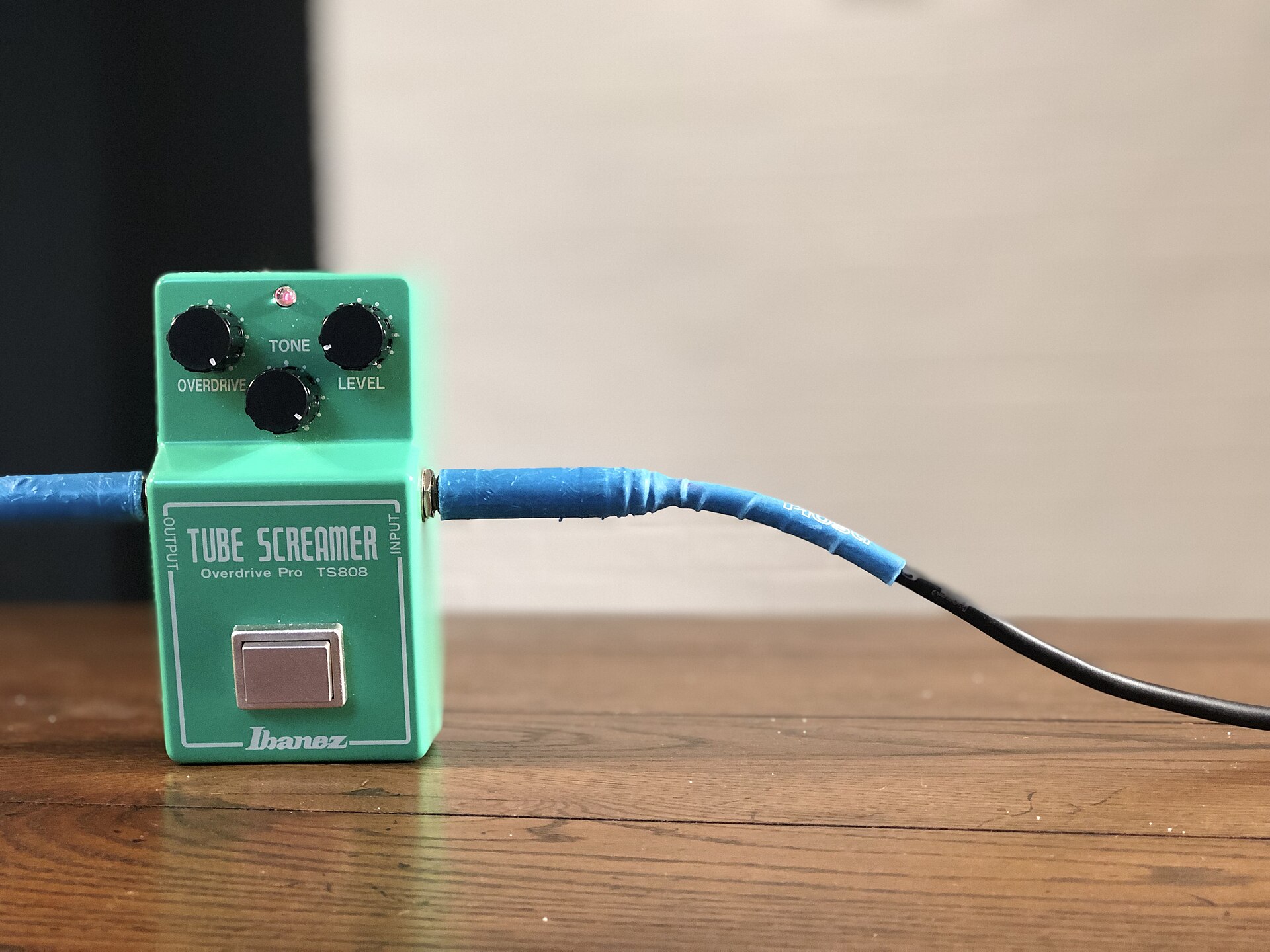
The Ibanez Tube Screamer: How a Little Green Box Built to Compete Became the Pedal Everyone Copies
How a Maxon engineer's answer to the Boss OD-1 became the Ibanez Tube Screamer, why the TS808 vs TS9 debate never ends, and what SRV really used.
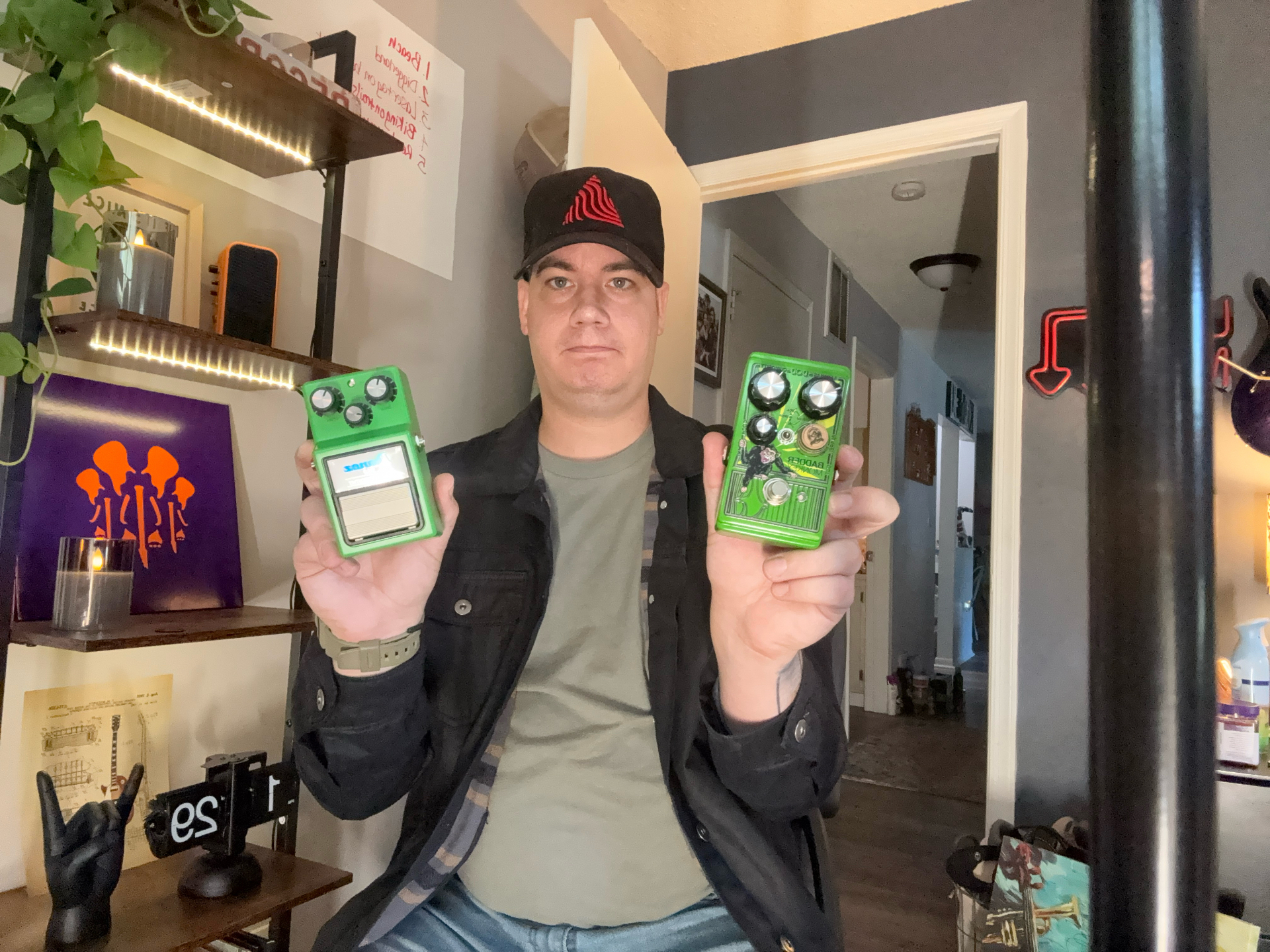
Can the Badder Monkey Beat the Legendary Tube Screamer? I Put Them Head-to-Head
The DOD Badder Monkey takes on the Ibanez Tube Screamer in a head-to-head shootout. Same guitar, same amp, same playing — here's which overdrive actually deserves a spot on your board.
Jeff Beck: The Guitarist Who Never Stopped Reinventing the Electric Guitar
There are guitarists who become famous for a sound. There are guitarists who become famous for a song. And then there are the rare players who seem to spend their entire careers trying to discover sounds the electric guitar wasn't supposed to make. Jeff Beck belonged to that last category.
Tone Decoded: Inside Kurt Cobain's Raw, Basement Grunge Sound
Kurt Cobain's tone wasn't pristine — it was angry, broken, loud, and human. Here's exactly how he built the Nevermind and In Utero sound from cheap Fenders, a Boss DS-1, and pure attitude.

The 10 Best Overdrive Pedals That Actually Sound Like Money
From transparent touch tools to iconic mid-humps and Klon chime, these 10 overdrives under $300 in 2026 punch above their weight with pro tones, tough builds, and real-world value.
Why Nuno Bettencourt Might Be the Most Complete Rock Guitarist Alive
Shred precision, funk groove, pop songwriting instincts, and stadium-sized stage presence — Nuno Bettencourt quietly checks every box. Here's why a new generation is finally putting him in the all-time conversation.