The Guitar Plugged · Guitarist Index
Gary Moore
Thin Lizzy / solo
1969–2011
Blues · Rock · Metal
The most intense vibrato in blues-rock, backed by hard rock firepower.
Main guitar
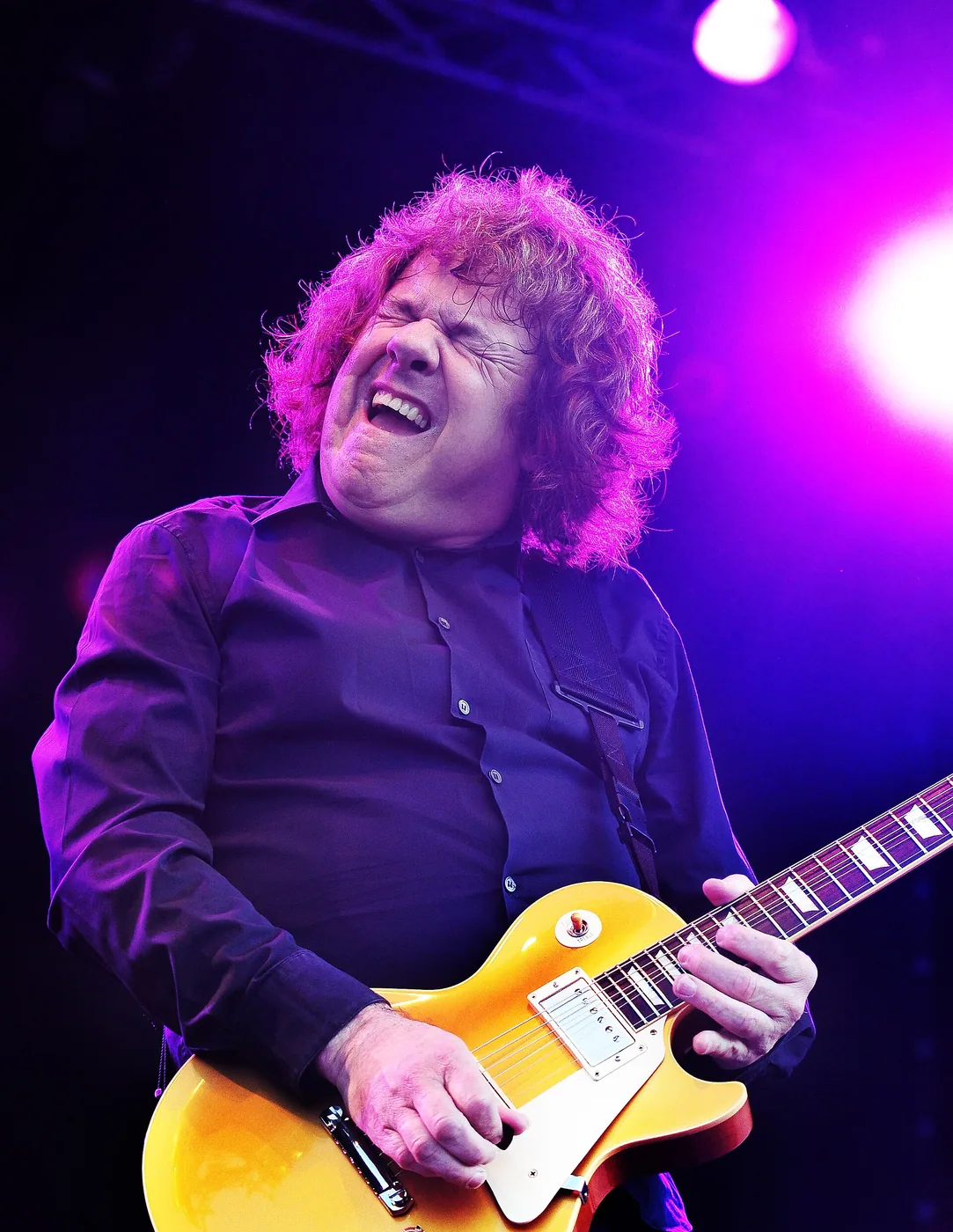
1959 Gibson Les Paul Standard (formerly Peter Green's)
Signature sound
Screaming Les Paul sustain with violent vibrato and a Tube Screamer push
Era
1969–2011
Influence
90 / 100
Genre
Blues / Rock / Metal
Why they matter
The most intense vibrato in blues-rock, backed by hard rock firepower.
Moore had two careers: a hard rock and metal player through the 1970s and '80s, and a blues revivalist from 1990's Still Got the Blues onward. He was excellent at the first and extraordinary at the second, because the aggression he brought from rock made his blues playing physically overwhelming.
His vibrato is the calling card — faster and wider than almost anyone, applied to notes held far past the point where most players would move on. Combined with a Les Paul running into a hot amp, it produces a sound that sits somewhere between a cry and a scream.
He owned Peter Green's 1959 Les Paul, with its famous out-of-phase middle position, for decades. Some of his most distinctive tones come directly from that instrument.
The sound
Screaming Les Paul sustain with violent vibrato and a Tube Screamer push
Still Got the Blues
Fat, sustaining Les Paul neck-pickup lead with an almost orchestral vibrato — the tone that defined blues-rock in the 1990s.
Parisienne Walkways
One note held for what feels like a minute, kept alive by amp feedback and vibrato alone.
Out in the Fields
The hard rock era: bright, aggressive and heavily compressed, closer to a superstrat sound.
The Loner
Wide stereo chorus and long delay wrapped around a mid-heavy lead — the most 1980s tone in his catalogue.
Recreate the sound
Want this tone on your rig?
ToneMD translates Gary Moore's sound into settings for the amp, modeler or plugin you already own.
Prescribe my tonePowered by ToneMD
Style & technique
How you recognise the playing
Extreme vibrato
Wide, fast and deliberate, applied at the top of bends and sustained until the note dies.
Rock attack in blues phrasing
Metal-honed picking force applied to traditional blues vocabulary.
Long sustained bends
Full-step and higher bends held for bars, relying on amp feedback for sustain.
Dynamic extremes
Whisper-quiet passages followed immediately by full volume, used as a compositional device.
The rig
Instruments, amplification and effects
- 1959 Les Paul Standard ('Greeny')
- Fender Stratocaster
- Charvel and Ibanez superstrats (1980s)
- Gibson ES-335
- Marshall JTM45 and Super Lead
- Soldano SLO-100
- Fender Bassman (blues era)
- Ibanez Tube Screamer
- Boss Chorus
- Roland Space Echo
- Marshall Guv'nor
- Gibson PAFs — the 'Greeny' neck pickup famously reverse-wound
Essential listening
Where to start
- 011978
Parisienne Walkways
Gary Moore · Back on the Streets
- 021987
The Loner
Gary Moore · Wild Frontier
- 031985
Out in the Fields
Gary Moore with Phil Lynott · Run for Cover
- 041990
Still Got the Blues
Gary Moore · Still Got the Blues
- 051990
Oh Pretty Woman
Gary Moore with Albert King · Still Got the Blues
Career landmarks
The moments that mattered
1990
Still Got the Blues, 1990
A hard rock guitarist's blues album that outsold everything else he ever did and revived his career.
'Parisienne Walkways' sustained note
A live moment that became the benchmark for controlled feedback sustain.
Owning 'Greeny'
Custodian of one of the most storied Les Pauls in existence, later sold to Kirk Hammett.
The legacy
Lineage
Influenced by
Influenced
Adjacent players
More from the archive
The player who turned amplifier noise into a musical language.
The virtuoso who rewrote the vocabulary of rock guitar.
Session-hardened producer who built rock guitar as an architecture, not a solo.
The player who translated Chicago blues into British rock volume.
The restless technician who kept reinventing what an electric guitar could be.
The master of the long note — space, sustain and perfect note choice.