
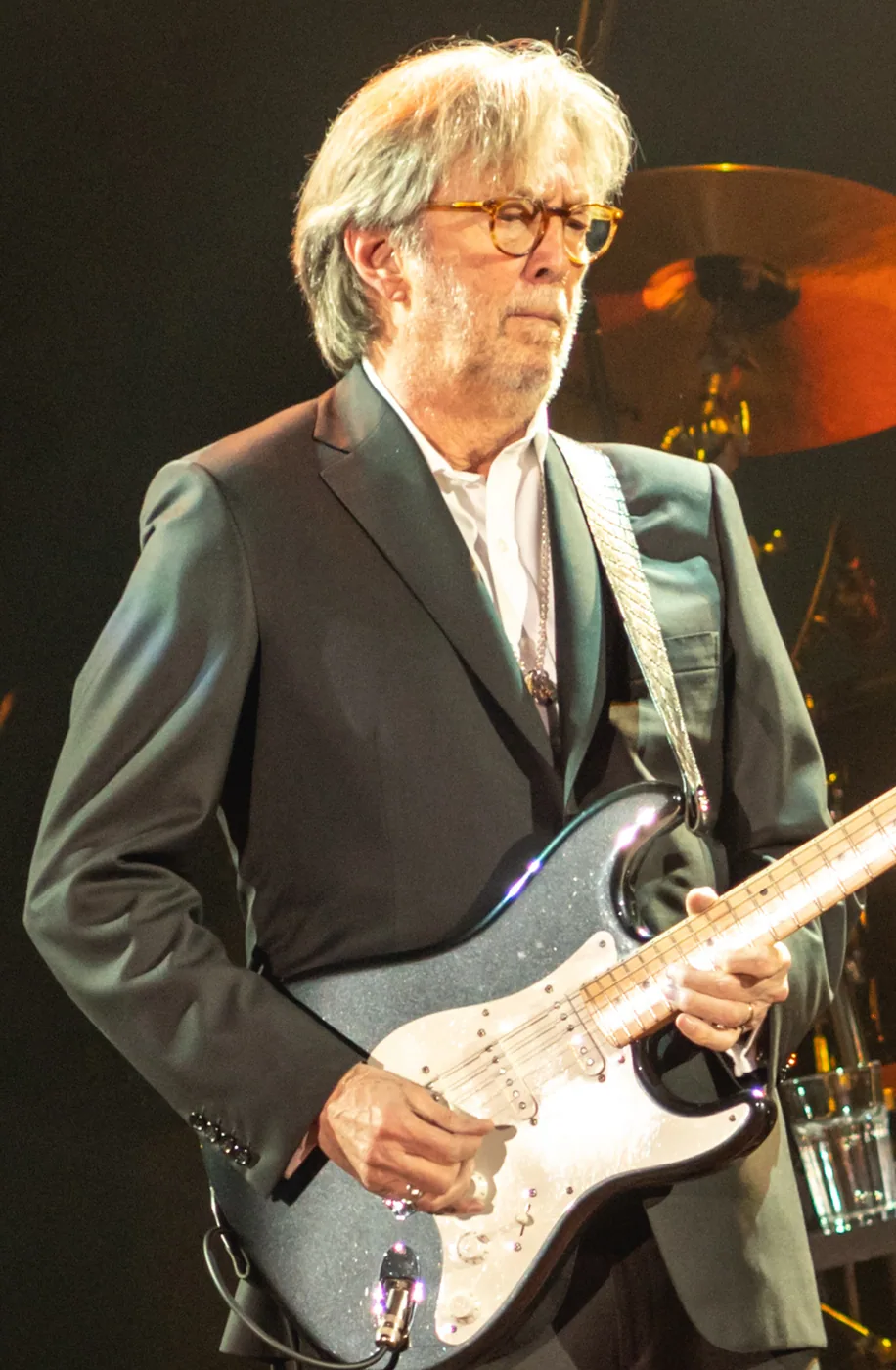
The Guitar Plugged · Guitarist Index
Eric Clapton
Cream / Derek and the Dominos / solo
1963–present
Blues · Rock
The player who translated Chicago blues into British rock volume.
Main guitar
Fender Stratocaster ('Blackie'); previously a 1960 Les Paul Standard
Signature sound
The 'woman tone' — neck pickup, tone rolled off, driven Marshall — and later a clean Strat bite
Era
1963–present
Influence
96 / 100
Genre
Blues / Rock
Why they matter
The player who translated Chicago blues into British rock volume.
Clapton's importance is partly historical and partly sonic. With John Mayall's Bluesbreakers in 1966 he plugged a Les Paul into a cranked Marshall combo and produced a sound that had effectively not existed before: sustaining, vocal, distorted but articulate. British guitar shops sold out of Les Pauls, and modern rock lead tone starts there.
In Cream he pushed the same voice into extended improvisation; in Derek and the Dominos he sharpened it against Duane Allman's slide; as a solo artist he moved toward restraint, Stratocasters and song-first playing that some fans consider a retreat and others consider maturity.
The through-line is phrasing. Clapton plays fewer notes than almost any of his contemporaries and lands harder because of it.
The sound
The 'woman tone' — neck pickup, tone rolled off, driven Marshall — and later a clean Strat bite
Hideaway (Bluesbreakers)
The original 'Beano' tone: Les Paul into a small Marshall combat volume — the birth certificate of British blues-rock lead.
Sunshine of Your Love
Woman tone in full effect — dark, sustaining and almost saxophone-like against Cream's power trio churn.
Layla
Multiple layered Strat and Les Paul tracks with Duane Allman's slide woven in; the interlocking riff is a two-guitar arrangement, not one part.
Wonderful Tonight
Clean Strat, neck-and-middle position, minimal drive — proof that his phrasing carries the sound rather than the gain.
Recreate the sound
Want this tone on your rig?
ToneMD translates Eric Clapton's sound into settings for the amp, modeler or plugin you already own.
Prescribe my tonePowered by ToneMD
Style & technique
How you recognise the playing
Vocal bending and vibrato
Wide, slow vibrato applied at the top of a bend — the signature that made him identifiable within a single note.
'Woman tone'
Neck humbucker with the tone control rolled fully off, producing a dark, hornlike lead voice.
Economy of phrasing
Deliberate space between phrases so each line reads as a sentence rather than a run.
Blues vocabulary played with rock volume
Traditional Chicago licks amplified past their original context and given sustain.
The rig
Instruments, amplification and effects
- 1960 Gibson Les Paul Standard (Bluesbreakers)
- Gibson SG 'The Fool' (Cream)
- Fender Stratocaster 'Blackie'
- Martin 000-42 (Unplugged)
- Marshall JTM45 combo
- Fender Twin / Dual Showman
- Music Man HD-130
- Fender Tweed Twin reissue
- Vox wah
- Leslie cabinet (Cream era)
- Dallas Rangemaster-style treble boost (early)
- Gibson PAF humbuckers (1960s)
- Fender Lace Sensors in later Strats
- Boost from the amp rather than pedals for most of his career
Essential listening
Where to start
- 011966
Hideaway
John Mayall's Bluesbreakers with Eric Clapton · Blues Breakers
- 021967
Sunshine of Your Love
Cream · Disraeli Gears
- 031968
Crossroads (live)
Cream · Wheels of Fire
- 041970
Layla
Derek and the Dominos · Layla and Other Assorted Love Songs
- 051977
Wonderful Tonight
Eric Clapton · Slowhand
- 061992
Tears in Heaven
Eric Clapton · Unplugged
Career landmarks
The moments that mattered
1966
The 'Beano' album, 1966
The recording that established the Les Paul / Marshall pairing as the standard rock lead rig.
Cream's 'Crossroads' live solo
A masterclass in building an improvisation across two choruses without wasting a bar.
1992
Unplugged, 1992
Reframed acoustic blues for a mainstream audience and sold tens of millions of copies.
The legacy
Lineage
Influenced by
Adjacent players
More from the archive
The player who turned amplifier noise into a musical language.
The virtuoso who rewrote the vocabulary of rock guitar.
Session-hardened producer who built rock guitar as an architecture, not a solo.
The restless technician who kept reinventing what an electric guitar could be.
The master of the long note — space, sustain and perfect note choice.
The Texas force of nature who dragged the blues back into the mainstream.