
The Guitar Plugged · Guitarist Index
Stevie Ray Vaughan
Double Trouble
1975–1990
Blues · Rock
The Texas force of nature who dragged the blues back into the mainstream.
Main guitar
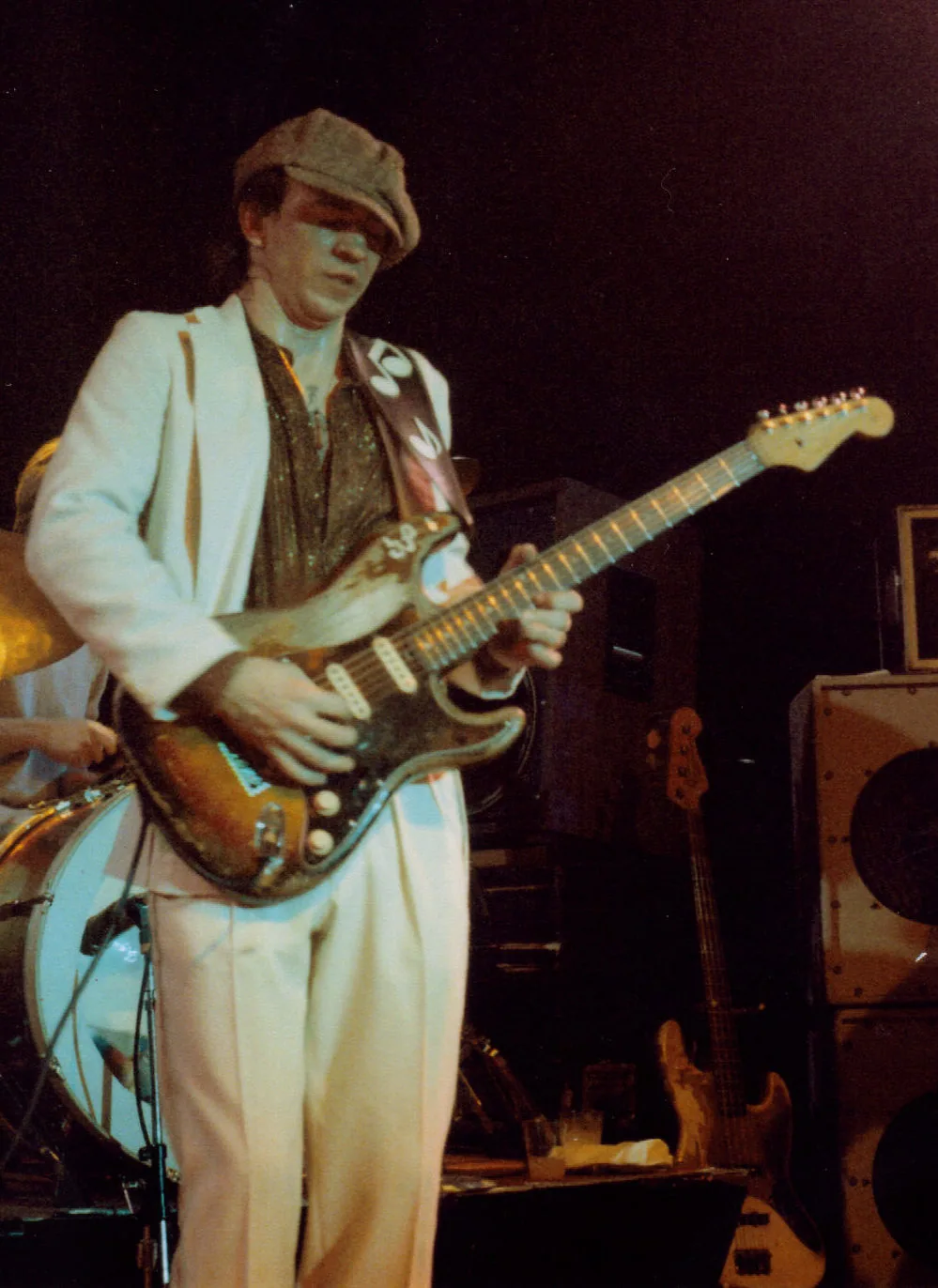
1962/63 Fender Stratocaster hybrid ('Number One')
Signature sound
Heavy strings, Tube Screamer into loud Fender and Marshall amps, massive attack
Era
1975–1990
Influence
95 / 100
Genre
Blues / Rock
Why they matter
The Texas force of nature who dragged the blues back into the mainstream.
When Texas Flood arrived in 1983, the blues was commercially dormant. Vaughan revived it by force: enormous string gauges, a right hand that hit the strings harder than almost anyone on record, and amps set loud enough that the tone was 60% physics and 40% equipment.
His playing was a synthesis rather than an invention — Albert King's bends, Hendrix's rhythm-lead blur, Lonnie Mack's aggression — but the combination was overwhelming, and the seven years of his major-label career produced a body of work that every blues-rock guitarist since has had to reckon with.
He died in a helicopter crash in 1990, four albums into a career that had only just found its sober, disciplined second act on In Step.
The sound
Heavy strings, Tube Screamer into loud Fender and Marshall amps, massive attack
Texas Flood
Almost no pedals — a Vibroverb pushed hard, with all the grit coming from string gauge and attack.
Pride and Joy
The shuffle tone: bridge-and-middle Strat position, slight Tube Screamer push, and a right hand doing double duty.
Little Wing
Clean-to-edge tone with a Univibe wash; the Hendrix arrangement recast with a heavier, wider low end.
Riviera Paradise
Neck pickup, clean Dumble-style headroom, played at conversational volume — the counterexample to his loud reputation.
Tightrope
The In Step-era sound: tighter, less scooped, with the Tube Screamer used as a mid-boost rather than a distortion.
Recreate the sound
Want this tone on your rig?
ToneMD translates Stevie Ray Vaughan's sound into settings for the amp, modeler or plugin you already own.
Prescribe my tonePowered by ToneMD
Style & technique
How you recognise the playing
Extreme attack
Very heavy picking into thick strings — a large part of the tone is generated before the signal reaches the amp.
Albert King-style bends
Wide, over-bent phrases with a vocal cry at the top, borrowed from King and executed with more force.
Rhythm-lead integration
Hendrix-derived comping where chord fragments and lead lines occupy the same phrase.
Dynamic control at volume
Everything from a whisper to a roar without touching a pedal, purely through pick pressure.
The rig
Instruments, amplification and effects
- 'Number One' Stratocaster (1962/63 hybrid)
- 'Lenny' Stratocaster
- 'Charley' custom Strat
- Fender Vibroverb 1x15
- Marshall Club & Country
- Dumble Steel String Singer
- Fender Super Reverb
- Ibanez Tube Screamer TS808/TS9
- Vox and Dallas Arbiter wah
- Fuzz Face
- Univibe (later Roger Mayer)
- Fender single-coils, pickups from various 1959–63 Strats
- GHS Nickel Rockers .013–.058 strings
- Frets replaced with jumbo bass wire
- Guitars tuned down a half step
Essential listening
Where to start
- 011983
Texas Flood
Stevie Ray Vaughan and Double Trouble · Texas Flood
- 021983
Pride and Joy
Stevie Ray Vaughan and Double Trouble · Texas Flood
- 031984
Cold Shot
Stevie Ray Vaughan and Double Trouble · Couldn't Stand the Weather
- 041991
Little Wing
Stevie Ray Vaughan and Double Trouble · The Sky Is Crying
- 051989
Riviera Paradise
Stevie Ray Vaughan and Double Trouble · In Step
- 061989
Tightrope
Stevie Ray Vaughan and Double Trouble · In Step
Career landmarks
The moments that mattered
1982
Montreux, 1982
Booed by part of the crowd, then signed by John Hammond — the performance that started everything.
1983
Texas Flood, 1983
A debut cut in two days that restarted mainstream interest in electric blues.
The 'Number One' Stratocaster
Perhaps the most imitated guitar setup in blues: heavy gauges, jumbo frets, tuned down a half step.
The legacy
Lineage
Influenced by
Influenced
Adjacent players
More from the archive
The player who turned amplifier noise into a musical language.
The virtuoso who rewrote the vocabulary of rock guitar.
Session-hardened producer who built rock guitar as an architecture, not a solo.
The player who translated Chicago blues into British rock volume.
The restless technician who kept reinventing what an electric guitar could be.
The master of the long note — space, sustain and perfect note choice.