
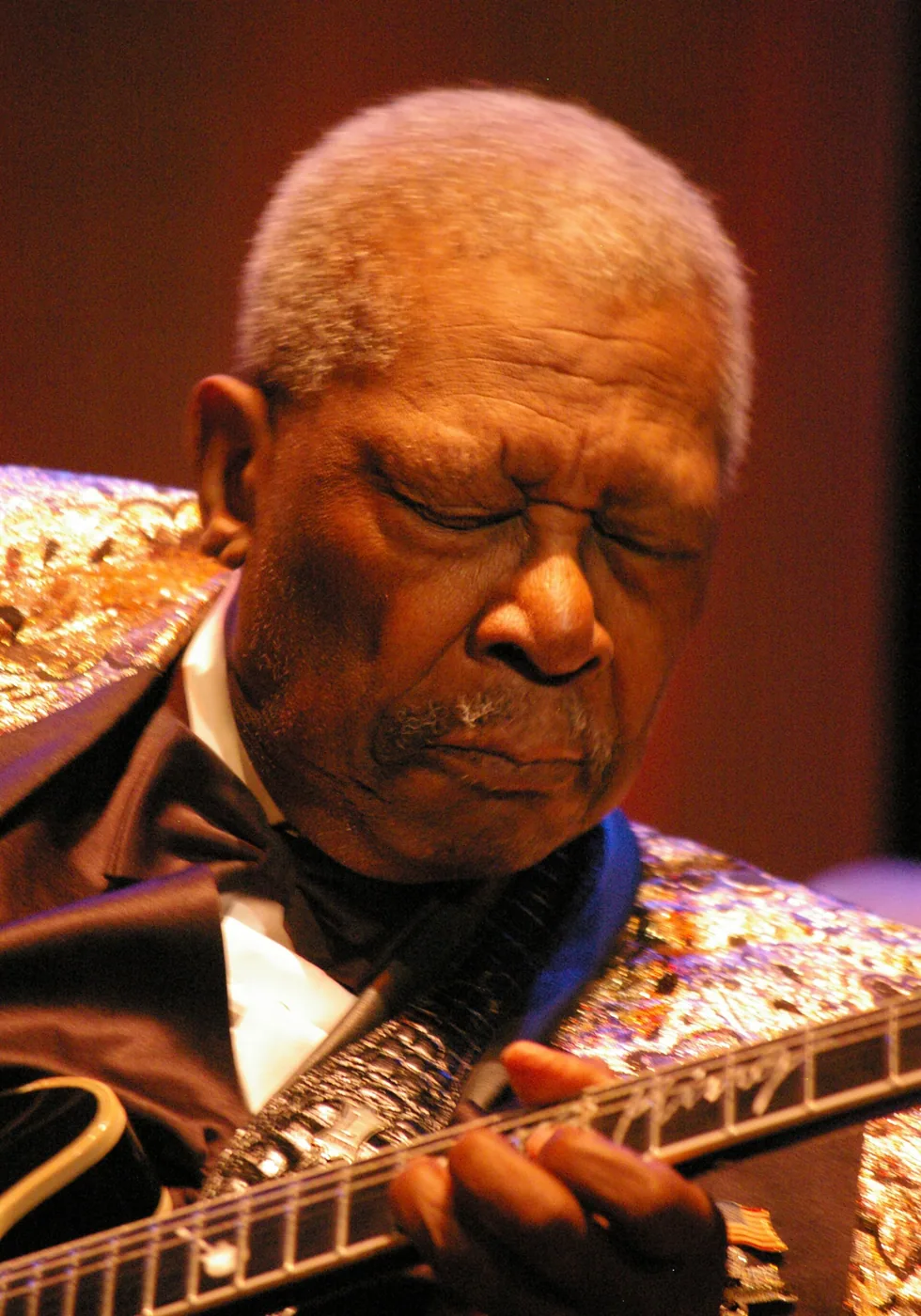
The Guitar Plugged · Guitarist Index
B.B. King
Solo
1949–2015
Blues
The single-note singer whose vibrato became the blues standard.
Main guitar
Gibson ES-355 / Lucille
Signature sound
Warm semi-hollow neck pickup, clean-to-edge amp, and that butterfly vibrato
Era
1949–2015
Influence
97 / 100
Genre
Blues
Why they matter
The single-note singer whose vibrato became the blues standard.
Almost every blues-derived lead guitarist alive is playing some diluted version of B.B. King. He built a vocabulary out of single notes — no chords under the solos, no fast runs, no slide — and made it carry entire concerts because each note was sung rather than played.
His innovation was the vibrato: a rapid shake generated from the wrist with the fretting hand pivoting, imitating the throat vibrato of gospel singers and the bottleneck slide players he grew up hearing in Mississippi. It was so identifiable that it turned into a named technique.
He also worked harder than anyone: more than 250 shows a year for decades, playing to audiences who had never heard a blues record.
The sound
Warm semi-hollow neck pickup, clean-to-edge amp, and that butterfly vibrato
The Thrill Is Gone
Clean semi-hollow with string arrangement and a light chorus of natural amp compression — the definitive modern blues tone.
Sweet Little Angel (Live at the Regal)
A hotter Fender-amp edge with the room and the crowd audibly shaping the sound.
Every Day I Have the Blues
Big-band context with the guitar sitting cleanly above horns rather than fighting them.
Recreate the sound
Want this tone on your rig?
ToneMD translates B.B. King's sound into settings for the amp, modeler or plugin you already own.
Prescribe my tonePowered by ToneMD
Style & technique
How you recognise the playing
The butterfly vibrato
A fast, wrist-driven shake that imitates a slide player's shimmer without a slide.
Call and response
Guitar phrases answering his vocal lines rather than playing under them — he almost never sang and played simultaneously.
Box-position economy
Nearly everything played inside a small region of the neck, with expression rather than movement providing variety.
Bends into the vocal register
Half and whole-step bends placed for emotional emphasis rather than technical display.
The rig
Instruments, amplification and effects
- Gibson ES-355 'Lucille'
- Gibson ES-335
- Gibson ES-175 (early)
- Fender Twin Reverb
- Lab Series L5
- Gibson Lab Series solid-state amps
- Minimal — a clean amp with a little natural compression
- Gibson humbuckers; f-holes closed on later Lucilles to combat feedback
- Varitone circuit on ES-355
- Very light picking with a plectrum, no fingerpicking
Essential listening
Where to start
- 011951
Three O'Clock Blues
B.B. King · Singin' the Blues
- 021965
Sweet Little Angel
B.B. King · Live at the Regal
- 031969
The Thrill Is Gone
B.B. King · Completely Well
- 041969
Why I Sing the Blues
B.B. King · Live & Well
- 051988
When Love Comes to Town
U2 with B.B. King · Rattle and Hum
Career landmarks
The moments that mattered
1965
Live at the Regal, 1965
Frequently named the greatest live blues album ever recorded, and required listening for phrasing.
'The Thrill Is Gone'
A crossover hit that brought orchestral arrangement into electric blues without diluting the guitar.
Naming Lucille
The story behind the name became one of the most repeated pieces of guitar folklore in the world.
The legacy
Lineage
Influenced by
T-Bone Walker
Lonnie Johnson
Charlie Christian
Adjacent players
More from the archive
The player who turned amplifier noise into a musical language.
Session-hardened producer who built rock guitar as an architecture, not a solo.
The player who translated Chicago blues into British rock volume.
The restless technician who kept reinventing what an electric guitar could be.
The master of the long note — space, sustain and perfect note choice.
The Texas force of nature who dragged the blues back into the mainstream.