The Guitar Plugged · Guitarist Index
Slash
Guns N' Roses
1983–present
Rock · Blues · Metal
The last true rock guitar hero, and the most quotable lead melodies of the era.
Main guitar
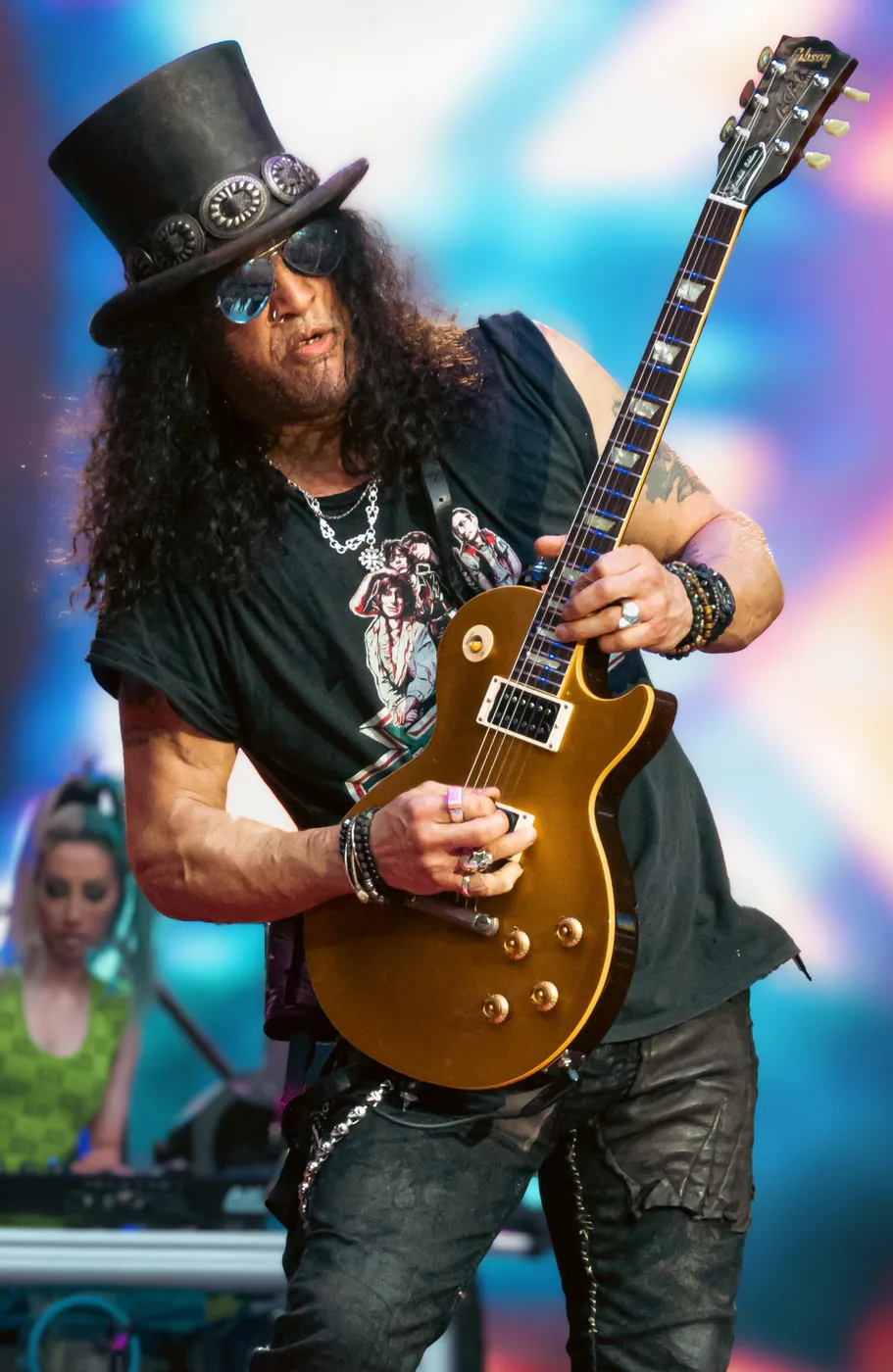
Gibson Les Paul (the Kris Derrig replica used on Appetite)
Signature sound
Les Paul into a modified Marshall — warm, thick and unmistakably classic
Era
1983–present
Influence
90 / 100
Genre
Rock / Blues / Metal
Why they matter
The last true rock guitar hero, and the most quotable lead melodies of the era.
Appetite for Destruction arrived in 1987 into a landscape of scooped, processed hair-metal guitar tones, and it sounded like it had been recorded in 1972. That was deliberate: a Les Paul replica into a rented modified Marshall, minimal processing, and a player whose vocabulary came from Aerosmith and AC/DC rather than Yngwie Malmsteen.
His strength is melody. 'Sweet Child o' Mine', 'November Rain' and 'Estranged' contain solos structured as songs within songs, and the intro riff to 'Sweet Child' — written as a warm-up exercise he initially disliked — is one of the most recognisable guitar figures ever recorded.
Thirty-five years on he is still the visual and sonic shorthand for 'rock guitarist'.
The sound
Les Paul into a modified Marshall — warm, thick and unmistakably classic
Sweet Child o' Mine
Warm neck-pickup clarity for the intro figure and a bridge tone with just enough gain to sustain the solo.
Welcome to the Jungle
Wah-flavoured, mid-heavy Marshall crunch with almost no modern processing.
November Rain
Enormous sustaining lead over orchestration — the most arena-scale tone in his catalogue.
Paradise City
Two panned rhythm tracks with the gain low enough that the chords stay open.
Recreate the sound
Want this tone on your rig?
ToneMD translates Slash's sound into settings for the amp, modeler or plugin you already own.
Prescribe my tonePowered by ToneMD
Style & technique
How you recognise the playing
Melodic, singable solos
Composed lead lines with clear phrases and resolution rather than continuous runs.
Blues-rock vocabulary
Pentatonic and mixolydian phrasing inherited from Aerosmith, AC/DC and Clapton.
Wah as tone shaping
Cry Baby often parked or slowly swept to add midrange body rather than effect.
Big, deliberate bends
Slow, wide bends with heavy vibrato at the peak — the phrasing signature.
The rig
Instruments, amplification and effects
- Kris Derrig Les Paul replica
- Gibson Slash signature Les Pauls
- Gibson EDS-1275 doubleneck
- B.C. Rich Mockingbird (early)
- Marshall Silver Jubilee 2555
- S.I.R. modified Marshall #36 (Appetite)
- Magnatone Super Fifty-Nine
- Dunlop Cry Baby SW-95
- Boss DD delay
- MXR Octavio
- Boss GE-7
- Seymour Duncan Alnico II Pro 'Slash'
Essential listening
Where to start
- 011987
Sweet Child o' Mine
Guns N' Roses · Appetite for Destruction
- 021987
Welcome to the Jungle
Guns N' Roses · Appetite for Destruction
- 031987
Paradise City
Guns N' Roses · Appetite for Destruction
- 041991
November Rain
Guns N' Roses · Use Your Illusion I
- 051991
Estranged
Guns N' Roses · Use Your Illusion II
Career landmarks
The moments that mattered
Appetite for Destruction
The best-selling debut album in US history, and a hard reset of rock guitar tone in the late 1980s.
The 'Sweet Child' intro
A warm-up exercise that became one of the most famous guitar figures in existence.
The legacy
Lineage
Influenced by
Influenced
Synyster Gates
Most modern hard rock lead players
Adjacent players
More from the archive
The player who turned amplifier noise into a musical language.
The virtuoso who rewrote the vocabulary of rock guitar.
Session-hardened producer who built rock guitar as an architecture, not a solo.
The player who translated Chicago blues into British rock volume.
The restless technician who kept reinventing what an electric guitar could be.
The master of the long note — space, sustain and perfect note choice.