The Guitar Plugged · Guitarist Index
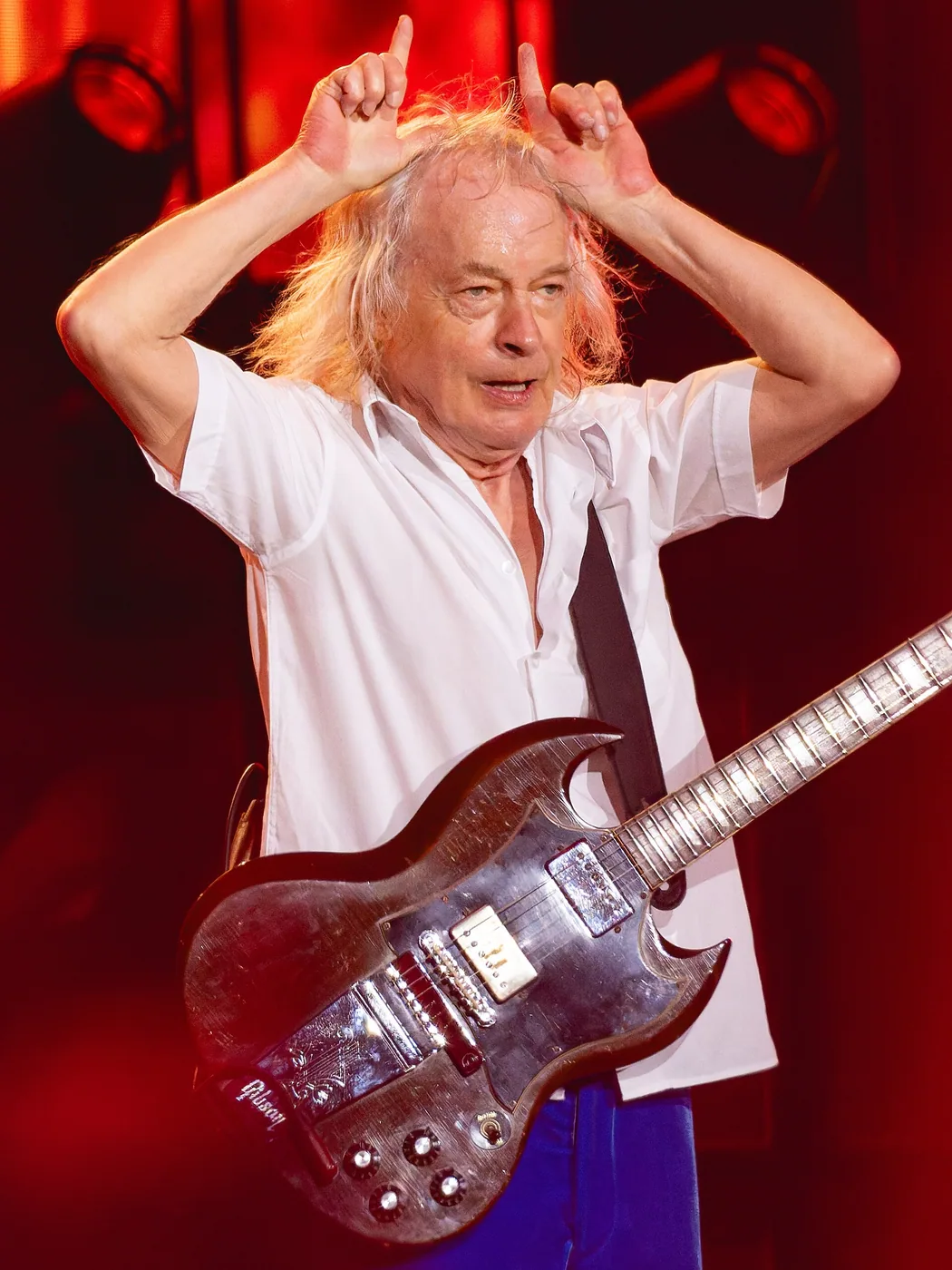
Angus Young
AC/DC
1973–present
Rock · Blues
Pure blues-rock aggression with the least complicated rig in stadium music.
Main guitar
Gibson SG Standard
Signature sound
SG straight into cranked Marshalls — no pedals, no tricks
Era
1973–present
Influence
90 / 100
Genre
Rock / Blues
Why they matter
Pure blues-rock aggression with the least complicated rig in stadium music.
AC/DC's guitar sound has been misunderstood for fifty years, mainly because people assume it is heavily distorted. It is not. Angus and Malcolm Young ran SGs and Gretsches into Marshalls set just past breakup, with no pedals at all, and the enormity comes from the rhythm section's space and Malcolm's rhythm parts sitting rock-solid underneath.
Angus's lead playing is straight blues vocabulary — Chuck Berry, Freddie King, a little B.B. — played with an unreasonable amount of energy. He does not play outside the box; he plays the box harder than anyone else.
The lesson for guitarists is the one most refuse to learn: turn the gain down, hit the strings harder, and get the band to leave room.
The sound
SG straight into cranked Marshalls — no pedals, no tricks
Back in Black
The cleanest 'heavy' tone in rock — Marshall on the edge of breakup with the mids left completely alone.
Highway to Hell
Slightly rawer and more open, with the two guitars panned hard so the rhythm and lead never mask each other.
Thunderstruck
A picked, single-note pattern that only works because the gain is low enough to keep every note separate.
Let There Be Rock
The live tone at full commitment — feedback and sustain generated by volume, not saturation.
Recreate the sound
Want this tone on your rig?
ToneMD translates Angus Young's sound into settings for the amp, modeler or plugin you already own.
Prescribe my tonePowered by ToneMD
Style & technique
How you recognise the playing
Low-gain, high-volume tone
Amps just past breakup, so dynamics and pick attack control the distortion, not a pedal.
Blues box lead
Pentatonic phrasing played with maximum attack, bends and vibrato rather than harmonic complexity.
Rhythmic space
Riffs written with holes in them, letting the drums define the groove.
Aggressive vibrato
Fast, wide and constant — the main thing separating his phrasing from generic pentatonic playing.
The rig
Instruments, amplification and effects
- Gibson SG Standard (1968 and later)
- Jaydee SG replicas
- Marshall JTM45 / 1959 Super Lead
- Marshall Plexi reissues
- Wireless system — and essentially nothing else
- Gibson humbuckers, bridge position almost exclusively
- Schaller wireless as the only signal-chain device
Essential listening
Where to start
- 011977
Whole Lotta Rosie
AC/DC · Let There Be Rock
- 021979
Highway to Hell
AC/DC · Highway to Hell
- 031980
Back in Black
AC/DC · Back in Black
- 041980
You Shook Me All Night Long
AC/DC · Back in Black
- 051990
Thunderstruck
AC/DC · The Razors Edge
Career landmarks
The moments that mattered
Back in Black
One of the best-selling albums in history, recorded weeks after the death of their singer.
The no-pedals rig
Proof that tone is playing and volume long before it is equipment.
Malcolm and Angus's two-guitar split
A rhythm/lead division of labour that countless rock bands have copied.
The legacy
Lineage
Influenced by
Influenced
Slash
Zakk Wylde
Dan Hawkins
Joe Perry-era rhythm players
Adjacent players
More from the archive
The player who turned amplifier noise into a musical language.
The virtuoso who rewrote the vocabulary of rock guitar.
Session-hardened producer who built rock guitar as an architecture, not a solo.
The player who translated Chicago blues into British rock volume.
The restless technician who kept reinventing what an electric guitar could be.
The master of the long note — space, sustain and perfect note choice.