
The Guitar Plugged · Guitarist Index
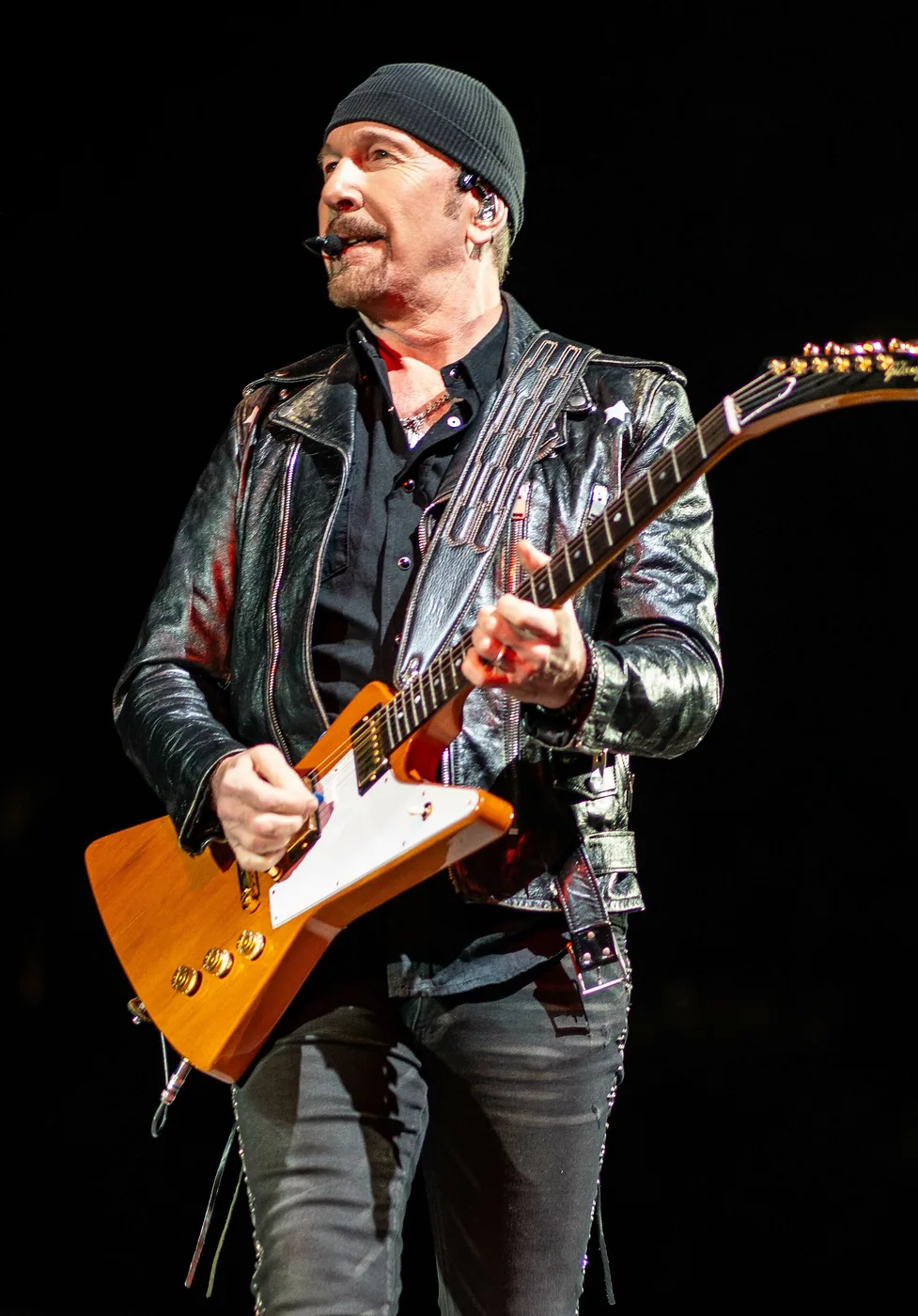
The Edge
U2
1976–present
Rock · Alternative
Rhythmic delay as a compositional instrument — minimalism that filled stadiums.
Main guitar
1976 Gibson Explorer; Fender Stratocaster; Rickenbacker 330
Signature sound
Dotted-eighth delay, shimmering compression and Vox AC30 chime
Era
1976–present
Influence
87 / 100
Genre
Rock / Alternative
Why they matter
Rhythmic delay as a compositional instrument — minimalism that filled stadiums.
The Edge decided early that he had no interest in blues-rock vocabulary and built a style out of space instead. His central device — a dotted-eighth delay synchronised to the song tempo — turns simple arpeggios into rippling, interlocking patterns that sound like two or three guitarists.
'Where the Streets Have No Name' is the definitive example: a repeated six-note figure that becomes an entire arrangement once the delays lock in.
The technique is more musically demanding than it looks, because the player has to leave the right notes out for the delay to fill in. Very few imitators get it right.
The sound
Dotted-eighth delay, shimmering compression and Vox AC30 chime
Where the Streets Have No Name
Two synchronised delays over an AC30 — the pattern is created by the effects, not the picking hand.
With or Without You
Infinite-sustain Infinite Guitar tone floating above almost nothing else.
Sunday Bloody Sunday
Dry, compressed and harmonically sparse — the aggression is in the rhythm.
Recreate the sound
Want this tone on your rig?
ToneMD translates The Edge's sound into settings for the amp, modeler or plugin you already own.
Prescribe my tonePowered by ToneMD
Style & technique
How you recognise the playing
Rhythmic delay composition
Dotted-eighth and quarter-note delays timed to tempo so repeats become counter-melodies.
Sparse note choice
Deliberate space left in parts for the effects to complete the pattern.
Open and suspended voicings
Ringing chord shapes rather than barre chords or power chords.
Texture-first approach
Guitar treated as atmosphere and rhythm rather than lead voice.
The rig
Instruments, amplification and effects
- 1976 Gibson Explorer
- Fender Stratocaster
- Rickenbacker 330
- Gretsch Country Gentleman
- Vox AC30
- Fender Deluxe
- Multiple AC30s in stereo live
- Korg SDD-3000 delay (the signature unit)
- TC Electronic 2290
- Memory Man
- Compressors, tremolo, e-bow
- Gibson humbuckers, Fender single-coils
Essential listening
Where to start
- 011983
Sunday Bloody Sunday
U2 · War
- 021987
Where the Streets Have No Name
U2 · The Joshua Tree
- 031987
With or Without You
U2 · The Joshua Tree
- 041984
Bad
U2 · The Unforgettable Fire
Career landmarks
The moments that mattered
The Joshua Tree
An album whose guitar identity is almost entirely built from delay architecture.
The Korg SDD-3000
A rack delay so associated with him that it was reissued as a pedal decades later.
The legacy
Lineage
Influenced by
Influenced
Coldplay's Jonny Buckland
Editors
Countless ambient rock players
Adjacent players
More from the archive
The player who turned amplifier noise into a musical language.
The virtuoso who rewrote the vocabulary of rock guitar.
Session-hardened producer who built rock guitar as an architecture, not a solo.
The player who translated Chicago blues into British rock volume.
The restless technician who kept reinventing what an electric guitar could be.
The master of the long note — space, sustain and perfect note choice.