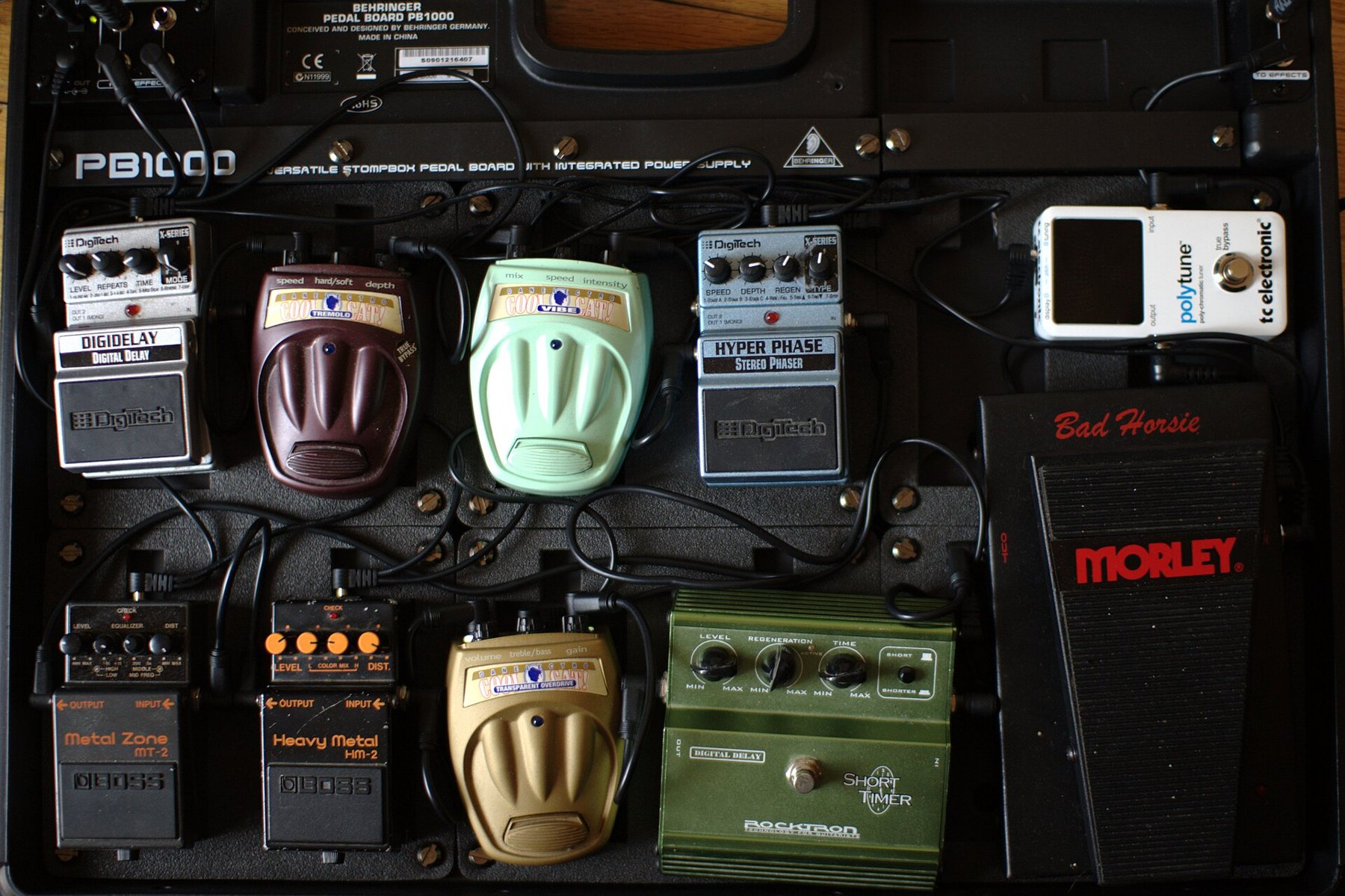
Illustrative: a modulation-heavy pedalboard with a DigiTech Hyper Phase phaser in the top row. This photo doesn't show the JHS Pherb.
JHS says it decided, designed, prototyped and approved the 3 Series Pherb in 35 hours. It's a $99 lo-fi reverb running into a four-stage phaser, with a bitcrushing BREAK mode for noise players.
JHS Pedals has a new pedal, and it started as a joke. The Kansas City company's new 3 Series Pherb is a lo-fi reverb running straight into a four-stage phase shifter, with both effects on all the time. JHS lists it at $99 on its own store.
The product page opens with the punchline: "You asked us for Flerb. You're getting PHERB." That's a nod to the Flerb setting on the Electro-Harmonix Holy Grail, which puts a flanger inside a reverb. The other headline is how quickly JHS made it. The company says the Pherb was "decided, designed, prototyped and approved for production in just 35 hours. The fastest pedal we have ever made." According to JHS, the old record holder was the Twin 12.
What JHS Announced
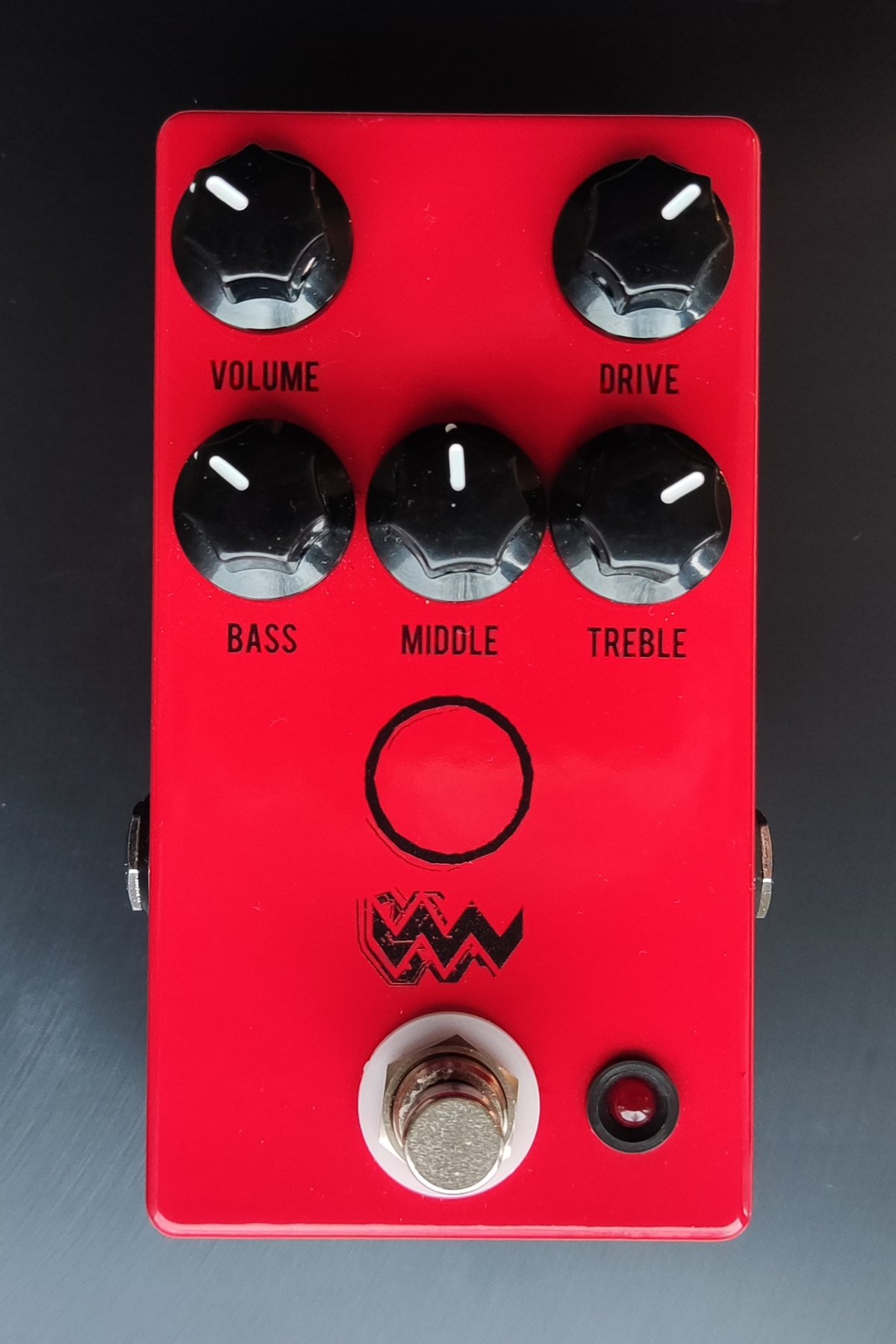
The 3 Series is JHS's affordable line, and the Pherb keeps it simple: three knobs and one toggle. JHS describes it as "a dark, moody lo-fi reverb running into a four-stage phase shifter. Both on, all the time."
There's no blend control between the two effects and no switch to reverse their order. JHS built it that way on purpose. If you want only the reverb, turn Speed all the way counterclockwise in normal mode and the phaser drops out.
The product copy is written in the first person. Its author mentions writing a 500-plus page book on the history of Electro-Harmonix, and that book is JHS founder Josh Scott's. The copy explains where the idea came from:
"I love the Holy Grail reverb — it's legendary, but the Flerb setting is a monstrosity. I wrote a 500-plus page book on the history of Electro-Harmonix out of pure love for the company, so this is no slam on them. Flanger inside of a reverb just makes my skin itch. Phaser inside of a reverb however, is a different story, and that's the one nobody ever built. So I'm giving you the thing that should have been and never was."
It's a fair point. Plenty of pedals put modulation inside a reverb tail, but a phaser and a lo-fi reverb wired together as one fixed circuit is rare at this price.
The Reverb: Lo-Fi on Purpose
Don't expect a pristine studio reverb. JHS calls the Pherb's reverb "dark, moody and lo-fi on purpose. Not a plate. Not a hall." The company says it's "chorused and chunky, and at longer decay times it slightly pulses."
The Length knob controls decay and adds pre-delay as you turn it up. JHS lists a reverb time (RT60) of 241 milliseconds to 49.83 seconds, so the long end of the knob goes well past anything you'd call a room sound. The Mix knob sets how much reverb you hear against your dry signal.
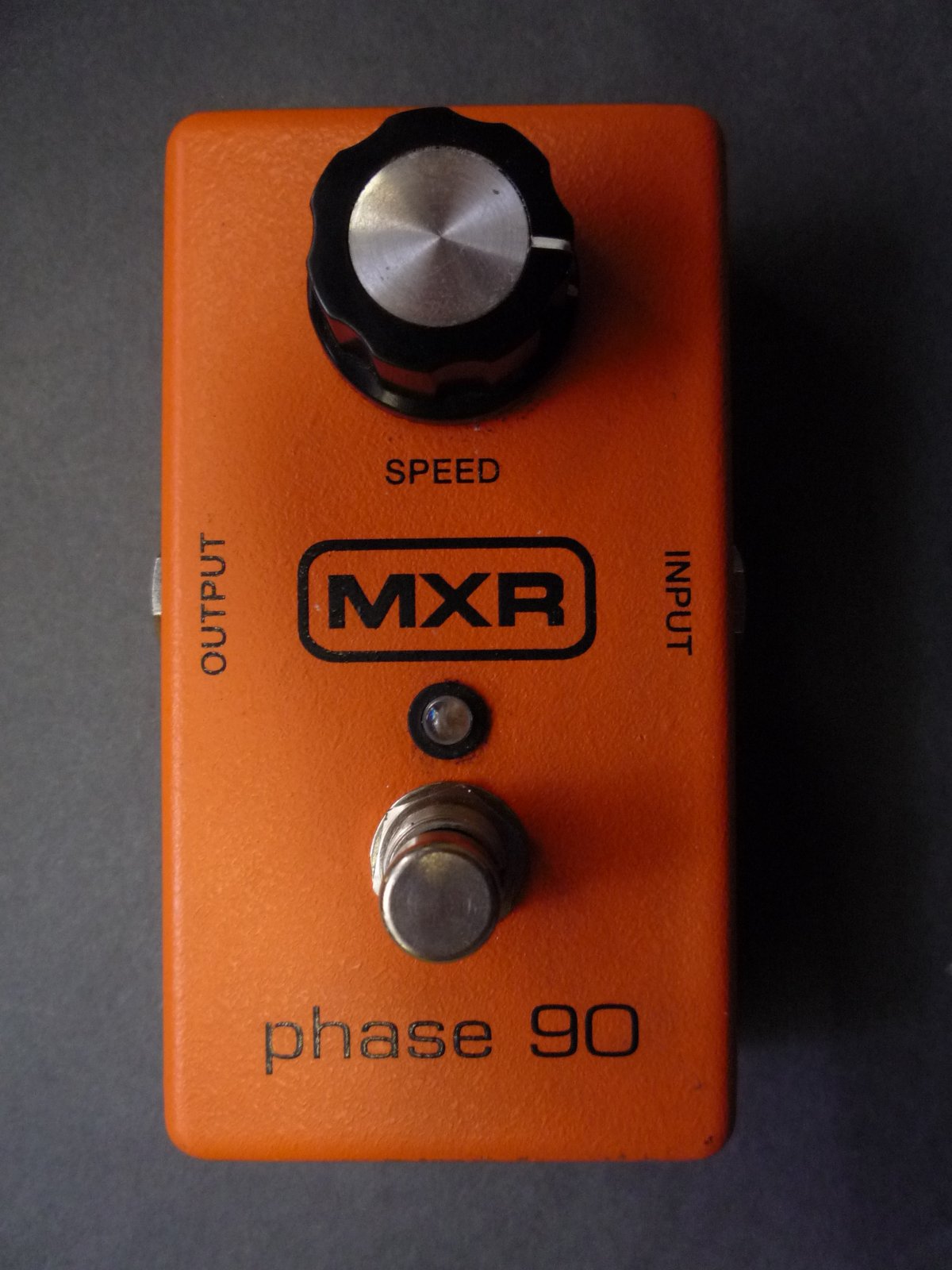
The Phaser: "Think Phase 90"
The phaser will get Phase 90 players' attention. JHS describes it as "a four-stage vintage style phase shifter (think Phase 90) with the feedback left off and the notch sweeps moved up through the frequency spectrum, so they stay out of the way of the reverb's low mids."
If you've read our MXR Phase 90 history, you'll recognize both points. A four-stage phaser produces two notches, which is why it sounds smooth and vocal rather than like a jet. Feedback is the big difference between script-logo and block-logo Phase 90s. The early script circuits had no feedback resistor and a softer swoosh. The block-logo circuit added feedback and got a chewier midrange. Leaving the feedback off puts the Pherb closer to the gentler script-era voice, at least on paper.
Moving the sweep higher is a practical choice. A reverb's low mids are where the tail builds up, so a phaser sweeping through that range would muddy it. JHS keeps the notches higher so the two effects don't compete.
The Speed knob runs from 0.05 Hz to 5 Hz, which JHS describes as "from barely moving to seasick."
BREAK Mode Is the Wild Card
The toggle switches the Pherb into BREAK mode. JHS calls it an "asymmetric bitcrusher" with analog-style clipping before it, and it processes the whole signal: reverb, phaser and dry guitar. In BREAK mode you can't turn the phaser off.
JHS says the result "reminds us of an old Jordan Bosstone fuzz from the 60s if it collided with a DOD Grunge!" That's a vague description, but it does tell you this isn't a subtle drive setting. If you want a cleaner drive in front, our best overdrive pedals of 2026 roundup covers that. BREAK is closer to the broken-gear sounds of a Bosstone than to a Tube Screamer.
Where JHS Suggests Starting
JHS's product page gives a few starting points:
- Always-on ambience: Mix low, Length low, Speed around ten o'clock.
- Drone: Length all the way up with a slow Speed.
- Fuzz: BREAK mode with a short Length.
- "Nightmare": BREAK mode with a long Length.
JHS also says who the Pherb is for: shoegaze, industrial, noise, experimental pop and ambient players. It also says who it isn't for. If you want a vintage spring reverb for blues or a polite phaser, JHS says to look elsewhere. It's unusual for a pedal company to tell you not to buy something.
Specs, Price and Availability
These come from JHS's official product page:
- Effect: Lo-fi reverb into a four-stage phase shifter, both always on
- Controls: Mix, Speed, Length (decay with proportional pre-delay) and a BREAK toggle
- Phaser speed: 0.05 Hz to 5 Hz
- Reverb time (RT60): 241 ms to 49.83 s
- Power: 9V DC, center negative, 70mA
- Jacks: Input on the right, output on the left
- Size: 4.42" x 2.38" x 1.22"
- Price: $99.00 USD at the JHS Pedals web store
Some early press coverage gives the price as $99.99, but JHS's own store lists $99.00.
Why It Matters
The Pherb is a low-cost pedal with a joke for a name, but there are two real stories here.
The first is speed. A pedal going from idea to approved production prototype in 35 hours, by JHS's own account, shows how fast a small team can now design and iterate on a circuit. JHS has spent years building an audience on YouTube, and the Pherb started as a response to that audience. The "You asked us for Flerb" line says as much.
The second is the sound. Shoegaze and noise players have been running phasers into reverbs for decades, usually as two pedals wired together. The Pherb puts that combination into one 3 Series box, sweeps the phaser so it stays out of the reverb's way, and adds a fuzz-like BREAK setting. A Phase 90 and a reverb pedal in front of a dirty amp can sound like this, but the Pherb builds those choices into the circuit for you. You give up the option to reorder or blend the effects, and in return you get one $99 pedal with less to set up.
We haven't played a Pherb yet, so don't read this as a review. Judging by JHS's description, it's built for sustained, washy chords rather than quick blues licks.
The Bottom Line
The JHS 3 Series Pherb is a $99 lo-fi reverb and four-stage phaser that you can't separate. It has an optional bitcrusher, and JHS says it built the whole thing in a day and a half. If you've been stacking a Phase 90 and a reverb to get a shoegaze wash, it's worth hearing. The footnote on JHS's page also mentions the Phineas and Ferb theme song.
For the background on the circuit the Pherb's phaser is modeled on, read our MXR Phase 90 history. More gear news is on our news page.
Sources
- JHS Pedals, "3 Series PHERB" official product page: https://www.jhspedals.info/products/3-series-pherb
- JHS Pedals official YouTube channel, "What is the JHS PHERB? In Under 5min": https://www.youtube.com/watch?v=NLluI1MLhJI
Experience-driven coverage, not algorithm bait.
- 20+ years of guitar playing experience
- Real-world retail experience at Guitar Center
- Thousands of hours testing guitars, amps, and pedals
- A community of 50,000+ guitar enthusiasts across platforms
- Partnerships with Fender, DistroKid, TrueFire, Card Chords, and Enya
- Editorial standards published openly — see how we test gear
The Modern Guitar Magazine. Delivered to your inbox.
No spam. No gimmicks. Just great guitar content — stories, tones, iconic solos, and honest gear takes. Every week.
Ask GP
3 free questions a dayStill curious? Ask GP about this story.
Your personal classic-rock and guitar guide — ask anything about JHS Pherb.
Discussion (0)
Sign in to join the discussion.
Sign in to commentLoading comments…
Discover another guitar story
Swipe through our latest features, breaking news and iconic solos — one story at a time.
Open Swipe →More Guitar News
The MXR Phase 90 History: How One Orange Knob Taught Rock Guitar to Swirl
The MXR Phase 90 was the first pedal MXR ever sold and it's still in production 50 years later. Here's who built it, script vs. block, how Eddie Van Halen used it on Van Halen I, and which version to buy today.
Boss DS-1 History: The Orange Box That Defined Distortion
The Boss DS-1 history from its 1978 debut to the Waza Craft DS-1W: the circuit, the chip changes, the mods, and the players who made the orange box famous.

The 10 Best Overdrive Pedals That Actually Sound Like Money
From transparent touch tools to iconic mid-humps and Klon chime, these 10 overdrives under $300 in 2026 punch above their weight with pro tones, tough builds, and real-world value.
Zoom’s Neurig Puts Neural Amp Modeling in Reach — But the Fine Print Matters
Dual touchscreens, community amp captures and a Japanese price around $300 by conversion: Zoom’s new pedal has an ambitious spec sheet — and some important caveats.