
The MXR Phase 90 History: How One Orange Knob Taught Rock Guitar to Swirl
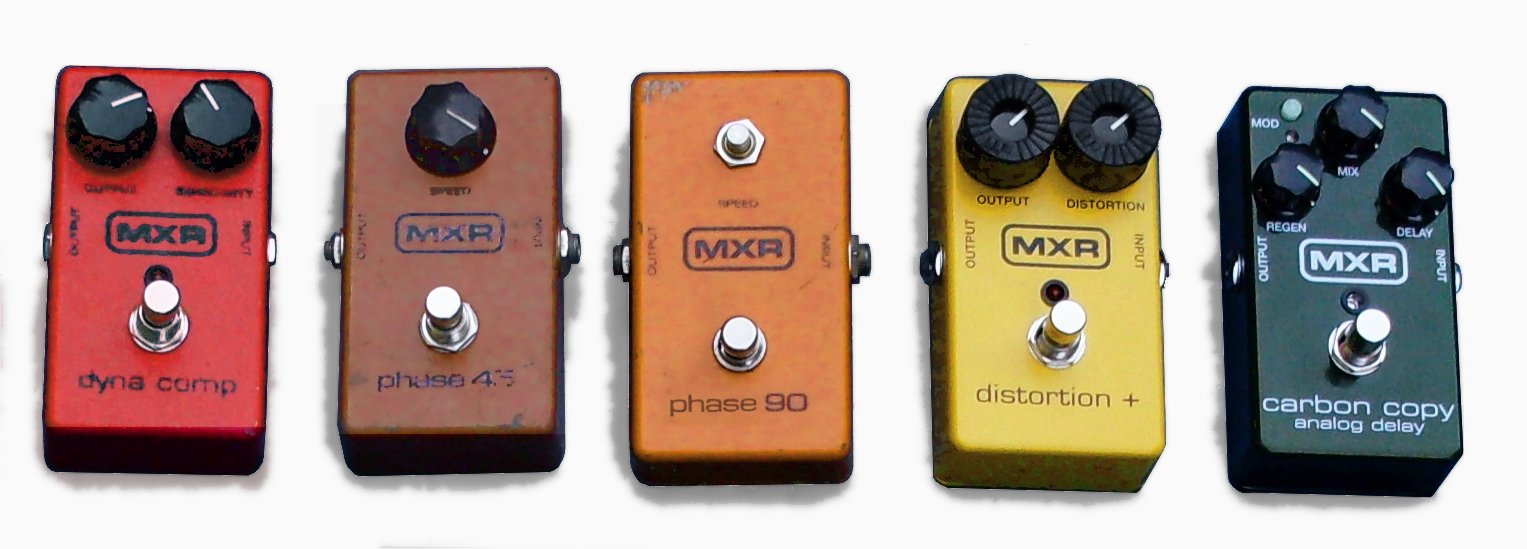
A lineup of original MXR-era pedals: Dyna Comp, Phase 45, Phase 90, Distortion+ and an analog delay. The orange Phase 90 in the middle is the pedal that started it all. Photo: Roadside Guitars (Matt's Pedals), derivative work by Guitarpop and Clusternote, CC BY-SA 3.0 (https://creativecommons.org/licenses/by-sa/3.0/), via Wikimedia Commons. Source: https://commons.wikimedia.org/wiki/File:MXR_effect_pedals_1.jpg
The MXR Phase 90 was the first pedal MXR ever sold and it's still in production 50 years later. Here's who built it, script vs. block, how Eddie Van Halen used it on Van Halen I, and which version to buy today.
Put on "Eruption" and skip to the tapping section. Under all that speed and those hammer-ons, the tone itself is moving. It isn't wobbling or warbling the way a vibrato would. It's breathing, a slow, slightly hollow swirl that makes the notes jump off the record.
That swirl came from a small orange box with one knob on it. It had no LED and no power jack, and it ran on a single 9-volt battery. It was made by a young company in Rochester, New York, that had started out fixing other people's broken stereos.
The box was the MXR Phase 90. It was the first pedal MXR ever sold, and more than 50 years later it's still in production. It may be the easiest effect ever designed to use: plug it in, turn the Speed knob, and you're done. Not many pedals have stayed on that many big records and pedalboards for that long.
This is the MXR Phase 90 history: who built it, what's actually happening inside the box, why a "script" logo can make collectors' eyes light up, how Eddie Van Halen made it part of his sound, and what to buy if you want that swirl today.
Two Repairmen in Rochester
The MXR story starts with two high school friends from the Rochester suburbs. Keith Barr and Terry Sherwood met at Rush-Henrietta Senior High School in Henrietta, New York. Later they ran a small repair business called Audio Services, fixing stereos and music gear out of a rented basement apartment.
Repair work is a great education in what goes wrong. According to Dunlop's own history of the brand, Barr and Sherwood were surprised by how badly made many of the guitar effects their customers brought in were. Early-'70s effects were often fragile, noisy or awkward. Barr decided he could build a phaser that sounded better, was more reliable, and was a lot smaller than the bulky units on the market.
Barr was an unusual kind of engineer. His Mix magazine obituary describes him as largely self-taught. He had been building electronics since he was a kid and left school at 16 to do it full time. He later founded Alesis in 1984 and helped bring affordable digital recording to home studios with the ADAT. In 1974, though, he was a young guy in Rochester trying to make a better stompbox.
The exact founding date is a little fuzzy, and it's worth being honest about that. Some sources say MXR started in 1972, Barr's obituaries say 1973, and the company was incorporated as MXR Innovations, Inc. in 1974. The Mix obituary also names Michael Laiacona as a co-founder alongside Barr and Sherwood. Laiacona handled sales in the early days and later founded the cable and audio company Whirlwind. Dunlop treated 1974, the year of incorporation, as MXR's starting point when it celebrated the brand's 40th anniversary in 2014.
The early operation was about as small as you can get. Dunlop says the first few dozen Phase 90s were built in a basement and sold out of a car at gigs. The very first units had their logos silk-screened by hand. When MXR ran its first print ad on the back cover of Rolling Stone, it featured the Phase 90 and a short, confident line: "MXR: We Are Here."
Why the Timing Was Perfect
The Phase 90 arrived at a time when guitarists badly wanted movement in their sound and couldn't easily get it.
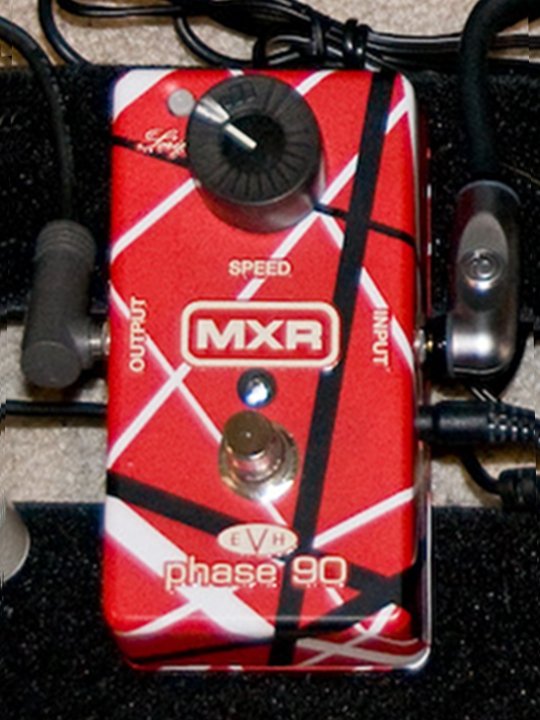
The Leslie rotating speaker was huge and heavy. The Uni-Vibe came in a big box with a separate speed treadle and a light bulb inside. Maestro's early PS-1 phaser was also a large unit. As Guitar World put it in a 2024 history of the pedal, the years between 1973 and 1975 brought a wave of phasers made for gigging guitarists. The Electro-Harmonix Small Stone, the Maestro Mini-Phase, Mu-Tron's Phasor and Bi-Phase, and a trio of Roland phasers all appeared in that window.
Most of those pedals are long gone. The Phase 90 and the Small Stone are the two that survived.
The Phase 90's advantage was size and simplicity. It came in a small diecast box that could fit in a guitar case's accessory compartment, and it had one control. You didn't have to understand phase shifting to get a good sound out of it. You just turned the knob until the swirl matched the song.
What's Inside: Four Stages and One Knob
A lot of players use phasers for years without knowing what's happening inside one. Since the Phase 90's circuit explains so much of its personality, it's worth a quick look.
How a phaser works
A phase shifter splits your guitar signal in two. One copy goes through a chain of filters called all-pass stages. These don't cut any frequencies. They only shift the timing of the waveform, and they shift it by different amounts at different frequencies. When that shifted copy is blended back with the dry signal, some frequencies line up perfectly out of phase and cancel each other. Those cancellations are called notches.
A low-frequency oscillator, or LFO, then sweeps those notches up and down the frequency range. Your ear hears the moving notches as the familiar whoosh.
The Phase 90's version
The Phase 90 uses four all-pass stages, which gives it two notches. That's what "four-stage phaser" means. Each stage is built around an op-amp, and the part that makes the notches move is a JFET transistor wired up as a voltage-controlled resistor. The original schematic, which has been widely published and analyzed by people like R.G. Keen of GEO, uses four 2N5952 JFETs, one per stage.
The LFO sends a slow triangle wave to the gates of those four JFETs. As the voltage rises and falls, the JFETs' resistance changes and the notches slide up and down. The one knob on the front, labeled Speed, sets how fast that happens.
That's the whole control set. There's no depth knob, no mix knob, no resonance knob and no mode switch on the original. Barr made those choices for you.
There's one practical detail that matters for anyone building or fixing these pedals. JFETs vary a lot from one to the next, even within the same part number. For all four stages to sweep together evenly, builders often match the JFETs by hand. That's one reason Dunlop advertises "hand-matched FETs" on its high-end '74 Vintage reissue.
How it sounds compared to other phasers
Compared with a lot of the phasers from the same era, the Phase 90 is subtle. Guitar World compared it with the Small Stone, which is also a four-stage design but uses a different method to move its notches. The Small Stone has a wider speed range and a Color switch for a more dramatic sweep. The Phase 90 is the gentler, more musical-sounding of the two.
The best description of the sound probably comes from Trevor Curwen's 2008 MusicRadar review of Dunlop's '74 Vintage reissue. He called it "organic phasing that seems an integral part of the guitar sound rather than something slapped on top of it," and wrote that "the original Phase 90 always had a mellow quality that just worked with guitar." That's the Phase 90 in a sentence. It doesn't sound like a separate effect sitting on top of your tone. It sounds like your tone has started to move.
Script vs. Block: The Resistor Collectors Talk About
If you go looking for a vintage Phase 90, you'll quickly find two kinds: "script logo" and "block logo." The names come from the lettering on the front of the box.
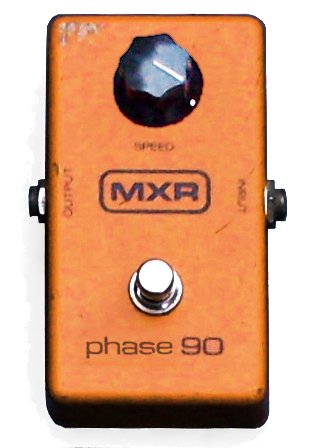
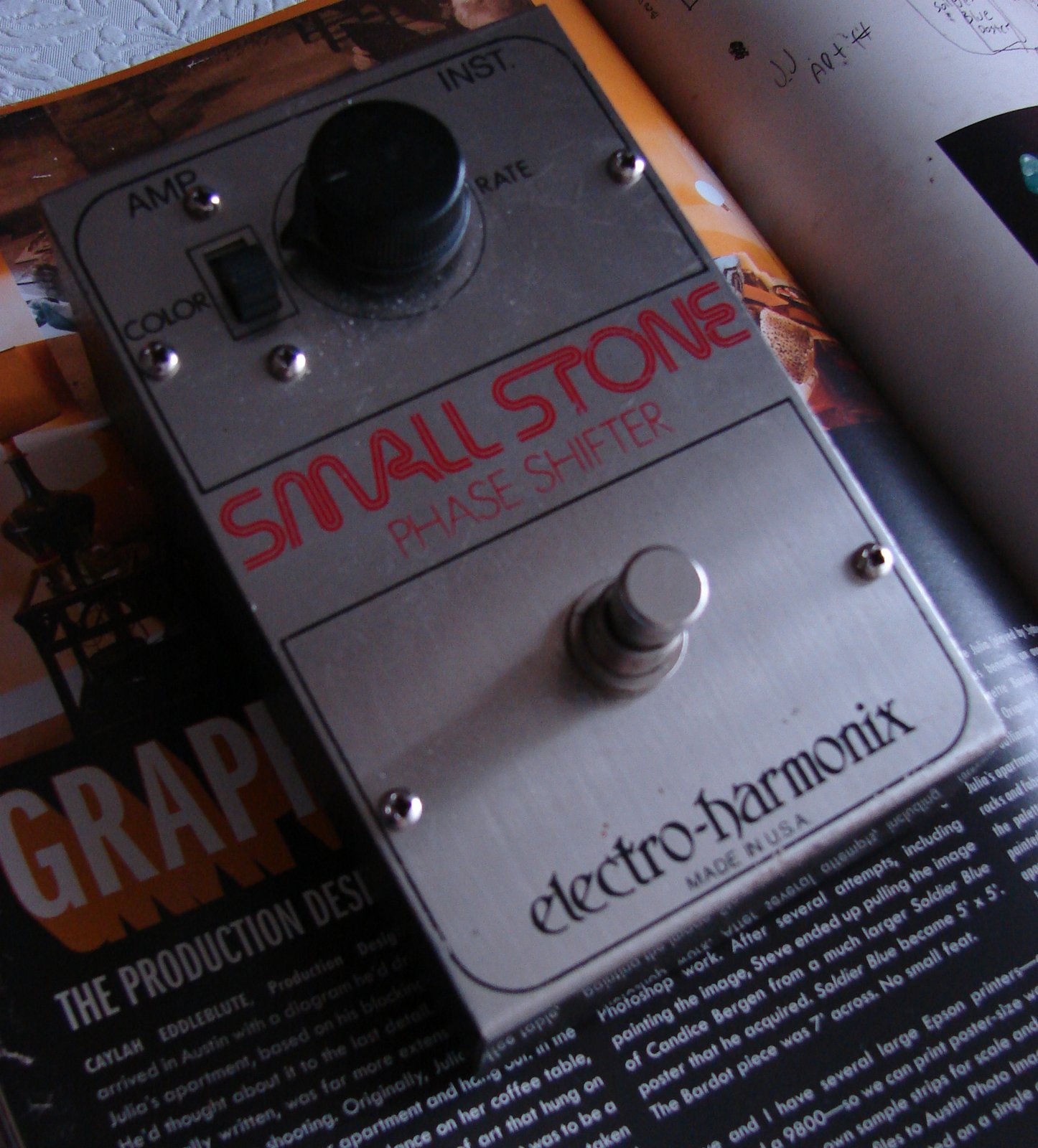
The early pedals had "MXR" and "phase 90" in a flowing cursive script. In the mid-'70s, MXR switched to a bolder block-letter logo inside a black box outline. Sources disagree slightly on the exact year. Guitar Player's Dave Hunter says the whole line had moved to block logos by 1976. Wikipedia's Phase 90 article puts the change in 1977. You'll see both dates quoted.
Here's why it matters for tone. During the move from script to block, MXR's engineers added a feedback resistor to the circuit. Pedal techs usually call it R28, after its position on the circuit board. It takes some of the output and feeds it back into the phasing stages.
The result, as Dunlop describes it, is that the original script circuit has a "subtle and more subdued swoosh," while the block circuit with the feedback resistor is "dirtier" and more pronounced. Circuit analyses show that the feedback adds a bump in the midrange and a bit of extra gain. If you've ever heard a Phase 90 that sounds chewy and almost vocal, it was probably a block circuit.
There's a catch for collectors. During the changeover, some pedals in block-logo boxes were built with script circuits, and vice versa. So the logo on the front doesn't always match the circuit inside. If you're paying script-logo money for a vintage pedal, the only way to be sure is to open it up and look at the board.
A few other changes happened over the years. Pre-1981 MXR pedals had no LED, no AC adapter jack, and no true bypass. In 1981, MXR added LEDs and power jacks. Later block-logo boards also switched from six single op-amps to three dual op-amps, which mostly came down to parts cost and availability rather than tone.
The Phase 90's Family
The Phase 90 didn't stay alone for long. By late 1974, MXR had added the Distortion+, the Dyna Comp compressor and the Blue Box octave fuzz. Those pedals turned a one-product company into a full line of brightly colored boxes.
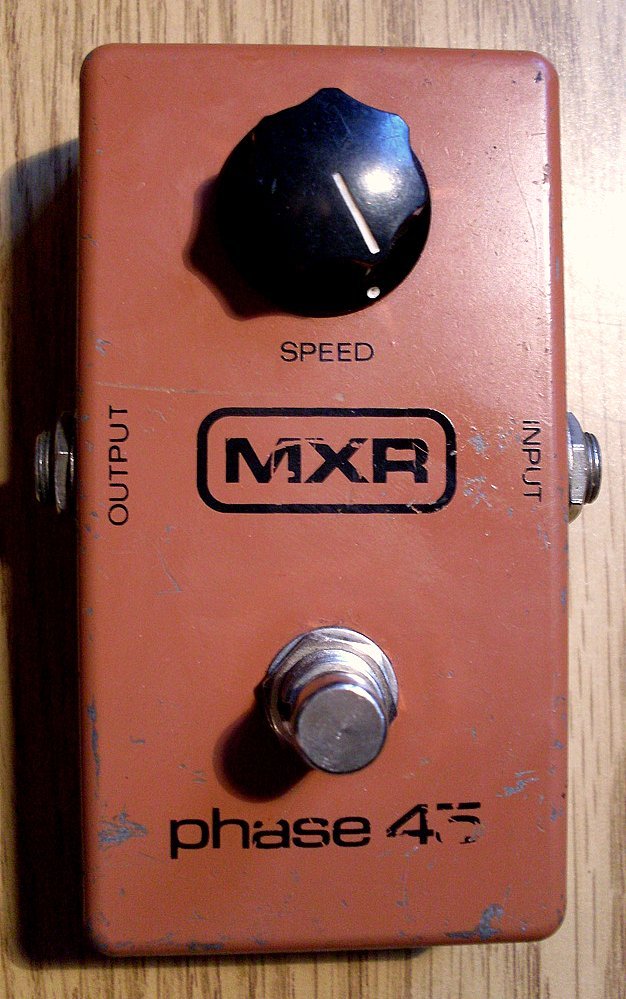
MXR also made two more phasers. The Phase 45 used two stages instead of four. That gave it one notch and a gentler sound that sits back in a band mix. The Phase 100 came later. It was a bigger, two-knob pedal with a rotary switch for four intensity settings and a different circuit. According to the ElectroSmash circuit analysis, it moved its notches with light-dependent resistors, which puts it closer to the Uni-Vibe's optical approach.
Guitar Player summed up why the middle child won: the Phase 90 was more dramatic than the Phase 45, and cheaper and less obtrusive than the Phase 100. It sat right in the sweet spot.
Eddie Van Halen and the Sound of Van Halen I
Plenty of famous players used a Phase 90, but one name is tied to it more than any other.
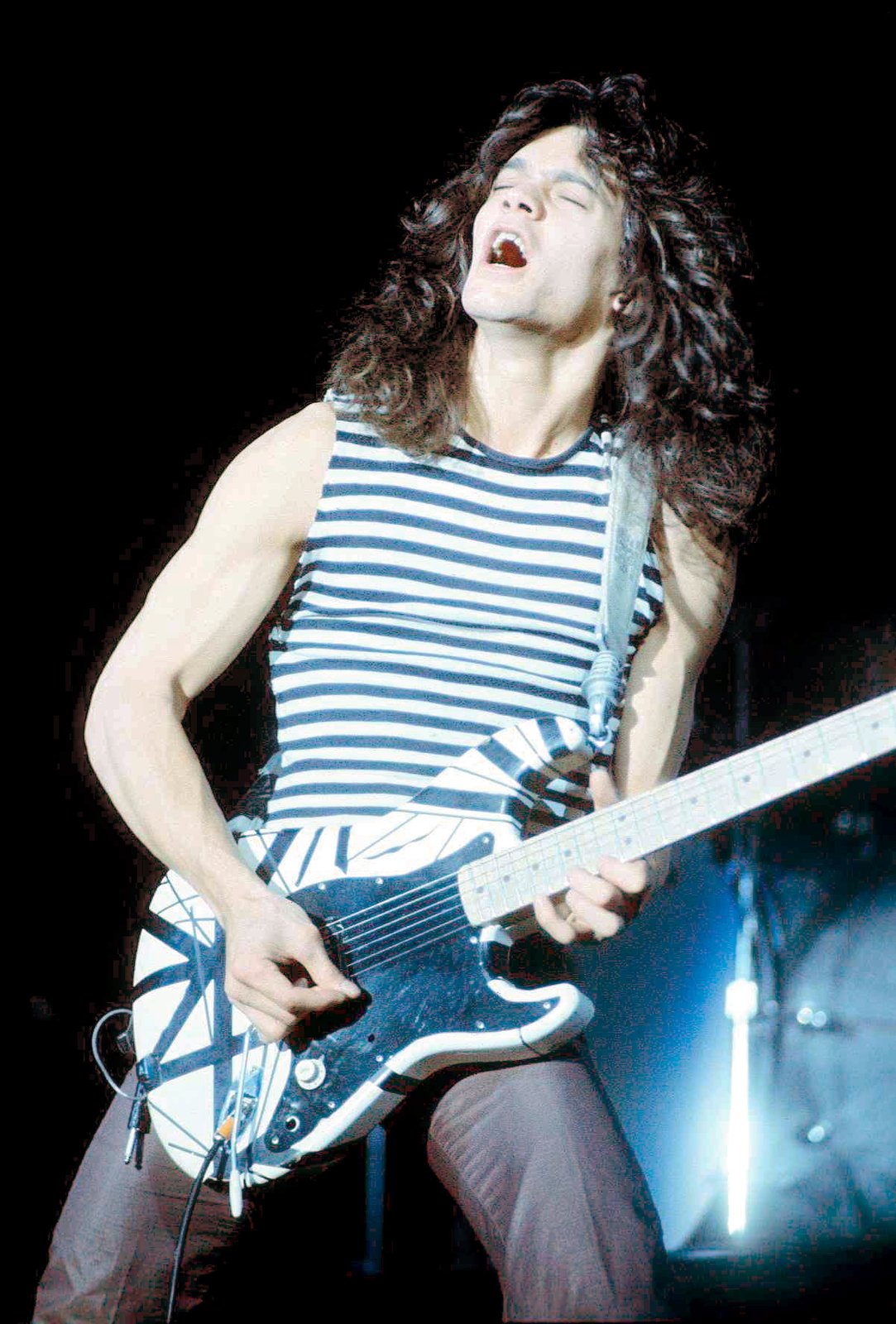
Van Halen's debut album was recorded at Sunset Sound in Hollywood with producer Ted Templeman and released on February 10, 1978. Dave Hunter of Guitar Player said Eddie Van Halen "smeared" the Phase 90's tones all over Van Halen I. Dunlop goes even further and credits the Phase 90 on "virtually every song" on that record. That's a marketing claim, but it shows how central the pedal was.
Eddie told the story of how he found it in a 2014 Guitar World interview with Chris Gill, timed to MXR's 40th anniversary. In the mid-'70s, he and his friend Terry Kilgore were, in Eddie's words, the "so-called gunslingers in Pasadena." At one of Kilgore's band rehearsals, Eddie saw a Phase 90 for the first time. Kilgore played a lot of Robin Trower material and set his Speed knob around 2 o'clock for a fast, swirling sound.
Eddie bought one of his own but went the other way. He set his Speed knob between 9 and 10 o'clock, slow and gentle, and said he kept it there for the rest of his career.
His reason for going slow is the best explanation of the Phase 90 you'll find. He thought other companies' phasers had a heavy sweep that sounded almost like a flanger, while the Phase 90 made "a very light change of the sound." In the same interview he said, "It's not an over-the-top effect. It's very subtle."
He also explained why he used to kick it on for solos. In the club days, Van Halen played through bad PA systems with bad sound engineers. The phaser didn't add volume, but Eddie said it would "make the solo pop," changing the character of the tone enough that his leads cut through the mix. That's a practical trick working players still use today.
Here's where you can hear it:
- "Eruption" — the swirl under the solo and the tapping section is the clearest example of Eddie's slow Phase 90 setting.
- "Atomic Punk" — Guitar World points to the Phase 90 as a sound effect on the intro, where Eddie's scraped and muted string noises turn into something spacey.
- "Ain't Talkin' 'Bout Love" — Guitar World's introduction to that 2015 interview lists it among the classic Phase 90 tracks. Eddie also used his MXR Flanger on this record, and some rig guides credit the Flanger on parts of the song, so if you're learning it, listen closely for which modulation you're hearing.
- "Everybody Wants Some!!" and "Drop Dead Legs" — later Van Halen songs on the same Guitar World list, showing he never stopped using it.
Guitar World also noted that Eddie's original Phase 90 was a 1974 script-logo pedal. That fits his description of the sound: soft, light and subtle, the way the script circuit is known to sound.
It's also worth remembering the rest of the rig, which we break down in our Eddie Van Halen brown sound guide. On those early records, Eddie went through a cranked 100-watt Marshall Super Lead, with his homemade "Frankenstein" guitar plugged into the Phase 90 and Flanger in front of the amp. There was no distortion pedal. The phaser went straight into a roaring tube amp, and that's a big part of why it sounded the way it did.
Page, Gilmour, Trower and the Rest
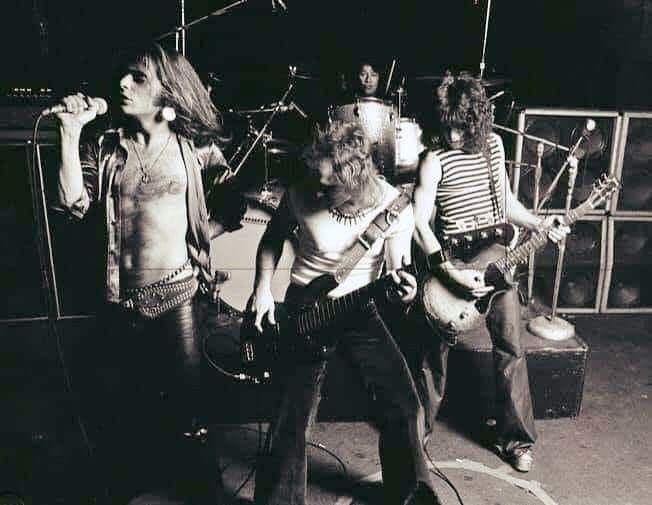
Eddie may be the face of the Phase 90, but the list of other players is long.
David Gilmour (see our David Gilmour tone guide) used a Phase 90 on Pink Floyd's Wish You Were Here (1975). Guitar World points specifically to "Shine On You Crazy Diamond," sometimes with a rotating-speaker effect and sometimes without, and to "Have a Cigar."
Jimmy Page is on Dunlop's list of famous Phase 90 users, and MusicRadar names him alongside Gilmour and Van Halen as one of the players who made it "a pedalboard staple." Exactly which Led Zeppelin recordings it's on is harder to pin down, so we won't guess at a song list here.
Robin Trower, the king of the Uni-Vibe (more on his sound in our Bridge of Sighs tone story), used a Phase 90 on stage for a while as a replacement for his aging vibe, according to Guitar World. That makes sense. At faster speeds, a Phase 90 can get surprisingly close to vibe territory.
Steve Hackett was an early user and can be heard with one on Genesis albums from the mid-'70s.
Punk loved it too. Guitar World says Steve Jones ran his doubled rhythm tracks on the Sex Pistols' "Anarchy in the U.K." through a Phase 90. Guitar Player says Mick Jones put it all over the Clash's "Lost in the Supermarket."
Guitar World lists more recent users including Matt Bellamy of Muse, John Frusciante, Dave Grohl, Josh Homme and John Petrucci. Bellamy has gone a step further: according to a 2022 Premier Guitar interview cited on Wikipedia, he has had a Phase 90 built into his custom Manson guitars.
The Collapse and the Dunlop Revival
MXR was huge in the late '70s, but it didn't last. Competition was fierce, and Guitar Player notes that it was one of several factors that drove the company out of business in 1984. Keith Barr moved to California and started Alesis. Terry Sherwood and four MXR managers and engineers co-founded Applied Research & Technology (ART), the rack-gear maker.
In 1987, Jim Dunlop bought the MXR brand. Dunlop's first MXR releases were the four core classics: the Phase 90, the Distortion+, the Dyna Comp and the Blue Box. They were built in block-logo form with the LEDs and power jacks MXR had added near the end.
Dunlop also fixed a long-standing complaint. The original pedals weren't true bypass, so your signal still went through the circuit when the effect was off, and some players heard a loss of tone. According to ElectroSmash's circuit history, Dunlop's reissue added an input buffer around 1989–1990 to deal with that.
The EVH Phase 90: Two Circuits, One Switch
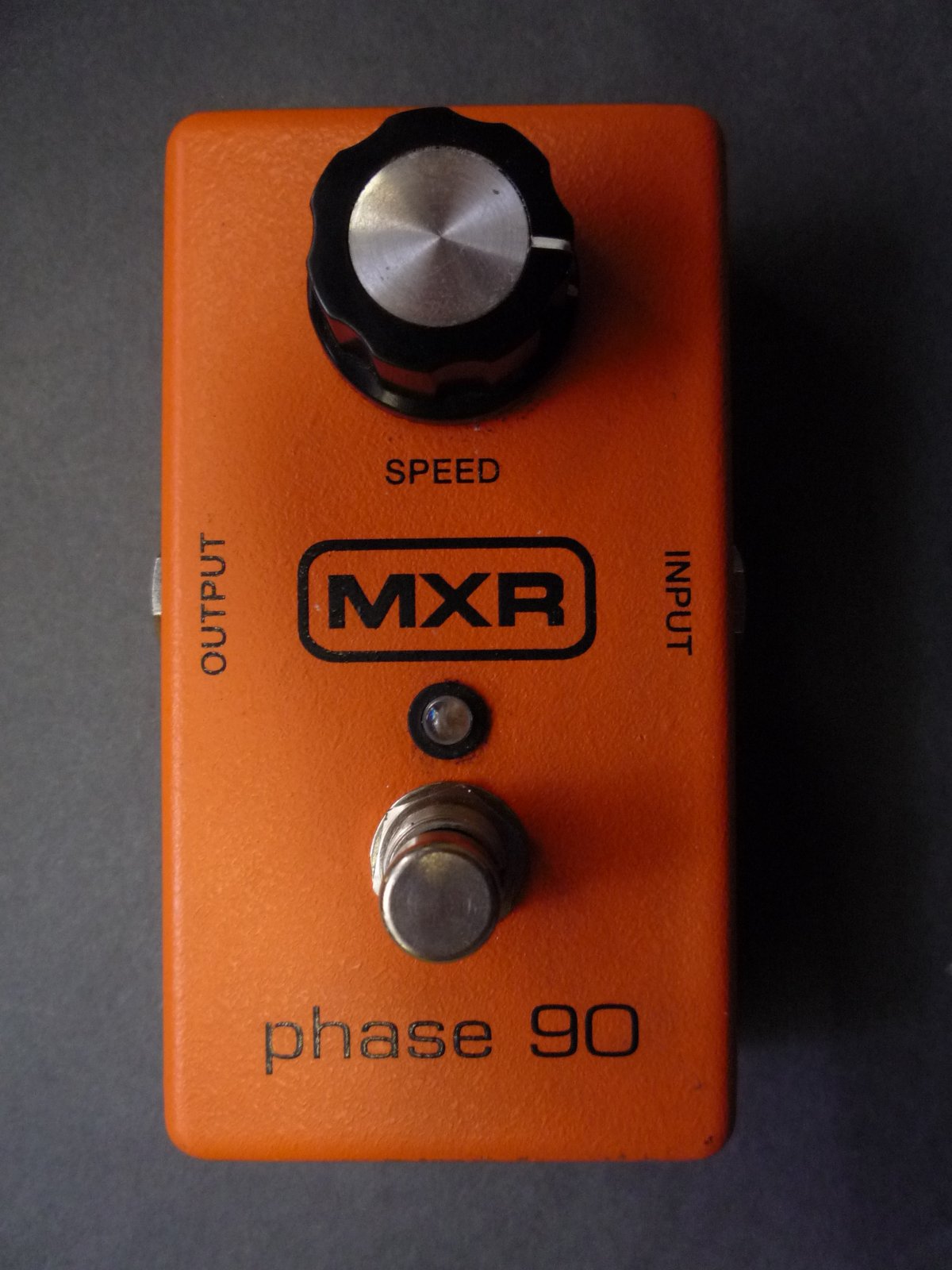
When Eddie Van Halen wanted to work with Dunlop on versions of his classic MXR pedals, Dunlop engineer Bob Cedro started with his own original 1974 script-logo Phase 90. Dunlop's account says Cedro built a prototype script-style circuit and modified it for more headroom and dynamic range. For testing, he added a switch so Eddie could compare it with the block sound.
Eddie liked the switch so much that he kept it. The finished EVH90 came out in 2004. It has a Script button that switches between the subtle vintage sound and the more aggressive block sound, which in circuit terms basically turns the feedback resistor on and off. It's also painted in the red, white and black stripes of Eddie's Frankenstein guitar.
It was a hit. Guitar World reported in 2015 that the EVH90 and the later EVH117 Flanger (2007) had become "perennial best-selling" MXR products. When Dunlop surveyed guitarists about which player they associate most with MXR, Eddie was the answer more than 60 percent of the time.
The EVH90's success led Cedro back to his 1974 pedal for two more reissues. The '74 Vintage Phase 90 has a hand-wired board, selected resistors and hand-matched FETs in a script-logo box. It's also battery-only with no LED, just like the original. The Script Phase 90 offers that script sound with a modern LED and power jack.
Phaser vs. Flanger vs. Uni-Vibe
These three get mixed up all the time, partly because Eddie used two of them on the same records. Here's the quick version.
| Effect | How it moves the sound | What it sounds like | Classic example |
|---|---|---|---|
| Phaser (Phase 90) | All-pass filter stages create a few notches that sweep up and down | Smooth, hollow swirl; subtle at slow speeds | Van Halen, "Eruption" |
| Flanger | A very short, changing delay mixed with the dry signal creates many evenly spaced notches | Metallic, jet-plane sweep; more dramatic | Van Halen, "Unchained" (MXR Flanger) |
| Uni-Vibe | An optical phaser: a light bulb and four photocells drive staggered stages | Throbbing, lurching pulse, close to a rotating speaker | Hendrix, "Machine Gun" |
The key difference between a phaser and a flanger is the number and spacing of the notches. A flanger uses a delay, so it creates a whole comb of notches spread evenly across the frequency range. That's where the jet-plane whoosh comes from, especially with the feedback (regeneration) turned up. A four-stage phaser like the Phase 90 only has two notches, and they aren't evenly spaced, so it sounds softer and more vocal.
The Uni-Vibe is technically a phaser too. Its bulb and photocells, plus its deliberately mismatched stages, give it a lumpier, more organic pulse. Turn a block-circuit Phase 90 up fast and it gets into Uni-Vibe territory. That's why Guitar World suggests setting the knob around 2 o'clock with a drive pedal in front for a Hendrix-and-Trower vibe sound. Still, it's not the same thing.
Getting the Sound: Tone Tips
These are starting points based on how the circuit works and on the players and sources quoted above. They're not TGP bench tests.
Start slow. Eddie's 9-to-10 o'clock setting is the classic for solos and rhythm parts that need a little movement without seasickness. Turn the knob up toward 2 o'clock for vibe-style throb, and keep it fast for special effects.
Decide where it goes: before or after the dirt. There's no single right answer. Ask yourself whether you want the distortion to chew on the moving signal, or the phaser to color an already distorted sound.
- Before your drive or before a cranked amp (Eddie's approach): the swirl gets mixed into the distortion, so it sounds thicker and more like part of the guitar. It's subtle and great for leads.
- After your drive pedal: the sweep is more obvious and pronounced. Guitar World notes that putting a drive in front of a Phase 90 makes the phasing stand out more.
- Into an amp with an effects loop: putting the phaser in the loop, after the preamp distortion, gives you the most obvious, hi-fi sweep. Try it if your amp gets its gain from the preamp.
Watch out with vintage fuzz. Fuzz Face-style circuits can be picky about what comes before them, especially buffers. If your fuzz suddenly sounds thin with the phaser in front of it, try putting the fuzz first. Our Fuzz Face history explains why.
Pick script or block on purpose. For Eddie's light, early sound, use script mode (or a script pedal). For a chewier, more vocal sound that cuts with distortion, use block mode.
Use it like Eddie did: kick it on for solos. A phaser doesn't add volume, but it changes the texture enough to help a lead cut through a busy band.
Tune carefully. Modulation makes small tuning problems much more obvious. Check your tuning with our Free Guitar Tuner before you start chasing tones. Fresh strings help too, since old, dull strings take away the shimmer a phaser depends on.
Modern Versions and Clones
There are more Phase 90s and Phase 90-inspired pedals available today than at any other point in the pedal's history. Here are the main options.
Dunlop MXR Phase 90 (M101). This is the standard block-logo Phase 90 with an LED and power jack. It's the pedal most people mean when they say "Phase 90."
MXR Script Phase 90 (CSP101SL). This one has the subtle script circuit, but with an LED and power jack.
MXR '74 Vintage Phase 90 (CSP026). This is the purist's choice: a hand-wired board with hand-matched FETs, no LED, and battery power only.
MXR EVH90. You get both script and block sounds in one box, plus the Frankenstein graphics.
MXR Phase 95 (2017). This was MXR's first mini pedal. It gives you Phase 45 and Phase 90 modes, each in script or block form, so it's four phasers in a mini-size box.
MXR Phase 100. This is the bigger, more dramatic sibling with four intensity settings, for players who want a deeper sweep.
Clones and alternatives. Because the circuit is simple and well documented, there are plenty of Phase 90-inspired pedals and DIY kits. Mooer's Ninety Orange is a budget mini pedal with a vintage/modern switch that covers similar script-vs-block territory, plus true bypass. The Electro-Harmonix Small Stone isn't a clone. It's the Phase 90's old rival, with a different circuit, a Color switch for a more dramatic sweep, and its own fans.
Which Phase 90 Should You Buy?
Here's a short buying guide. These are researched picks, not pedals we've tested for this article. Prices change often: the figures below are Dunlop's own store prices as of October 2026, and street prices are often lower. If you buy through the Amazon link below, TGP may earn a commission at no extra cost to you.
| If you want… | Get… | Why |
|---|---|---|
| The classic sound at the lowest price from MXR | M101 Phase 90 ($99.99) | The standard block circuit, built tough, easy to find new or used |
| Eddie's subtle Van Halen I sound | Script Phase 90 ($139.99) or '74 Vintage ($159.99) | The script circuit without the feedback resistor; the '74 adds hand-wiring and vintage details |
| Both sounds and the EVH look | EVH90 ($139.99) | A Script switch flips between vintage and block |
| Maximum flexibility in minimum space | Phase 95 ($115.99) | Phase 45 and Phase 90 modes, script and block, in a mini case |
| A cheap way to try a Phase 90-style pedal | Mooer Ninety Orange or a DIY kit | Covers similar ground for less money, but it's not an MXR |
| A real vintage pedal | Original script or block MXR | The real thing, but expensive, no true bypass, and you'll want to check the board inside |
If you're new to phasers, the simple answer is the M101 or the EVH90. If you know you want Eddie's early sound, choose a script-circuit pedal. If you're buying vintage, open it up before you pay script-logo prices.
Why the Orange Box Still Matters
The Phase 90 succeeded by leaving things out. It had no depth control, no mode switch, and only one knob, set by a guy in Rochester who thought the bulky phasers on the market could be done better. That simplicity is exactly why it worked. Guitarists didn't have to tweak it. They had to play it.
Eddie Van Halen showed what that meant. He found one setting he liked in the mid-'70s and kept it for the rest of his career, using the phaser to make his solos jump out of a bad club PA and onto one of the most influential debut albums in rock. Gilmour used it for shimmer, Steve Jones used it for snarl, and Trower used it as a stand-in for his Uni-Vibe. All of them were working with the same knob.
More than 50 years later, the little orange box is still in production. If you want to hear what movement does to a great guitar tone, start there: set the knob at 9 o'clock, plug into something loud, and play "Eruption" badly until you play it less badly.
Want more pedal history? Read the stories of the Ibanez Tube Screamer, the ProCo RAT and the Boss DS-1, then tell us in Guitar Talk: script or block, and where does your phaser go in your chain?
Sources
- Guitar Player, Dave Hunter, "A Favorite of Eddie Van Halen, the MXR Phase 90 Smeared Its Luscious Tones Over Countless Classic Recordings" (2023): https://www.guitarplayer.com/gear/mxr-phase-90-phaser-pedal
- Guitar World, Chris Gill, "The smallest, the simplest, the best? Why the MXR Phase 90 remains a pedalboard classic" (2024): https://www.guitarworld.com/features/mxr-phase-90-history-of-a-pedalboard-classic
- Guitar World, Chris Gill, "Eddie Van Halen on how he created his signature sound using MXR's Phase 90 and Flanger pedals" (2015): https://www.guitarworld.com/gear/eddie-van-halen-how-he-created-his-signature-sound-using-mxrs-phase-90-and-flanger-pedals
- MusicRadar, Trevor Curwen, "MXR CSP-026 '74 Vintage Phase 90 review" (2008): https://www.musicradar.com/reviews/guitars/mxr-csp-026-74-vintage-phase-90-156062
- MusicRadar, "In praise of: MXR Phase 90" (2015): https://www.musicradar.com/news/guitars/in-praise-of-mxr-phase-90-622648
- ElectroSmash, "MXR Phase 90 Analysis": https://www.electrosmash.com/mxr-phase90
- Mix, George Petersen, "In Memoriam: Keith Barr 1949–2010" (2010)
- Dunlop, MXR Phase 90 product page: https://www.jimdunlop.com/mxr-phase-90/
- Dunlop, MXR '74 Vintage Phase 90 product page: https://www.jimdunlop.com/mxr-74-vintage-phase-90/
- Wikipedia, "MXR Phase 90": https://en.wikipedia.org/wiki/MXR_Phase_90
Experience-driven coverage, not algorithm bait.
- 20+ years of guitar playing experience
- Real-world retail experience at Guitar Center
- Thousands of hours testing guitars, amps, and pedals
- A community of 50,000+ guitar enthusiasts across platforms
- Partnerships with Fender, DistroKid, TrueFire, Card Chords, and Enya
- Editorial standards published openly — see how we test gear
The Modern Guitar Magazine. Delivered to your inbox.
No spam. No gimmicks. Just great guitar content — stories, tones, iconic solos, and honest gear takes. Every week.
Ask GP
3 free questions a dayStill curious? Ask GP about this story.
Your personal classic-rock and guitar guide — ask anything about The MXR Phase 90 History.
Discussion (0)
Sign in to join the discussion.
Sign in to commentLoading comments…
Discover another guitar story
Swipe through our latest features, breaking news and iconic solos — one story at a time.
Open Swipe →More Guitar News
Boss DS-1 History: The Orange Box That Defined Distortion
The Boss DS-1 history from its 1978 debut to the Waza Craft DS-1W: the circuit, the chip changes, the mods, and the players who made the orange box famous.
The Fuzz Face History: How a Cheap Copy in a Mic-Stand Base Outlived Its Flaws
The Fuzz Face was a borrowed circuit in a mic-stand base, and half of them sounded bad. Here's how it became Hendrix's fuzz and still sells 60 years later.

Eddie Van Halen’s “Brown Sound”: What He Actually Used & How to Get Close Today
Few guitar tones in history are as mythologized as Eddie Van Halen’s “brown sound.” It wasn’t one magic piece of gear—it was a chain of simple tools pushed in very specific ways. Here’s the real rig, and how to recreate it with modern gear.

The Solo That Changed Guitar Forever: Inside Eddie Van Halen's Eruption
At just 102 seconds, Eddie Van Halen's Eruption rewired what a rock guitarist could do — a perfect collision of speed, feel, the legendary Brown Sound, and fearless innovation that still defines electric guitar nearly five decades later.