
The Fuzz Face History: How a Cheap Copy in a Mic-Stand Base Outlived Its Flaws
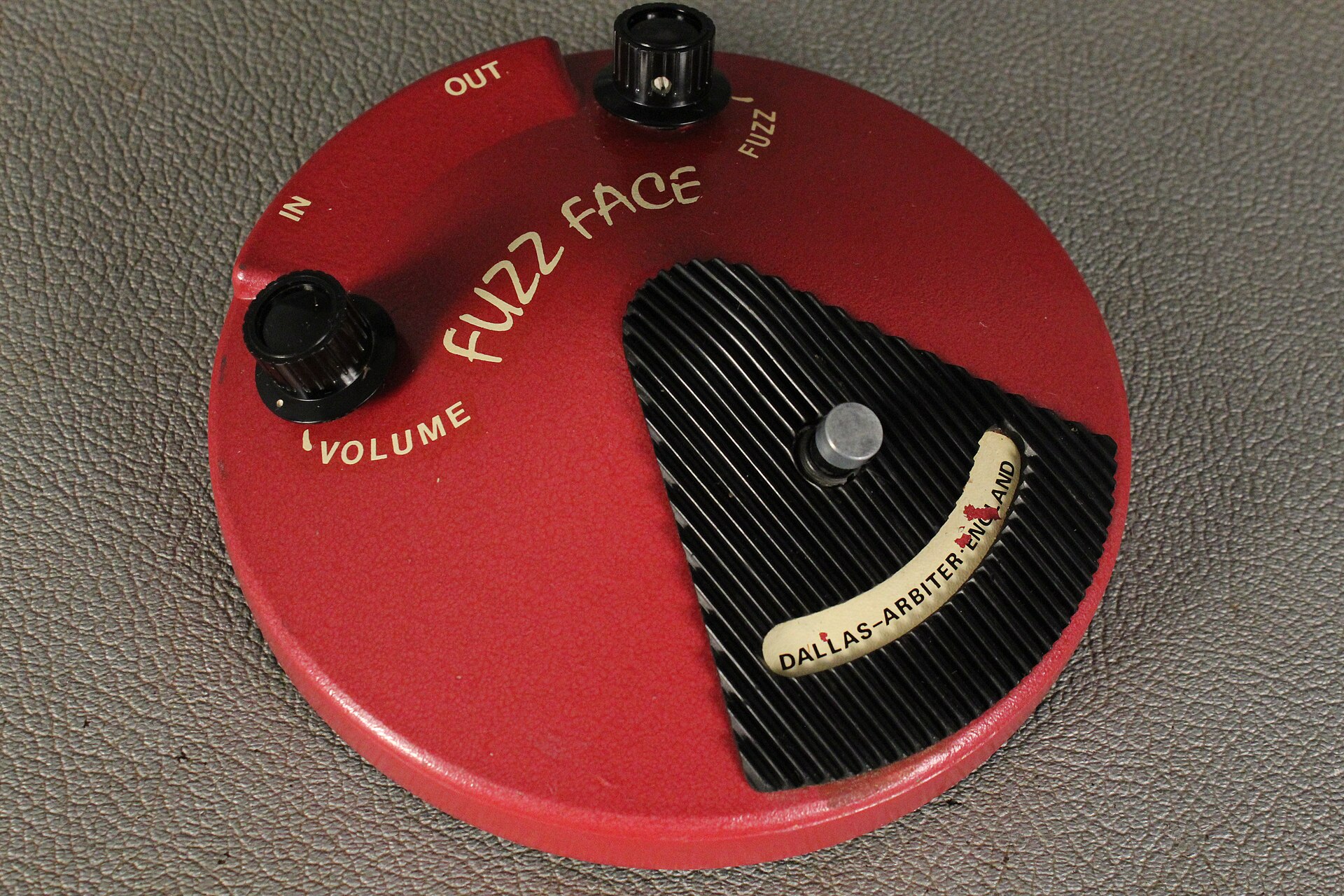
A red Dallas-Arbiter Fuzz Face: Volume, Fuzz, a footswitch, and the "smile." (Illustrative photo.)
CC BY 2.0 (https://creativecommons.org/licenses/by/2.0/). Photo: sploshette / Flickr via Wikimedia Commons. Source: https://commons.wikimedia.org/wiki/File:Dallas_Arbiter_Fuzz_Face.jpg
The Fuzz Face was a borrowed circuit in a mic-stand base, and half of them sounded bad. Here's how it became Hendrix's fuzz and still sells 60 years later.
The Fuzz Face wasn't an original circuit, it wasn't well engineered, and by the account of the man who kept Jimi Hendrix's pedals alive, maybe one in twenty sounded good. It still became the most recognizable fuzz box ever made.
Ivor Arbiter, a London drum-shop owner, put a borrowed two-transistor circuit into a round housing inspired by the base of a microphone stand and sold it cheap in 1966. Within weeks Hendrix had one at his feet. Sixty years later Dunlop sells about half a dozen versions of it, and players still argue about transistors that went out of production decades ago. This is the Fuzz Face history that matters to guitar players: where it came from, why it behaves the way it does, which myths don't hold up, and which modern version makes sense on your board.
Soho, 1966: A Drum Man Builds a Fuzz Box
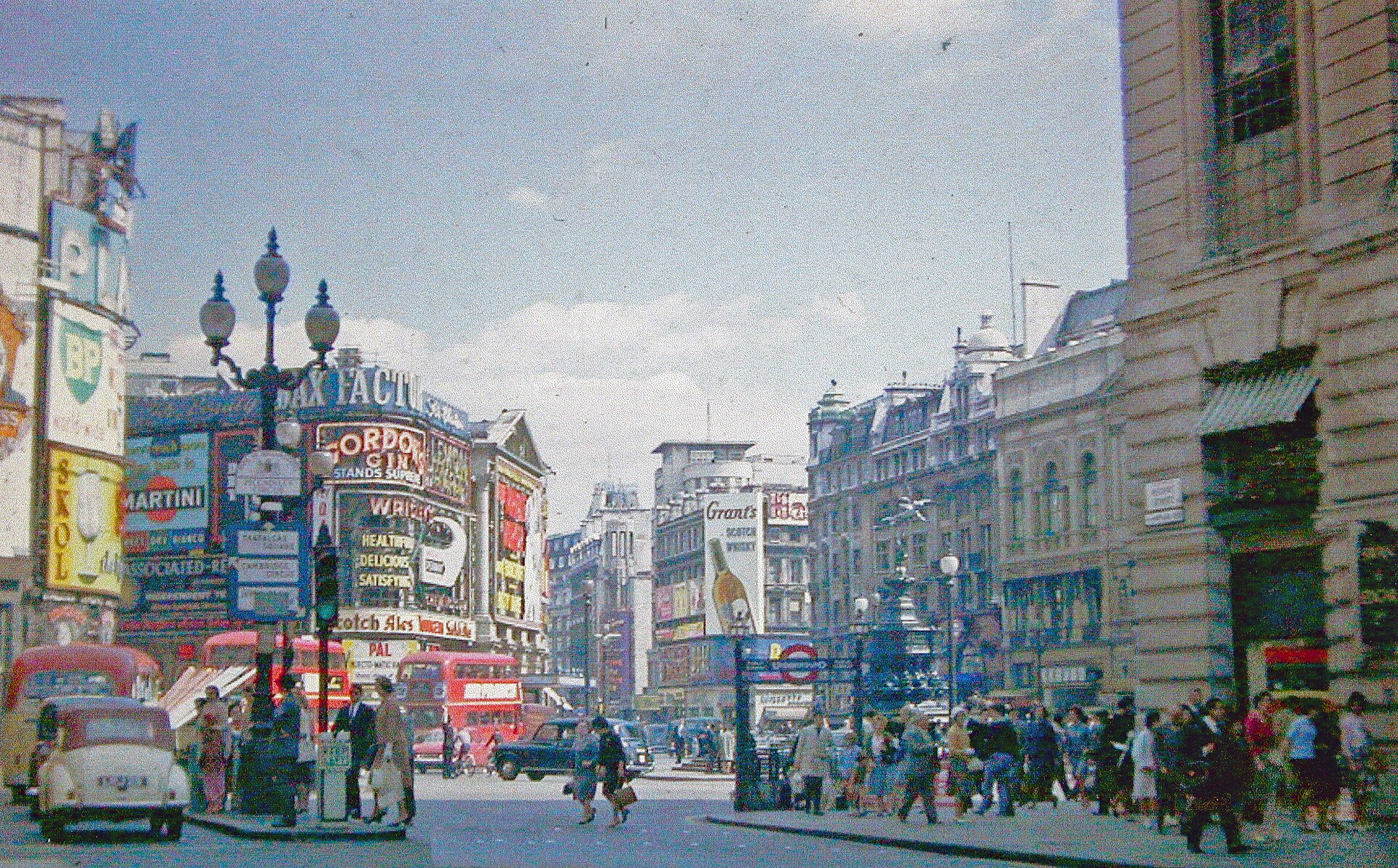
Ivor Arbiter wasn't an electronics engineer. Born in south London in 1929, he started out repairing saxophones, and by the early 1960s he ran a cluster of shops in the West End: Drum City on Shaftesbury Avenue and Sound City, first on Rupert Street and later on Shaftesbury Avenue. He's the man credited with sketching the Beatles' "dropped-T" logo onto the bass drum head of the Ludwig kit he sold Ringo Starr in 1963.
CC BY-SA 2.0 (https://creativecommons.org/licenses/by-sa/2.0/). Photo: Ben Brooksbank / geograph.org.uk via Wikimedia Commons. Source: https://commons.wikimedia.org/wiki/File:Picadilly_Circus_geograph-3963212-by-Ben-Brooksbank.jpg
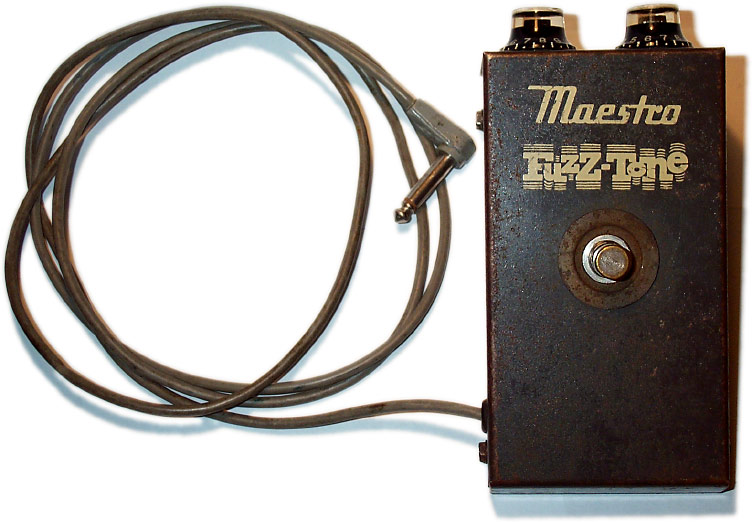
By the mid-'60s, his company, Arbiter Electronics, had its own factory in Ashford, Middlesex, and fuzz was the hot new sound. The Maestro Fuzz-Tone had been on the market since 1962 and was all over "(I Can't Get No) Satisfaction" in 1965, but in London it was rare and expensive. Vintage Guitar's history of the pedal puts the Maestro at about £30 in the UK, against roughly £6 for the Fuzz Face. Arbiter's own launch advertising listed a recommended retail price of 8 guineas, so the exact gap depends on whose number you trust. Either way, the Fuzz Face was the cheap option, and that was the whole point.
Copyrighted free use per the Commons file page. Photo: Red Rooster / Wikimedia Commons. Source: [https://commons.wikimedia.org/wiki/File:Gibson_maestro_fuzz_tone_1_752.jpg](https://commons.wikimedia.org/wiki/File:Gibson_maestro_fuzz_tone_1_752.jpg)
According to the research site Fuzzboxes.org, which has documented well over a hundred surviving units, the Fuzz Face was first shown at the British Musical Instrument Industries trade fair in August 1966. Potentiometer date codes in surviving pedals suggest production didn't really ramp up until that September. By November it was in the shops.
The Circuit Arbiter Didn't Invent
The Fuzz Face circuit is often described as "textbook," and in a sense it is. Two transistors, a handful of resistors and capacitors, two pots, and a switch. Roger Mayer, the electronics engineer who worked on Hendrix's effects, put it bluntly to MusicRadar: "It's impossible to patent an obvious way of connecting up two transistors."
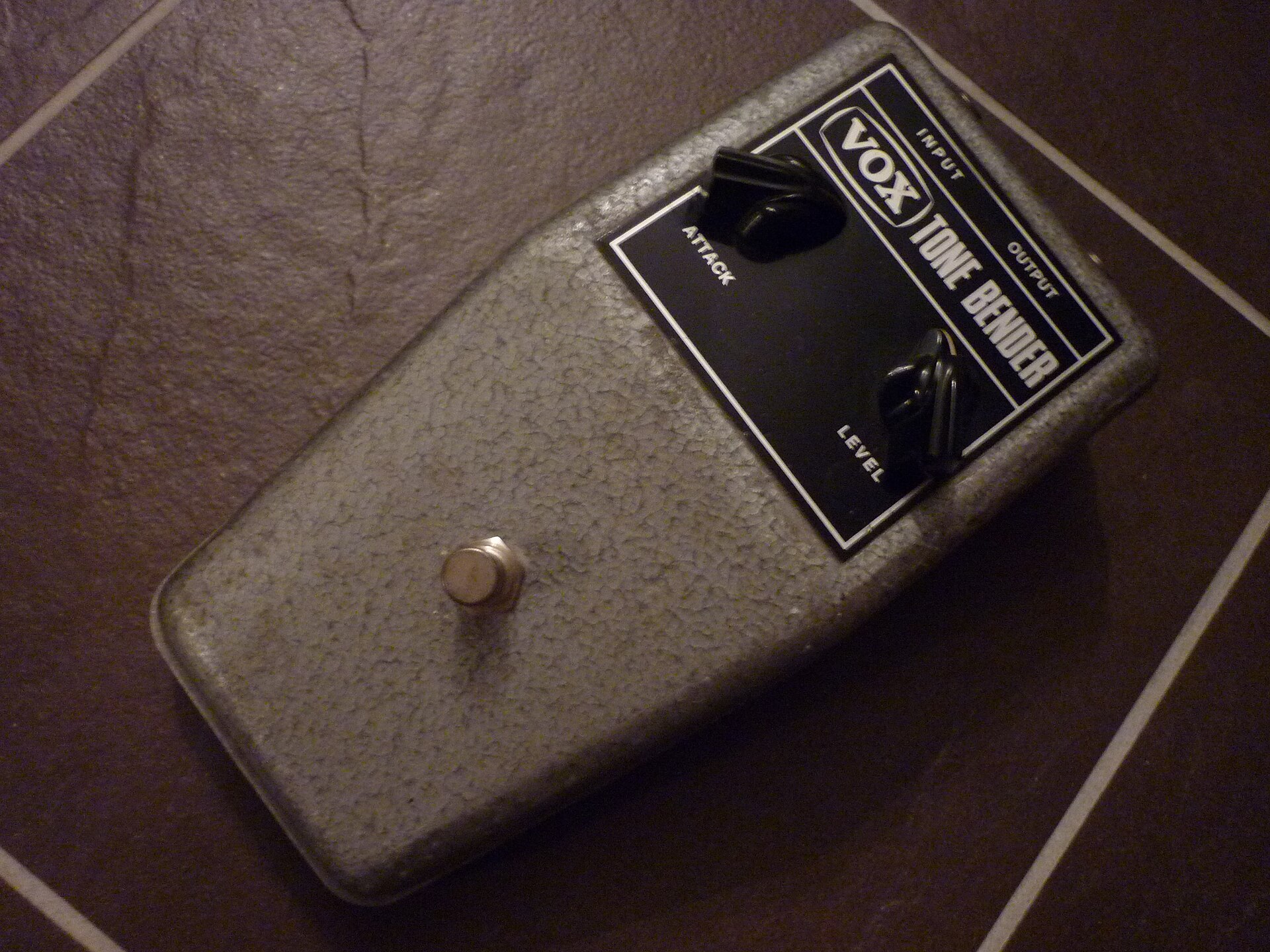
But Fuzzboxes.org makes a sharper case. The specific mix of part values in early Fuzz Faces nearly matches Sola Sound's two-transistor Tone Bender from 1966, the version collectors call the "MK1.5." The main changes were Newmarket NKT275 germanium transistors in place of the Tone Bender's Mullard OC75s and a slightly different bias on the first transistor. The site also notes that Arbiter's own instruction sheet called the Fuzz Face a "Tone-Bending" unit.
CC BY 2.0 (https://creativecommons.org/licenses/by/2.0/). Photo: sploshette / Flickr via Wikimedia Commons. Source: https://commons.wikimedia.org/wiki/File:1966_VOX_TONE_BENDER_FUZZ.jpg
So the Fuzz Face wasn't a new sound so much as a known sound, made cheaper and put in a box nobody could forget. That isn't a knock on it. Plenty of great gear started as a better-marketed version of something that already existed.
The Mic-Stand Base and the Smile
The box is the part Arbiter did invent. Denis Cornell, who tested Fuzz Faces at the factory before they shipped and later built his own pedals and amps, told MusicRadar that Arbiter explained the shape himself: "He used the bottom of a microphone stand to fit the circuit board in, and that is how the round shape came about."
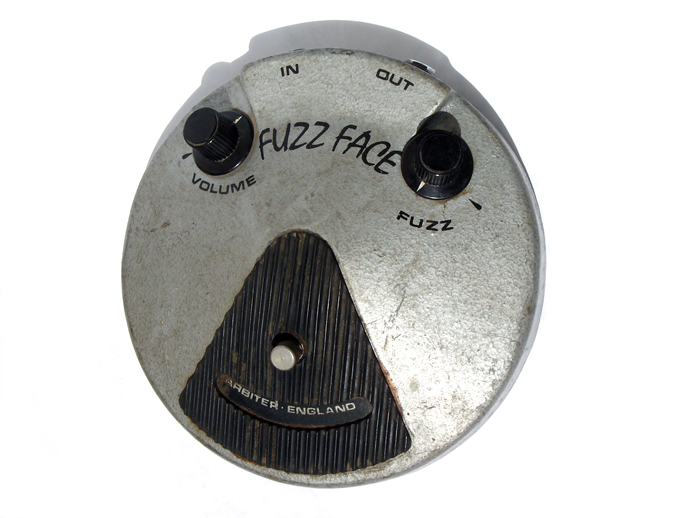
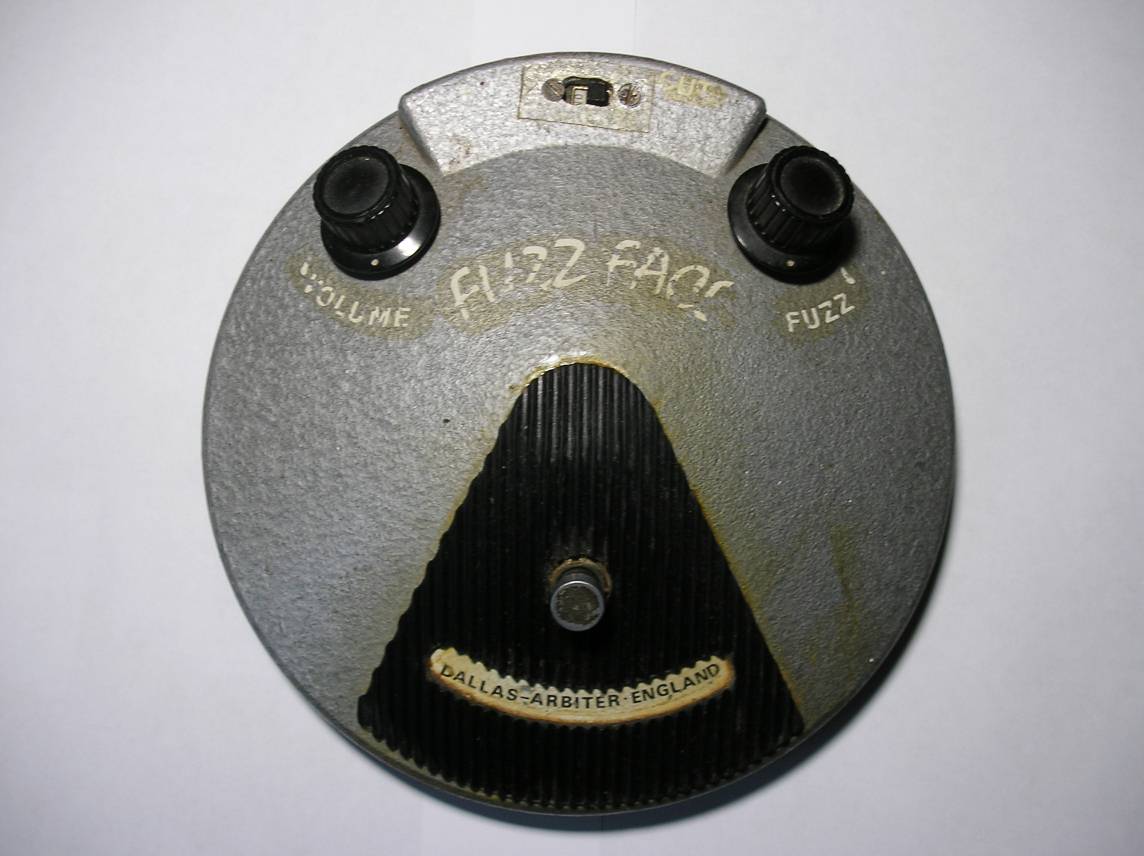
The production version moved into a sand-cast aluminum housing with a steel bottom plate held on by one center screw. Put the Volume and Fuzz knobs up top, the footswitch in the middle, and the semicircular "Arbiter England" logo plate below, and the pedal looks like a face smiling up at you. Arbiter's launch copy called the design "both attractive and amusing," and offered it in red, black, or hammered silver. Blue and gray versions followed.
Every other fuzz on the market at the time was a wedge or a plain box. The Fuzz Face had a personality, and it's hard to overstate how much that has helped it since. You can identify one from across a stage, which matters when the most photographed guitarist of the era is standing on it.
CC BY-SA 3.0 ([https://creativecommons.org/licenses/by-sa/3.0/](https://creativecommons.org/licenses/by-sa/3.0/)). Photo: Starman1984 / Wikimedia Commons. Source: [https://commons.wikimedia.org/wiki/File:Fuzzfacewiki1.jpg](https://commons.wikimedia.org/wiki/File:Fuzzfacewiki1.jpg)
Hendrix and the Twenty-Pedal Problem
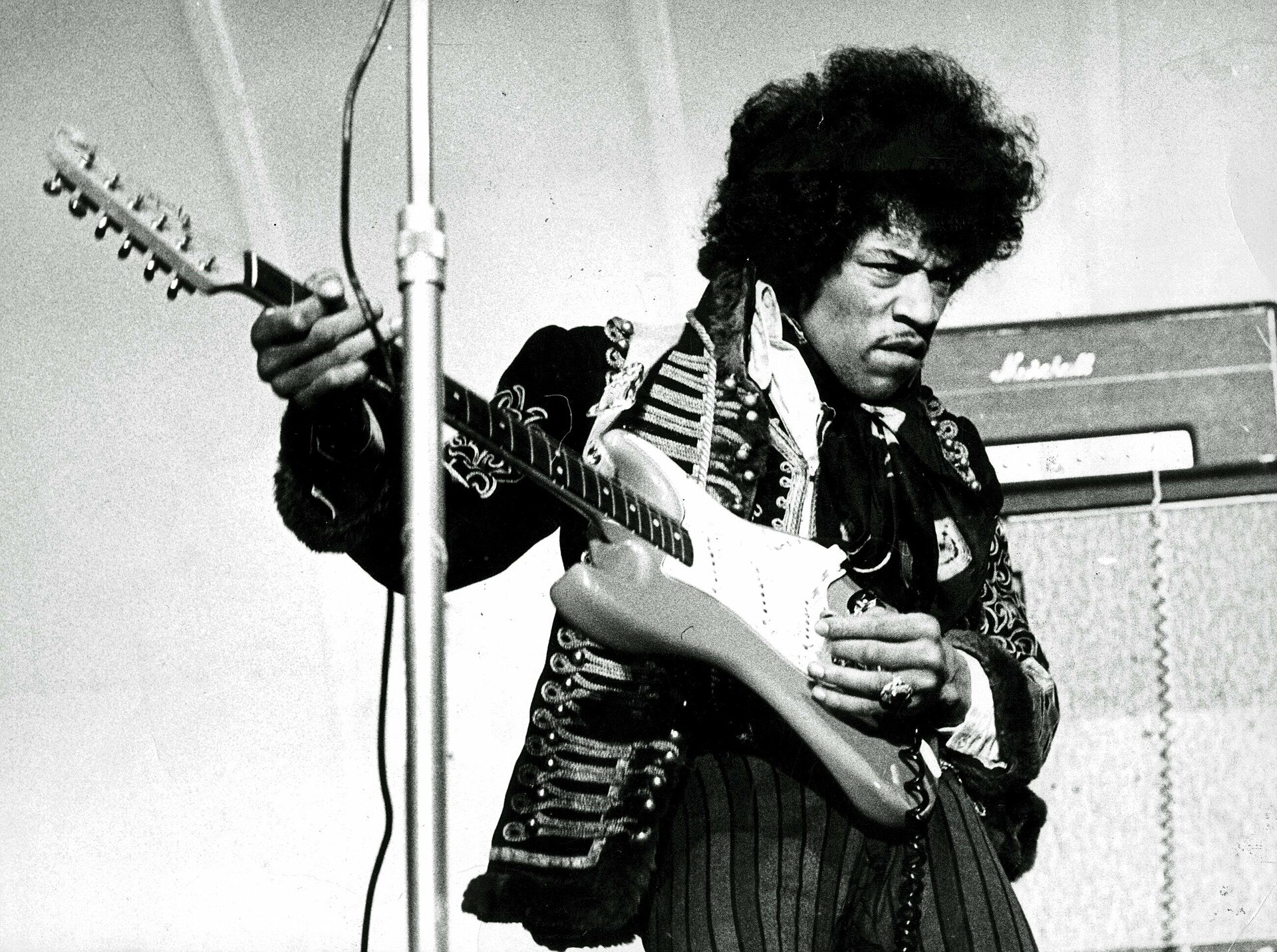
Jimi Hendrix landed in London in September 1966. Fuzzboxes.org says he was photographed performing with a Fuzz Face in November that year, which means he found it almost as soon as it hit the shops. By the time Are You Experienced came out in 1967, the round pedal and the Marshall stack were part of his image.
Public domain (per the Commons file page). Photographer unknown. Source: https://commons.wikimedia.org/wiki/File:Jimi_Hendrix_1967_uncropped.jpg
The problem was consistency. Mayer, who started working with Hendrix in early 1967, said he quickly took a Fuzz Face back to his lab to see why no two sounded alike. "It became apparent without very much analysis that it is what one would call a 'minimum-parts circuit,'" he told MusicRadar. "So, this very simple circuit: yes, it worked, but maybe only one out of 20 worked well."
The parts of the day had wide tolerances. Mayer said resistors could test 10 to 20 percent off their rated values and capacitors could swing from minus 20 to plus 50 percent. The transistors were worse. In a 2003 interview with Tom Hughes, later published by Premier Guitar, Mayer described germanium transistors whose gain could range "anywhere from 100 up to 800." In a circuit this simple, where the two transistors depend on each other, that spread decides whether a pedal sings or sputters.
Cornell saw the same thing from inside the factory. "At first, testing these units was a nightmare - each unit having different output levels, I seemed to be forever changing transistors to find some kind of common ground," he told MusicRadar. Oscilloscope tests didn't reveal the differences, so he added a guitar test. "Striking a note and listening to the decay: poor units would die away quickly and lose the tone… Finding a good one was a dream, and the guitar would sustain forever."
Why Hendrix kept buying cheap ones
Mayer's fix was to measure everything in a pedal that worked and match parts until other units behaved the same way. He also built his own fuzz boxes for Hendrix within a couple of months of meeting him. But those were expensive and irreplaceable, so they mostly stayed in the studio. The road got the cheap ones.
"You couldn't go and buy 20 of them down the road for £6 each," Mayer told MusicRadar. "So, the boxes I made for Jimi, he didn't want to lose, so we only took out commercial ones on the gigs. Then we didn't worry if they were stolen. We had 15 or 20 of them and we used to lose three or four a week!"
Temperature made it worse. Mayer told Hughes that Hendrix "would buy half a dozen of these pedals, find one that sounded great, and then we'd mark it." The next night, in a hotter or colder room, the same pedal might sound wrong. "I'd say, 'Well, it's got to be temperature, Jimi. That's the only thing that's changing.'"
What you hear on the records isn't just a Fuzz Face
This is the part that tone-chasers tend to skip. Mayer told Vintage Guitar that Hendrix rarely recorded through a Fuzz Face on its own. In the studio, Mayer put buffers and equalization in front of the pedal so it saw a low-impedance source instead of the guitar's pickups, varied the voltage, and shaped the tone again after it. Hendrix also blended two or three amps and sometimes a direct signal.
"You're not going to get the tone that Jimi Hendrix got on a record with one simple device," Mayer said. "That's not going to happen, mate!"
CC BY 2.0 (https://creativecommons.org/licenses/by/2.0/). Photo: ~Jen~ from Victoria BC, Canada / Flickr via Wikimedia Commons. Source: https://commons.wikimedia.org/wiki/File:Shin-ei_Uni-Vibe_(1968),_Jimi_Hendrix,_EMP_Museum.jpg
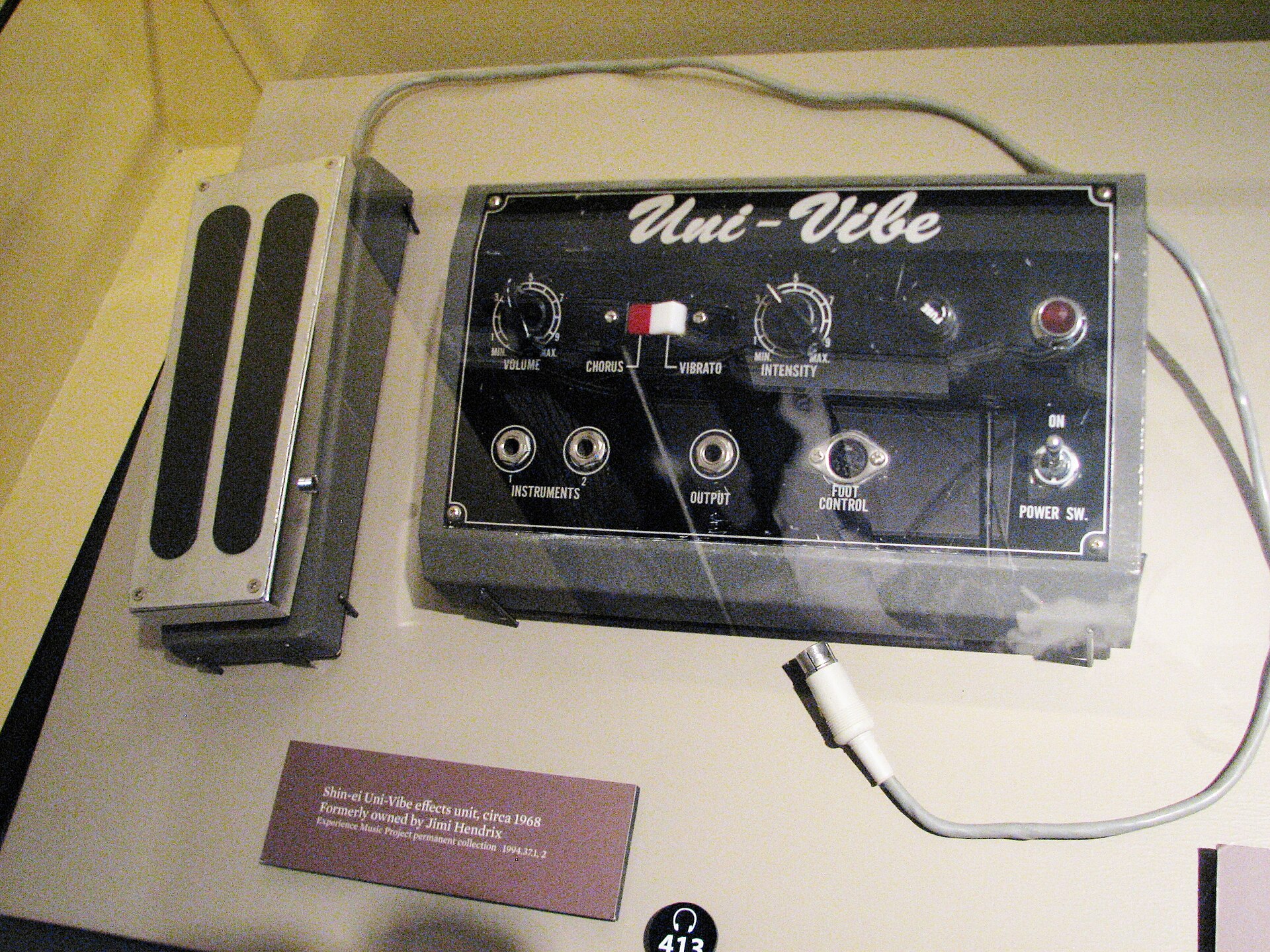
So if your Fuzz Face clone doesn't sound like "Purple Haze," the pedal isn't necessarily broken. The record was never one pedal into one amp. (For the full story of that riff, including Mayer's Octavia on the solo, see our History of the Riff: Purple Haze.)
Germanium to Silicon: When Did the Switch Actually Happen?
Every Fuzz Face conversation eventually becomes a germanium-versus-silicon argument, and the history behind it is muddier than most forum posts admit.
The broad outline is agreed. The first Fuzz Faces used PNP germanium transistors, which most players describe as warmer, lower in gain, and better at cleaning up. Later units switched to NPN silicon transistors, which were cheaper, more consistent, and less sensitive to heat, but brighter and more aggressive. The question is when.
Here's where the sources split:
- Roger Mayer told MusicRadar: "They were still germanium-only at the beginning of 1967, but I reckon that by about mid-'67 they were on to silicon; by Axis: Bold As Love they were silicon."
- Tom Hughes, author of Analog Man's Guide to Vintage Effects, put the change much later for Hendrix: germanium "right up to Are You Experienced," and silicon by the Band of Gypsys period.
- Fuzzboxes.org, working from pot date codes in surviving pedals, found the earliest silicon Fuzz Faces (with BC183L transistors) typically carry pots dated October 1968, and germanium units were still being built into 1969. It suggests the two types were made side by side for a while around 1968 and 1969.
The physical evidence supports a later switch than Mayer remembered, at least for factory production. It's possible Hendrix's team had silicon units or modified pedals earlier, but if you're buying a "1967 silicon Fuzz Face," be skeptical.
CC BY-SA 3.0 (https://creativecommons.org/licenses/by-sa/3.0/). Photo: Djdaedalus at English Wikipedia / Wikimedia Commons. Source: https://commons.wikimedia.org/wiki/File:FuzzFace_Effect_Pedal_Inside.jpg
The AC128 question
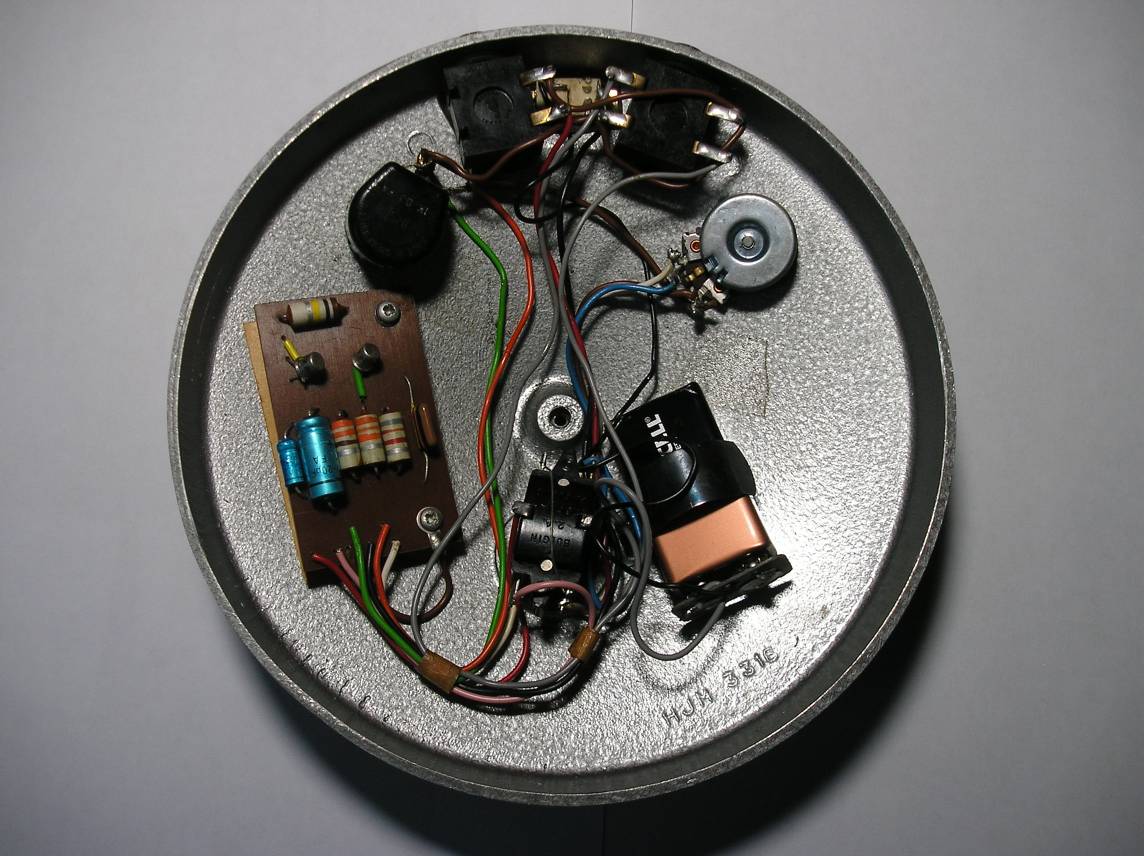
You'll also read that early Fuzz Faces used AC128 transistors as well as NKT275s. Cornell himself told MusicRadar he thought the "Arbiter-England" units used AC128s. Fuzzboxes.org disagrees: it says photos of more than a hundred surviving germanium units show only NKT275s, and that unusual transistors in vintage pedals appear to come from later repairs. It points out that Cornell used AC128s when he built Arbiter's Fuzz Face reissue in the late 1990s, which may be where the memory crossed over. That's a credible explanation, but it's an inference, so treat it as the best current answer rather than settled fact.
The later silicon units went through BC183L, BC183KA, BC108C, BC209C, and BC239C transistors, according to the same research. The BC108 is the one most players know by name, largely because of Hendrix's late-period pedals and David Gilmour.
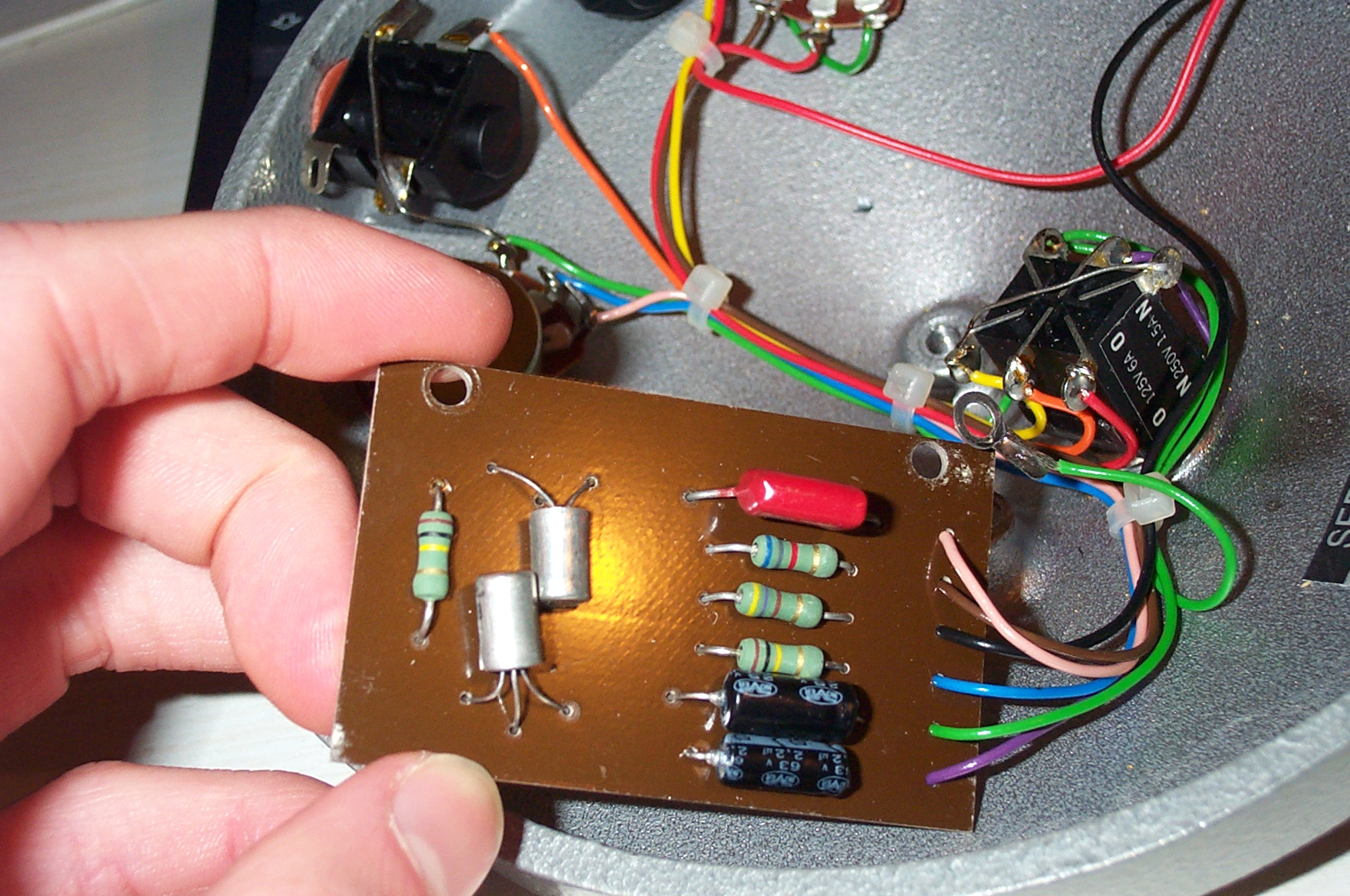
CC BY 2.0 (https://creativecommons.org/licenses/by/2.0/). Photo: germanium from Eichwalde, Germany / Flickr via Wikimedia Commons. Source: https://commons.wikimedia.org/wiki/File:Arbiter_Fuzz_Face_(reissued_model)_-_circuit_board_(2005-03-10_19.33.04_by_germanium).jpg
How a Fuzz Face Actually Works
You don't need to read a schematic to use a Fuzz Face, but a few facts about the circuit explain almost everything people love and hate about it.
It's two transistors feeding each other. The first transistor amplifies the guitar signal, and the second amplifies it again. A feedback path between them sets how hard the pair works, and the Fuzz control adjusts that. Cornell described the result as close to a "Schmitt trigger," a circuit that turns a wave into something like a square wave. "At very low sensitivities it can't make up its mind," he said, which is why low Fuzz settings can sound sputtery.
It has a low input impedance, and that's the magic. The pedal loads down your pickups heavily. That interaction is why turning your guitar's volume knob down doesn't just make a Fuzz Face quieter. It reduces the gain, so you can go from full fuzz to crunch to something close to clean without touching the pedal. Mike Piera of AnalogMan told MusicRadar that a good germanium unit can sound "cleaner than 'off' in some situations - like into a cranked Marshall." He also said silicon "tends to get a little brittle and bright when you turn the guitar down."
That same impedance makes it picky about what comes before it. Put a buffer, a buffered-bypass pedal, or a wah in front of it, and the pedal no longer sees your pickups. The cleanup trick fades, and the tone usually gets thinner or harsher. That's why the usual advice is to put the Fuzz Face first, straight from the guitar. Hendrix did run a wah into his fuzz, so "first in the chain" is a strong default, not a law, but expect it to sound different.
Germanium hates heat. Piera put it simply: "germanium just sounds bad when it gets too hot." MusicRadar reports that some studios keep vintage Fuzz Faces in a fridge before a session. On a summer stage under hot lights, a germanium unit can drift from sweet to farty in a set.
Silicon can pick up radio. Mayer told Vintage Guitar that the higher-gain silicon units, with no protection against radio interference, turned the guitar cable into an antenna. On the 1968 U.S. tour he remembered running onstage to yank a Fuzz Face out because it was playing AM radio through Hendrix's amps.
Vintage germanium units are positive ground. The PNP germanium circuit runs with its polarity reversed compared with almost every modern pedal. If you own a vintage-style germanium unit, check its manual before you plug it into a shared daisy-chain supply, or just run it on a battery.
David Gilmour and the Silicon Seventies
Hendrix made the Fuzz Face famous, but David Gilmour may be the best example of what a silicon Fuzz Face can do in a band setting.
According to Gilmourish.com, the most detailed public record of Gilmour's gear, he used germanium NKT275 Fuzz Faces through 1970, trying red and blue units on tour. Sometime in early 1971 he moved to a silicon Dallas-Arbiter Fuzz Face with BC108 transistors. The site identifies that pedal on his floor at the October 1971 Live at Pompeii filming, alongside a Vox wah, a DeArmond volume pedal, and a Binson Echorec.
The silicon Fuzz Face stayed with him through the Dark Side of the Moon period. Gilmourish credits it with the solos on "Time" and "Money," and notes he used it for both rhythm and lead by riding the guitar's volume. By the Animals era, around 1977, a Big Muff had taken over as his main fuzz.

Public domain (per the Commons file page). Capitol Records, published in Billboard, Oct. 30, 1971. Source: https://commons.wikimedia.org/wiki/File:Pink_Floyd,_1971_(HQ).jpg
It's a useful counterpoint to the "germanium or nothing" crowd. Gilmour's most famous fuzz tones came from the cheaper, harsher transistor, running into big Hiwatt amps, and they sound enormous.
Dallas, CBS, Crest, and Dunlop: The Fuzz Face's Corporate Afterlife
The pedal outlived several companies.
- 1968: Arbiter merged with Dallas Musical Ltd. The logo plate changed to "Dallas-Arbiter England," which is the name most people still use for vintage units.
- Around 1974–1975: Arbiter left Dallas-Arbiter after what Fuzzboxes.org describes as a "clash of personalities" and formed CBS/Arbiter as a European Fender dealer. Some late pedals carry a CBS/Arbiter logo.
- Around 1975–1976: Dallas ran into financial trouble and was absorbed by CBS/Arbiter. The last British-built Fuzz Faces are branded Dallas Music Industries.
- Late 1970s to 1980s: Production moved to the United States. Vintage Guitar says Crest Audio of New Jersey reissued the design in the late '70s and again in the late '80s.
- 1993: Dunlop bought the name and has made Fuzz Faces ever since.
- Late 1990s: Arbiter briefly reissued the pedal himself, with Cornell building them.
Through the original decade of British production, the core circuit barely changed. Mostly the transistors, knobs, logos, and paint did.
Ivor Arbiter died in 2005. By then he'd also founded Hayman drums and, of all things, helped bring karaoke to Britain. The smiling pedal is still the thing guitarists remember him for.
Which Fuzz Face Should You Buy?
Dunlop's current family covers most of the Fuzz Face's history. This table describes each model from Dunlop's descriptions and from Reverb's and Guitar Center's guides. It isn't a TGP shootout, and availability changes, so check before buying.
CC BY-SA 3.0 (https://creativecommons.org/licenses/by-sa/3.0/). Photo: Djdaedalus at English Wikipedia / Wikimedia Commons. Source: https://commons.wikimedia.org/wiki/File:FuzzFace_Effect_Pedal.jpg
| Model | Transistors | What it's modeled on | Notes | |---|---|---|---| | JDF2 Fuzz Face | Germanium | The original Dallas-Arbiter spec | Full-size, battery only, no LED | | FFM2 Germanium Fuzz Face Mini | Germanium | 1966–68 pre-silicon units | Red mini with LED, DC jack, battery door | | FFM1 Silicon Fuzz Face Mini | Silicon (BC108) | A 1970 Fuzz Face from Dunlop's collection | Blue mini, brighter and more aggressive | | JHF1 Jimi Hendrix Fuzz Face | Silicon (BC108) | Hendrix's 1969–70 Dallas-Arbiter | Full-size, hand-wired, battery only | | FFM3 Jimi Hendrix Fuzz Face Mini | Silicon (BC108) | Same circuit as the JHF1 | The pedalboard-friendly Hendrix option | | FFM6 Band of Gypsys Fuzz Face Mini | Silicon | The Octavio circuit minus the octave effect | A different flavor from the standard Fuzz Face | | EJF1 Eric Johnson Fuzz Face | Silicon (BC183) | Eric Johnson's own vintage units | Full-size; released in 2012 | | JBF3B / FFM4 Joe Bonamassa Fuzz Face | Germanium (NOS Russian military) | Voiced for humbuckers | Full-size or mini |
A few rules of thumb:
- If you play single coils and want the classic cleanup trick, start with a germanium model, the FFM2 or JDF2, and keep it first in your chain.
- If you want Gilmour or late-Hendrix bite, go silicon. The FFM1 or FFM3 fits on a board, and the JHF1 is the full-size version.
- If you play humbuckers, the Bonamassa model was built for you. Standard Fuzz Faces can get woolly with hot pickups.
- If board space matters, the minis have the LED and DC jack the originals never did.

CC BY-SA 4.0 (https://creativecommons.org/licenses/by-sa/4.0/). Photo: Lightburst / Wikimedia Commons. Source: https://commons.wikimedia.org/wiki/File:Joe_Bonamassa_2-18-23_Riverside_Theatre_in_Milwaukee.jpg
Plenty of builders make Fuzz Face-style pedals too, including AnalogMan's Sun Face, which Piera builds with hand-selected transistors. A boutique unit makes sense if you want a specific transistor or a bias control. If you just want the sound, a Dunlop mini gets you most of the way.

CC BY 4.0 (https://creativecommons.org/licenses/by/4.0/). Photo: Ian Abbott / Flickr via Wikimedia Commons. Source: https://commons.wikimedia.org/wiki/File:Eric_Johnson_(55288020769).jpg
Getting a Good Sound From a Fuzz Face
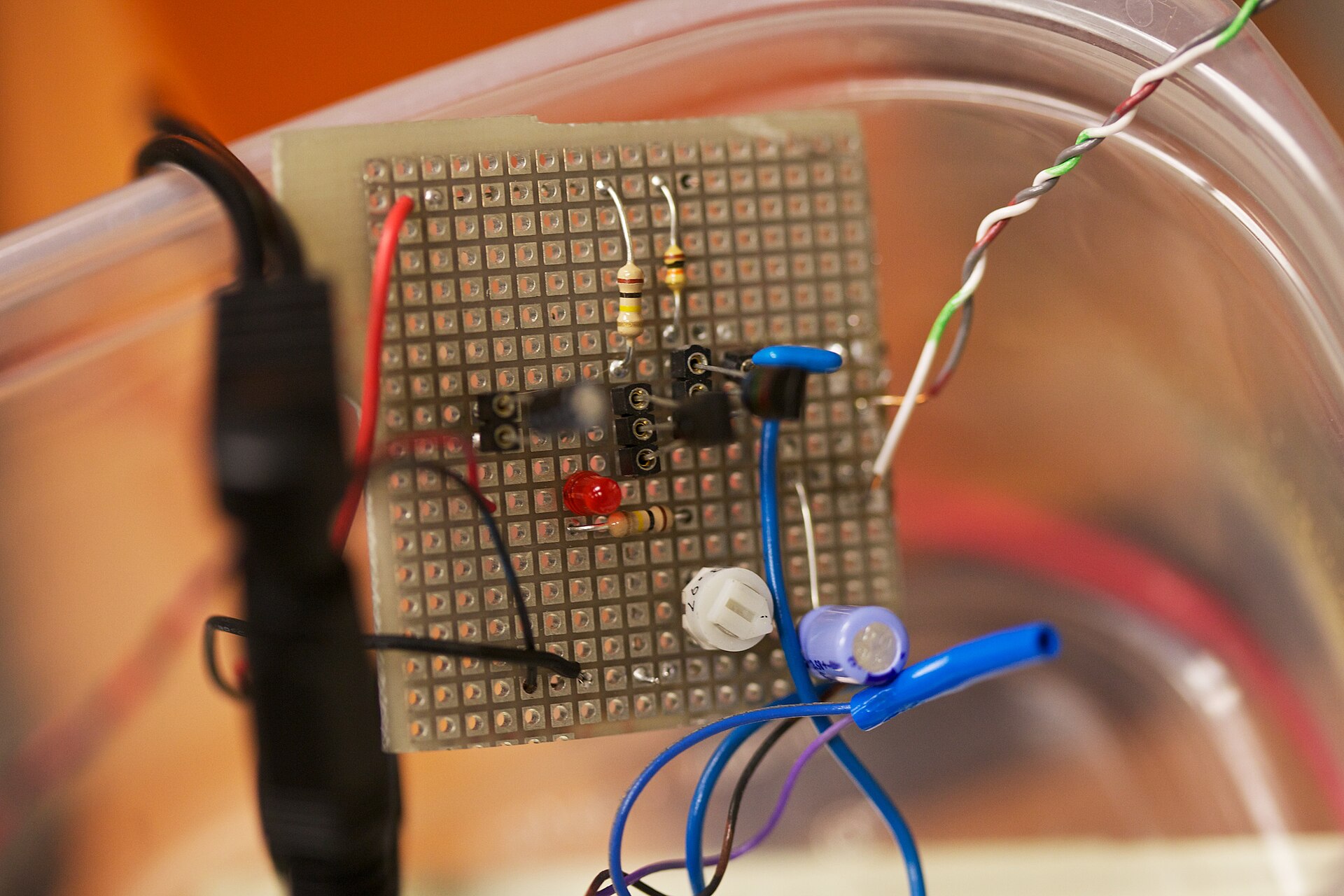
CC BY-SA 2.0 (https://creativecommons.org/licenses/by-sa/2.0/). Photo: Jason Gessner / Flickr via Wikimedia Commons. Source: https://commons.wikimedia.org/wiki/File:Matts_Fuzz_Face_Guitar_Pedal_(photo_by_Jason_Gessner).jpg
These are starting points based on how the circuit works and on the sources above. They aren't TGP test results.
- Plug the guitar straight into it. Put it first, ahead of any buffered pedal or tuner. If your tuner is buffered, move it after the fuzz or use a true-bypass tuner.
- Set the Fuzz high and use your guitar's volume knob as the gain control. Most of the Fuzz Face's range lives on the guitar. Full up is lead fuzz, around 7 or 8 is crunchy rhythm, and lower can get surprisingly clean.
- Use a clean-ish amp turned up. A Fuzz Face into a sterile, quiet amp can sound thin. Into an amp that's starting to break up, it fills out. That's the Hendrix and Gilmour recipe.
- Treat low Fuzz settings carefully. Cornell's "can't make up its mind" description is accurate for many units. If it sputters, turn the Fuzz up and roll the guitar back instead.
- Keep germanium units out of the sun. If your tone changes during a gig, heat is the first suspect.
- Know what's in front of your wah. If you run a wah and a Fuzz Face, try both orders. Wah into fuzz is the Hendrix order and gives a wilder, more vocal sweep. Fuzz into wah usually sounds smoother and more controlled.
The Takeaway
The Fuzz Face history is a lesson in how little "best engineered" matters. Arbiter borrowed a known circuit, used whatever transistors were cheap, did nothing to stabilize the bias, and sold it for less than a third of the Maestro's price in a box shaped like a microphone stand. Many of them sounded bad. The good ones sounded so good that the most important guitarist of the era bought them by the handful and kept throwing the bad ones away.
What survived isn't the flaws. It's the interaction: a pedal that responds to your pickups, your volume knob, and your picking hand more than almost anything else on a pedalboard. If you've never played one, get a germanium mini, plug it straight into a slightly dirty amp, and spend an evening playing only with your guitar's volume knob. That's where the Fuzz Face lives.
*Do you run germanium or silicon, and where does your Fuzz Face sit in your chain? Tell us in Guitar Talk, and if you're following our pedal history series, read The ProCo RAT History next.*
Experience-driven coverage, not algorithm bait.
- 20+ years of guitar playing experience
- Real-world retail experience at Guitar Center
- Thousands of hours testing guitars, amps, and pedals
- A community of 50,000+ guitar enthusiasts across platforms
- Partnerships with Fender, DistroKid, TrueFire, Card Chords, and Enya
- Editorial standards published openly — see how we test gear
Ask GP
3 free questions a dayStill curious? Ask GP about this story.
Your personal classic-rock and guitar guide — ask anything about The Fuzz Face History.
Discussion (0)
Sign in to join the discussion.
Sign in to commentLoading comments…
Discover another guitar story
Swipe through our latest features, breaking news and iconic solos — one story at a time.
Open Swipe →More Guitar News
The RAT Started With the Wrong Resistor: The Real ProCo RAT History
The ProCo RAT was born from a wrong resistor in a Kalamazoo basement. Here's how it went from 11 hand-built boxes to Beck, Nevermind, and your pedalboard.
The Ibanez Tube Screamer: How a Little Green Box Built to Compete Became the Pedal Everyone Copies
How a Maxon engineer's answer to the Boss OD-1 became the Ibanez Tube Screamer, why the TS808 vs TS9 debate never ends, and what SRV really used.

The 10 Best Overdrive Pedals That Actually Sound Like Money
From transparent touch tools to iconic mid-humps and Klon chime, these 10 overdrives under $300 in 2026 punch above their weight with pro tones, tough builds, and real-world value.

Tone Decoded: Joe Bonamassa Finally Embraces Amp Modeling — What the Fender Tone Master Says About the Future of Guitar Tone
One of guitar's biggest tube amp advocates has put a digital Fender Tone Master amp in his touring rig. Here's what it means for the future of guitar tone.