The Guitar Plugged · Guitarist Index
Alex Lifeson
Rush
1968–present
Progressive · Rock
The chord voicings and texture writing that made a three-piece sound orchestral.
Main guitar
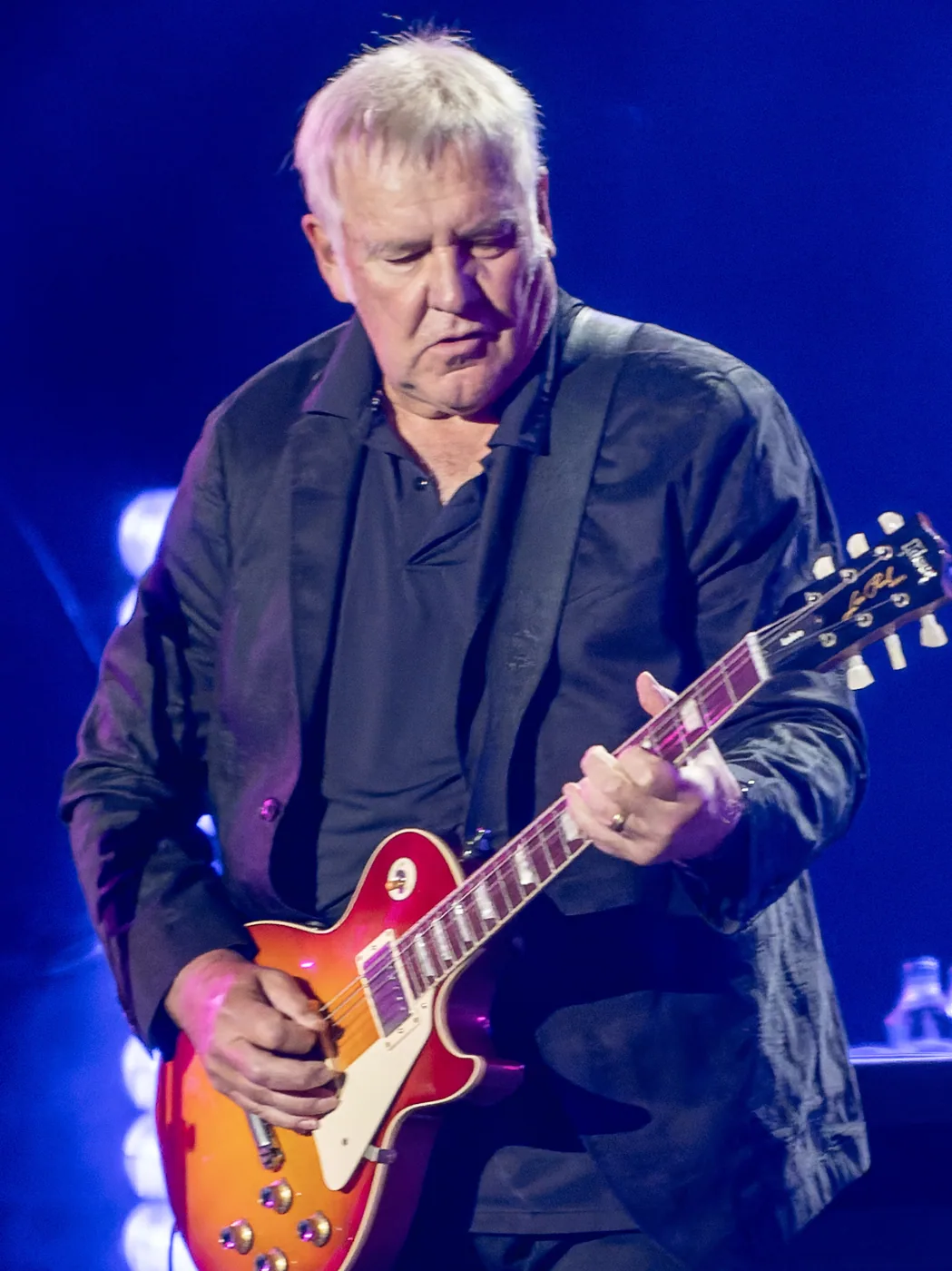
Gibson ES-355 and Les Paul; later Signature and Telecaster hybrids
Signature sound
Chorused, suspended chord washes with enormous stereo width
Era
1968–present
Influence
89 / 100
Genre
Progressive / Rock
Why they matter
The chord voicings and texture writing that made a three-piece sound orchestral.
Rush had no keyboard player for years and three musicians total, so Lifeson's job was to be the entire harmonic and textural bed while Geddy Lee and Neil Peart occupied the rhythmic foreground. He solved it with open strings, suspended and add9 voicings, and a chorus-and-delay rig that turned a single guitar into a landscape.
'The Spirit of Radio' is the case study: an opening figure that sounds like electricity, built from harmonics and a delay-shaped rhythmic pattern rather than a conventional riff.
His soloing is often overlooked because it is not fast, but 'Limelight' and 'Freewill' contain some of the most emotionally direct playing in progressive rock.
The sound
Chorused, suspended chord washes with enormous stereo width
The Spirit of Radio
Harmonics and picked figures through a bright chorus and delay — the tone is the riff.
Limelight
Chorus-washed clean verses against a mid-forward lead with a wide, singing vibrato.
Xanadu
Doubleneck-era layering with volume swells and Taurus pedals filling the low end.
Recreate the sound
Want this tone on your rig?
ToneMD translates Alex Lifeson's sound into settings for the amp, modeler or plugin you already own.
Prescribe my tonePowered by ToneMD
Style & technique
How you recognise the playing
Open-string voicings
Suspended and add9 chords with ringing open strings that shift colour without changing root.
Texture over density
Chorus, delay and volume swells used compositionally to fill the space a keyboard would occupy.
Odd-meter rhythm playing
Riffs in 7/8 and 5/4 that still feel like grooves.
Expressive, unhurried leads
Solos built on phrasing and bends rather than speed.
The rig
Instruments, amplification and effects
- Gibson ES-355
- Gibson Les Paul 'Hentor Sportscaster'
- Fender Telecaster
- Gibson Howard Roberts
- Hiwatt (1970s)
- Marshall JMP
- Gallien-Krueger
- Hughes & Kettner (later)
- Roland chorus
- TC Electronic 2290
- Moog Taurus pedals
- Boss digital delay
- Gibson humbuckers, Shadow and Bill Lawrence installs
Essential listening
Where to start
- 011980
The Spirit of Radio
Rush · Permanent Waves
- 021981
Limelight
Rush · Moving Pictures
- 031981
YYZ
Rush · Moving Pictures
- 041977
Xanadu
Rush · A Farewell to Kings
- 051978
La Villa Strangiato
Rush · Hemispheres
Career landmarks
The moments that mattered
Moving Pictures
Progressive rock made concise, and the peak of his texture-driven approach.
The Rush chord vocabulary
Suspended and add9 voicings that thousands of alternative and prog bands later adopted.
The legacy
Lineage
Influenced by
Influenced
Adjacent players
More from the archive
The player who turned amplifier noise into a musical language.
The virtuoso who rewrote the vocabulary of rock guitar.
Session-hardened producer who built rock guitar as an architecture, not a solo.
The player who translated Chicago blues into British rock volume.
The restless technician who kept reinventing what an electric guitar could be.
The master of the long note — space, sustain and perfect note choice.