The Guitar Plugged · Guitarist Index
Ritchie Blackmore
Deep Purple / Rainbow
1962–present
Rock · Metal · Progressive
Classical menace and baroque runs welded to the heaviest rock of the early '70s.
Main guitar
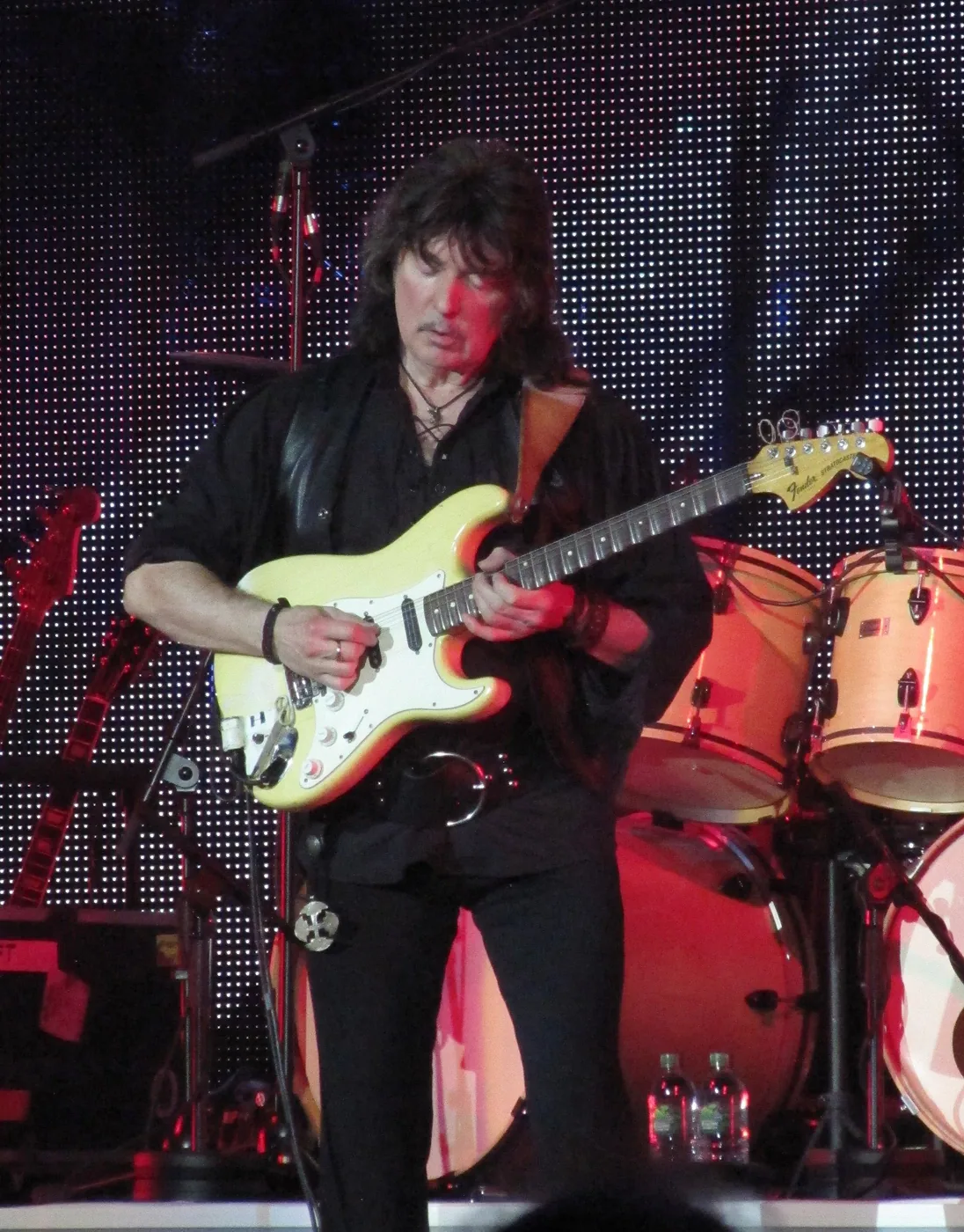
Fender Stratocaster with scalloped fingerboard
Signature sound
Treble-boosted Strat into modified Marshall Majors, aggressive and dry
Era
1962–present
Influence
92 / 100
Genre
Rock / Metal / Progressive
Why they matter
Classical menace and baroque runs welded to the heaviest rock of the early '70s.
Blackmore brought European classical vocabulary into hard rock before anyone had a name for it. Harmonic minor runs, baroque sequences and pedal-point riffs turned Deep Purple's blues foundation into something colder and more architectural, and 'Highway Star' effectively invented the neoclassical rock solo.
He is also one of the great riff writers. 'Smoke on the Water' is a four-note figure played in fourths that any beginner can approximate and almost nobody plays with the right feel — the phrasing is behind the beat and the two guitars are tracked with slightly different attacks.
He walked away from hard rock entirely in the 1990s to play Renaissance folk in Blackmore's Night, which tells you how little interest he had in repeating himself.
The sound
Treble-boosted Strat into modified Marshall Majors, aggressive and dry
Highway Star
Treble booster into a cranked Major — bright, dry and unforgiving, which is why every note in the classical run is audible.
Smoke on the Water
The famous riff is doubled and played clean-ish; most of the grind is amp, not pedal.
Child in Time
Clean-to-edge tone with enormous dynamic range across the song's build.
Stargazer
Rainbow-era tone: darker, thicker, sitting inside an orchestral arrangement.
Recreate the sound
Want this tone on your rig?
ToneMD translates Ritchie Blackmore's sound into settings for the amp, modeler or plugin you already own.
Prescribe my tonePowered by ToneMD
Style & technique
How you recognise the playing
Neoclassical runs
Harmonic minor and diminished sequences imported from Bach and Vivaldi into rock soloing.
Scalloped fretboard control
Deep scallops allowing microtonal pressure bends and an unusually vocal vibrato.
Aggressive, dry attack
Very little compression — the pick noise and string rattle are part of the sound.
Fourths-based riff writing
Riffs built on stacked fourths rather than power chords, producing a colder, more modal edge.
The rig
Instruments, amplification and effects
- Fender Stratocaster (scalloped fretboard)
- Gibson ES-335 (early)
- Marshall Major 200W (modified)
- Vox AC30 (early)
- Engl signature heads
- Hornby Skewes treble booster
- Aiwa reel-to-reel used as a preamp/delay
- Wah (occasional)
- Fender single-coils; later Lace Sensors and Seymour Duncan Quarter Pounders
- Middle pickup often disconnected
- Very high amp volume as a compression source
Essential listening
Where to start
- 011972
Highway Star
Deep Purple · Machine Head
- 021972
Smoke on the Water
Deep Purple · Machine Head
- 031970
Child in Time
Deep Purple · In Rock
- 041974
Burn
Deep Purple · Burn
- 051976
Stargazer
Rainbow · Rising
- 061978
Gates of Babylon
Rainbow · Long Live Rock 'n' Roll
Career landmarks
The moments that mattered
'Highway Star' solo
A written, harmonically deliberate solo that pointed directly at the neoclassical shred movement a decade later.
'Smoke on the Water' riff
Probably the first riff most guitarists ever learn.
Rainbow's Rising
Fantasy-themed hard rock with classical structure — the blueprint for European power metal.
The legacy
Lineage
Influenced by
Adjacent players
More from the archive
The player who turned amplifier noise into a musical language.
The virtuoso who rewrote the vocabulary of rock guitar.
Session-hardened producer who built rock guitar as an architecture, not a solo.
The player who translated Chicago blues into British rock volume.
The restless technician who kept reinventing what an electric guitar could be.
The master of the long note — space, sustain and perfect note choice.