
The Guitar Plugged · Guitarist Index
Carlos Santana
Santana
1966–present
Rock · Blues · Fusion
Endless sustain, Latin rhythm, and one of the most identifiable single notes in music.
Main guitar
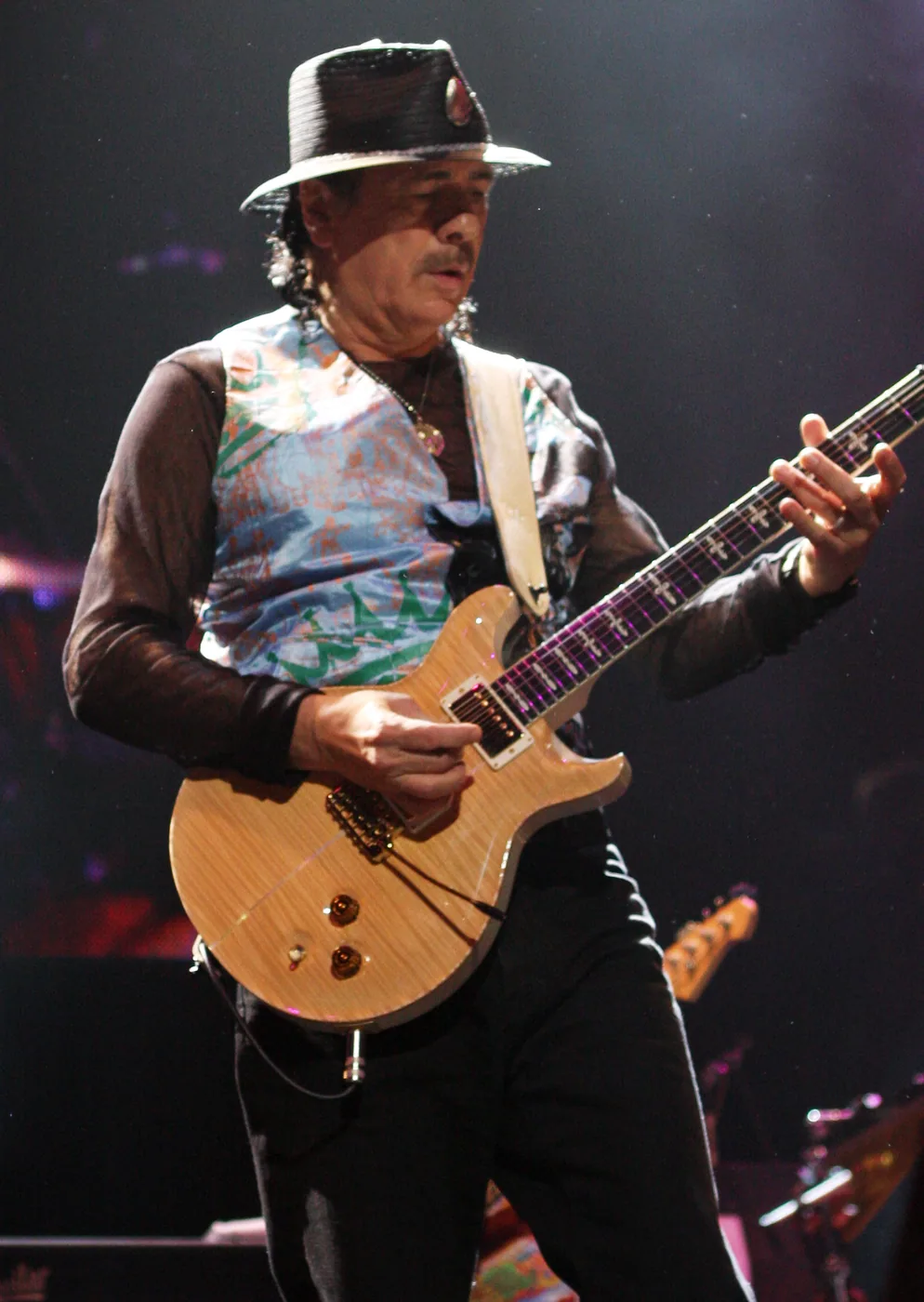
PRS Santana signature (previously Gibson SG Special and Les Paul)
Signature sound
Singing, violin-like sustain from a mid-boosted amp on the edge of feedback
Era
1966–present
Influence
93 / 100
Genre
Rock / Blues / Fusion
Why they matter
Endless sustain, Latin rhythm, and one of the most identifiable single notes in music.
Santana fused Afro-Cuban and Latin percussion with blues-rock guitar at a moment when the two worlds barely spoke, and the result was a sound that has never really been duplicated — partly because the band is a percussion ensemble with a guitar on top, not a rock band with congas added.
His tone is one of the most recognisable in recorded music: an extremely sustaining, midrange-heavy lead voice that behaves more like a bowed instrument than a plucked one. It comes from a combination of hot pickups, a boosted midrange amp, and standing exactly where the feedback loop supports the note.
Note choice is conservative — mostly Dorian and minor pentatonic — but the phrasing and sustain do the work that flurries of notes do for other players.
The sound
Singing, violin-like sustain from a mid-boosted amp on the edge of feedback
Europa
The clearest example of the sustain tone: one note per bar, held, with vibrato that never stops.
Black Magic Woman
Warmer, less saturated, with the guitar weaving between organ and percussion instead of dominating.
Soul Sacrifice (Woodstock)
SG through a Fender at breaking point — raw, aggressive and a very different animal from the later Boogie sound.
Samba Pa Ti
Melody-first tone with the amp just past clean, so quiet phrases stay clear and loud ones bloom.
Recreate the sound
Want this tone on your rig?
ToneMD translates Carlos Santana's sound into settings for the amp, modeler or plugin you already own.
Prescribe my tonePowered by ToneMD
Style & technique
How you recognise the playing
Infinite sustain
Notes held for whole bars, kept alive by amp feedback controlled through body position.
Vocal-length phrasing
Melodies constructed in breath-length phrases, closer to a singer than a guitarist.
Latin rhythmic placement
Lead lines phrased against clave and conga patterns rather than a rock backbeat.
Restrained note vocabulary
Small scale palette used with heavy vibrato and dynamics to create variety.
The rig
Instruments, amplification and effects
- PRS Santana signature
- Gibson SG Special (Woodstock)
- Yamaha SG175B
- Gibson Les Paul
- Mesa/Boogie Mark series
- Fender Twin (Woodstock era)
- Dumble Overdrive Reverb
- Ibanez Tube Screamer
- Wah
- Minimal delay and reverb
- PRS Santana humbuckers
- Gibson P-90s (early)
- Boogie amps used with heavy midrange — the mid-hump is central to the tone
Essential listening
Where to start
- 011969
Soul Sacrifice
Santana · Santana (live at Woodstock)
- 021970
Black Magic Woman / Gypsy Queen
Santana · Abraxas
- 031970
Samba Pa Ti
Santana · Abraxas
- 041976
Europa (Earth's Cry Heaven's Smile)
Santana · Amigos
- 051999
Smooth
Santana feat. Rob Thomas · Supernatural
Career landmarks
The moments that mattered
1969
Woodstock, 1969
A largely unknown band delivered one of the festival's defining performances before their debut album was released.
Abraxas
The record that established Latin rock as a commercial genre rather than a curiosity.
1999
Supernatural, 1999
A late-career commercial resurrection that sold 30 million copies and introduced his tone to a new generation.
The legacy
Lineage
Influenced by
Influenced
Adjacent players
More from the archive
The player who turned amplifier noise into a musical language.
The virtuoso who rewrote the vocabulary of rock guitar.
Session-hardened producer who built rock guitar as an architecture, not a solo.
The player who translated Chicago blues into British rock volume.
The restless technician who kept reinventing what an electric guitar could be.
The master of the long note — space, sustain and perfect note choice.