
ADDAC’s New Guitar Clamps Turn Your Strings Into a Drone Machine
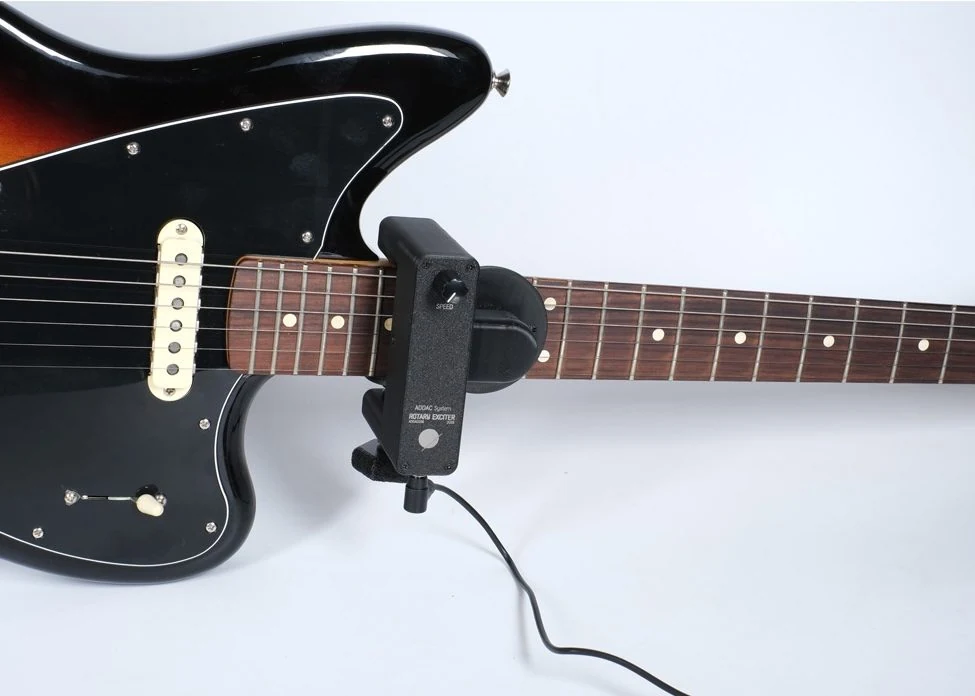
The ADDAC006 clamps to the guitar neck, placing its motor-driven magnetic assembly above the strings.
One clamp uses a 7,000 RPM motor to excite the strings; the other makes them resonate to external audio. ADDAC’s new guitar accessories are strange, physical and genuinely different.
Most guitar gadgets ask you to step on them, turn a knob or load a preset. ADDAC System’s two new creations clamp onto the guitar itself. One vibrates the strings with a motor-driven magnetic field. The other uses the strings as a mechanical resonator for incoming audio. No modeling algorithm or impulse response is the starting point here: the instrument’s own strings are part of the effect.
The Portuguese company calls them the ADDAC006 Rotary Exciter Clamp and ADDAC007 Resonator Clamp. Both are available now, according to its November launch announcement, priced at €120 and €200 respectively. ADDAC’s store notes that displayed prices exclude VAT and orders outside the EU are VAT-free.
That description will inevitably remind players of an EBow, but the comparison only goes so far. These are two different mechanical systems with fixed mounting, external audio options and their own practical constraints. We have not tested either unit, so the useful story is what the documented design makes possible—not a verdict on how musical or reliable the results are.
ADDAC006: A Motor Above the Strings
The Rotary Exciter clamps to a guitar neck up to 60mm wide, positioning a small assembly above the strings. Inside is a brushless motor rated at 7,000 RPM. It rotates a surface carrying two magnets, producing a rotating magnetic field. When the rotational speed matches a string’s frequency or one of its harmonics, that relationship drives the string into vibration.
A speed knob supplies non-linear motor control. That makes the control more than an on/off switch: moving it changes which frequencies and harmonics take hold, while the guitar’s tuning determines the available notes. The distance between the motor and strings is another variable. Small setup changes could therefore alter the response substantially, just as moving an EBow changes its behavior.

Fender Player II Telecaster
$849.99 at Guitar Center
Power comes from a standard 9V DC, center-negative pedal supply rated at 200mA. ADDAC includes a five-meter extension cable, acknowledging that the power source will probably live on a pedalboard rather than on the guitar. The official product page also warns against overtightening the clamp.
Sustained Notes Without Holding a Device

Never Run Out of Strings Again.
Fresh USA-made strings delivered every month from the X Concepts String Club.
The obvious attraction is a sustained pad underneath conventional playing. With the clamp doing the exciting, both hands remain available to fret melodies, add chords or operate other effects. Turning the speed control while a note sustains should also change the texture in a way that resembles adjusting a resonant filter, although the mechanism is physical rather than digital.
That fixed position is the crucial difference from a handheld sustainer. It may be more convenient for a repeating drone or an installation, but it does not offer the same freedom to move quickly from string to string. Players considering one should think of it less as a universal EBow replacement and more as a dedicated instrument modification—one that can be removed, but that occupies a particular place on the neck.
Tuning becomes compositional material. An open tuning could give the motor several related notes to work with, while selective muting could keep the sustained texture from becoming overcrowded. Delays, reverbs and modulation can then process the guitar’s pickup output as usual. The effect happens before the pickup; the rest of the rig is free to shape what follows.
ADDAC007: Play Audio Through the Guitar
The Resonator takes the opposite approach. Instead of generating its own rotating magnetic field, it receives an audio signal and uses a transducer—a vibration speaker—to make the strings resonate. The guitar’s pickups capture that vibration, allowing the strings’ tuning and natural decay to color the incoming sound.
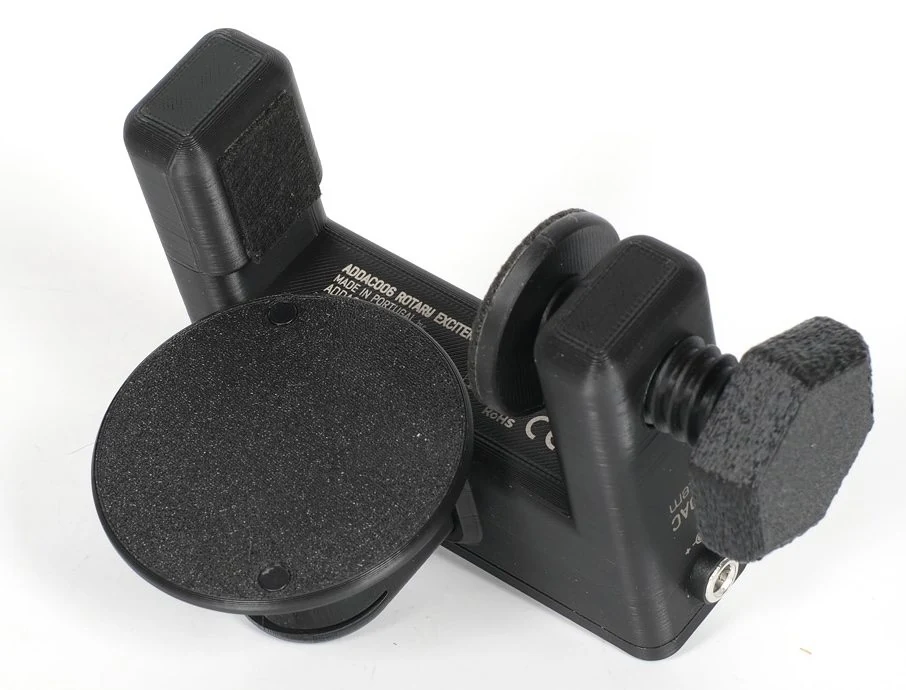
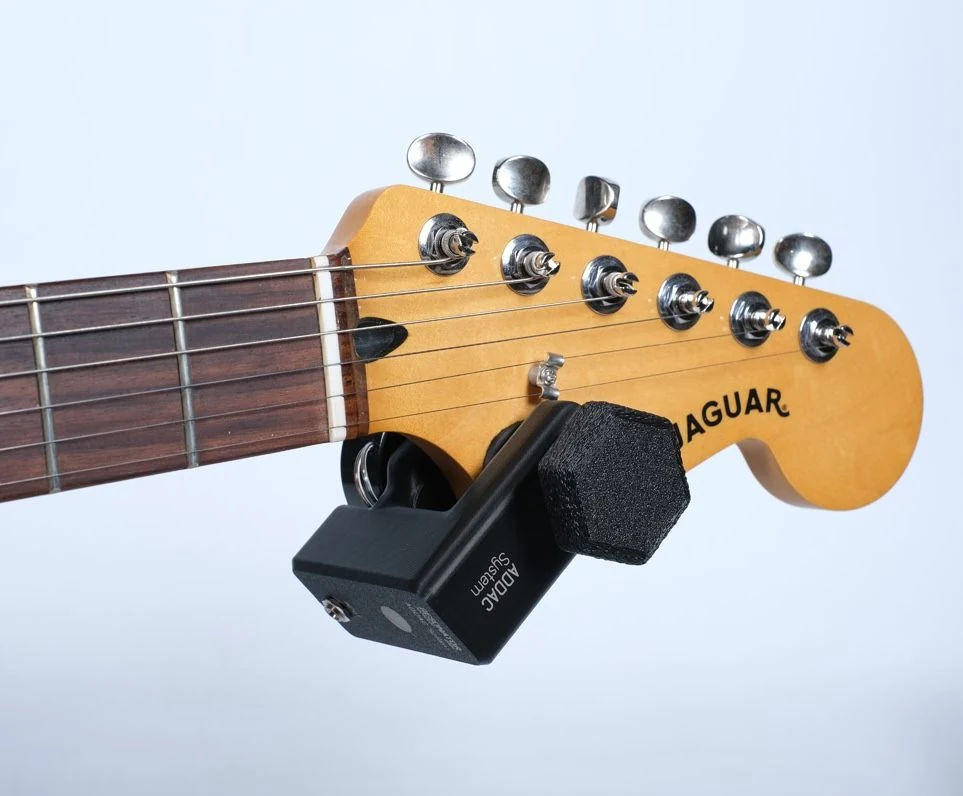
The standard ADDAC007 fits headstocks up to 20mm thick. The wider ADDAC007W accommodates surfaces up to 45mm. Felt pads protect the contact points, and ADDAC again cautions against overtightening. A headstock-mounted device will not suit every instrument equally, so checking the available flat area and thickness matters before ordering.
Its system has two parts: the clamp and a small amplifier box. Feed a synthesizer, piano recording, sequencer or other modular/line-level source into the amplifier, then connect its output to the transducer. As the source changes pitch, the strings respond with related resonances. Short bursts can produce decaying harmonic clusters; sustained input can create a shifting drone filtered by the open strings.
There is one specification discrepancy worth flagging. The launch release describes quarter-inch mono connections and a 9–12V DC 3A supply, while the current product page lists 3.5mm mono sockets and an included 9V DC 3A adapter. Buyers should confirm the revision and included connections rather than assuming which cables they need.
Three Creative Routes to Try
First, use the Rotary Exciter as a sustained harmonic floor. Let it establish one or two notes, then play sparse melodies over the top. A volume pedal after the guitar can control the balance without disturbing the clamp’s motor setting. This is the clearest route to an ambient performance without prerecorded backing.
Second, feed the Resonator an external part that already has rhythmic or harmonic movement. A piano chord, vocal phrase or sequenced synth note becomes a trigger for the guitar’s strings. Recording the pickup output separately gives you a resonance track that can be blended with the original sound instead of replacing it.
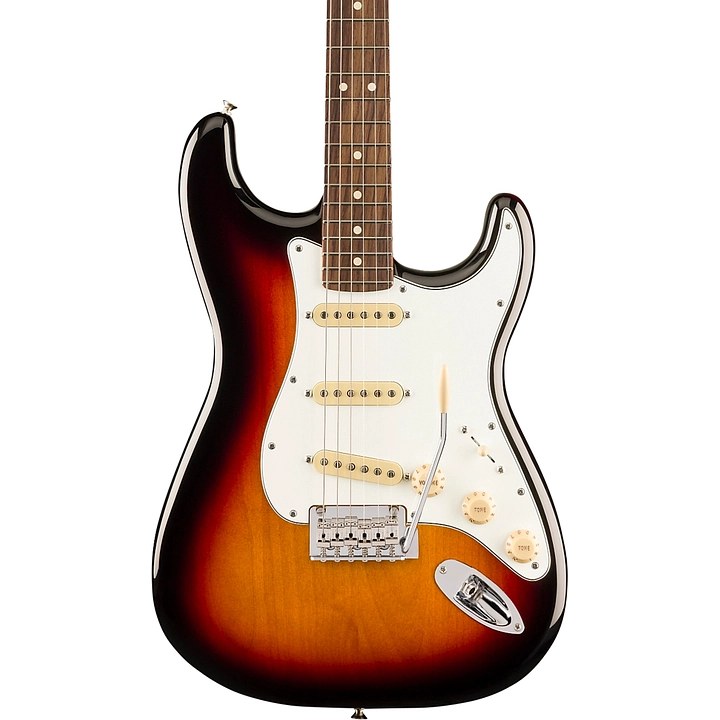
Fender Player II Stratocaster
$849.99 at Guitar Center
Third, build a feedback-aware studio setup. ADDAC’s documentation discusses routing options involving effects, amplifiers and DAWs. Keep initial input levels conservative: stronger drive does not automatically mean a better resonance, and gain staging will determine whether the result feels like a distinct instrument or an indistinct wash.
The Important Limitations
These are specialized tools, not bargain replacements for a full ambient pedalboard. The €120 and €200 prices exclude VAT where applicable, and each addresses a different job. Buying both means committing space on the guitar, managing cables and learning how tuning, placement and level interact.
There are also unanswered playing questions. How much mechanical noise reaches the recording? How quickly can a player move between usable motor settings? How consistently does the Resonator track complex audio? The official demonstrations show the concept, but a hands-on review would need to answer those questions independently.
That restraint does not make the launch less interesting. At a time when new gear often arrives as another software update, ADDAC has made the guitar’s physical behavior the main event. For players who enjoy the experimental side of our Zoom Neurig coverage or the portable processing discussed in our Neko pocket-rig story, these clamps offer a refreshingly mechanical alternative. The appeal is not a promise of instant ambience. It is the chance to discover a sound that belongs to your particular guitar, tuning and setup.
Plugged Gear Co., Guitar Center and American Musical Supply links may earn us a commission from qualifying purchases.
Reader-supported
Keep Guitar Alive
Enjoyed this story? The Guitar Plugged is free to read and reader-supported. If it helped you play, listen or buy a little smarter, chip in to keep guitar journalism like this coming.
One-time contribution, processed securely by Stripe. Contributions are not tax-deductible.
Experience-driven coverage, not algorithm bait.
- 20+ years of guitar playing experience
- Real-world retail experience at Guitar Center
- Thousands of hours testing guitars, amps, and pedals
- A community of 50,000+ guitar enthusiasts across platforms
- Partnerships with Fender, DistroKid, TrueFire, Card Chords, and Enya
- Editorial standards published openly — see how we test gear
The Modern Guitar Magazine. Delivered to your inbox.
No spam. No gimmicks. Just great guitar content — stories, tones, iconic solos, and honest gear takes. Every week.
Ask GP
20 free questions a dayStill curious? Ask GP about this story.
Your personal classic-rock and guitar guide — ask anything about ADDAC’s New Guitar Clamps Turn.
Discussion (0)
Sign in to join the discussion.
Sign in to commentLoading comments…
Discover another guitar story
Swipe through our latest features, breaking news and iconic solos — one story at a time.
Open Swipe →More Guitar News

Mooer’s Future Flex Puts a Complete Portable Guitar Rig in One Box
Mooer’s Future Flex combines amp modeling, stereo speakers, four footswitches, AI tools and a rechargeable battery. The NAM A2 details—and the regional pricing—need a careful read.
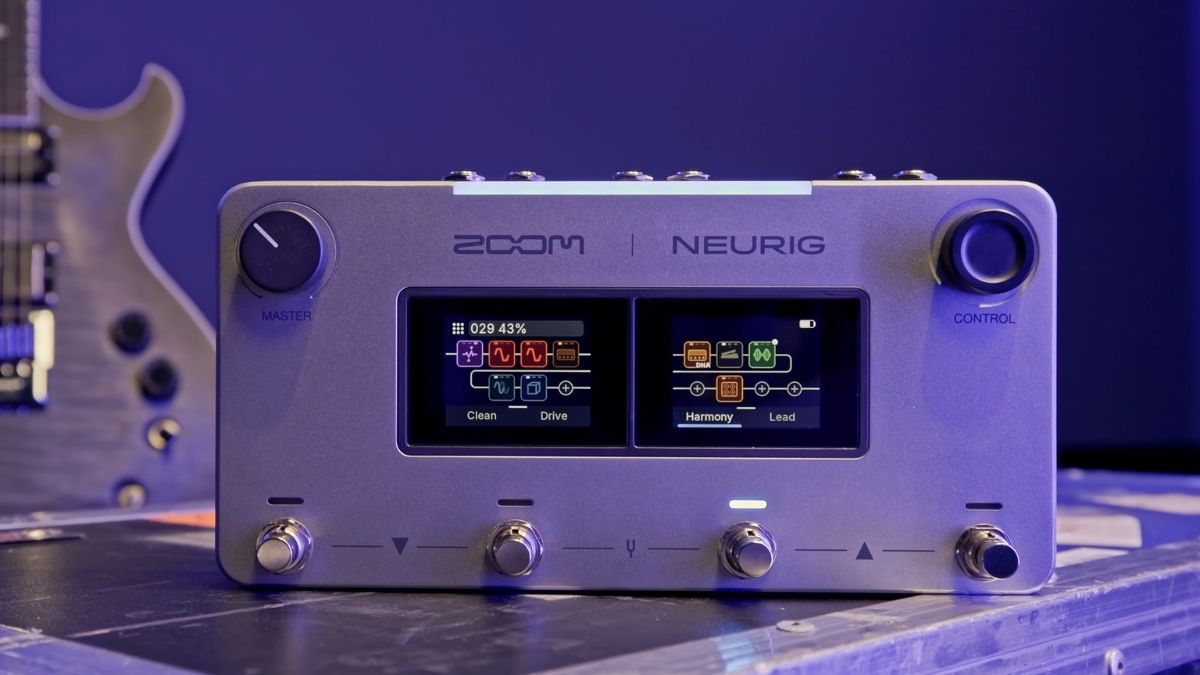
Zoom’s Neurig Puts Neural Amp Modeling in Reach — But the Fine Print Matters
Dual touchscreens, community amp captures and a Japanese price around $300 by conversion: Zoom’s new pedal has an ambitious spec sheet — and some important caveats.
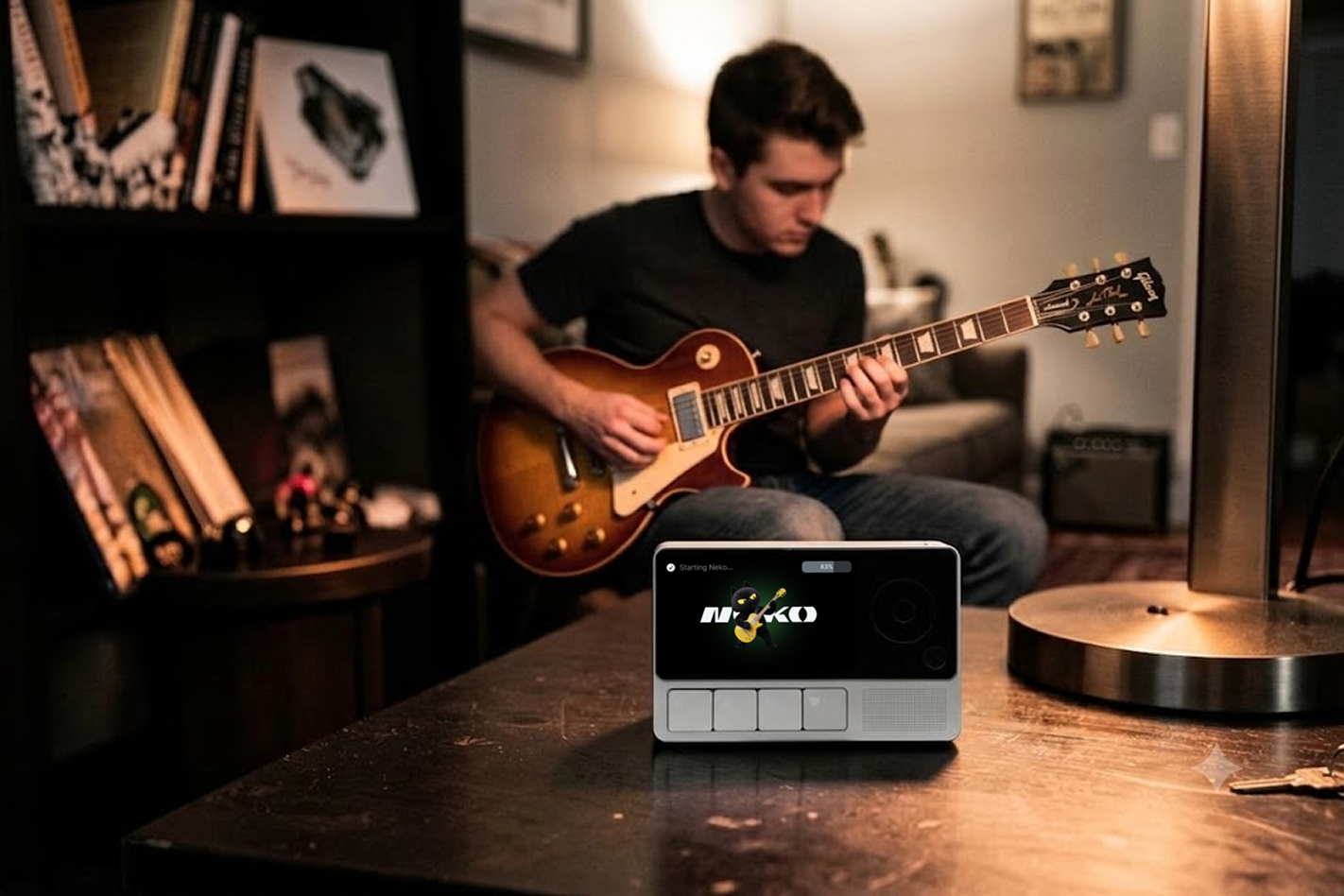
Neko Wants to Put Your Whole Rig, a Stem Splitter and a Songwriting Partner in Your Pocket
Neko Engineering's pocket wireless guitar rig runs LALAL.AI stem separation on its own chip, with no cloud or app. NAM A2 Full tones, tabs, riff recorder and AI Arranger; $399 on Kickstarter, shipping April 2027.
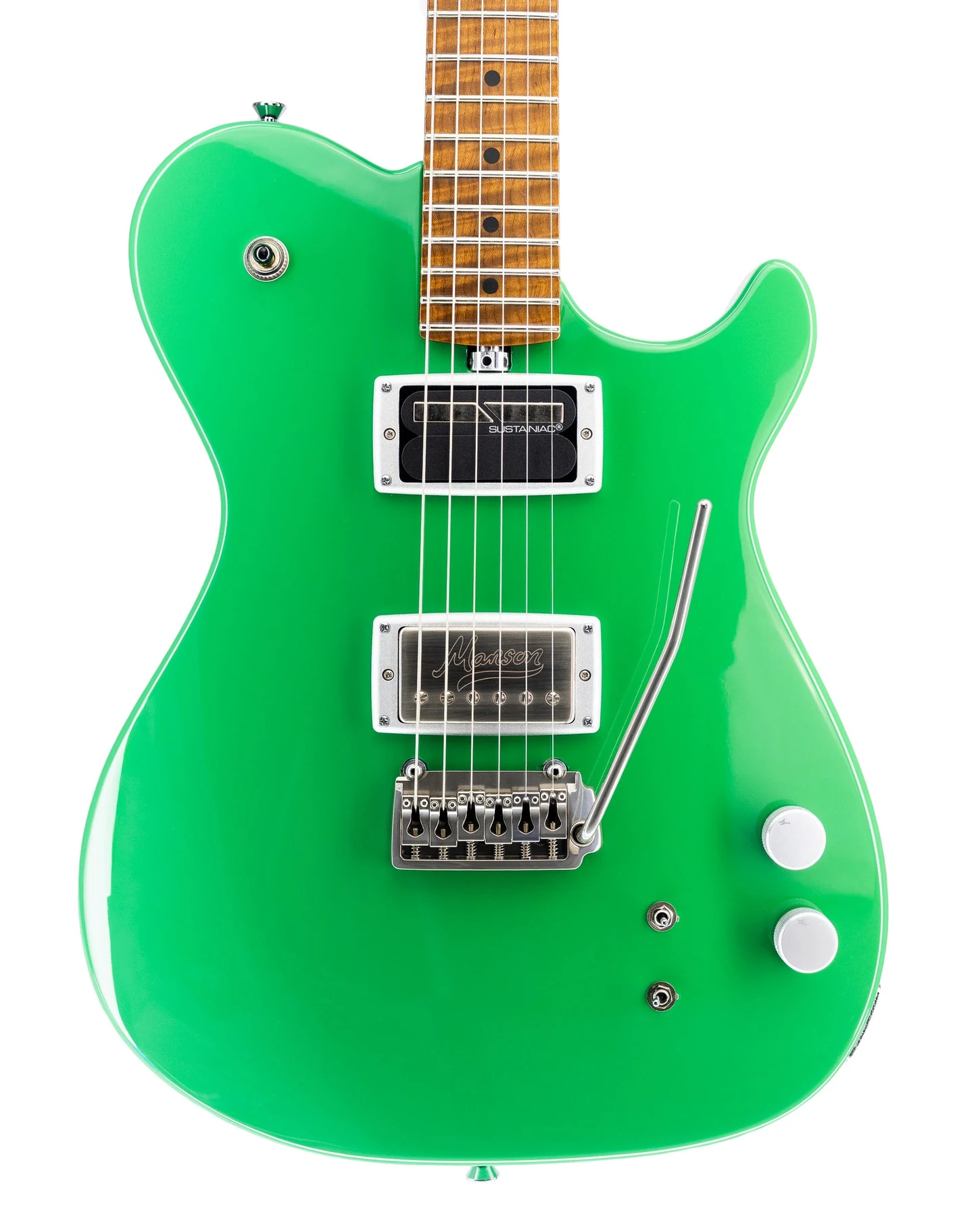
Graham Coxon’s Wild New Manson Guitars Are Built for Infinite Mischief
Graham Coxon’s GC-1 and GC-3 are not museum-piece Telecasters. Their Sustainiacs, custom humbuckers and kill button reflect the same tension between melody and chaos that powers his playing.