
Mooer’s Future Flex Puts a Complete Portable Guitar Rig in One Box
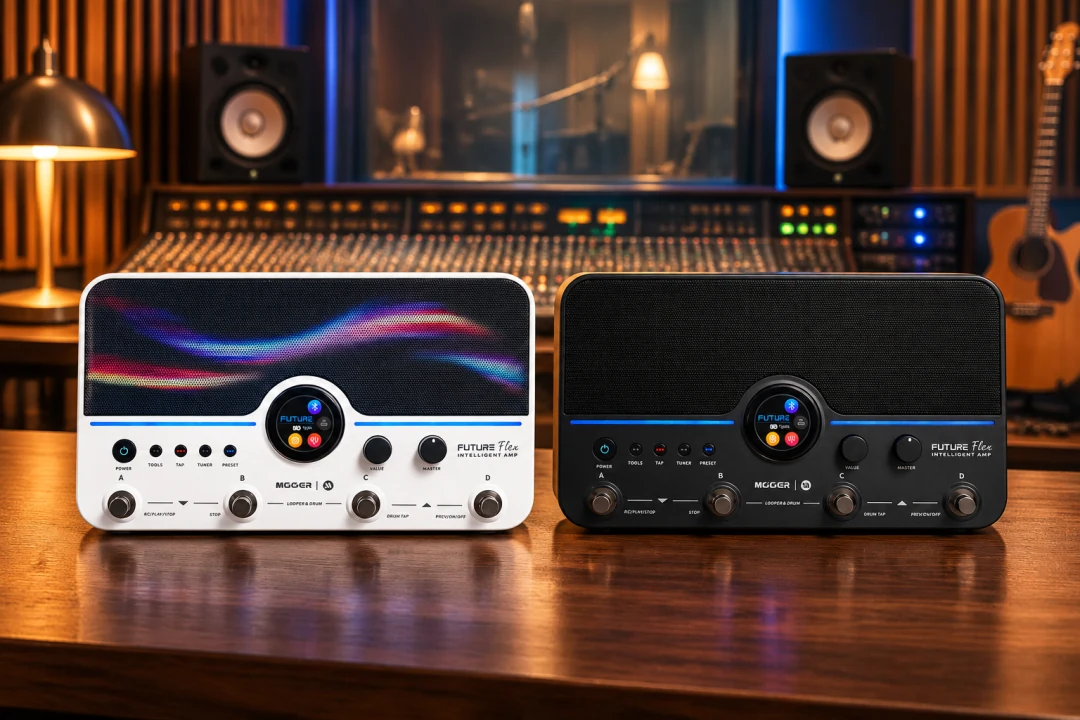
The Future Flex in Snowfall White and Phantom Black, with four footswitches and a circular touchscreen.
Mooer’s Future Flex combines amp modeling, stereo speakers, four footswitches, AI tools and a rechargeable battery. The NAM A2 details—and the regional pricing—need a careful read.
A portable guitar rig normally involves a compromise. A modeler needs headphones, a speaker or a PA. A practice amp is self-contained but may not offer foot control. A pedalboard is easy to perform with, but it adds another chain of cables and power supplies. Mooer’s new Future Flex tries to put all three jobs into one battery-powered unit.
The specification is dense: 55 amp models, 69 effect types, four configurable footswitches, two built-in speakers, a microphone input, looping, AI-assisted tone creation and support for converted NAM A2 models. The circular touchscreen and app control come from Mooer’s Future family, but the angled chassis and footswitches make the Flex a different proposition from a desktop smart amp.
Mooer’s official Chinese launch page lists an official retail price of ¥1,480 RMB. Guitar World’s November 21 report gives a UK price of £199 and says it is available there in Snowfall White or Phantom Black. An official US price has not been confirmed, so any dollar figure circulating now should be treated as unverified rather than converted currency dressed up as an MSRP.
The Rig Without the Extra Amp
The headline hardware feature is not AI; it is the speaker system. Two 2.2-inch full-range drivers provide 15 watts of stereo output, assisted by Mooer’s DPE spatial enhancement. That means the Flex can produce sound without headphones or an external amplifier, then connect to larger speakers when the situation demands it.
The enclosure measures 396 × 178 × 179mm and weighs 1.2kg. A 7.4V, 4,000mAh battery is rated for approximately five to six hours of use and a roughly 2.5-hour recharge over USB-C. Those are manufacturer figures, not an independent battery test, and real runtime will depend on output level and connected devices.
Fifteen watts through small full-range drivers tells us about the intended role, not how loud it will feel beside a drummer. The sensible expectation is bedroom practice, writing, acoustic-style rehearsals and a travel rig—not a guaranteed replacement for a stage combo. Stereo line outputs allow the same processor to feed a mixer or PA when more coverage is required.
Footswitches Change How Useful It Is
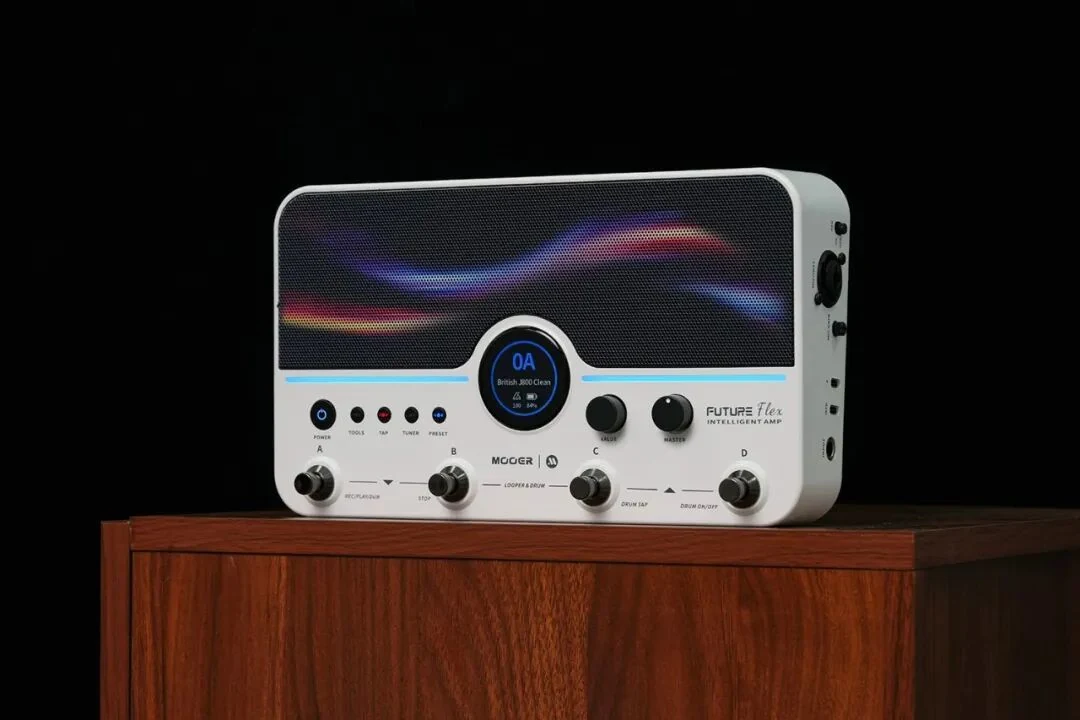
A desktop amp can be deep yet frustrating once your hands are on a guitar. The Flex’s four footswitches address that problem. Mooer says they can handle preset changes, tap tempo, tuner/exit functions, Sub Patch module control and EXP FST, a footswitch-based expression simulation. Their assignments are configurable in the iAMP app’s control settings.
The 1.28-inch circular touchscreen handles onboard navigation, while the app provides deeper editing, preset management and visual footswitch configuration. MOOER STUDIO covers firmware updates, third-party IR imports and preset backups. That division could work well: immediate changes from the floor, detailed sound building on a larger screen.

Fender Player II Telecaster
$849.99 at Guitar Center
It also means buyers should consider their tolerance for app-dependent workflows. Four switches are a genuine performance feature, but complex editing still appears oriented toward the companion software. We have not tested how quickly the unit boots, reconnects or recalls a customized control layout.
NAM A2: Conversion, Not Native Loading
The Future Flex contains 55 MNRS amp models and 69 effect types, with 80 preset locations arranged as 20 groups of four. There are also 10 slots for third-party impulse responses at 1024 points. Those built-in resources would be substantial on their own, but NAM compatibility is the feature many players will notice first.
The wording matters. Mooer says the Flex supports converted NAM A2 model imports. It does not claim native loading of arbitrary .nam files, and it does not say the unit can create its own NAM captures. Mooer’s broader NAM A2 guidance distinguishes native A2 Lite support on some hardware from conversion workflows on others. The Flex belongs in the latter category.
For players, that means access to compatible community captures after the required conversion, not a promise that every download will work directly. It also means the practical experience will depend on the converter, file management and any limitations of the embedded implementation. Treat NAM A2 as an expandable library with a preparation step—not magic compatibility with the entire ecosystem.
What the AI Tools Actually Claim to Do
Mooer’s AI Tone Assistant accepts a written description and generates candidate signal chains. A single conversation can produce up to nine suggestions, with further prompts used to refine them. This is best understood as a starting-point generator: it may save menu diving, but it cannot know your guitar, room or taste until you listen and adjust the result.
The second AI feature is stem separation, already seen in Mooer’s StemLab and Future ecosystem. It can separate vocals, guitar, bass and drums from a track for practice, transcription or arranging. The potential is obvious—remove a guitar part to join the band, isolate a bass line to learn it, or build a custom backing track—but separation quality varies by source recording. Mooer’s feature list is confirmed; artifact-free results are not.
Practice, Singing and Recording
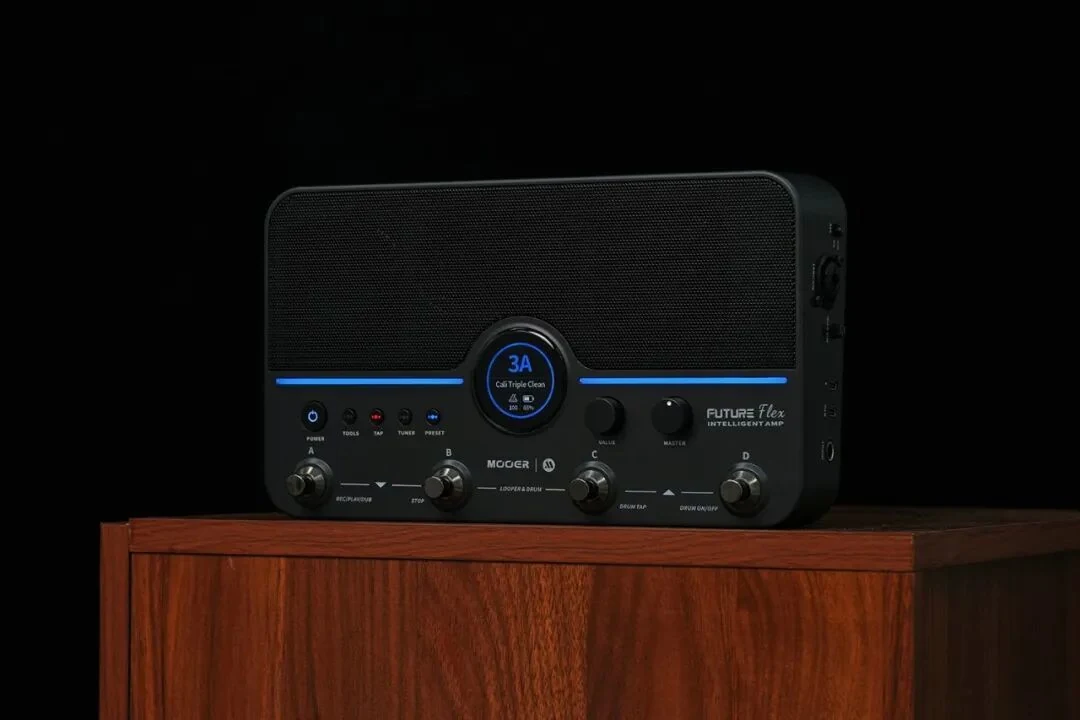
Practice tools include 60 drum patterns, 10 metronome modes, a tuner and a stereo looper with up to 60 seconds of recording and drum-machine synchronization. Bluetooth 5.0 handles backing-track audio. These features make the self-contained speaker more useful because a quick practice session does not require a second playback device cabled to the rig.
There are two independent input channels: a 6.35mm instrument input and an XLR combo microphone/instrument input with 48V phantom power. Each can receive independent processing. That makes the Flex relevant to singer-guitarists, although phantom power should only be enabled for microphones that require it.
Fender Player II Stratocaster
$849.99 at Guitar Center
Connections also include stereo 6.35mm line outputs, a 3.5mm TRRS headset socket and USB-C OTG. The USB audio interface is specified as two-in/two-out at 24-bit, from 44.1 to 192kHz. On paper, that covers silent practice, mobile recording and a small DAW setup without adding a separate interface.
Where It Fits Against Affordable Alternatives
The Future Flex sits between categories rather than replacing all of them. A conventional affordable modeler may offer more hands-on controls or a larger display, but requires monitoring. A smart practice amp includes speakers, yet usually needs an accessory for comparable floor control. Positive Grid’s Spark Pedal explores AI-assisted tones from the floor, but it is not a self-contained stereo practice amp.
Within Mooer’s own range, the F15i Li is the obvious comparison for players who do not need four switches or a microphone input. The Flex’s extra hardware makes sense when one box must move from sofa practice to a rehearsal or performance. If it will never leave a desk, the added foot-control hardware may be less important.
That is the buying question: not whether 55 amps beat another brand’s total, but whether the combination removes equipment you currently carry. The Future Flex’s documented feature set is ambitious and its UK and Chinese prices are clear. Its speaker headroom, AI output quality, converted-NAM workflow and real-world switching remain tests for another day. For a different take on portable neural processing, read our Zoom Neurig analysis and our report on NAM A2 coming to Fender’s Tone Master Pro.
Plugged Gear Co., Guitar Center and American Musical Supply links may earn us a commission from qualifying purchases.
Reader-supported
Keep Guitar Alive
Enjoyed this story? The Guitar Plugged is free to read and reader-supported. If it helped you play, listen or buy a little smarter, chip in to keep guitar journalism like this coming.
One-time contribution, processed securely by Stripe. Contributions are not tax-deductible.
Experience-driven coverage, not algorithm bait.
- 20+ years of guitar playing experience
- Real-world retail experience at Guitar Center
- Thousands of hours testing guitars, amps, and pedals
- A community of 50,000+ guitar enthusiasts across platforms
- Partnerships with Fender, DistroKid, TrueFire, Card Chords, and Enya
- Editorial standards published openly — see how we test gear
The Modern Guitar Magazine. Delivered to your inbox.
No spam. No gimmicks. Just great guitar content — stories, tones, iconic solos, and honest gear takes. Every week.
Ask GP
20 free questions a dayStill curious? Ask GP about this story.
Your personal classic-rock and guitar guide — ask anything about Mooer’s Future Flex Puts a.
Discussion (0)
Sign in to join the discussion.
Sign in to commentLoading comments…
Discover another guitar story
Swipe through our latest features, breaking news and iconic solos — one story at a time.
Open Swipe →More Guitar News
Zoom’s Neurig Puts Neural Amp Modeling in Reach — But the Fine Print Matters
Dual touchscreens, community amp captures and a Japanese price around $300 by conversion: Zoom’s new pedal has an ambitious spec sheet — and some important caveats.
Fender Confirms NAM A2 Is Coming to the Tone Master Pro: What It Means for Amp Modeling
Fender confirms NAM A2 support is coming to the Tone Master Pro — captures load like any amp block, with touchscreen and app control. No release date yet.
Neko Wants to Put Your Whole Rig, a Stem Splitter and a Songwriting Partner in Your Pocket
Neko Engineering's pocket wireless guitar rig runs LALAL.AI stem separation on its own chip, with no cloud or app. NAM A2 Full tones, tabs, riff recorder and AI Arranger; $399 on Kickstarter, shipping April 2027.
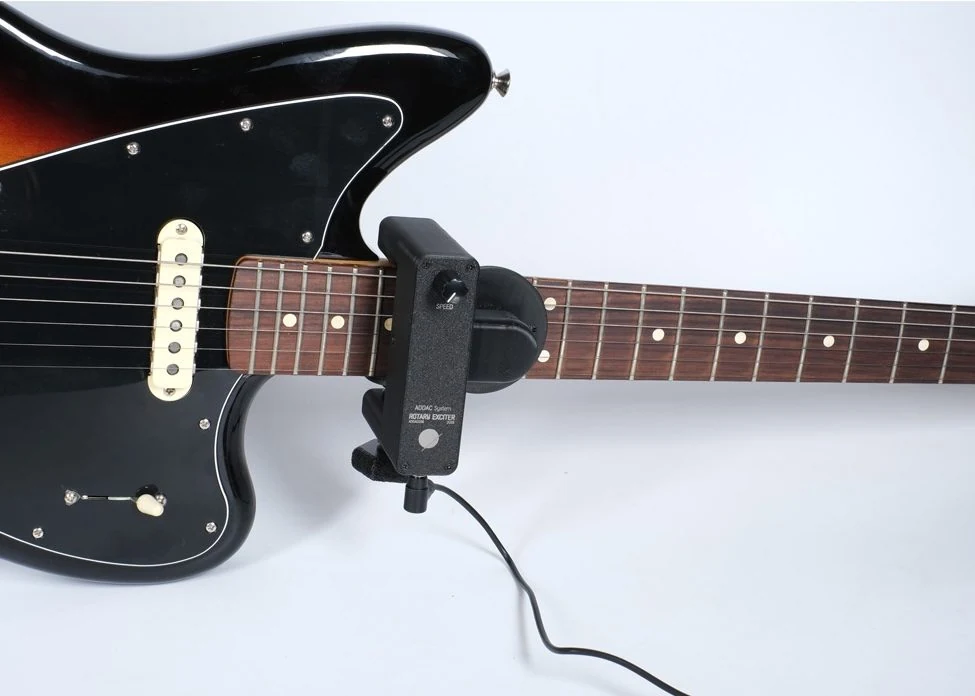
ADDAC’s New Guitar Clamps Turn Your Strings Into a Drone Machine
One clamp uses a 7,000 RPM motor to excite the strings; the other makes them resonate to external audio. ADDAC’s new guitar accessories are strange, physical and genuinely different.