
There are guitar scenes in movies. And then there is Crossroads. Forty years on, the final duel remains part movie sequence, part guitar lesson, part urban legend — and the truth behind it is stranger than the film ever let on.
There are guitar scenes in movies.
And then there is Crossroads.
For guitar players of a certain generation, the final duel in Walter Hill's 1986 film occupies a place somewhere between movie sequence, guitar lesson, urban legend and rite of passage. You didn't necessarily need to remember every detail of the plot. You didn't even need to be particularly interested in blues mythology.
You remembered the duel.
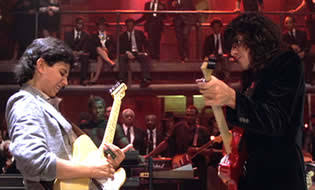
A young Ralph Macchio stands onstage as Eugene Martone, the classically trained guitarist who has traveled into the American South chasing the mythology of Robert Johnson. Across from him stands Jack Butler: silent, intimidating, dressed in black and carrying a blood-red hot-rodded guitar.
And Butler is played by somebody who doesn't merely look like a guitar player. It is Steve Vai.
Then 25 years old and already possessing a resume that included Frank Zappa and Alcatrazz, Vai wasn't yet the universally recognized virtuoso who would become one of the defining guitarists of the next several decades. The Ibanez JEM didn't exist yet. Passion and Warfare was years away. His tenure with David Lee Roth was only beginning to explode.
But for a few minutes near the end of Crossroads, millions of moviegoers were introduced to a guitarist who seemed almost impossible.
Vai bends notes into screams. He whips the tremolo bar. He tears across the fingerboard. He stares down his opponent with almost supernatural contempt.
Then Eugene answers. The phrases become faster. The blues begins mutating into something else. Classical music enters the fight.
Finally Eugene launches into the piece guitarists now know as "Eugene's Trick Bag." Jack Butler tries to follow him. And for the first time, the Devil's guitarist can't.
But there is something wonderfully strange about the entire scene. Because in reality, Steve Vai was effectively battling Steve Vai. And the story of how that happened is considerably more complicated than the movie makes it appear.
Before Steve Vai, the Crossroads Duel Was a Blues Battle
The final scene of Crossroads feels so inseparable from Steve Vai today that it is difficult to imagine another version. But there was one.
The movie was fundamentally built around blues mythology. Its story draws heavily from the legend surrounding Robert Johnson and the supposed deal at the crossroads, while Ry Cooder was brought aboard to create the film's music.
The original conception of the climactic duel reportedly followed that philosophy much more closely. It wasn't supposed to be the explosive blues-versus-shred confrontation that guitarists know today. It was going to be a slide-guitar battle.
Vai has recalled that the original version involving Cooder wasn't producing the dramatic impact the filmmakers wanted. According to Vai, Cooder contacted Guitar Player looking for the new "hotshot" guitarist on the scene. That search eventually led to Vai.
This is one of the great sliding-door moments in guitar culture. Had the original concept remained intact, Crossroads might still be remembered as a beloved blues movie. Instead, its ending became something larger.
It accidentally documented one of the biggest transitions in guitar history. The old world and the new world collide onstage. Blues phrasing meets the technical revolution of the 1980s. And sitting directly at the center of that collision was Steve Vai.
The Forgotten Guitar Hero Behind Crossroads
There is another name that has to be included whenever the guitar history of Crossroads is discussed: Arlen Roth.
Roth's involvement in the movie was extensive. He worked with Ralph Macchio before filming, teaching him how to convincingly behave like a guitarist. Roth says he taught Macchio four days per week for roughly two months before production and created much of the guitar vocabulary that Macchio could realistically mimic on camera.
That detail matters enormously. One reason the guitar sequences in Crossroads continue to work is that Macchio doesn't simply look like an actor randomly moving his fingers while somebody else's guitar plays on the soundtrack. The movements were designed. The vocabulary was taught. The visual performance was constructed around music that could later be synchronized with what audiences heard.
Roth also contributed substantial guitar work to the movie, particularly its slide material. Vai himself made a point of acknowledging Roth's contribution in a 1987 Guitar World interview, saying Roth had worked extremely hard on the project, trained Macchio and recorded many of the slide-guitar passages alongside Cooder.
Roth's own account is more complicated. He has said that he worked on the project for months without the formal contractual and credit arrangements he expected ultimately materializing in the manner promised. Despite the frustration, he has continued to describe the experience itself as extraordinary.
And that brings us to an important point. There isn't one guitarist responsible for everything you hear in Crossroads. There is a small army of them: Ry Cooder, Arlen Roth, William Kanengiser and Steve Vai — and their contributions overlap in ways that have confused viewers for decades.
Ralph Macchio Wasn't Actually Playing Those Impossible Parts
Macchio deserves considerable credit for making the performance believable. But the audio is another story.
Classical guitarist William Kanengiser supplied the classical guitar performance associated with Eugene earlier in the film. Roth performed a substantial amount of Eugene's other guitar material. Cooder contributed extensively to the film's musical world. And when the final showdown arrives, Steve Vai becomes central to both sides of the battle.
In his 1987 interview, Vai put it plainly: he played his own material, but when Eugene enters the blistering classical section, that's Vai too.
Think about what that means. The scene is edited as a duel between two guitarists. Musically, portions of it amount to Steve Vai attempting to defeat himself.
Jack Butler plays a phrase. Vai. Eugene answers with increasingly difficult material. Vai again. The actor Steve Vai has to look increasingly concerned as the guitarist Steve Vai plays the music that will ultimately defeat the character Steve Vai.
It's one of the greatest pieces of guitar-movie trivia ever committed to film.
Vai Didn't Simply Walk Onto the Set and Improvise
The duel had to exist before the cameras could properly capture it. That is an important distinction.
Film music involving visible instrumental performance presents a synchronization problem: if the actors' movements are going to correspond convincingly with the soundtrack, the filmmakers need to know exactly what the music is going to do. Ry Cooder later explained that the duel needed to be carefully mapped because its call-and-response structure had to work as playback during filming.
Vai was exceptionally suited to that kind of assignment. He wasn't merely a fast guitarist. He was a composer with an unusually analytical understanding of the instrument — a musician who had once transcribed Frank Zappa's notoriously complex music and who approached the guitar almost architecturally.
Give him a narrative problem — construct a guitar duel that progressively escalates until one guitarist reaches something the other cannot play — and Vai could turn that problem into composition.
Vai has said that Cooder originally called him because the production needed a "hot rod guitar player" for the scene. Vai read the script, built a duel concept and recorded it. Only after Walter Hill met Vai and heard what he had created did the director ask whether he wanted to appear in the movie as Jack Butler.
Vai initially said no. He reconsidered after reading the script again. Cinema history followed.
So Vai's contribution was musical before it was visual. Jack Butler essentially emerged from the music.
How Do You Write a Guitar Duel?
A guitar duel can't simply consist of two players shredding continuously. If both guitarists begin at maximum intensity, there is nowhere for the scene to go.
A duel needs escalation. It needs conversation. It needs danger. It needs one-upmanship. Most importantly, it needs an ending.
Listen to the sequence as storytelling rather than simply as guitar playing and its construction becomes clearer. The characters trade musical statements. One presents an idea. The other responds. The vocabulary gradually expands. Technique becomes more aggressive. Speed increases. The blues framework begins to stretch.
Eventually, Eugene reaches for something Jack Butler isn't prepared to answer: classical music.
That is the dramatic trick. Eugene doesn't beat Butler by simply playing the same language slightly faster. He changes the language.
The Riff That Eventually Became "Bad Horsie"
Even the beginning of Vai's side of the duel contains a fascinating piece of his future. The script called for a guitar sound that suggested a locomotive passing by. Vai developed a menacing riff for the sequence.
Years later, that musical idea resurfaced. Vai has directly confirmed that "Bad Horsie" was built around the riff he created for Crossroads. The song would eventually appear on 1995's Alien Love Secrets, almost a decade after the movie.
Vai recalled director Walter Hill hearing the original riff and reacting as though the duel might already be finished because it sounded so intimidating.
That tells us something important about how Vai approached the movie. He wasn't simply demonstrating technique. He was composing for character. Jack Butler's guitar needed to sound dangerous before the audience understood anything technical about what he was doing. The low, snarling riff establishes him as a threat. It's musical costume design.
Then Comes "Eugene's Trick Bag"
If the duel is a musical boxing match, "Eugene's Trick Bag" is the knockout punch. The piece combines Vai's technical vocabulary with classical material and famously draws upon Niccolo Paganini's Caprice No. 5.
That choice is perfect for the story. Paganini himself was surrounded by mythology. His technical abilities were so extraordinary that rumors circulated during his lifetime that his talent was somehow connected to the Devil.
So at the climax of a movie built around a musician making a deal with the Devil, Eugene defeats the Devil's guitarist using musical language associated with another virtuoso who had once been rumored to possess supernatural ability.
Get Steve Vai’s “Crossroads — Jack Butler Guitar Duel” Tone
Tell ToneMD what gear you own and get a full signal chain with real numbered settings for this tone.
Included with Premium
But guitarists recognize something else: the piece is brutally difficult. Rapid alternate picking. Arpeggiated figures. Position shifts. Legato. Wide-register lines. Harmonic-minor vocabulary. Precise articulation at speed. And that unforgettable final climb.
The music isn't difficult simply for spectacle. The difficulty is the plot. Jack Butler has to reach a point where he physically cannot answer. When Eugene reaches the final section, Butler tries. He fails. He stares at the guitar. He knows. The duel is over.
The Greatest Irony: Vai Recorded the Part That Beats Him
Vai recorded the climactic Eugene material too. That means the final impossible lick — the one Jack Butler cannot reproduce — comes from the same guitarist playing Jack Butler.
Vai had to compose a musical obstacle formidable enough to defeat his own fictional character. And then he had to act defeated by it.
Vai's performance sells it. Watch his face. The arrogance disappears. There's confusion. Then disbelief. Then recognition. Jack Butler knows that Eugene has found the ceiling. He tries to follow. Can't. Eugene finishes the phrase. Butler rips off his guitar, throws it down and walks away.
No speech is necessary. The guitar told the story.
The Red Crossroads Guitar Didn't Make the Sound You Hear
This is perhaps the biggest gear misconception surrounding the scene. Ask somebody to picture Steve Vai in Crossroads and they'll probably picture the red guitar. It is one of the most recognizable instruments in guitar-film history.
But that isn't the guitar responsible for Vai's recorded Crossroads tone. The instrument heard on Vai's recorded parts was his famous Green Meanie. Vai has directly identified it as the guitar used for Crossroads.
Green Meanie was a Charvel-style Superstrat that became one of the crucial transitional instruments in Vai's development. It sits between two eras of his career. Before it, Vai had been rooted more heavily in Strat-style instruments. After it came the guitar that would become almost synonymous with him: the Ibanez JEM.
Vai needed something heavier and more aggressive for the rock environment he was entering with Alcatrazz. The result was a guitar capable of retaining the response of a Strat-derived platform while delivering the output demanded by increasingly aggressive 1980s guitar music.
It appeared on Alcatrazz's Disturbing the Peace. It followed Vai into the David Lee Roth era. It appears in the history surrounding Passion and Warfare. And it is the instrument behind one of cinema's most famous guitar battles.
What Pickups Were in Green Meanie?
Modern research into Green Meanie confirms the guitar as a basswood-bodied instrument and strongly points toward DiMarzio PAF Pro pickups as the likely pickups used during the Crossroads recording.
But even Vai himself hasn't claimed absolute certainty about the exact pickup configuration at the precise moment the duel was recorded. He was experimenting during that period. The DiMarzio X2N has also been associated with his Alcatrazz-era experimentation. After discussions involving Vai and DiMarzio's Steve Blucher, Guitar World's investigation concluded that PAF Pros were the most likely candidates for the Crossroads sessions.
That uncertainty is worth preserving. Guitar history is often cleaner in retrospect than it was while it was actually happening. Players changed pickups. Guitars were modified. Parts moved. Nobody in 1985 necessarily imagined that guitarists four decades later would be analyzing every component of the recording rig.
The Actual Crossroads Amp Rig
Fortunately, Vai has been much more explicit about the broader signal chain. According to Vai himself, his Crossroads setup included the Charvel Green Meanie into a Carvin X-100B amplifier, with an MXR distortion, a Cry Baby wah and a Roland SDE-3000 digital delay.
That rig is almost a time capsule of high-performance mid-'80s guitar tone. The Carvin X-100B is particularly important. Long before modern modelers gave guitarists hundreds of amplifiers inside a floorboard, players like Vai were building identifiable voices through relatively compact combinations of amplifier, pedals, rack processing and highly modified guitars.
The distortion isn't hyper-saturated in the modern sense. Listen closely and there is still articulation underneath the gain. That matters when the music becomes dense. At extreme speed, too much gain turns individual notes into fog.
Vai needed sustain, aggression and harmonic complexity — but he also needed enough transient definition for the picking to remain audible. The delay adds dimension without swallowing the attack. The wah becomes another expressive filter. The Carvin provides the muscular foundation. And Green Meanie supplies the front-end character.
ToneMD Prescription: Building the Jack Butler Tone Today
The mistake would be chasing "Steve Vai tone" generically. There isn't one Steve Vai tone.
“The guitar everybody remembers isn't the guitar everybody heard.”
The Crossroads sound predates the mature JEM-era rig most players associate with him. If you load a modern Vai-inspired preset designed around Passion and Warfare or his later Legacy amplifier sound, you may end up with something spectacular — but historically you're aiming at the wrong target.
For Crossroads, the starting point should be a Superstrat-style instrument with basswood-style response if available, a medium-to-hot PAF-style bridge humbucker, and a Carvin X-100B / hot-rodded American tube lead amp architecture. Gain high but not excessively compressed. Midrange forward. Bass controlled. Treble present without becoming brittle. Digital delay at a moderate level with relatively clean repeats. Wah available for expressive passages. Minimal modulation. Light noise gate — don't destroy sustain. And playing dynamics are absolutely essential.
A useful starting point for a modern modeler: Gain 6.5/10, Bass 4.5/10, Mid 6.5–7/10, Treble 6/10, Presence 5.5–6/10. Then add a relatively clean digital delay around the 300–400ms neighborhood with low-to-moderate feedback and keep the wet level restrained.
Those numbers aren't presented as documented knob settings from the original session — they are a practical modern approximation based on the known equipment and audible character of the recording. Tone archaeology should separate documented equipment from reconstructed settings.
ToneMD can take the idea further. Choose your actual platform — Helix, Fractal, Headrush, Kemper, TONEX, Quad Cortex, Neural DSP, AmpliTube, Guitar Rig, Boss Katana or another supported rig — enter Steve Vai / Crossroads / Jack Butler, tell ToneMD what guitar and pickups you're actually using, and build the prescription around your equipment rather than blindly copying settings designed for somebody else's rig.
A Les Paul into a modeler doesn't need the same EQ compensation as a basswood Superstrat. A modern high-output ceramic pickup doesn't hit the virtual amplifier like a PAF-style pickup. That's why recreating a tone is more complicated than copying six numbers from a screenshot.
So What Was the Red Guitar?
The red instrument Jack Butler holds onscreen has generated decades of confusion. It is generally described as a custom Charvel/Jackson-family instrument from the pre-JEM period of Vai's career.
The instrument used on camera featured the unmistakable Superstrat architecture of the era: dual humbuckers, Floyd Rose tremolo and a finish designed to look appropriately sinister under stage lighting. Research published by Guitar World traced the instrument and its various replicas through a surprisingly complicated history.
The important distinction is this: the red guitar is the movie star. Green Meanie is the recording star. That distinction alone clears up decades of confusion.
Why Were There Multiple Red Guitars?
Because Jack Butler does something no guitarist wants to do with a valuable custom instrument. He throws it on the floor.
Production needed instruments that could survive the demands of filming — or, more accurately, instruments the filmmakers could afford to damage. According to the history uncovered by Guitar World, Steve Ripley and Pat Wilkins were involved in creating a duplicate after Vai understandably wasn't enthusiastic about repeatedly dropping his guitar. One mockup reportedly used a Kramer body finished to resemble the original instrument.
That has made identifying surviving Crossroads guitars surprisingly complicated. Different instruments were involved. Different components appeared. Copies existed. And the red guitar's visual fame eventually eclipsed the fact that it wasn't even the instrument Vai used for the recorded performance.
In a strange way, that's perfect Hollywood. The guitar everybody remembers isn't the guitar everybody heard.
And No — It Wasn't an Ibanez JEM
Steve Vai and the Ibanez JEM are so closely connected that it is difficult to imagine one without the other. But the timeline doesn't work.

Crossroads was filmed in 1985 and released in March 1986. Vai's JEM relationship with Ibanez came afterward; Vai himself notes that he designed and began using the JEM in 1987.
So the duel captures Vai during an important evolutionary moment. You are essentially watching the guitarist who would help define the next generation of Superstrat design immediately before his most famous guitar existed. Green Meanie was part of that transition, and the needs Vai discovered through instruments like it helped inform what would eventually become the JEM.
Where Was the Crossroads Music Recorded?
Arlen Roth's firsthand account says the early music work included approximately two weeks of recording in Los Angeles with Ry Cooder, Jim Keltner and Jim Dickinson before the production moved into six weeks of location filming in Mississippi. The movie itself was shot across Mississippi, New York City and Los Angeles, with principal production running from late April through July 1985.
What we have not found is sufficiently reliable primary documentation identifying a specific commercial studio room for Vai's final duel recording that we would be comfortable presenting as established fact.
There are countless online claims about Crossroads, and once one unsourced detail gets repeated often enough, it begins looking like history. The evidence supports Los Angeles recording activity surrounding the soundtrack. It supports Vai developing and recording his duel before filming the sequence. It supports the Green Meanie/Carvin rig. But unless stronger session documentation emerges, claiming a specific room for Vai's final duel performance would go beyond the evidence currently available.
Sometimes the responsible answer to a forty-year-old recording mystery is simply: we don't know for certain.
How Much Did Steve Vai Get Paid for Crossroads?
After searching interviews, retrospective features, soundtrack documentation and Vai's own published recollections, there does not appear to be a trustworthy public source documenting Steve Vai's exact compensation for Crossroads. Any specific dollar amount circulating without a primary source should be treated cautiously.
We know Vai was brought in initially for musical reasons. We know he constructed and recorded the duel. We know Walter Hill subsequently asked him to portray Jack Butler. We know the production credited "Butler's Bag," "Head Cuttin' Duel" and "Eugene's Trick Bag" to Vai in various combinations with Cooder, with Vai appearing courtesy of Capitol Records.
What we do not have is a verified public pay stub, contract amount or reliable interview in which Vai states, "I was paid X dollars." So The Guitar Plugged isn't going to invent one.
There is, however, a wonderful irony here. Whatever the check was worth in 1985, the scene's long-term value to Vai's career was probably immeasurable.
Crossroads Arrived at Exactly the Right Moment
Vai had already been through Frank Zappa's musical boot camp. He had released Flex-Able. He had replaced Yngwie Malmsteen in Alcatrazz and appeared on Disturbing the Peace. Then came Crossroads. Then David Lee Roth. Eat 'Em and Smile arrived in 1986.
Suddenly Vai wasn't merely the frighteningly talented guitarist musicians talked about. He was becoming a guitar hero. Crossroads gave that transformation a visual mythology.
Jack Butler wasn't Steve Vai. But Jack Butler represented the exaggerated version of what audiences were beginning to believe Vai might be: the guitarist you summoned when normal guitarists weren't enough.
Why the Scene Still Works 40 Years Later
Technical guitar playing has advanced tremendously since 1986. There are teenagers on social media today capable of executing phrases that would have sounded extraterrestrial when Crossroads appeared. Yet the duel still works.
Because it isn't really about technique. It's about drama. The guitar is the dialogue. Jack Butler doesn't need lines because every phrase communicates arrogance. Eugene doesn't need to explain his growth because his playing demonstrates it.
The duel escalates in exactly the way a physical confrontation would. Threat. Response. Counterattack. Escalation. Desperation. Defeat. The speed serves the story rather than replacing it. That's the difference between a memorable piece of virtuosity and a collection of difficult licks.
The Blues Purists Had a Point — And So Did the Movie
From a strict blues perspective, turning the climax of a Robert Johnson-inspired film into a high-gain neoclassical shred battle is ridiculous. Roth himself has expressed his preference for the original slide-duel concept, and it's easy to understand why. A genuine slide confrontation would have fit the film's musical geography more naturally.
But movies aren't museum pieces. They need dramatic conclusions. Walter Hill's decision pulled Crossroads away from blues realism and toward mythology. And that choice may be precisely why guitarists are still discussing the scene four decades later.
The ending isn't realistic. It's legendary. Those aren't the same thing.
Vai's Most Important Acting Role Was Playing His Own Opposite
Vai has described Crossroads as a snapshot of a particular period in his life. Jack Butler captures an exaggerated, fictionalized version of the virtuoso guitarist at the precise moment when guitar culture was preparing to make Vai one of its biggest stars.
The irony is that the actual Steve Vai was almost the opposite of the character. Butler is cold. Vai is famously thoughtful. Butler treats music as domination. Vai has spent much of his career discussing creativity, individuality and expression. Butler's entire identity depends on being unbeatable. Vai built a career around expanding what he believed was possible.
Maybe that's why the character works. Vai wasn't playing himself. He was playing the nightmare version of virtuosity: technique without humanity.
And Eugene ultimately beats him not because he has sold his soul for greater technique, but because he has accumulated different musical languages. Classical. Blues. Rock. Discipline. Experience. The film's message is more interesting than "the good guy plays faster." Eugene wins because he becomes a more complete musician.
The Crossroads Duel as a Guitar Lesson
Most players spend enormous amounts of time asking: how do I play faster? But the duel suggests a better question: how many musical languages can I speak?
Eugene's advantage isn't merely velocity. It's vocabulary. Learn blues phrasing. Learn triads. Learn classical sequences. Learn rhythm. Learn bends. Learn alternate picking. Learn chord melody. Learn dynamics. Learn how delay changes phrasing. Learn how your pickup responds to the amplifier. Learn when not to play.
The most dangerous guitarist isn't necessarily the fastest person in the room. It's the guitarist with another answer.
Tone Is Part of That Vocabulary
Try playing "Eugene's Trick Bag" through an excessively saturated modern metal preset. The gain may feel incredible. Then listen to what happens to the picking: notes smear together.
Reduce the saturation. Push the mids. Control the low end. Add enough delay to create depth without hiding the transient. Suddenly the articulation begins returning.
Tone isn't separate from technique. Tone changes what technique communicates. A rig that flatters slow bends might fight against rapid alternate picking. A heavily compressed tone can make legato effortless but flatten dynamic range. A bright, low-gain tone can expose every picking inconsistency. A dark, saturated sound can hide attack but destroy clarity.
The Crossroads rig works because the tone supports the performance. That's what ToneMD prescriptions are ultimately designed to accomplish: not simply identify an amp model, but understand the relationship between guitar, pickup, amplifier, effects, player and target recording.
The $0 Lesson Crossroads Gave an Entire Generation
A lot of players discovered advanced guitar music through this scene accidentally. They weren't necessarily buying instrumental guitar records. They weren't studying Paganini. They didn't know what alternate picking was. They went to see the kid from The Karate Kid in a movie.
Then Steve Vai appeared. For some young guitarist sitting in a theater in 1986, that might have been the moment the ceiling disappeared. Wait — a guitar can do THAT?
Every generation of guitar players has those moments. Hendrix at Monterey. Eddie Van Halen's "Eruption." Randy Rhoads. Yngwie. Vai in Crossroads. Satriani's Surfing with the Alien. The first time somebody saw Michael Hedges. The first time somebody watched Tosin Abasi.
The technology changes. The technique changes. The feeling doesn't. It is the moment the instrument becomes bigger than you thought it was.
And That May Be the Real Reason Jack Butler Never Died
Jack Butler has only a handful of minutes to establish himself. He barely speaks. He has no elaborate backstory. Yet guitarists have been talking about him for forty years.
Because Butler isn't really a character. He's an archetype. He's the unbeatable guitarist. Every musician eventually meets one. Sometimes it's the player at the local music store who seems impossibly good. Sometimes it's Eddie Van Halen on a record. Sometimes it's a twelve-year-old on YouTube. Sometimes it's the player you were six months ago.
There is always another Jack Butler. And there is always another "Eugene's Trick Bag" waiting somewhere beyond what you can currently play.
That's why the final image remains satisfying. Butler drops the guitar. Eugene wins. Not because the Devil suddenly became weak. Because the student kept learning.
The Final Prescription
Want to chase the Jack Butler sound with the gear you already own? Open ToneMD and build a prescription for Steve Vai — Crossroads (1986) / Jack Butler Guitar Duel.
Start with the historically documented foundation: Charvel Green Meanie into a Carvin X-100B, with MXR distortion, a Cry Baby wah and a Roland SDE-3000-style digital delay. Then let ToneMD translate that signal chain to your actual rig — Helix, Fractal, Headrush, Kemper, TONEX, Neural DSP, AmpliTube, Guitar Rig, Boss Katana or whatever you're currently playing through.
Because forty years after Jack Butler walked onto that stage, the most interesting part of the Crossroads tone isn't owning the red guitar. It isn't even owning Green Meanie. It's understanding why the rig responded the way it did under Steve Vai's hands — and then finding out how close your rig can get.
The Guitar Plugged Verdict
Crossroads shouldn't have worked as well as it did. A blues film ends with an '80s shred guitarist appearing as a supernatural hired gun. The climactic battle abandons strict blues authenticity for Paganini-inspired pyrotechnics. The guitar everybody remembers seeing isn't the guitar responsible for the recorded tone. The guitarist playing the villain also records the music that defeats the villain. Another guitarist, Arlen Roth, contributed enormously to the movie's guitar authenticity while receiving far less recognition than his role deserved. And the exact amount Steve Vai was paid for any of it remains publicly undocumented.
Yet somehow those contradictions produced one of the most enduring guitar scenes ever filmed. Maybe that's because Crossroads captured something true beneath all of its mythology.
Every guitarist eventually reaches a crossroads. You can stay inside the vocabulary you already know. Or you can keep going.
Eugene keeps going. Jack Butler doesn't have an answer. The red guitar hits the floor. And somewhere in 1986, an entire generation of guitar players started practicing.
Forty years later, some of us still haven't stopped.
Sources & Historical Notes
This feature draws upon Steve Vai's own published recollections through his official site and retrospective interviews, Guitar World's reporting and interviews with Vai, historical accounts from Arlen Roth, AFI production/credit records, and published research into the surviving Crossroads instruments. Where the historical record remains uncertain — particularly Vai's exact compensation and the specific recording room used for his final duel tracks — The Guitar Plugged has intentionally identified those details as unverified rather than repeating unsupported figures.
Experience-driven coverage, not algorithm bait.
- 20+ years of guitar playing experience
- Real-world retail experience at Guitar Center
- Thousands of hours testing guitars, amps, and pedals
- A community of 50,000+ guitar enthusiasts across platforms
- Partnerships with Fender, DistroKid, TrueFire, Card Chords, and Enya
- Editorial standards published openly — see how we test gear
The Modern Guitar Magazine. Delivered to your inbox.
No spam. No gimmicks. Just great guitar content — stories, tones, iconic solos, and honest gear takes. Every week.
Ask GP
3 free questions a dayStill curious? Ask GP about this story.
Your personal classic-rock and guitar guide — ask anything about The Devil Went Down to.
Discussion (0)
Sign in to join the discussion.
Sign in to commentLoading comments…
Discover another guitar story
Swipe through our latest features, breaking news and iconic solos — one story at a time.
Open Swipe →More in Guitar Talk
History of the Riff: Black Sabbath's "Iron Man" — A Lumbering Monster, a Factory Accident, and Doom's Walking Template
After Smoke on the Water turned four notes into guitar-shop folklore, Tony Iommi's Iron Man riff showed how a slow, blues-stained figure — born in a rehearsal room over Bill Ward's boom — could invent metal's sense of weight, space, and riff-as-character.

Gretchen Menn on Finding Her Own Voice, Playing with Steve Vai, and the Hardest Music of Her Career
From Zepparella and a Dante-inspired solo album to a guitar concerto, orchestral recording, and a new band, Menn has built a career that refuses to stay in one musical lane. In an exclusive conversation with TheGuitarPlugged, she talks about the experiences and ideas connecting it all.
History of the Riff: The Kinks' "You Really Got Me" — How Two Power Chords and a Sliced Speaker Invented Hard-Rock Guitar
After Rumble taught the guitar to threaten and Misirlou taught it to sprint, Dave Davies' 1964 two-chord smash taught it to punch the charts — with a razor-cut Elpico, a Vox slave, and zero apology.