
Eric Johnson and band at the Colonial Theatre, Phoenixville, Pennsylvania, October 1, 2025.
Eric Johnson just walked Guitarist through his touring rig for the first time in 13 years. Here's how the three-amp setup, the '54 Strat, the pedals and his picking hand add up to the most-studied lead tone in instrumental rock, and how to get close today.
Every guitar player who has tried to learn "Cliffs of Dover" knows what happens next. You get the notes, and maybe even the speed, but it still doesn't sound like Eric Johnson. His lead tone is smooth, vocal and violin-like. It sustains like a held note on a bow, and it has a clarity that most overdriven guitars lose. Steve Vai, one of his oldest touring partners, summed it up in an April interview with the St. Pete Catalyst: "His tone, and his almost neurotic focus on tone."
This has been a big year for anyone studying that sound. Johnson spent 2026 on his Texaphonic tour, playing the US in the spring and then his first UK run in more than a decade over the summer. Along the way he gave some of the most detailed gear interviews of his career. In September, Guitarist (via Guitar World) published its first full rig tour with him in 13 years. Earlier in the year he talked picks and picking with MusicRadar, Dumbles with MusicRadar again, and how he chooses a guitar with Guitar World. He has also told interviewers that a straight-ahead blues-rock EP is coming this fall. As of this writing we couldn't find an announced title or release date.
So this is the right moment to put the pieces together. Here's Eric Johnson's tone, decoded in his own words wherever possible.
The Sound: Clean Notes Inside a Distorted Tone
Johnson's lead sound is distorted, but it never turns to mush. Each note blooms instead of barking. Two things cause that, and you can hear both of them in nearly every solo he has recorded since Tones in 1986.
The first is the bottom end. Johnson leans warm and woody, and he admits he sometimes goes too far. "I think sometimes I run it a little too bassey," he told eonmusic in March. "I've been trying to kind of inch the treble up a little bit because it got a little out of hand. Everybody's like; 'it sounds like it's in the bottom of a swimming pool!', so I'm trying to get that together. But typically I like a more kind of smooth, or kind of woody kind of lead tone." He traces that taste to early Eric Clapton, B.B. King and Jeff Beck's Truth, records with what he called a "real reedy, kind of smooth tone."
The second is attack, or rather how little of it he wants. Johnson started on piano, and he still thinks like a pianist. "I like the sound of the piano because it's a lot of note and not a lot of attack," he told Guitarist. "It was just the blooming of the note, like Wes Montgomery, or in particular steel-guitar players."
That one idea, a lot of note and not much attack, explains most of his gear choices.
The Three-Amp Rig, in His Own Words

Most players run one amp and use pedals for clean, crunch and lead. Johnson splits those jobs across three separate signal paths, and the 2026 rig he shipped to the UK works the same way it has for years. Here's how he described it to Guitarist's David Mead:
"I use three different sounds: the guitar goes into two A/B boxes; the first A/B selects whether it's going to be lead or it's going to be a choice of rhythms. So it comes out for the lead, goes into a wah-wah, and then it goes over to an Echoplex and a Tube Driver, and it comes out of that and goes into a Marshall [JMP] head connected to the bottom [Marshall] cabinet."
Broken down, the three paths look like this:
- Lead: wah, then Echoplex, then Tube Driver, into a Marshall JMP head and the bottom Marshall cab.
- Clean rhythm: a loop box for a Deluxe Memory Man, then a second Echoplex and a TC Stereo Chorus, into two Fender Deluxe Reverbs in stereo.
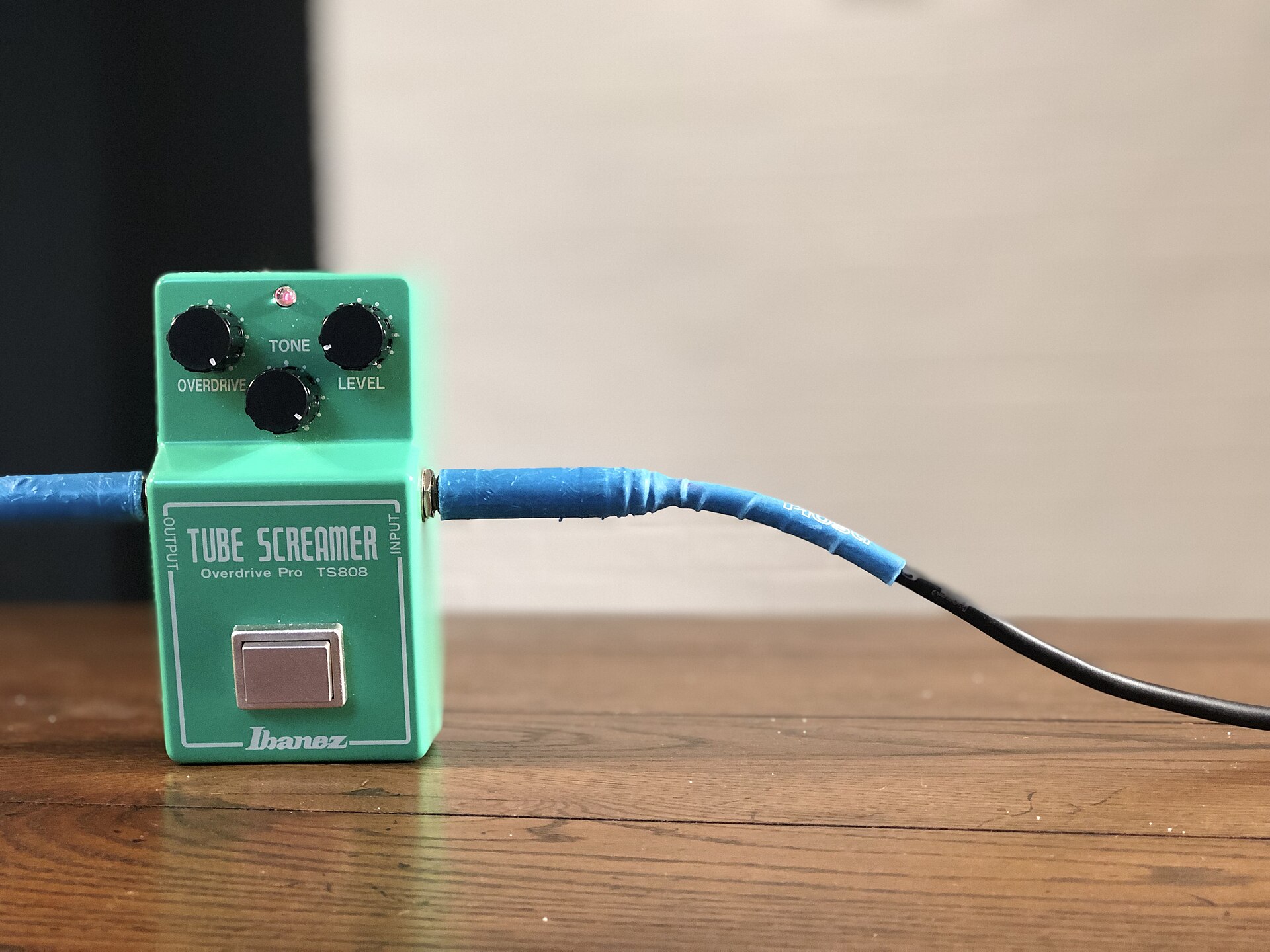
- Dirty rhythm: an Ibanez TS808 Tube Screamer, an Arbiter Fuzz Face and an MXR Digital Delay, into a Two Rock Classic Reverb and the top Marshall cab.
"So it's really just a matter of having three different sounds," he said. "One clean stereo rhythm, one dirty rhythm with fuzz, or a lead with the tube overdrive. Pretty much the same as it's been for years, although the particular amps might change, but the general structure and architecture stays the same."
The amps really do change. In April he told MusicRadar that his usual big rig uses "a modified Bandmaster Reverb through a Marshall cabinet for dirty rhythm," with "a 50 or 100-watt Marshall through a 412 cabinet for lead." In the UK that dirty-rhythm job went to the Two Rock. What stays fixed is the plan: a Fender clean in stereo, a crunch amp for fuzz rhythm, and a Marshall for lead.
And he really did ship it all. "Yeah, it's pretty extravagant," he said of bringing the US rig to Europe instead of hiring backline. "I'm going to go home broke because I shipped everything over here, so I'll be eating bread and cheese for the next year or two, but that's okay, at least I'll have my sound, I guess."
Why Three Amps? Gain Structure and Tone Stacks
This isn't excess for its own sake. Johnson's reason is about where each amp is strongest.
"One thing is the gain structure of the amps," he explained. "I was able to get a better lead tone out of a high gain or a higher gain amp like a Marshall. And I was able to get a better rhythm tone out of a lower gain amp like a Fender."
The second reason is more technical. "The tone controls are in a different place in the schematic on a Marshall than they are on a [Fender] black-panel, so it affects the sound," he said. A black-panel Fender gives him the clean country and "Wind Cries Mary" sounds. The Marshall handles blues-rock lead. "I just had to part it out because I could never figure out a way to make it work just using one amp and getting all those sounds. I wish I could do that."
That's the key to the whole rig. Johnson doesn't make one amp do three jobs badly. He gives each job to the amp that does it best, and the A/B boxes keep the paths separate so the clean tone never runs through a fuzz pedal or an overdriven preamp.
The Lead Chain: Tube Driver, Echoplex, Marshall
The lead sound, the one everyone chases, comes from a fairly simple chain. There's nothing exotic in it. Even Guitarist said it was surprised by how little "exotica" the rig contains.

Never Run Out of Strings Again.
Fresh USA-made strings delivered every month from the X Concepts String Club.
The Tube Driver is the core of it: a tube-based overdrive pushing a Marshall that is already working. That stacked, moderate gain gives a thicker, more compressed sustain than one hot preamp would. The Echoplex adds a little tape character and a short echo behind each note. That's a large part of why his single notes sound so wide and wet without obvious delay trails.
If you want the background on the pedals involved, we've covered them in detail: the history of the Fuzz Face, including Dunlop's EJF1 Eric Johnson signature version, and the Ibanez Tube Screamer story, from the TS808 on.
The Dumble Years
Before this rig settled into its current form, Johnson spent time with Dumble amplifiers. His mid-'90s Dumble Manzamp preamp and Odyssey power amp later sold for a reported $400,000, according to MusicRadar. Johnson said the Manzamp wasn't the one he loved, though.
"The [Dumble] Steel String Singer was the one I used the most," he told MusicRadar's Jonathan Horsley. "I'd use the Steel String Singer preamp into the Odyssey power amp." He described the amps as "kind of like a Twin Reverb but with a lot more treble, and a lot more bass capability – and headroom," and added: "For a crunch rhythm sound, there's just nothing that I have ever found that was as good as those, and a fuzz would sound real good through them, too."
He went through a period of trying to play very quietly, decided the Steel String Singer had to go, and still regrets it. "That was a mistake," he said. For more on why those amps still matter, read our piece on Dumble's return.
The Guitar: A '54 Strat, Lightly Modified

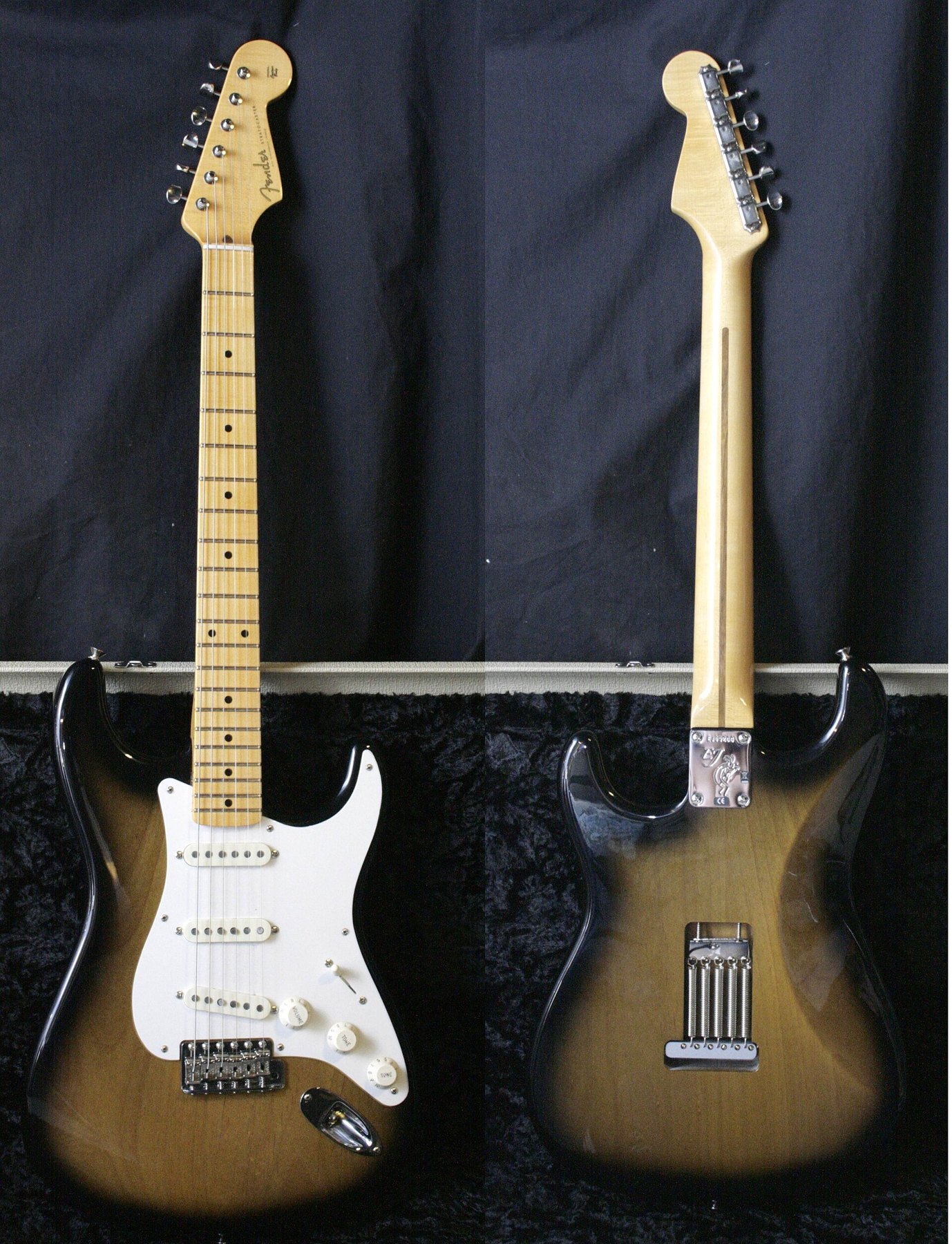
On the 2026 tour, Johnson's main guitar is a 1954 Stratocaster. "I just use my '54 Strat, and I have one of my EJ rosewood [fingerboard] Stratocasters with me," he said. "But the Strat is the main thing I use for most of the show." He also brought a Custom Shop Les Paul for a few songs.
His setup notes are the most useful part of the interview:
- Fretboard and frets: "I like the fretboard a little flatter with bigger frets."
- Tone control: "I hook [the lower] tone control up to the bridge pickup." That gives him a way to roll off the bridge pickup's top end, which a stock vintage Strat doesn't offer.
- Bridge pickup: "The neck and middle are the old pickups, but I replaced the bridge pickup with a HS2 DiMarzio. But I don't hook up the bottom coil, I just leave it single coil, so it has a little bit more gain than a regular Fender pickup."
- Action: "The action is not too low, but kind of low; so that it doesn't fret out."
- Strings: "I just use a stock 10 through 46," he said, adding that he used to go a little heavier but found 10s "more balanced."
He also talked about how attitudes to old guitars have changed. The '54 was refinished, and the neck "was already flattened before I got it, which is perfect because nowadays you don't want to touch it anymore. But in the old days it didn't matter. I mean, I used to find ['50s Strats] for 400 bucks and you could do whatever you wanted. But it's kind of become a stigma now." He's realistic about it, too. "This is the only '54 I have and it's a good guitar, although it's not particularly original, but it does the job."
Fender has built that same recipe into his signature models. In 2020, the Eric Johnson "Virginia" Stratocaster became the first model in Fender's Stories Collection. It recreates the 1954 Strat he used on Tones and Ah Via Musicom, with a sassafras body, custom wiring, a flattened 12-inch fingerboard radius, jumbo frets and a Graph Tech high-E saddle. Fender's spec sheet for the production version mirrors his current '54: a DiMarzio HS-2 in the bridge with only the top coil active, a second tone control wired to the bridge pickup, and .010–.046 strings. Johnson's description of the prototype could also describe his whole approach: "It has a particular smooth sustained tone but as you turn it up, it has gain like a little violin."
How He Picks a Guitar: "Some Guitars Fight You"
Johnson's test for a guitar has little to do with specs. In August he told Guitar World: "Some guitars fight you when you play, and other ones kind of play with you."
He hears it in the response to his pick attack. "I think it's the breathing of the resonance of the wood – whether the envelope is matching your picking style, or if it's kind of the opposite. You can kind of feel it when you pick." Some guitars, he said, "are kind of stiff and too in your face… Other ones fold in and out like they're breathing with your picking. So, I look for ones that do that. That's probably my most important thing."
Everything else is fixable, in his view. "I can get used to the neck or change the pickups… But the most important thing to me is that it has that kind of envelope breathing thing…"
That's worth remembering the next time you're comparing Strats in a shop. If you're shopping on a budget, start with our best Strats under $1,000, then play them unplugged and listen for how the note answers your pick.
The Part You Can't Buy: The Pick and the Picking Hand
Johnson says the sound starts before the amp, before the pedals and before the pickups. It starts with the pick.
"Depending on the type of material you use for a pick, and the way you first strike the pick, that's the beginning of the whole thing, and you can't underestimate that," he told MusicRadar. "That's what begins the sound and so, to me, the type of pick, the material, not so much the size but the material, and the way you pick the note [is essential]."
His pick is a nylon Jazz III. Dunlop now makes the Eric Johnson Custom Nylon Jazz III in a custom nylon blend that replaces his earlier signature model. "This newly designed Jazz III Pick is the result of extensive experimentation with different types of nylon," Johnson says in Dunlop's product notes. "I find it to have a really great tone—it's my favorite pick today." Nylon is warmer than most modern pick materials. That fits a player who wants a lot of note and not much attack.
The motion matters just as much. Johnson borrowed it from pedal steel players. "The way I like to pick is I've watched steel guitar players where they kind of bounce up and down on the guitar," he said. "And it's not a very efficient way to pick, but to me it just sounds better, so I kind of try to stick with that." In a Sweetwater lesson quoted by MusicRadar, he described picking from the pickguard side outward, "where it kind of thrusts the note out a little bit more," which he finds works better with a lot of distortion.
He compares it to Wes Montgomery, his favorite jazz guitarist, who used his thumb even though it was harder. "He realised very early on that it was gonna be a harder journey to just effortlessly play this stuff," Johnson said. "But he just loved the way it sounded."
The lesson is the same one we drew in our Stevie Ray Vaughan Tone Decoded: the gear sets the stage, but the hands make the sound. It's also why most rig copies fall short, as we argued in the last 10 percent.
The Brain Behind the Hands: Notes, Not Shapes
The final part of Johnson's sound isn't gear at all. It's how he sees the fretboard. Because he learned guitar by moving piano parts onto it, he had to learn every note on every fret, and he thinks most guitarists are still stuck in box shapes.
"I think most guitar players are still somewhat trapped in patterns," he told Guitarist. His fix is simple to describe and hard to do: "Just sit down and learn – to where you [can do it] without thinking – to look at any fret on any string and know what note it is. It is a daunting task, but it's totally doable. And then, once you get it, it's like breathing."
He's still pushing himself, too. "Lately, I've been trying to think, 'Where could you go with guitar if you decided there were no limitations at all,'" he told MusicRadar in April. It's a striking thing to hear from a player whose "Cliffs of Dover" sits in our Top 25 guitar solos of all time.
Digital Amps: A New Tool, Not a Copy
The biggest surprise in the 2026 interview: the most tone-obsessed player in rock has been trying digital. "The Tone Master by Fender and the Neural [Quad Cortex]. Still messing with it," he said. Most players buy a modeler to clone their tube amp. Johnson is leaning the other way. "I think at this juncture it seems that its strength is to use it as its own tool instead of trying to make it sound exactly like a vintage amplifier, you know?"
He even pointed out that a modeler could solve the problem his three-amp rig was built for. "I wish I could do that," he said of getting every sound from one amp. "I think they actually call that the Neural DSP [Quad Cortex], don't they?" For the bigger picture, see our evolution of guitar modeling, from POD to Quad Cortex.
How to Get Close to the Eric Johnson Tone Today
You don't need three amps, two Echoplexes and a vintage Strat. You need the same structure. Here's TGP's practical take, built on what Johnson describes:
1. Split clean and dirty. Even with one amp, keep your clean sound truly clean. Put chorus and delay on the clean tone, and keep the fuzz and overdrive off it. On a modeler, build three separate scenes: clean stereo, fuzz rhythm and lead. 2. Use a Fender-style clean. A black-panel style clean with headroom is the base for his rhythm sound, and stereo chorus and delay give it width. 3. Stack moderate gain for lead. A tube-style overdrive into an amp that is already a little driven sustains better than one high-gain stage. Add a short, slightly dark echo, not a long trail. 4. Fuzz is for rhythm. In his current rig the Fuzz Face sits on the dirty rhythm path with a Tube Screamer, not the lead path. 5. Tame the bridge pickup. A hotter single coil in the bridge, plus a tone control wired to it, lets you roll off the harshness without losing gain. 6. Change your pick before your amp. Try a nylon Jazz III-style pick, and practice picking so the note "jumps out" rather than snapping. 7. Learn the notes. Johnson's single most repeated piece of advice costs nothing.
Tone Decoded Verdict
Eric Johnson's tone has a reputation for being impossible, and in one sense it is. Nobody else has his hands, his ears or his patience. But the rig he described this year is not a mystery. It's three ordinary paths, each going to the amp that does its job best, fed by a lightly modified Strat with a slightly hotter bridge pickup and played with a warm nylon pick and a bouncing, steel-player motion.
The real secret is the one he keeps repeating: a lot of note and not much attack. If you chase that instead of the gear list, you'll get closer than any pedal will take you. And if the promised blues-rock EP does arrive this fall, we'll find out how that sound works in a straight-ahead power trio.
For more, read the rest of our Tone Decoded series, or catch up on what his G3 partners did next in our piece on Joe Satriani and Steve Vai's first studio album together.
Sources
- Guitar World / Guitarist, David Mead, "Talking gear, tone and technique with the great Eric Johnson," Sept. 25, 2026: https://www.guitarworld.com/artists/guitarists/eric-johnson-gear-tour-2026
- Guitar World, Matt Owen, "Eric Johnson has a valuable lesson for players 'trapped in patterns,'" Aug. 3, 2026: https://www.guitarworld.com/artists/guitarists/eric-johnson-most-valuable-guitar-lesson
- Guitar World, Phil Weller, Eric Johnson on what to look for in a guitar, Aug. 25, 2026: https://www.guitarworld.com/artists/guitarists/eric-johnson-what-to-look-for-in-a-guitar
- MusicRadar, Jonathan Horsley, Eric Johnson on the Dumble rig, Texaphonic tour and setting his playing free, April 19, 2026: https://www.musicradar.com/artists/eric-johnson-texaphonic-tour-dumbles-technique-theory
- MusicRadar, Jonathan Horsley, Eric Johnson on pick choice and Wes Montgomery, April 8, 2026: https://www.musicradar.com/artists/eric-johnson-guitar-picks-picking-wes-montgomery
- eonmusic, Eamon O'Neill, "Eric Johnson on Returning to the UK & Plans for a New EP," March 6, 2026: https://www.eonmusic.co.uk/interviews/eric-johnson-on-returning-to-the-uk-plans-for-a-new-ep
- St. Pete Catalyst, Bill DeYoung, "Talking with guitar virtuoso Eric Johnson," April 15, 2026 (Steve Vai quote; fall EP): https://stpetecatalyst.com/talking-with-guitar-vituoso-eric-johnson/
- eonmusic, "Eric Johnson Announces 2026 UK Tour," Feb. 16, 2026: https://www.eonmusic.co.uk/news/eric-johnson-announces-2026-uk-tour
- Fender Newsroom, "Fender launches all-new Stories Collection with Eric Johnson 'Virginia' Stratocaster," Feb. 11, 2020: https://www.fender.com/newsroom/271756-fender-launches-all-new-stories-collection-with-eric-johnson-virginia-stratocaster/
- Fender product page, Stories Collection Eric Johnson 1954 "Virginia" Stratocaster: https://www.fender.com/products/stories-collection-eric-johnson-1954-virginia-stratocaster
- Dunlop, Eric Johnson Custom Nylon Jazz III Pick 1.38mm (407-138EJ): https://www.jimdunlop.com/eric-johnson-custom-nylon-jazz-iii-pick-1-38mm/
- Official site: https://www.ericjohnson.com/
Experience-driven coverage, not algorithm bait.
- 20+ years of guitar playing experience
- Real-world retail experience at Guitar Center
- Thousands of hours testing guitars, amps, and pedals
- A community of 50,000+ guitar enthusiasts across platforms
- Partnerships with Fender, DistroKid, TrueFire, Card Chords, and Enya
- Editorial standards published openly — see how we test gear
The Modern Guitar Magazine. Delivered to your inbox.
No spam. No gimmicks. Just great guitar content — stories, tones, iconic solos, and honest gear takes. Every week.
Ask GP
3 free questions a dayStill curious? Ask GP about this story.
Your personal classic-rock and guitar guide — ask anything about Eric Johnson Tone Decoded.
Discussion (0)
Sign in to join the discussion.
Sign in to commentLoading comments…
Discover another guitar story
Swipe through our latest features, breaking news and iconic solos — one story at a time.
Open Swipe →More Guitar News
Tone Decoded: Stevie Ray Vaughan — The Truth Behind the Biggest Strat Tone in Texas
The Strat. The heavy strings. The Tube Screamer. The wall of amplifiers. We break down what really made Stevie Ray Vaughan's guitar tone sound so enormous.
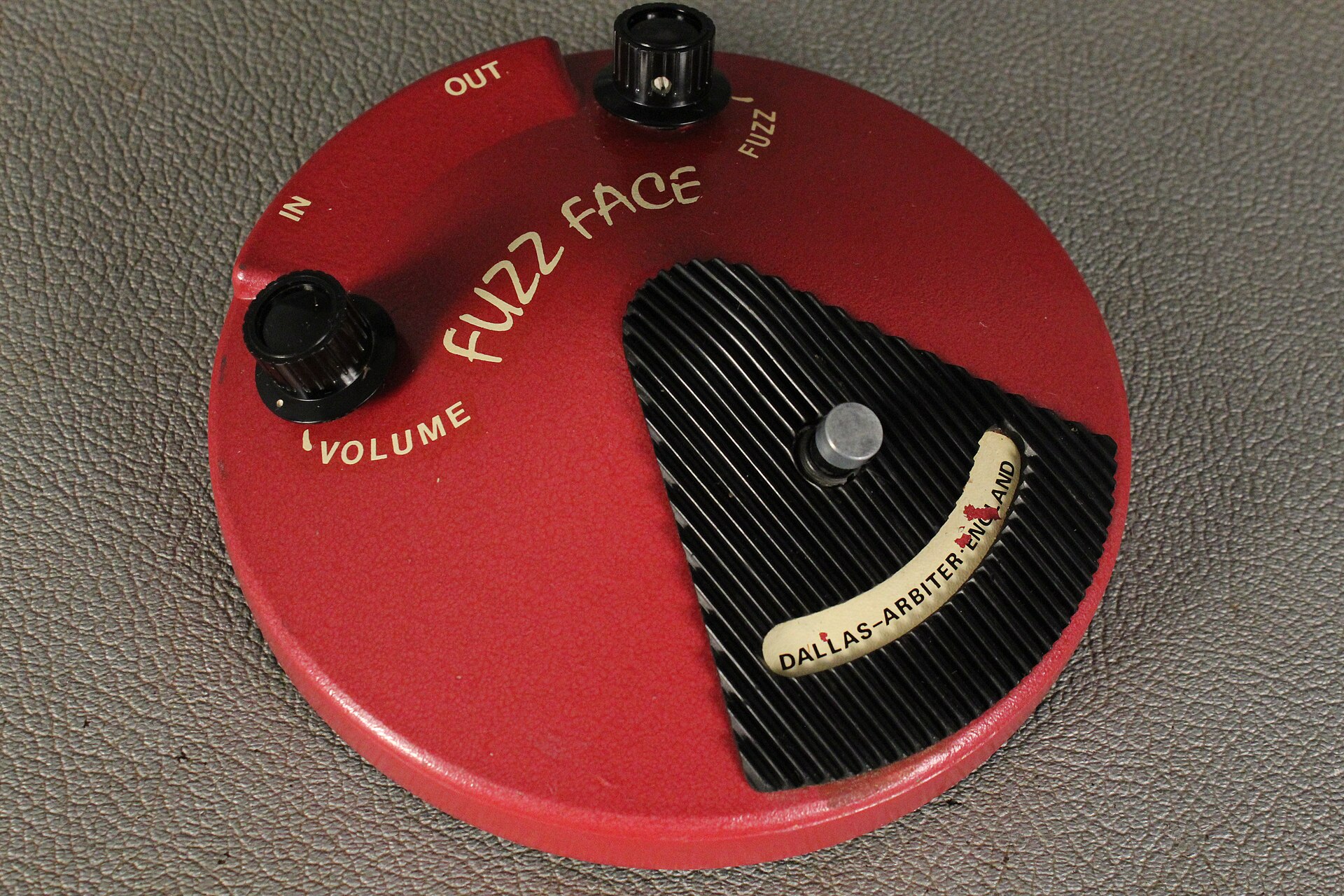
The Fuzz Face History: How a Cheap Copy in a Mic-Stand Base Outlived Its Flaws
The Fuzz Face was a borrowed circuit in a mic-stand base, and half of them sounded bad. Here's how it became Hendrix's fuzz and still sells 60 years later.

Dumble Is Taking Special Orders Again. That Is Not the Same Thing as Alexander Coming Back.
The Dumble Preservation Society is inviting special orders for an Overdrive Special, a Tweedle Dee, and a MegaPLX. No prices are listed. Alexander Dumble died in 2022, and the guitarist most tied to the Overdrive Special says the builder wanted the amplifiers to stop with him.
The Ibanez Tube Screamer: How a Little Green Box Built to Compete Became the Pedal Everyone Copies
How a Maxon engineer's answer to the Boss OD-1 became the Ibanez Tube Screamer, why the TS808 vs TS9 debate never ends, and what SRV really used.