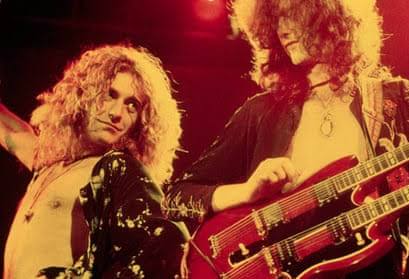
History of the Riff: "Black Dog" — How John Paul Jones Wrote It and Jimmy Page Weaponized It
Led Zeppelin turned one of rock's strangest riffs into a monument. The twist: the riff everybody credits to Jimmy Page began on the back of John Paul Jones's train ticket.
There are guitar riffs that announce themselves.
The opening of "Whole Lotta Love." The first three chords of "Smoke on the Water." Tony Iommi dragging "Iron Man" out of the darkness.
Then there is "Black Dog."
It doesn't so much begin as attack.
Robert Plant sings alone: Hey, hey mama…
Silence.
Then the entire band answers with a riff that seems to lurch sideways across the beat. Plant comes back. The band disappears again. Another vocal line. Another explosion.
It is one of the most recognizable guitar parts ever recorded, but more than five decades after Led Zeppelin released it, "Black Dog" still has the ability to make musicians wonder exactly where the hell the beat went.
That was no accident. And perhaps the greatest twist in the history of the riff is this: Jimmy Page didn't write it. John Paul Jones did.
The Riff That Shouldn't Have Worked
By 1971, Led Zeppelin had already changed the scale of rock music.
The first album had established the formula: enormous drums, blues vocabulary, acoustic textures and Jimmy Page's almost architectural approach to guitar production. Led Zeppelin II made them superstars. Led Zeppelin III complicated the picture, leaning further into folk, acoustic music and the band's more pastoral side.
Their fourth album would have to pull all of those identities together. Instead of chasing another "Whole Lotta Love," Zeppelin made an album that seemed determined to prove they could do virtually anything.
"Rock and Roll" was almost primitive in its directness. "The Battle of Evermore" sounded centuries old. "Going to California" barely needed electricity. "Stairway to Heaven" built an entire universe in eight minutes.
And near the beginning of the record sat "Black Dog": a blues song that behaved nothing like a conventional blues song.
At the center was that riff. It came from bassist and multi-instrumentalist John Paul Jones.
Jones later recalled writing the idea while riding a train home from a rehearsal at Jimmy Page's house. Having learned a shorthand method of musical notation from his father, Jones was able to write the riff down on the back of his train ticket.
That detail tells you something important about the riff. It wasn't simply discovered by somebody noodling around until something sounded good. It was constructed. Jones was thinking compositionally. And he was thinking rhythmically.
The idea reportedly drew inspiration from the kind of blues riff that could seemingly keep cycling without resolving in the obvious way. Jones took that concept and pushed it into distinctly Zeppelin territory. What emerged was simultaneously bluesy and deeply strange.
The notes themselves aren't what make "Black Dog" intimidating. The placement of them is.
Where Is Beat One?
Ask a guitarist who has never seriously studied "Black Dog" to play along with the record and something interesting often happens. They know the riff. They may even know the notes. Then John Bonham enters and suddenly everything feels wrong.
That is the genius of it.
The riff creates rhythmic ambiguity by making your ear question where the downbeat actually sits. John Paul Jones later explained the placement more specifically: the first A — the fourth note heard in the phrase — lands on beat one. Bonham makes the illusion even stronger because one of his enormous cymbal accents arrives on beat two.
Your brain wants to reinterpret what it is hearing. The riff refuses to cooperate.
This is why "Black Dog" can feel more complicated than it technically is. The band isn't showing off with complexity for complexity's sake. They're manipulating your internal sense of time. The riff feels as if it is chasing the rhythm section and then suddenly landing perfectly with it. That tension is the hook.
And once you hear the correct pulse, you can never entirely unhear it. That is one of the marks of a truly great riff: learning how it works doesn't diminish the magic. It makes the magic more impressive.
Enter Jimmy Page
John Paul Jones may have created the skeleton, but Jimmy Page gave the riff its teeth.
That distinction matters. Page's greatest gift wasn't simply being an extraordinary guitarist. He understood how guitars should occupy a recording. He thought like a producer. He understood distance, texture, contrast, frequency and arrangement.
So when Jones brought in this crooked, blues-derived bass figure, Page didn't simply reproduce it. He transformed it into something that sounded enormous.
The riff is essentially doubled on guitar an octave above Jones' original bass idea, creating a sound in which the bass and guitar become almost one instrument. That's a huge part of why the recording feels so heavy. It isn't just Page playing a loud guitar riff while Jones provides conventional bass underneath. The instruments reinforce the same musical architecture.
Jones supplies weight. Page supplies aggression. Bonham supplies gravity. And Plant floats above the whole thing. Four musicians, four completely different functions.
The Secret Weapon: Silence
Get Jimmy Page’s “Black Dog” Tone
Tell ToneMD what guitar and gear you own and we’ll show you how to get as close as possible using the equipment you already have — full signal chain, real numbered settings, no guesswork.
Included with The Guitar Plugged Premium
Listen again to the beginning of "Black Dog," but don't concentrate on the notes. Listen to what happens between them.
Silence.
That may be the most underrated element of the entire arrangement. The song opens with Plant virtually unaccompanied. He delivers a line like an old blues singer calling across a room. Then Zeppelin answers. Not Plant and Zeppelin simultaneously. Plant. Then Zeppelin. Call. Response.
That design reaches directly back into the blues tradition, but the scale is completely different. Instead of a guitarist answering a vocal phrase with a small lick, Led Zeppelin answers Plant with the equivalent of a building collapsing. Then they stop. The empty space resets the tension. Plant sings again. And the monster returns.
Imagine the same riff played continuously underneath the verse. It would still be good. But it wouldn't be "Black Dog." The silence makes the riff feel twice as heavy.
Bonham Doesn't Follow the Riff
A lesser drummer might have attempted to trace every rhythmic turn in Jones' figure. John Bonham does something much smarter. He anchors it.
This distinction is crucial to understanding Led Zeppelin. Bonham could play with staggering power, but his genius was rarely about simply playing more. He knew where the center of a song was.
On "Black Dog," the guitar and bass can twist around the listener because Bonham remains the gravitational force underneath them. His playing gives the riff permission to sound unstable. Without that foundation, the composition could easily feel clever but awkward. With Bonham underneath it, the riff becomes physical. You don't need to count it. You feel it.
That is one reason Led Zeppelin's most complicated moments rarely sound academic. The band could do strange things rhythmically without sacrificing swagger. "Black Dog" isn't prog rock dressed as blues. It's still dirty. It's still sexual. It's still dangerous. It just happens to be far smarter than it initially lets on.
Plant Becomes Another Instrument
Then there is Robert Plant. It's difficult to imagine "Black Dog" with a conventional vocal arrangement.
Plant isn't simply singing over the riff. He's sparring with it. His voice throws out a phrase. Page, Jones and Bonham throw something back.
This vocal/guitar relationship became one of Zeppelin's defining characteristics. Contemporary accounts of the band even noted the way Plant and Page would trade phrases onstage, Page playing figures that Plant would answer vocally and vice versa. "Black Dog" turns that chemistry into composition.
Plant's performance also gives the song its primal quality. On paper, this is sophisticated music. In the speakers, it sounds like lust. That's Zeppelin. They could hide extremely intelligent arranging inside music that hit the listener below the neck.
The Sound of Page's Guitar
Trying to reproduce "Black Dog" is where many guitarists discover another surprise. Too much gain ruins it.

X Concepts Strings • Made in USA
Never Run Out of Strings Again.
Join the X Concepts String Club and get fresh USA-made strings delivered every month—plus Premium membership options for the full Guitar Plugged experience.
Modern players sometimes hear a massive classic-rock guitar sound and instinctively reach for more distortion. But Page's great Zeppelin tones are often much clearer than memory suggests. The heaviness comes from the playing, arrangement, recording and frequency balance — not simply saturation.
Listen closely to "Black Dog." There is bite. There is compression. There is harmonic aggression. But there is also definition. You can hear the attack. You can hear the strings. You can hear the spaces between the notes.
That clarity is essential because the riff is rhythmically dense. Bury it under modern high-gain distortion and its personality starts disappearing. Page needed the notes to punch. The sound has to snarl without turning to mush.
That is a lesson worth remembering whenever chasing vintage Zeppelin tones. Heavy does not automatically mean high gain. Sometimes heavy means leaving enough room for the player to sound dangerous.
• Gain: Moderate — considerably less than you think you need
• Mids: Forward and vocal; this is where the riff lives
• Bass: Controlled, so the low notes stay articulate under Jones's bass
• Attack: Preserve the pick transient — you should hear the strings
• Pickup: Bridge humbucker, British-voiced amp on the edge of aggression
• Test: If individual notes stop speaking clearly, you've gone too far
Tone Prescription: Chasing "Black Dog" With ToneMD
“Jones wrote the puzzle. Bonham found the floor beneath it. Plant gave it a voice. And Jimmy Page plugged it in.”
"Black Dog" is also exactly the kind of recording that exposes the difference between buying gear and understanding tone. You can own a Les Paul and a British-style amplifier and still be nowhere close.
The important questions are more specific: How much gain? How much midrange? How bright should the attack be? How much low end should be removed so the riff stays articulate? How should the amp respond when you hit the strings harder? And how do you translate a 1971 studio sound onto a modern rig?
That's where ToneMD fits into the equation. Instead of treating tone chasing as a shopping list, ToneMD approaches it like a prescription. Choose the artist or song tone you're after and the equipment you're actually using, then build the signal chain around the gear already in front of you.
For a "Black Dog"-inspired sound, start with considerably less gain than you think you need. Keep the mids forward, preserve pick attack and resist the temptation to turn the low end into a wall. The riff needs teeth more than it needs distortion. If the individual notes stop speaking clearly, you've already gone too far. Page's sound works because the guitar remains alive.
The Little Details
Great riffs survive repetition because they aren't actually as repetitive as they seem. Page understood this instinctively.
Later in "Black Dog," he adds additional guitar information around the familiar figure, including a parallel harmony in thirds. It's easy to miss because the listener already believes they understand the riff.
That's another Page production trick. Establish the identity. Then subtly alter the picture. The result is movement without destroying familiarity.
These tiny decisions are why Zeppelin records reward headphone listening decades later. The songs are immediate enough to work from across a room. But get close and there is architecture everywhere.
The Solo
Then Page gets his opening. The solo doesn't suddenly transform "Black Dog" into a technical showcase. It keeps the attitude intact.
That is important. Page's playing has always been difficult to evaluate purely through conventional ideas of precision because conventional precision wasn't really the point. His phrasing could be reckless. Notes could smear together. Bends could sound almost violent. The guitar sometimes seemed to be fighting him. And that friction became part of the vocabulary.
"Black Dog" needs exactly that personality. A pristine, mathematically perfect solo would almost sound wrong. The song requires somebody willing to lean over the edge. Page does.
Led Zeppelin IV
"Black Dog" eventually became the opening proper song on the album most commonly known as Led Zeppelin IV, following the brief studio chatter and count-in embedded at its beginning.
Released in 1971, the untitled fourth Zeppelin record became something much larger than another successful rock album. It became mythology.
There was no conventional band name or album title printed prominently across its famous cover. Instead, Zeppelin increasingly presented themselves as something beyond normal rock-star marketing. Four symbols. A mysterious sleeve. A hermit. An old man carrying sticks. And music that moved between ancient folk textures and some of the heaviest rock ever recorded.
"Black Dog" was perfect for that world. It sounded ancient and futuristic simultaneously. The blues was inside it. So was hard rock. So was something stranger.
Before the Record Even Arrived
Led Zeppelin had already begun bringing their new material onto stages before audiences could buy the fourth album. Contemporary reports from 1971 document "Black Dog" appearing alongside other unreleased material from the forthcoming record.
That meant fans were hearing songs that would soon become canonical Zeppelin recordings without knowing what they were yet.
Imagine that. You buy a ticket to see Led Zeppelin in 1971. The band plays the songs you came for. Then Plant introduces something new. And Page launches into "Black Dog." No mythology yet. No decades of classic-rock radio. No guitar tabs. No YouTube lessons. No one around you knows what is about to happen. You're simply hearing the riff for the first time.
By September 1971, reports from Zeppelin's American shows were already singling "Black Dog" out among the band's unreleased new material. The riff was working before history told anyone it was important.
Why Guitarists Still Get It Wrong
There are two common ways to play "Black Dog" badly. The first is to focus entirely on the notes. The second is to focus entirely on the tone. Neither works.
You need the pocket. Learn the riff slowly enough that you understand its relationship to the pulse rather than memorizing it as an isolated sequence of notes.
Then listen to Bonham. Really listen. Don't treat the drums as accompaniment. Use them as the map. Once the rhythmic placement becomes internalized, the riff starts feeling dramatically easier.
Then address the guitar. Don't drown it in gain. Play aggressively. Control the spaces. Let the notes breathe.
And remember that Zeppelin's studio sound isn't one guitarist standing alone in a room. Jones is underneath Page. Bonham is underneath both. The recording is the instrument.
The John Paul Jones Problem
"Black Dog" also highlights one of the strange realities of Led Zeppelin's legacy. Jimmy Page is one of the most famous guitarists who ever lived. Robert Plant became the archetype for generations of rock singers. John Bonham is regularly placed near the top of greatest-drummer conversations.
John Paul Jones is sometimes treated as "the other guy." That's absurd.
Listen to "Black Dog." Jones didn't merely support the riff. He conceived it. His arranging background gave Zeppelin a musical sophistication that was easy to overlook because the band could make sophisticated ideas sound instinctive.
That may be Jones' greatest trick. He didn't need listeners to notice how clever something was. It simply had to work. "Black Dog" works spectacularly.
The Riff Becomes a Conversation
The best riffs often create an immediate emotional reaction. "Black Dog" creates something else too. Conversation.
Musicians argue about where the beat lands. Guitarists compare approaches to playing it. Players debate Page's tone. Bassists point out that Jones deserves the credit. Drummers explain what Bonham is doing underneath everything.
And every new generation eventually discovers the same thing: that riff is weirder than it sounds.
That is longevity. A disposable riff gives you everything on the first listen. A great riff gives you something immediately and keeps the rest hidden. "Black Dog" has been hiding things in plain sight since 1971.
Why It Still Matters
Rock guitar has become dramatically more technically sophisticated since Led Zeppelin's fourth album. Players are faster. Equipment is more powerful. Digital rigs can reproduce enormous libraries of sounds. A guitarist can carry hundreds of amps inside a box small enough to fit in a backpack.
None of that has made "Black Dog" obsolete. Because technology can't manufacture the thing that makes the riff great. Identity.
Play the first few notes and you know what it is. More importantly, you know how it feels. There is attitude encoded into the rhythm. There is tension inside the rests. There is blues DNA inside the phrasing. There is John Paul Jones' compositional brain. John Bonham's pocket. Jimmy Page's guitar. Robert Plant's voice.
Remove any one of those elements and the architecture changes. Together, they created something no amount of technical perfection could improve.
The Riff
More than half a century later, "Black Dog" still sounds like Led Zeppelin kicking down a door. But the deeper you go, the more interesting the story becomes.
The riff everybody associates with Jimmy Page began with John Paul Jones. The groove that sounds almost impossible becomes physical because John Bonham refuses to be dragged around by it. The vocal isn't simply placed over the arrangement; Robert Plant is part of the rhythmic architecture. And Page takes Jones' idea and gives it one of the most vicious guitar voices of the era.
That's why "Black Dog" belongs in the highest tier of rock riffs. Not because it's complicated. Not because it's famous. Not even because it sounds enormous. Because four musicians found a way to make something deeply sophisticated feel completely primal.
Jones wrote the puzzle. Bonham found the floor beneath it. Plant gave it a voice. And Jimmy Page plugged it in.
That is the history of the riff.
• Song: "Black Dog"
• Artist: Led Zeppelin
• Album: Led Zeppelin IV (1971)
• Primary riff writer: John Paul Jones
• Guitar: Jimmy Page · Bass: John Paul Jones · Drums: John Bonham · Vocals: Robert Plant
• Key center: A
• Riff character: Blues-derived, syncopated and deliberately rhythmically deceptive
• Tone philosophy: Moderate gain, strong attack, pronounced mids, controlled bass, maximum articulation
• Difficulty: The notes are manageable. The groove is the test.
• Essential lesson: Never confuse complexity with impact — and never underestimate silence.
• TGP Verdict: ★★★★★ — Immortal
Some riffs define songs. Some riffs define bands. "Black Dog" helped define what a rock band could sound like.
What to Remember
- ▸John Paul Jones wrote the "Black Dog" riff — reportedly notating it on the back of a train ticket on the way home from rehearsal at Jimmy Page's house.
- ▸The riff's difficulty is rhythmic, not technical: Jones placed the first A, the fourth note of the phrase, on beat one, and Bonham's cymbal accent on beat two deepens the illusion.
- ▸Page doubled the bass figure an octave up on guitar, so guitar and bass behave like one enormous instrument. That doubling, not distortion, is where the weight comes from.
- ▸The silence between Plant's vocal lines and the band's answer is a structural element. Play the riff continuously under the verse and the song loses half its power.
- ▸Chase the tone with moderate gain, forward mids, controlled bass and preserved pick attack. If the notes stop speaking clearly, there's too much distortion.
Keep Exploring History of the Riff
Shop "Black Dog"–Inspired Gear
Some links may be affiliate links. We may earn a small commission at no cost to you.
Experience-driven coverage, not algorithm bait.
- 20+ years of guitar playing experience
- Real-world retail experience at Guitar Center
- Thousands of hours testing guitars, amps, and pedals
- A community of 50,000+ guitar enthusiasts across platforms
- Partnerships with Fender, DistroKid, TrueFire, Card Chords, and Enya
- Editorial standards published openly — see how we test gear
The Modern Guitar Magazine. Delivered to your inbox.
No spam. No gimmicks. Just great guitar content — stories, tones, iconic solos, and honest gear takes. Every week.
Ask GP
3 free questions a dayStill curious? Ask GP about this story.
Your personal classic-rock and guitar guide — ask anything about "Black Dog".
Discussion (0)
Sign in to join the discussion.
Sign in to commentLoading comments…
Discover another guitar story
Swipe through our latest features, breaking news and iconic solos — one story at a time.
Open Swipe →More in Guitar Talk
Happy Birthday, Joe Perry: The Riff Machine Who Gave Aerosmith Its Swagger
Joe Perry turns 76 today. From the swampy grind of “Sweet Emotion” to the reunion that saved a band, this is the career of the guitarist who taught American hard rock how to strut.
History of the Riff: How Joe Satriani Made “Flying in a Blue Dream” Feel Weightless
An acoustic guitar in an unusual tuning, a stray broadcast and a melody that seems to hang in the air: inside the construction of Satriani’s 1989 masterpiece.
Tony Iommi Opens Up About His Final Conversation With Ozzy Osbourne: “I Still Can't Get It in My Head”
The Black Sabbath guitarist says Ozzy was exhausted after the band's emotional farewell — but determined to give fans one final show.