Remembering Eddie Van Halen: Six Years On, the Guitar Still Speaks His Language
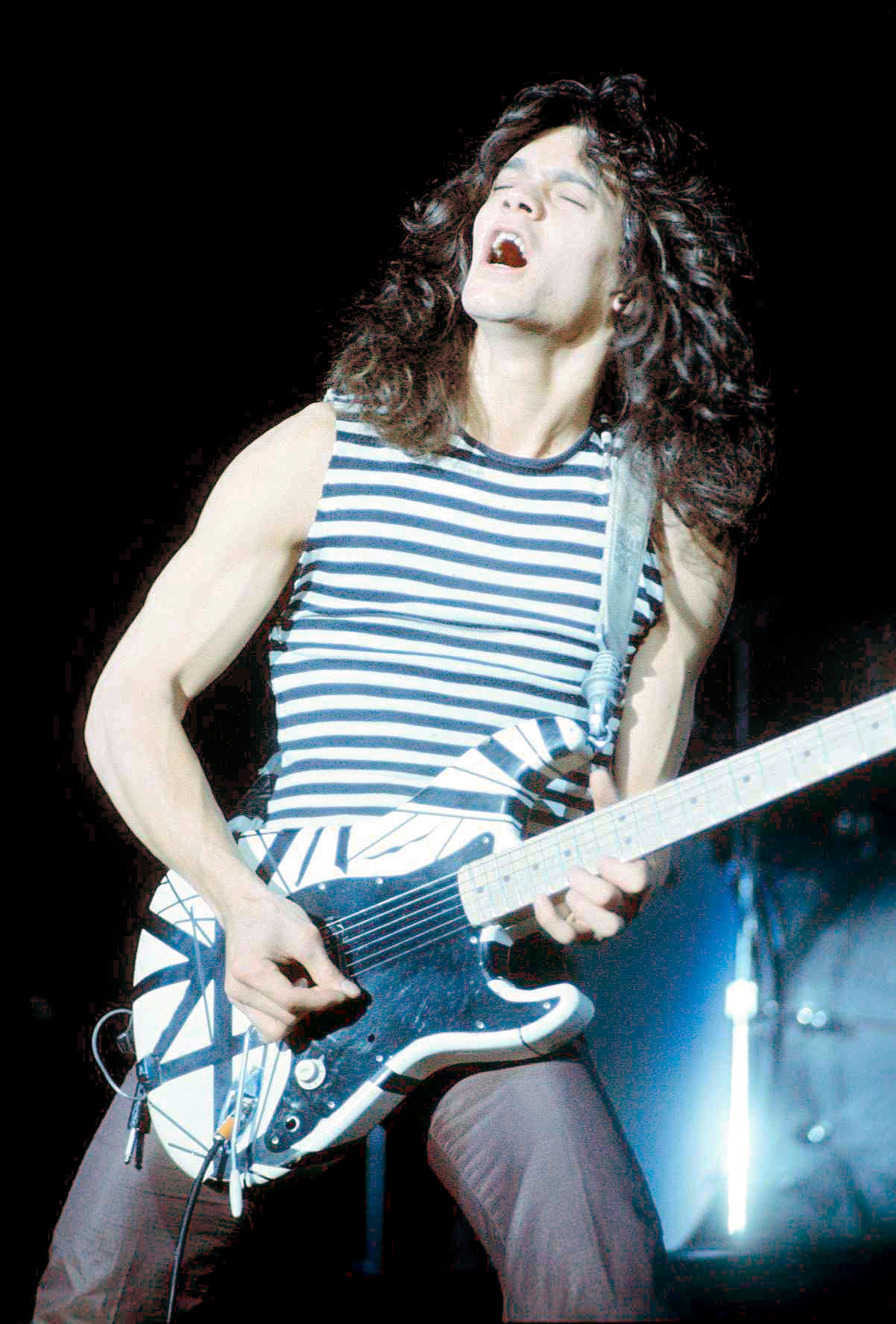
Eddie Van Halen at the New Haven Coliseum, September 10, 1978. Photo by Carl Lender. Wikimedia Commons, CC BY 2.0 (https://creativecommons.org/licenses/by/2.0/). Source: https://commons.wikimedia.org/wiki/File:Eddie_Van_Halen_at_the_New_Haven_Coliseum.jpg
Six years on, guitar shops still sound a little like Eddie Van Halen. This Guitar Talk feature is for players — what he left us that we still use every time we plug in.
October 6, 2026 — Six years to the day after Edward Lodewijk Van Halen left the room, guitar shops still sound a little like him. Not always on purpose. A kid in the corner is tapping sixteenth-note arpeggios on a Floyd Rose. Someone else is chasing a midrange that will never quite bloom the way they heard it on a worn copy of Van Halen. A striped Strat-shaped body hangs on the wall like a flag. The language he invented is still the house dialect of the instrument.
This is not another celebrity obituary. Eddie did not need one. Guitar players already know what he meant, because we still live inside the vocabulary he left behind — the Brown Sound, the Frankenstrat, the dive bomb, the hammer-on that felt like a laugh. Today we remember the player, the builder, and the joyful vandal who remade rock guitar in his own image.
Fact check for the record: Eddie Van Halen was born January 26, 1955, in Amsterdam, and died October 6, 2020, in Santa Monica, California, at age 65. October 6 is the anniversary of his death — not his birthday. (A common mix-up; we are correcting it here.)
Why This Remembrance, and Why Now
The Guitar Plugged has already dug into pieces of the EVH myth on their own terms. We have a Brown Sound / day-guitar-changed feature, an Iconic Solos deep dive on "Eruption", and a recent Beat It solo breakdown. Those pieces earn their keep as tone and technique archaeology.
This one is different. It is a remembrance for players — the sixth anniversary of the day Wolfgang confirmed what the guitar world already felt in its gut. It asks a simpler question: what did Eddie leave us that we still use every time we plug in?
Not the merch. Not the debate about eras and singers. The stuff that lives in your hands.
The Immigrant Kid Who Built His Own Future
Eddie and his brother Alex arrived in Pasadena as kids who did not speak English as a first language. Their father, Jan, was a Dutch jazz musician who worked janitorial jobs to keep music in the house. Their mother, Eugenia, worked as a maid. The brothers studied classical piano — Eddie never learned to read notation in the conventional way; he watched, listened, and improvised — before the British Invasion and Cream pulled them toward rock.
The swap that every guitar kid knows by heart still feels like fate when you say it out loud: Alex got better at drums, so Eddie grabbed the guitar and never put it down. He practiced for hours with the door locked. He learned Clapton solos note for note, then admitted later that Jimmy Page's reckless abandon was closer to who he actually was.
By 1972 the brothers had Mammoth. By 1974 David Lee Roth was in, the name was Van Halen, and Pasadena's club circuit — the Whisky included — was about to meet a guitarist who treated stock instruments as a starting suggestion, not a finished product.
Gene Simmons heard them open for UFO at the Starwood, cut early demos, then stepped back. Warner Bros. signed them. On February 10, 1978, Van Halen hit shelves. Guitar culture has been arguing with itself — productively — ever since.
What "Eruption" Actually Did to Guitar Culture
We have covered "Eruption" as a recording. Remembrance asks a different question: what did those 102 seconds do to the room?
It collapsed the distance between classical arpeggio logic and hard-rock swagger. It made two-handed tapping a public language instead of a parlor trick. (Eddie popularized it; he did not invent it — Steve Hackett, Harvey Mandel, and Jimmy Page's "Heartbreaker" pull-offs all sit in the ancestry, and Eddie himself credited Page as a spark.) It proved that a guitar solo could feel like a carnival and a thesis at the same time.
But the deeper shock, if you listen as a player rather than a tourist, was rhythmic. Eddie's right hand had swing and snap. Straight rock riffs suddenly breathed. Palm mutes barked. Harmonics squealed like they had somewhere to go. The Brown Sound was not just gain — it was clarity under saturation, notes that stayed articulate when most high-gain tones of the era turned to mush.
Overnight, every guitar magazine had homework. Shred was born as a cottage industry. Hair metal borrowed the smile and the speed. Players who rejected the trend still defined themselves against it. That is influence: when even your critics need your name to explain themselves.
The Frankenstrat: Frustration as Design Philosophy
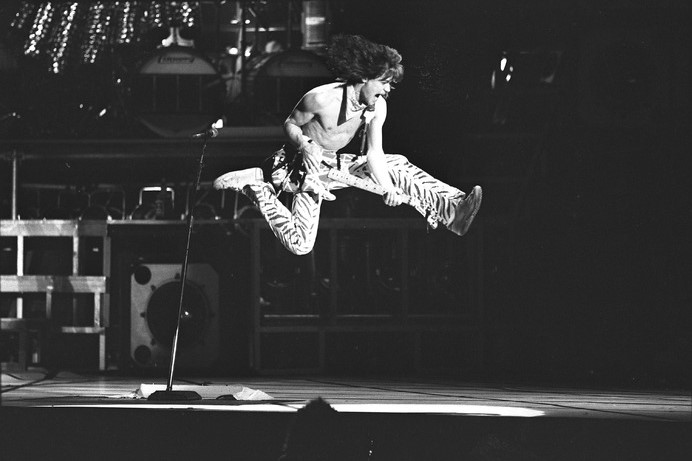
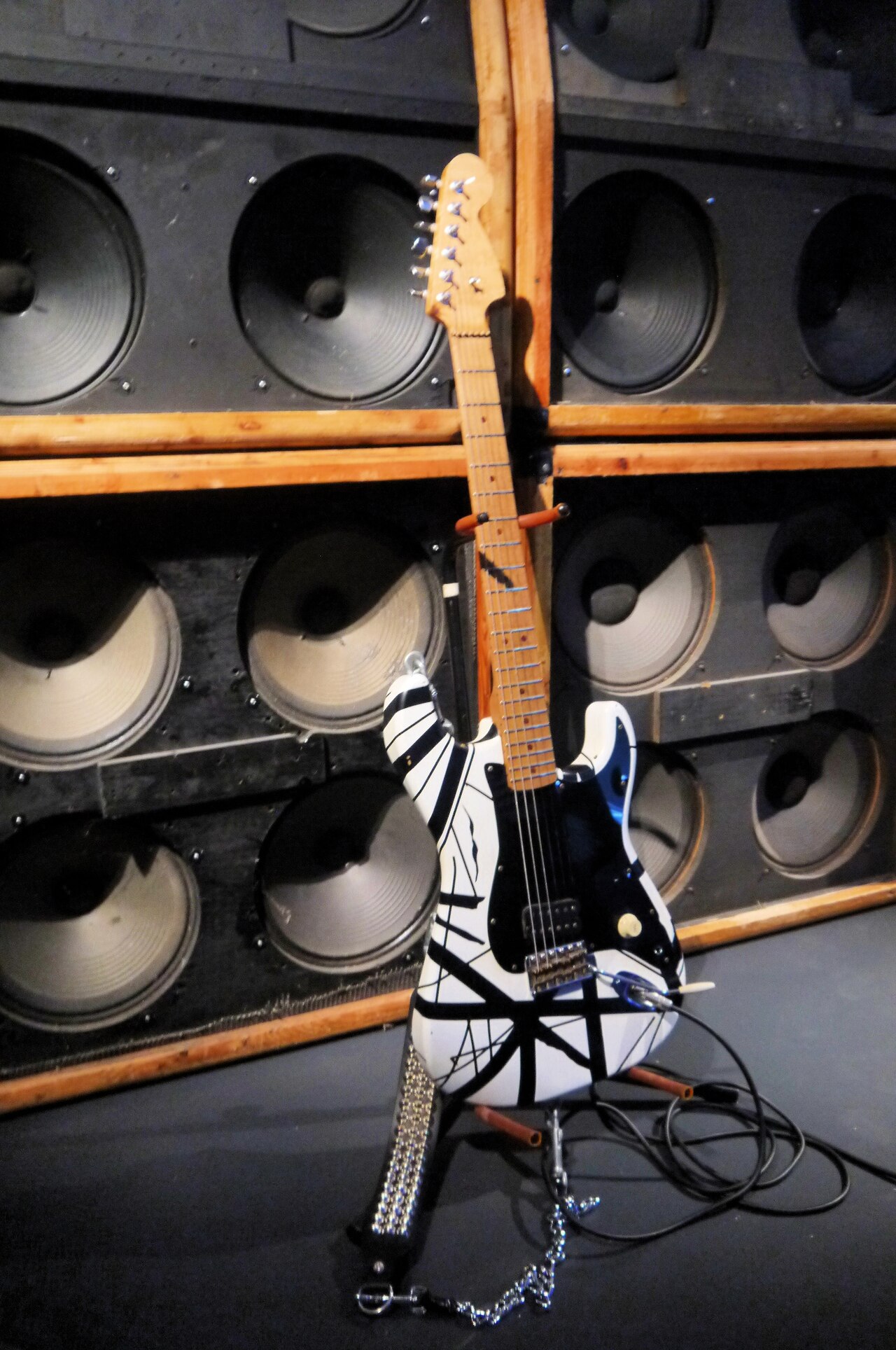
Eddie did not wait for the industry to build him the guitar he heard in his head. He built it from parts: a cheap ash Strat-style body with a knot in the wood, a maple neck, a Gibson PAF-style humbucker (often cited as salvaged/rewound from his ES-335 era), one volume knob that sometimes wore a "TONE" label for misdirection, and enough paint, tape, and bicycle-reflector chaos to look like a kid's art project.
It was not a prop. It was a thesis: Gibson power, Fender geometry, player-built attitude. That hybrid became the prototype for the entire superstrat economy — locking tremolos, hot humbuckers, thin necks, pointy silhouettes, striped finishes. Kramer, Charvel, Jackson, later Peavey Wolfgang and the EVH brand itself — all of that industry DNA runs through Eddie's parts-bin stubbornness.
Wolfgang has confirmed the case said "Frankenstein," which he considers the official name; "Frankenstrat" is the popular shorthand. Either way, the lesson for players is the same: if the instrument you need does not exist, stop waiting for permission.
Later came the Floyd Rose locking tremolo — essential for the dive bombs and return-to-pitch stability that made Eddie's whammy vocabulary usable night after night. Before that, a stock Strat trem would laugh you out of tune. Eddie's adoption and advocacy helped turn locking systems from fringe hardware into a hard-rock standard.
The Brown Sound Was Never Just an Amp Setting
We have told the Brown Sound story in more gear-first detail elsewhere. For a remembrance, here is the player-facing truth:
Eddie ran a late-'60s Marshall Super Lead (the classic 100-watt Plexi mythology) hard. He used a Variac to lower wall voltage — often cited around the high 80s to ~90 volts for recording sweet spots, lower for small rooms — so the amp could stay wide open without becoming a nuclear event in a club. Early interviews sometimes claimed the Variac raised voltage; later accounts and tech work make clear he was browning the supply, starving the amp for a warmer, more compressed saturation. That "brown" metaphor — lights dimming in a brownout — stuck to the tone forever.
Effects were spice, not the meal: MXR Phase 90 swirl, Echoplex / Univox echo trails, the occasional flanger. The pickup was hot and clear. The guitar was idiosyncratic. And then there were the hands.
Eddie himself later told Billboard that "brown sound," as he meant it, was originally about Alex's organic snare — beating on a log — more than a marketing slogan for guitar tone. That humility matters. The tone people chase as a product was, to him, a feeling. No modeling preset has ever fully bottled it, because the missing piece was always the attack, vibrato, and joy.
Riffs You Can Still Hear in Every Practice Room
Remembrance through repertoire: the songs that still teach.
"Ain't Talkin' 'bout Love" — the main riff is a masterclass in space and attitude. Power chords and single-note hooks that leave air for Roth to land. Beginners pretend they own it; veterans still chase the bounce.
"Unchained" (Fair Warning, 1981) — the flanger-soaked intro riff and the mid-song breakdown remain a rite of passage. Aggressive, funky, slightly unhinged. Proof that Eddie was a rhythm player first, virtuoso second.
"Panama" and "Hot for Teacher" (1984) — the former is pure grin-in-a-box groove; the latter is a clinic in how a guitar can be both cartoon and precision instrument. Alex's double-bass drama and Eddie's classroom-chaos solo still make guitar teachers smile and wince in the same breath.
"Jump" — the band's only Billboard Hot 100 No. 1 — is keyboard-forward (Oberheim OB-Xa), and that matters for remembrances too. Eddie refused to be boxed as "just" a shredder. He wrote hooks. He heard songs. The guitar still owns the solo and the swagger, but the synth riff is the doorway.
"Cathedral" (Diver Down) — volume-swell cathedral tones that still fool people into thinking there is a keyboard. Touch as architecture.
And outside the band: the "Beat It" solo on Michael Jackson's Thriller (1982). Eddie walked in, restructured the middle of a pop song, improvised two solos, and — by his own accounts — refused payment. A locking-trem vocabulary on the biggest album of the era. Pop radio never quite recovered, in the best way.
The Whammy Bar as Emotional Technology
Before Eddie, the Strat tremolo was often a gentle warble or a tuning liability. After him, it was a narrative device. Dive bombs that sounded like fighter jets. Harmonic squeals yanked into the basement and snapped back. Flutter that felt like laughter. The Floyd Rose made the theatrics reliable; Eddie made them musical.
Watch later footage — Montreal 2007, the Different Kind of Truth tour in 2012 — and you still see the same physical joy: the guitar as playground, not office equipment. That is the part no transcription captures.
From Marshall Myth to 5150 and the EVH Brand
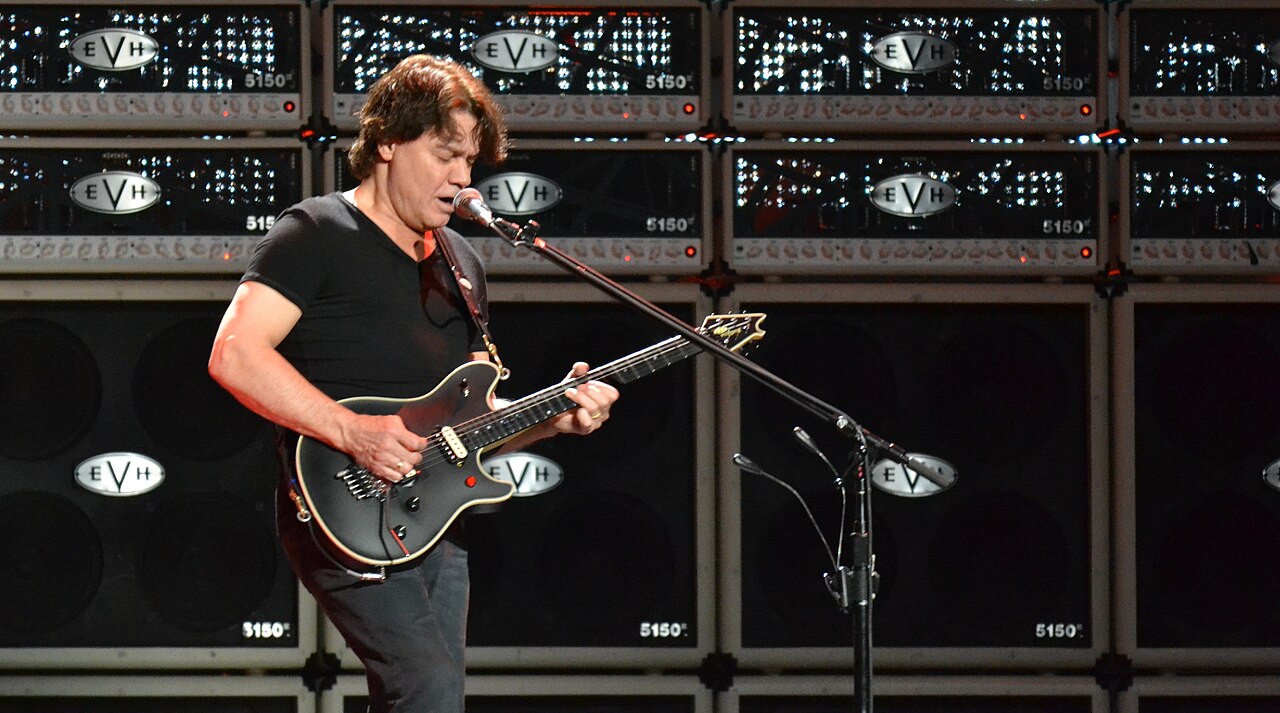
Eddie's career traced a full arc from scavenged parts to a branded ecosystem. Peavey’s 5150 series (named for Eddie’s studio address shorthand in guitar folklore) became a modern high-gain standard — tight, mid-forward, merciless on lazy technique. Later, the EVH brand with Fender carried Wolfgang guitars, 5150III amps, striped series replicas, and accessories into the mainstream.
That arc matters for remembrance because it closes the loop: the kid who could not buy the guitar he needed eventually built a company so other kids could. In 2017 he donated 75 guitars from his collection to Mr. Holland’s Opus Foundation for low-income school music programs. The builder instinct never quit; it just scaled into generosity.
The Human Cost, Without Soap Opera
Eddie struggled with addiction for much of his life and spoke publicly about getting sober around 2008. He faced hip replacement after years of stage athletics, tongue cancer treatment beginning around 2000 (roughly a third of his tongue removed; he was declared cancer-free in 2002), later throat cancer battles, and diverticulitis surgery in 2012 that postponed tour dates. He died of a stroke on October 6, 2020, at Saint John’s Health Center in Santa Monica, surrounded by Janie, Wolfgang, Valerie Bertinelli, and Alex.
We do not need to mythologize the pain. We do need to honor the playing that survived it — the 2012 album A Different Kind of Truth, the reunion energy with Roth, the father-son stage chemistry with Wolfgang on bass. Wolfgang later said plainly that you cannot have Van Halen without Eddie Van Halen. That was not branding. That was architecture.

What Guitar Culture Still Owes Him
Six years on, the ledger looks like this:
1. Technique as vocabulary, not circus. Tapping, harmonics, legato, and whammy abuse became tools ordinary players could study — not because Eddie dumbed them down, but because he made them musical enough to want.
2. DIY as identity. The Frankenstrat legitimized modding culture. Hot-rodding guitars stopped being pure eccentricity and became a rite of seriousness.
3. Tone as personality. The Brown Sound taught a generation that gain without clarity is just noise, and that hands beat pedals.
4. Joy as a technical requirement. Listen to Eddie smile through a run. The best players who followed him — from Satriani and Vai to Nuno, Gilbert, and countless bedroom shredders — kept that grin in the DNA even when the notes got denser.
5. Song first. For all the virtuosity, the catalog is full of choruses you can shout and riffs you can teach in five minutes. That balance is rarer than speed.
Van Halen was inducted into the Rock and Roll Hall of Fame in 2007. Rolling Stone’s 2023 list of the 250 greatest guitarists ranked Eddie fourth. Guitar World readers once voted him the greatest of all time. Rankings are parlor games. The real metric is the kid in Guitar Center still trying to get "Eruption" under their fingers before the salesman asks if they need a cable.
How to Remember Him as a Player (Not a Tourist)
If you want to honor Eddie this week without turning it into cosplay:
- Learn a riff, not just the tap showcase. "Ain't Talkin' 'bout Love," "Unchained," the "Panama" main figure. Feel the right hand.
- Chase clarity, not just gain. Crank less; articulate more. The Brown Sound was never a wall of fuzz.
- Build something. Mod a pickup. Set up a trem properly. File a nut. Eddie’s spirit lived in the workbench as much as the stage.
- Play with joy on purpose. Record yourself smiling through a bad take. Keep the take that feels alive.
- Then revisit the deep cuts on TGP — our Eruption, Brown Sound, and Beat It features — when you want the archaeology.
Final Thought
Eddie Van Halen did not merely play electric guitar at a higher level. He changed what the instrument was for. After 1978, it could be a piano, a fighter jet, a laugh track, and a church organ in the same two-minute stretch — and somehow still sound like a guy from Pasadena who just figured out the coolest thing in the world and could not wait to show you.
Six years after October 6, 2020, that feeling has not expired. It lives in striped guitars and Floyd Rose pivots, in Variac folklore and 5150 midrange, in every player who ignored the rulebook because the rulebook was boring.
We do not remember him by standing still. We remember him by plugging in.
Rest easy, Edward. The Brown Sound is still on the clock.
Experience-driven coverage, not algorithm bait.
- 20+ years of guitar playing experience
- Real-world retail experience at Guitar Center
- Thousands of hours testing guitars, amps, and pedals
- A community of 50,000+ guitar enthusiasts across platforms
- Partnerships with Fender, DistroKid, TrueFire, Card Chords, and Enya
- Editorial standards published openly — see how we test gear
The Modern Guitar Magazine. Delivered to your inbox.
No spam. No gimmicks. Just great guitar content — stories, tones, iconic solos, and honest gear takes. Every week.
Ask GP
3 free questions a dayStill curious? Ask GP about this story.
Your personal classic-rock and guitar guide — ask anything about Remembering Eddie Van Halen.
Discussion (0)
Sign in to join the discussion.
Sign in to commentLoading comments…
Discover another guitar story
Swipe through our latest features, breaking news and iconic solos — one story at a time.
Open Swipe →More in Guitar Talk
History of the Riff: Black Sabbath's "Iron Man" — A Lumbering Monster, a Factory Accident, and Doom's Walking Template
After Smoke on the Water turned four notes into guitar-shop folklore, Tony Iommi's Iron Man riff showed how a slow, blues-stained figure — born in a rehearsal room over Bill Ward's boom — could invent metal's sense of weight, space, and riff-as-character.

Gretchen Menn on Finding Her Own Voice, Playing with Steve Vai, and the Hardest Music of Her Career
From Zepparella and a Dante-inspired solo album to a guitar concerto, orchestral recording, and a new band, Menn has built a career that refuses to stay in one musical lane. In an exclusive conversation with TheGuitarPlugged, she talks about the experiences and ideas connecting it all.
History of the Riff: The Kinks' "You Really Got Me" — How Two Power Chords and a Sliced Speaker Invented Hard-Rock Guitar
After Rumble taught the guitar to threaten and Misirlou taught it to sprint, Dave Davies' 1964 two-chord smash taught it to punch the charts — with a razor-cut Elpico, a Vox slave, and zero apology.