History of the Riff: "Sweet Home Alabama" and the Lick That Came in a Dream
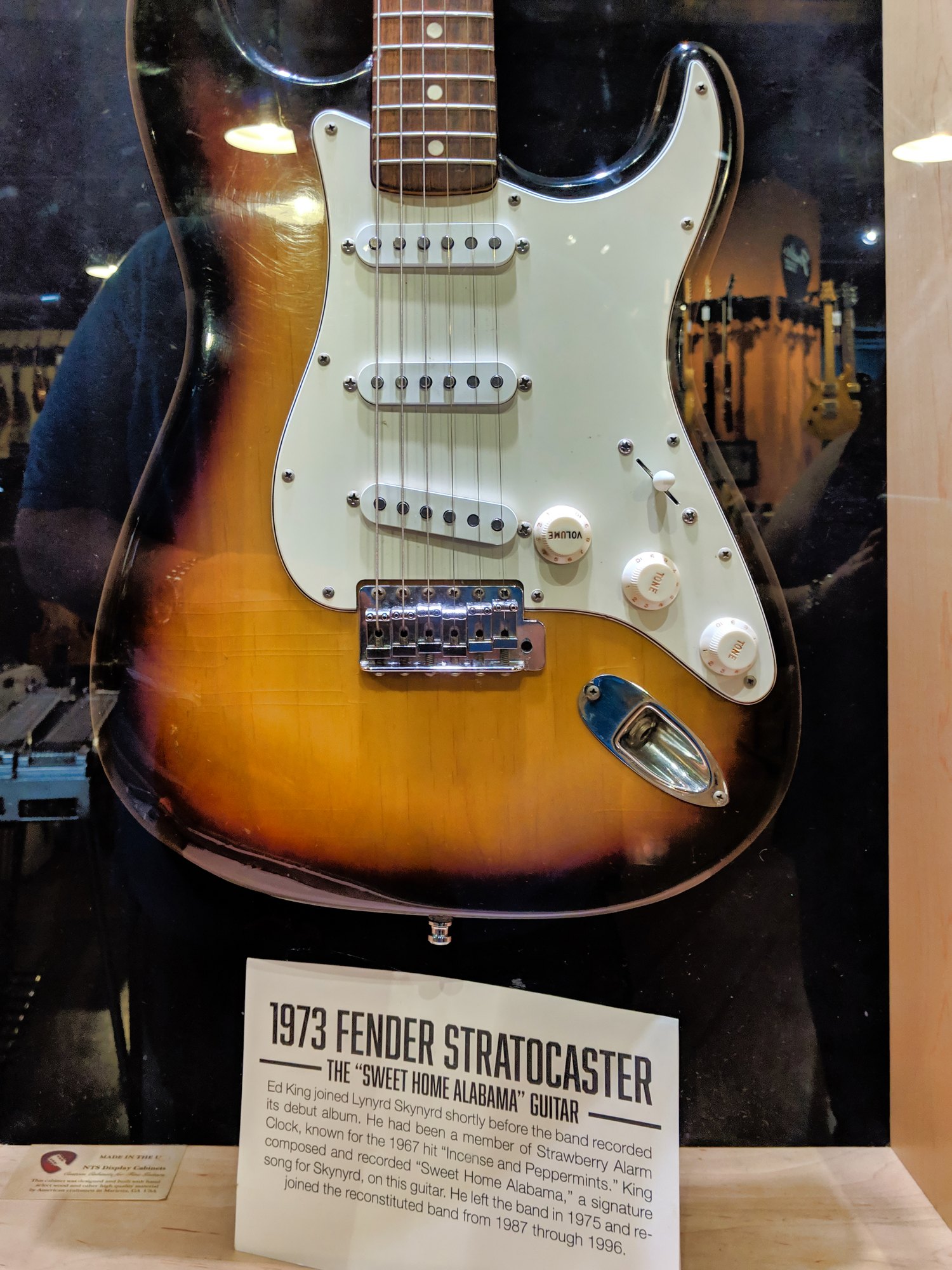
The Stratocaster displayed in Nashville as Ed King's "Sweet Home Alabama" guitar. Its placard dates it to 1973; engineer Rodney Mills recalled King using a late-'60s Strat on the session.
The history of the Sweet Home Alabama riff: Ed King's dream, Gary Rossington's spark, a cranked Fender Twin, and the D-or-G key debate that still splits players.
Three words, a count-in, and then that riff. "Sweet Home Alabama" opens with Ed King saying "one, two, three," Ronnie Van Zant asking somebody to "turn it up," and a bright, picked Stratocaster figure that has probably been played in more guitar stores, bar gigs, and backyard parties than any other Southern rock lick ever written.
The Sweet Home Alabama riff is one of the first things a lot of players learn after "Smoke on the Water." It's also one of the most misunderstood. It was written by a Californian, sparked by a Floridian's warm-up figure, recorded in Georgia, aimed at a Canadian, and, according to the man who played it, delivered to him in a dream. It even comes with its own music theory argument that has been running for half a century.
Here's the story of how that riff came together, what's actually going on under your fingers when you play it, and why it still sounds like summer.
The Band Before the Hit
By 1973, Lynyrd Skynyrd had already done the hard part. Their debut, (Pronounced 'Lĕh-'nérd 'Skin-'nérd), produced by Al Kooper for MCA, included "Free Bird," "Gimme Three Steps," and "Simple Man." What they didn't have yet was a real hit single.
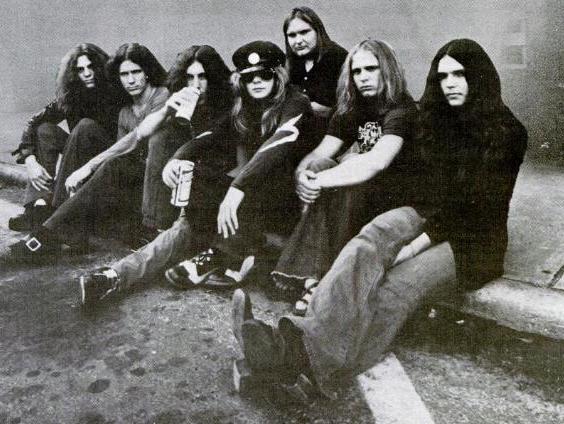
They also had an unusual weapon: three guitarists. Gary Rossington and Allen Collins had been in the band since the Jacksonville days. Ed King came from much further away. He grew up in Glendale, California, and had played guitar and bass in Strawberry Alarm Clock, the psychedelic pop band whose "Incense and Peppermints" went to No. 1 in 1967.
King had met Van Zant's band years earlier, when an early version of the group opened for Strawberry Alarm Clock, and told Ronnie that if they ever needed him, he'd come. In 1972 they called. Bassist Leon Wilkeson had quit, so King joined on bass. When Wilkeson came back, King moved to guitar, and the "three guitar army" was born.
That detail matters for this riff. King was the outsider in the room: the West Coast player who knew his way around a studio and a pop hook. Skynyrd's other two guitarists brought the blues and the attitude. "Sweet Home Alabama" is what happened when those worlds lined up.
Rossington's Spark, King's Riff
Ask two members of Lynyrd Skynyrd where the song came from and you get two honest answers that fit together.
Gary Rossington told Garden & Gun in 2015: "I had this little riff. It's the little picking part and I kept playing it over and over when we were waiting on everyone to arrive for rehearsal. Ronnie and I were sitting there, and he kept saying, 'play that again'. Then Ronnie wrote the lyrics and Ed and I wrote the music."
Ed King filled in the rest on his own fan forum in 2009. Rossington's figure is the part you can hear behind the verses, underneath King's Strat line. "His part came first," King wrote. "When I first heard that, I put my intro lick on top of that and then finished the tune. Without me hearing that riff of his, I wouldn't have written mine."
So the famous intro is King's, but it was built to sit on top of something Rossington was already playing. That's the secret of a lot of great three-guitar songs: nobody is playing the same thing. King also said the song took "less than an hour to write... and 4 hours to put together," and that it was written four days before the session.
The dream
Then there's the part of the story that gets repeated at every guitar store counter in America. King said that after a rehearsal, he went to bed and the song's two solos came to him in a dream, note for note. In his own words: "I didn't just hear it in a dream, I actually saw it."
You can believe that literally or treat it as a guitar player's way of saying the parts arrived fully formed. Either way, it ended up mattering in the studio, because that dream became the band's argument for keeping a solo the producer wanted to fix. More on that below.
Why Neil Young?
The lyrics were Van Zant's answer to Neil Young's "Southern Man" and "Alabama," songs the band felt painted the whole South with one brush. "We thought Neil was shooting all the ducks in order to kill one or two," Van Zant said at the time.
What usually gets lost is that the "feud" was mostly musical. The band were fans of Young, and Young came around too. In his 2012 memoir Waging Heavy Peace, he wrote: "My own song 'Alabama' richly deserved the shot Lynyrd Skynyrd gave me with their great record. I don't like my words when I listen to it."
The lyrics also include the much-debated lines about the governor and Watergate, and the band members themselves never fully agreed on what they meant. Van Zant said the "boo, boo, boo" after the governor line was the point, while Ed King later gave a very different reading. That debate is real and worth knowing about, but this column is about the guitar part, and the guitar part doesn't take sides.
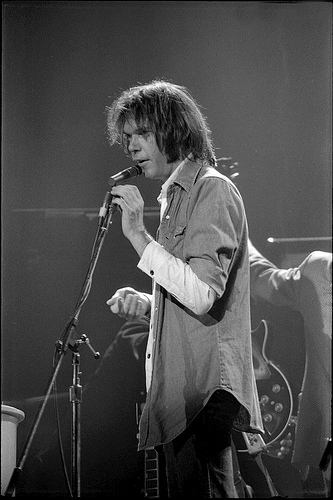
Photo: Mark Estabrook, via Wikimedia Commons (attribution license)
One Day at Studio One
"Sweet Home Alabama" was cut in a single day at Studio One in Doraville, Georgia, a suburb north of Atlanta. Engineer Rodney Mills, who designed the room, walked through the session in detail for Sound On Sound's Classic Tracks series in 2008, and his account is the best window we have into how the riff got on tape.
According to Mills, the song was recorded after the debut album was finished, because the band thought it might be strong enough to hold up that album's release. It ended up opening Second Helping in 1974 instead.
The basic track was just three players: Ed King on guitar, Leon Wilkeson on bass, and Bob Burns on drums, with Van Zant singing a guide vocal in the room. Burns was sealed inside a drum booth so dead and airless that Mills says a drummer could last about 20 to 30 minutes before he needed to come out and breathe. The band knew the song cold, so it took only a few takes.
The gear behind the riff
Here's the part guitar players care about. Mills told Sound On Sound that King played the signature lick on a late-'60s Fender Stratocaster through a Fender Twin, miked with a single Neumann U87 close to the cabinet.
"Because the rhythm part was not exceptionally loud, I padded the microphone down and put it close to the cabinet," Mills said. "That was it; just one mic."
King himself has said the Strat had weak pickups, so he had to crank the amp to get sustain. Mills confirmed it: King "had to turn it almost wide open to get any sustain."
That's a useful thing to know if you're chasing the sound. The Sweet Home Alabama riff isn't a high-gain tone. It's a Strat into a big, loud, clean-headroom Fender amp, pushed until it starts to compress and bloom. The bite comes from the volume and the pick attack, not from a distortion pedal.
There is one wrinkle in the gear story. A Stratocaster displayed in Nashville is labeled as a 1973 Fender Stratocaster, "the 'Sweet Home Alabama' guitar," and the placard says King "composed and recorded 'Sweet Home Alabama'" on it. That doesn't match Mills's memory of a late-'60s Strat. We can't settle that from here, so we're giving you both accounts as they were published.
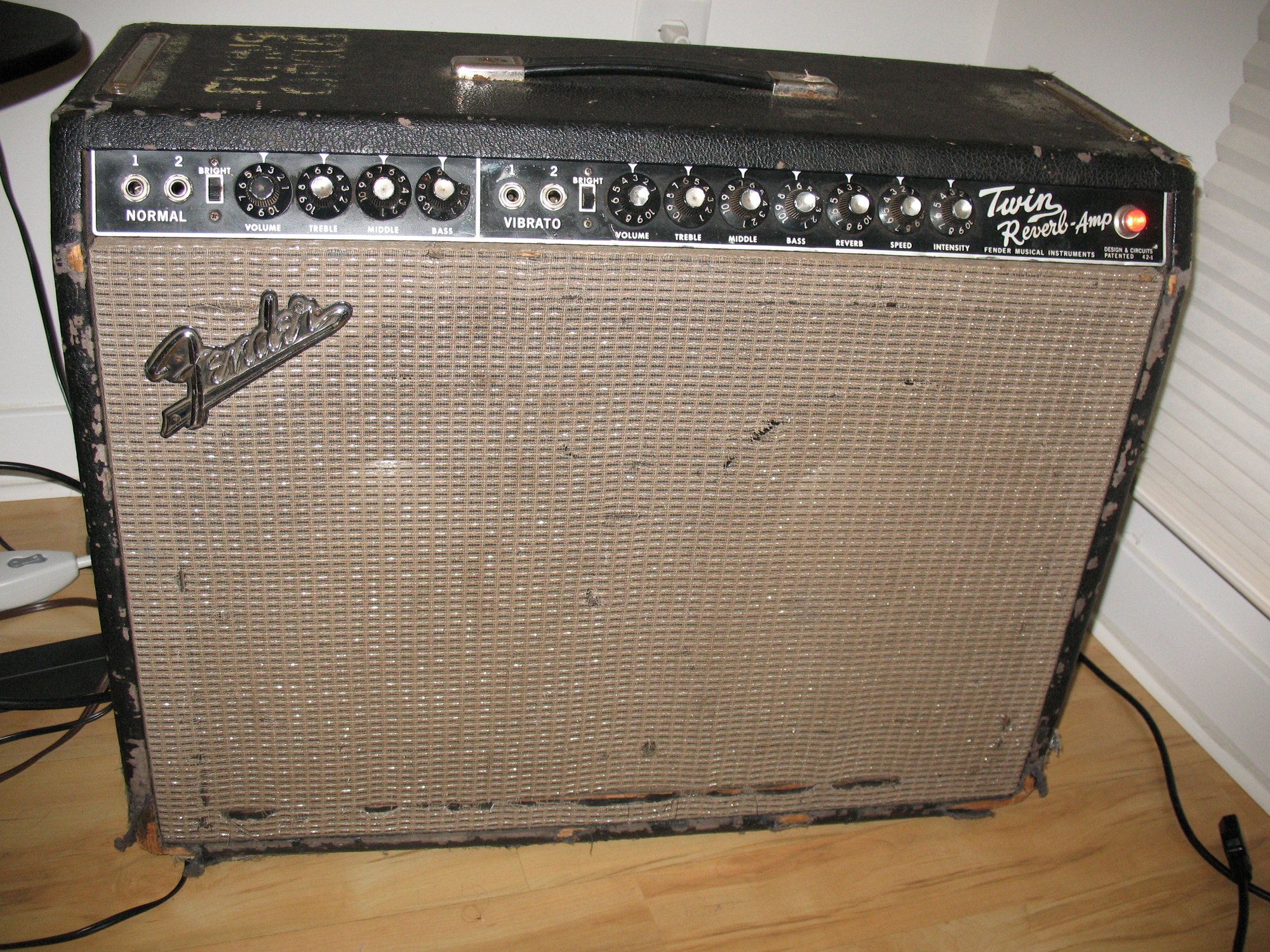
Photo: HammondCast (Jon Hammond), CC BY 3.0, via Wikimedia Commons
Layers on top
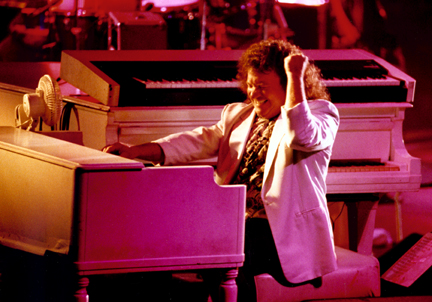
After the basic track, the band stacked the rest. Allen Collins and Gary Rossington overdubbed rhythm guitars through Marshall amps. Wikipedia's personnel list, drawing on Mills and Buskin, puts Collins in the left channel and Rossington in the right. Billy Powell added the piano part that Mills calls "one of the great rock & roll keyboard performances."
That's why the song sounds so wide. King's clean-ish Strat line sits in its own lane, the Marshall rhythm parts fill in the low mids around it, and the piano fills the gaps. If you've ever wondered why the riff sounds thin when you play it alone at home, that's the answer: it was never meant to be the whole picture.
The Happy Accidents
Several of the most famous moments on the record weren't planned as "parts" at all.
- "Turn it up." Van Zant was asking Kooper and Mills for more volume in his headphones. Mills had hit record early and caught it. "Al had the good sense to leave that in there," he said.
- The count-in. King's "one, two, three" doesn't appear on every version of the song. Mills believes the versions that have it were pulled from the original tape.
- The ghost of Neil Young. Right after Van Zant sings "Well, I heard Mister Young sing about her," you can faintly hear Al Kooper singing "Southern Man." Mills says Kooper went out and did it on impulse after the lead vocal was done.
- The backing singers. The female voices were added in California. Mills and Buskin credit the Sweet Inspirations, while other accounts, including Merry Clayton's own recollection, credit Clayton and Clydie King. The sources disagree, so we're not picking one.

The Key Fight: D or G?
This is where the Sweet Home Alabama riff becomes a music theory story.
The main progression is three chords: D, C, and G. Two beats of D, two beats of C, and a full bar of G, around and around. Those three chords all live in the G major scale. But the song starts on D and keeps landing back on it, so plenty of ears hear D as home.
Al Kooper was one of those ears. In his memoir Backstage Passes & Backstabbing Bastards, he described hearing King's solo and reacting right away: "You're in the wrong key, Ed!" King's reply, as Kooper tells it: "This song is in the key of G, Al. That's the chord we end the song on when we play it live."
Kooper thought the song was in D, and that King was soloing as if G were home. King thought the D chord was the five chord. Kooper eventually decided it was "very progressive" and let it go, adding that by the time he mixed the song he loved the solo.
King's version of events is a little spicier. On his forum he wrote that Kooper "simply didn't like the solo because it wasn't in the key of D," and that when Kooper played it for Mike Bloomfield, Bloomfield laughed and said King had played the solo in the wrong key. The band backed King: since he'd seen the solo in a dream, that's how it was going to stay.
So who was right?
Both of them, which is why the argument never ends. Guitar teacher Desi Serna lays it out clearly:
- Think G major: the chords are V, IV, I (D, C, G). G major pentatonic sounds right over the whole thing.
- Think D: the same chords become I, ♭VII, IV, which is D Mixolydian. D major pentatonic sounds right.
The notes of D Mixolydian and G major are identical. The only difference is which note your ear treats as home. Serna also points out that even though King said he was thinking in G, the very first lead line in the intro sits in D major pentatonic, and the first phrase of the first solo resolves on notes from a D major chord.
There's also an F major chord that shows up around the solos. It doesn't belong to G major or D Mixolydian; it's borrowed from G Mixolydian. That borrowed chord is a big part of why the solo sections feel like they lift off.
For players, the practical takeaway is simple. If you're soloing over "Sweet Home Alabama" at a jam, G major pentatonic is the safe, classic choice that matches King's thinking. Leaning on D major pentatonic gives you a sweeter, more "country" flavor. The best players move between both.
How the Riff Actually Works on the Guitar
Without getting into a note-for-note transcription, here's what makes the riff feel the way it does.
It's a melody wrapped around chord shapes. Most standard transcriptions place the intro around open-position D, C, and G shapes, with single notes picked between and around the chord tones. That's why it rings: open strings keep sustaining under the fretted notes, and the Strat's clarity lets each one speak.
It answers itself. The figure has a call-and-response feel, a little phrase over D and C, then a resolving tag over G. That's very much a pop-songwriter move, and it's probably not a coincidence that it came from the guy who played on a No. 1 psychedelic pop single.
It isn't alone. On the record, King's line rides on top of Rossington's counter-part and Collins's rhythm. If your band has two guitarists, splitting those parts instead of both playing the intro lick is the single biggest step toward sounding like the record.
The tone is clean-ish and loud. Single coils, a big Fender amp pushed hard, and a firm pick hand. If you're using a modeler, start with a clean American amp model with the volume up, add just enough compression from the amp model itself to smooth the attack, and skip the drive pedal at first. A middle or in-between Strat pickup position is a reasonable place to start experimenting, though we don't have a reliable source for exactly which position King used.
The First Solo Take
There's a nice postscript in Mills's account. "Ed King's first attempt at the long solo was the one that you hear on the record," he said. "The band members were in the control room when he did that, and at the end they pretty much fell on the floor."
Kooper still asked for another pass, which went on another track. But to the best of Mills's knowledge, the first one was used. King's own forum post says he believes he did the solo in two takes, so the memories differ slightly, but both men describe a solo that was basically finished the moment it was played.
What Happened Next
"Sweet Home Alabama" was released as a single on June 24, 1974, and reached No. 8 on the Billboard Hot 100. It's still Lynyrd Skynyrd's highest-charting single. Along with "Free Bird," it became the band's signature song.
The story around it turned tragic fast. Ed King quit in 1975 during the band's grueling "Torture Tour." In the documentary If I Leave Here Tomorrow, he said that after a night of playing on old strings and breaking two of them during "Free Bird," he'd had enough and packed up. On October 20, 1977, the band's plane crashed in Mississippi, killing Ronnie Van Zant, guitarist Steve Gaines, and backing singer Cassie Gaines, among others.
King returned when the band re-formed in 1987 and played with them until 1996, when heart failure forced him out. He was inducted into the Rock and Roll Hall of Fame with the band's pre-crash members in 2006, and he died in Nashville on August 22, 2018, at 68. Gary Rossington, the last surviving founding member, died in 2023.
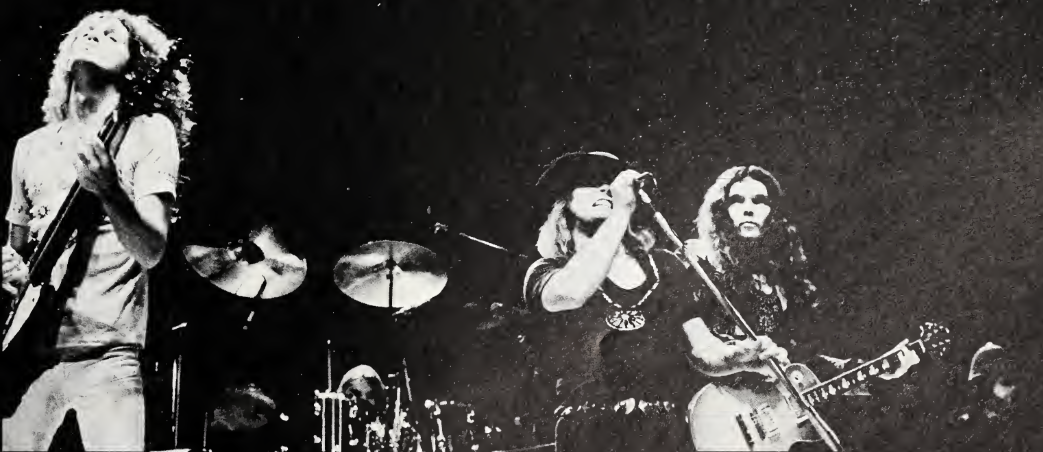
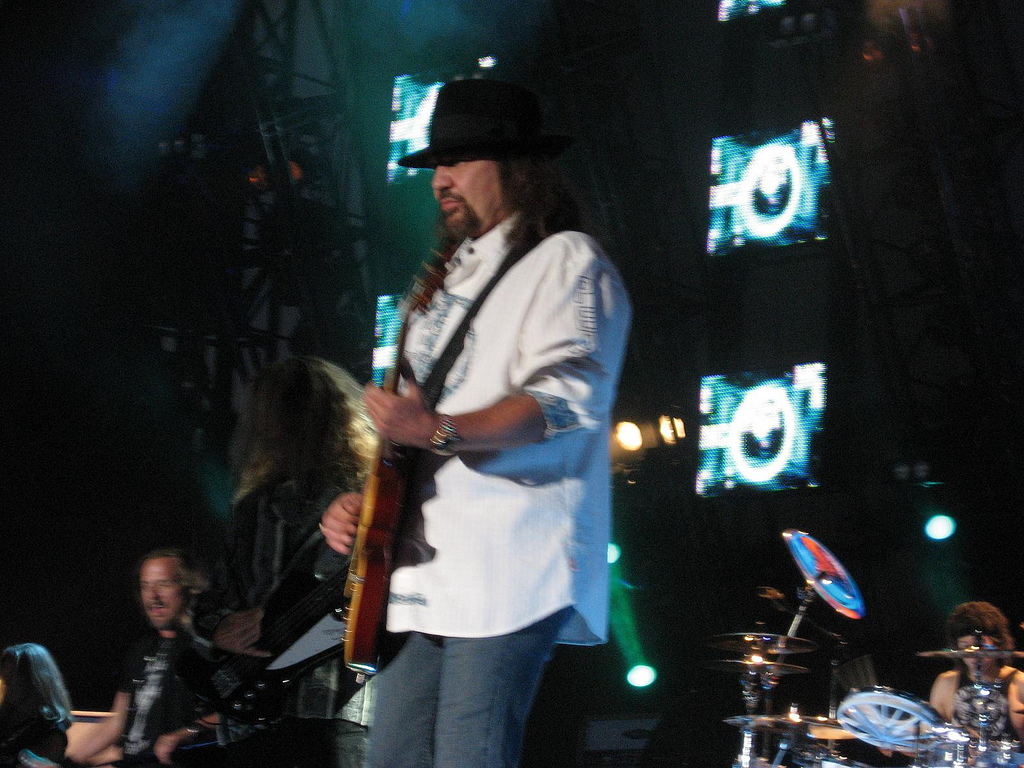
A riff that left the record
The song kept growing after the band did. Alabama started using "Sweet Home Alabama" in a state tourism campaign in 2007 and put the phrase on license plates in 2009. The song was inducted into the Grammy Hall of Fame in 2009. Kid Rock's 2008 hit "All Summer Long" borrowed its chorus, guitar solo, and piano outro, with Billy Powell featured on the track, and that exposure pushed the original back onto the UK chart.
And Neil Young? The man the song called out later said it richly deserved to be written.
Why the Sweet Home Alabama Riff Still Works
A lot of famous riffs are about power: big low notes and a wall of distortion. This one is about space. It's bright, melodic, and clean enough that you can hear every string. It's built on three chords a beginner learns in their first month, but it hides a modal puzzle that working pros still argue about.
It also captures what made that version of Lynyrd Skynyrd special. A Californian pop player heard a Florida bluesman's warm-up lick, put a melody on top, and a Georgia studio caught it in one day with one mic on a cranked Fender amp. Nobody planned "turn it up." Nobody planned the solo in the "wrong" key. They kept both, and that's why it sounds alive.
If you're learning it, learn Rossington's part too. Then play the solo once thinking in G and once thinking in D. You'll understand the song, and that 50-year-old argument, a lot better.
Where do you land: is "Sweet Home Alabama" in D or G? Make your case in Guitar Talk, and read our story on Steve Gaines and Street Survivors next.
Experience-driven coverage, not algorithm bait.
- 20+ years of guitar playing experience
- Real-world retail experience at Guitar Center
- Thousands of hours testing guitars, amps, and pedals
- A community of 50,000+ guitar enthusiasts across platforms
- Partnerships with Fender, DistroKid, TrueFire, Card Chords, and Enya
- Editorial standards published openly — see how we test gear
The Modern Guitar Magazine. Delivered to your inbox.
No spam. No gimmicks. Just great guitar content — stories, tones, iconic solos, and honest gear takes. Every week.
Ask GP
3 free questions a dayStill curious? Ask GP about this story.
Your personal classic-rock and guitar guide — ask anything about "Sweet Home Alabama" and the.
Discussion (0)
Sign in to join the discussion.
Sign in to commentLoading comments…
Discover another guitar story
Swipe through our latest features, breaking news and iconic solos — one story at a time.
Open Swipe →More Guitar News
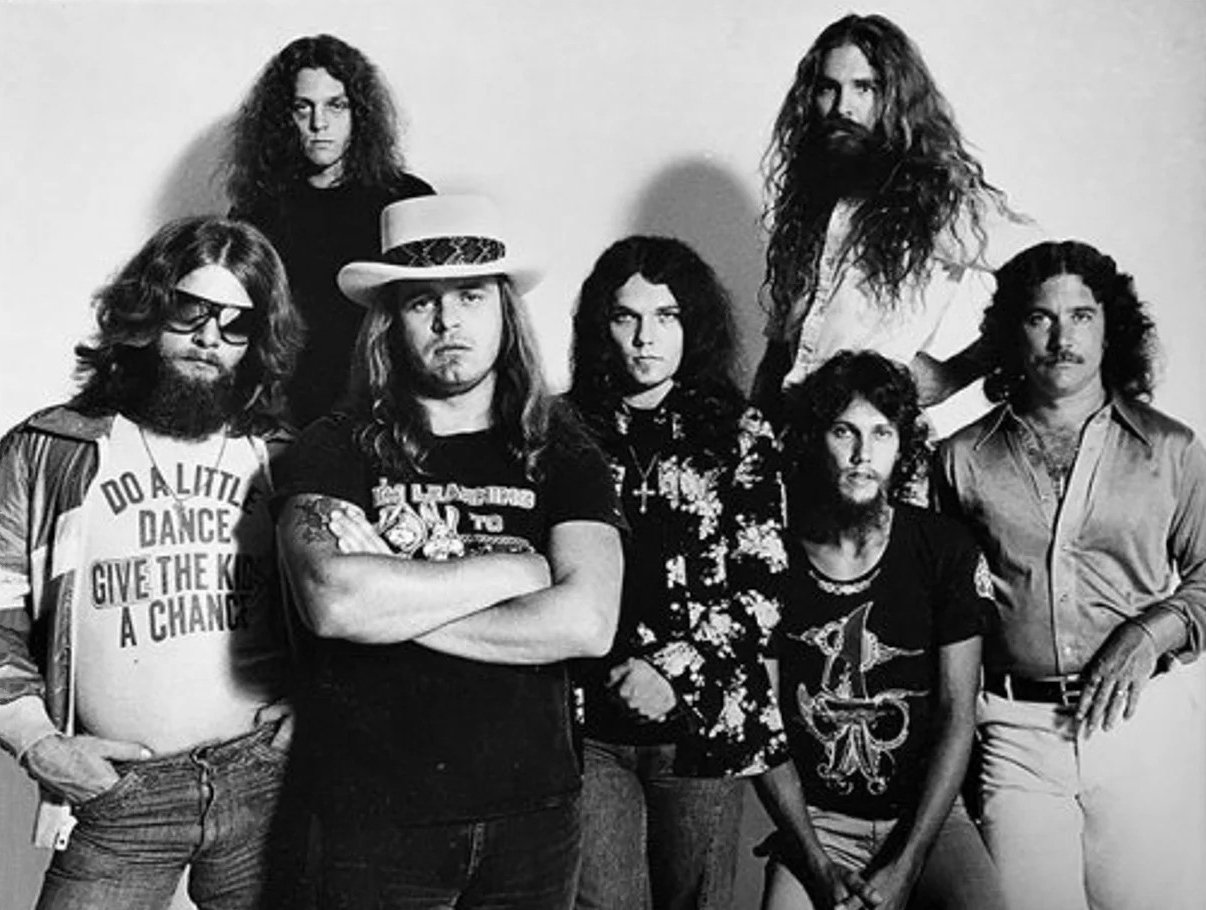
Steve Gaines: The Lynyrd Skynyrd Guitarist Who Had One Album and Changed the Band Anyway
Steve Gaines joined Lynyrd Skynyrd with an onstage audition and died three days after Street Survivors came out. 49 years on, here's the guitarist he was.
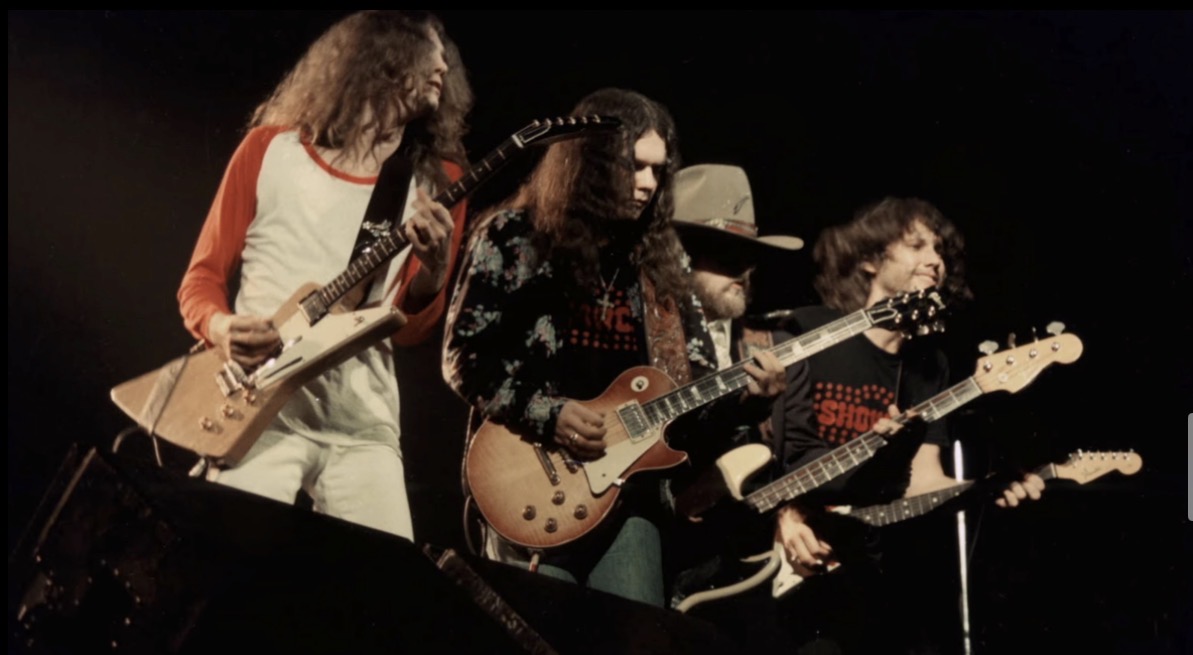
Iconic Solos: Why the "Free Bird" Solo Feels Like Flying
Allen Collins' four-minute Free Bird solo isn't about speed — it's about momentum, repetition, and reckless tone. Here's why it still gives guitarists chills.
History of the Riff: ZZ Top’s “La Grange” — The Texas Boogie Riff That Refused to Sit Still
There are riffs that impress you with complexity — and then there are riffs that make complexity irrelevant. Inside ZZ Top’s “La Grange” and the Texas boogie that guitarists still can’t get to sit just right.
Mark Knopfler and the History of "Money for Nothing": The Riff That Defined an Era
How Mark Knopfler chased Billy Gibbons, discovered a happy accident with a Les Paul and a strange microphone setup on Montserrat, and created one of the most recognizable guitar riffs ever recorded.