
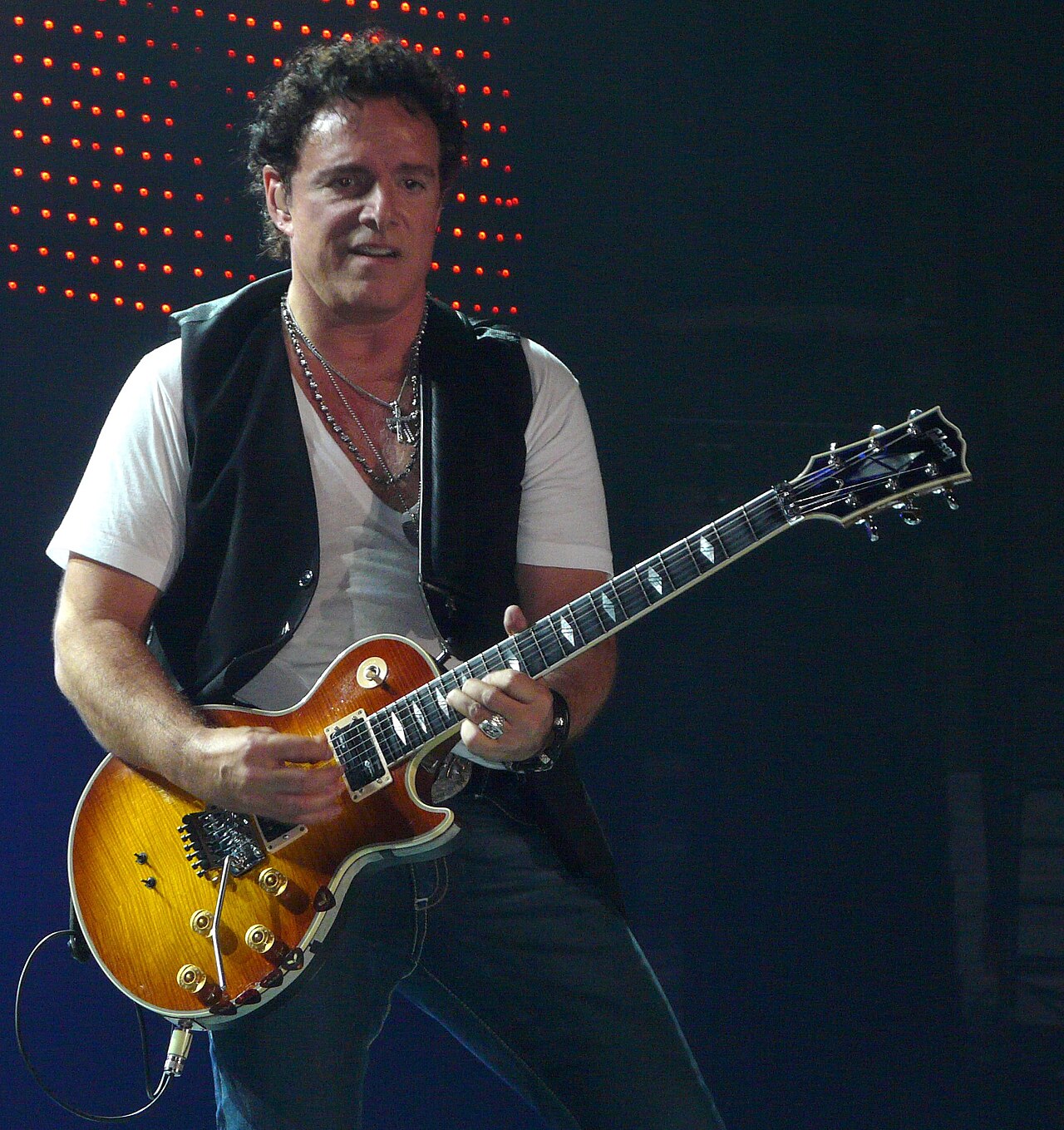
From Santana prodigy to the melodic engine behind Journey, Neal Schon built a guitar vocabulary where blues, fusion, fire and unforgettable melody could all exist in the same solo.
There is a strange thing that happens when a guitarist becomes attached to songs as enormous as Journey's. Eventually, the songs can become bigger than the musician.
"Don't Stop Believin'." "Separate Ways." "Faithfully." "Open Arms." "Any Way You Want It." "Wheel in the Sky." "Lights."
They have become part of the furniture of American popular culture: songs played at weddings, sporting events, bars, graduation parties and arenas; songs heard in movies, television shows and on classic-rock radio often enough that it is easy to forget somebody actually had to invent the musical language inside them.
And somewhere inside nearly all of it is Neal Schon.
That may be the best way to understand Schon's unusual place in guitar history. He is unquestionably famous. Journey is unquestionably enormous. He has spent more than half a century on major stages. Journey entered the Rock & Roll Hall of Fame in 2017, and Schon has remained the one continuous musical thread through the band's history.
Yet among guitarists, Schon can still feel oddly under-discussed. He is rarely placed in exactly the same conversation as Eddie Van Halen, Jeff Beck, David Gilmour, Eric Clapton, Jimmy Page, Stevie Ray Vaughan or Carlos Santana. He does not fit neatly into the shredder category occupied by Yngwie Malmsteen, Steve Vai and Joe Satriani either.
That is partly because Schon belongs to several worlds at once. He can play fast without making speed the central point. He can play blues without sounding like a blues traditionalist. He can move through fusion vocabulary without abandoning a three-minute rock song. He can use sustain, whammy-bar movement and high gain without losing his phrasing.
Most importantly, he can play a guitar solo that feels like another vocal melody. That may be Neal Schon's greatest skill. And it is why, after more than five decades, you can often identify him within a handful of notes.
Before Journey: The Kid Who Was Already Ready
Most guitarists spend their teenage years trying to play records made by their heroes. Neal Schon spent part of his teenage years playing alongside them.
Born in 1954, Schon developed rapidly enough that, while still extraordinarily young, he found himself in the orbit of Santana. Journey's own biography notes that Schon became a member of Santana at roughly age 15; by Santana III in 1971, the teenage guitarist had joined the band's core lineup and was sharing guitar duties with Carlos Santana. He also contributed to the increasingly adventurous Caravanserai period.
Pause on that for a second. Carlos Santana was not merely a successful guitarist. He was already developing one of the most identifiable electric-guitar voices in music — singing sustain, controlled feedback, Latin rhythmic sensibility, blues vocabulary and a tone that seemed capable of bending a single note until it became emotional language.
A teenage Schon had to stand beside that. For a developing musician, there could hardly have been a better education. But Schon did not simply become a Santana imitator. What he absorbed was the larger lesson: a guitarist needs a voice.
You can hear certain common ingredients between Santana and Schon — the vocal sustain, the love of long bends, the willingness to let a note bloom rather than immediately replacing it with another one — but Schon would ultimately take those ideas into a more aggressive rock vocabulary.
Where Santana often seems to float above the rhythm section, Schon frequently pushes into it. His attack can be sharper. His lines can become more muscular. There is often considerably more hard-rock aggression underneath his legato phrasing.
The combination became his fingerprint. Blues heart. Fusion instincts. Rock attack. Pop awareness. And melody above everything.
Journey Wasn't Originally the Band Most People Remember
One reason Schon's musicianship can be underestimated is that modern listeners often encounter Journey backward. They hear the giant hits first. Then they discover the rest of the story.
Journey's early music was considerably more exploratory than the polished arena-rock records that would eventually make the band one of the biggest acts in America. Schon and keyboardist Gregg Rolie emerged from the Santana world with the sort of musical vocabulary you would expect from players who had spent years around improvisation, extended arrangements and musicians capable of actually jamming.
Early Journey could be progressive, jazzy, heavy and occasionally downright strange compared with what came later. That matters when assessing Schon. The guitarist who eventually played economical melodic solos over radio songs did not arrive there because that was all he could do. He arrived there because he learned how to edit.
That is a completely different thing. Plenty of guitarists learn more vocabulary as they mature. Schon learned when not to use all of his.
When Steve Perry Arrived, Everything Changed
Steve Perry's arrival transformed Journey. But it did not diminish Neal Schon. It gave him a new canvas.
Perry possessed one of the defining rock voices of his generation — a soaring tenor capable of tremendous power but also remarkable vulnerability. Suddenly Journey had a singer whose melodies could carry massive songs.
Schon's job changed. The guitar no longer needed to dominate every available space. Instead, it could answer the singer.
Perry sings a phrase. Schon responds. Perry builds tension. Schon releases it. The vocal reaches upward. The guitar climbs after it.
Listen carefully to great Journey recordings and the guitar often behaves almost like an additional character in the song rather than a layer placed over the top. That is why Schon's solos frequently remain memorable even among listeners who do not consider themselves guitar players. They function melodically. You can sing them. And that is harder than it sounds.
Neal Schon's Greatest Weapon: Melody
Virtuosity is easy to recognize when it announces itself. Thirty-second-note runs impress immediately. Huge tapped arpeggios are obvious. Sweep picking is obvious. Extreme alternate picking is obvious.
Melody is different. A guitarist plays twelve notes that somehow feel inevitable, and nobody notices how difficult the decision-making behind them really was. Schon has spent much of his career doing exactly that.
His best solos rarely sound like demonstrations. They sound like conclusions. The song reaches a point where words are no longer enough, and the guitar finishes the sentence.
That places Schon in an interesting lineage alongside guitarists such as David Gilmour and Brian May, despite the fact that his technique and vocabulary can be considerably more aggressive. Like Gilmour, Schon understands the value of a bend arriving at exactly the right moment. Like May, he understands that a guitar part can become part of the composition rather than merely decoration.
But underneath that melodic instinct is far more technical fire than casual listeners sometimes realize. Schon can rip. He simply does not always feel compelled to remind you.
Even in later interviews, Schon has repeatedly emphasized expression and a recognizable voice over technique for technique's sake. In discussing modern virtuosity, he has argued that astonishing dexterity alone does not automatically make a compelling guitar record; the composition still matters.
"Lights": When the Guitar Becomes Part of the Skyline
"Lights" is one of the first songs anyone should study when trying to understand Neal Schon. Not because it contains his wildest playing. Because it doesn't need to.
Everything sits in the right place. The guitar has warmth and sustain without swallowing the vocal. The phrases breathe. Schon allows notes to ring instead of treating empty space as something that must be filled.
There is blues underneath the playing, but it does not sound like a blues song. That distinction is important. Schon takes the emotional vocabulary of blues guitar and removes some of its stylistic boundaries. The bend does not necessarily say "blues." It simply says what the song needs. It is a trick he would repeat for decades.
"Wheel in the Sky": The Other Side of Schon
If "Lights" demonstrates his ability to sing through the instrument, "Wheel in the Sky" reminds listeners that Schon can sound dangerous. The guitar is harder. The attack is heavier. The entire arrangement carries more grit.
This is where the misconception that Journey was simply a polished pop-rock band starts falling apart. Underneath the keyboards, harmony vocals and enormous choruses was a guitarist who could make the band genuinely heavy when required. Schon has always had that gear. It is one reason Journey could place a ballad and an aggressive rocker beside one another without sounding like two completely unrelated groups.
"Any Way You Want It": Controlled Chaos
There is a kinetic quality to the guitar playing here. Schon is not simply decorating the chord progression. He is pushing the song forward. This is where his rhythm playing deserves more attention.
Lead guitarists are frequently judged by what happens after somebody says, "Here comes the solo." But players like Schon shape the entire record: the transitions, the chord voicings, the fills, the textures, the little explosions between vocal phrases. The guitar becomes part of the propulsion system.
Journey needed that energy because Steve Perry's voice was so smooth. Put an equally smooth guitarist underneath him and the band might have become too polished. Schon introduced friction. That friction made the records rock.
"Stone in Love": A Masterclass in Arena-Rock Guitar
Ask a guitarist to build a Neal Schon playlist and "Stone in Love" belongs near the top. It may be one of the purest examples of his strengths meeting in one place: big rhythm guitar, hooks, melody, sustain, technical confidence, and an ending that feels as though Schon has been given permission to remove the governor from the engine.
The brilliance of the track is not simply that the guitar playing is good. It is that the guitar grows with the song. Schon understands dramatic architecture. He knows that if you start at maximum intensity, there is nowhere left to go. Instead, the guitar keeps opening doors. By the final section, the listener is ready for him to let loose. This is compositional soloing rather than guitar athleticism — the same instinct we broke down in Anatomy of a Perfect Guitar Solo.
"Who's Crying Now": Say Less, Mean More
This is the kind of Neal Schon performance that should be required listening for guitarists who believe a solo needs dozens of ideas to be interesting. The outro is patient. Melodic. Emotional. Almost conversational.
Schon doesn't sound as though he is trying to conquer the song. He sounds as though he is listening to it. That may sound like a small distinction. It isn't. The best session players understand it. Great accompanists understand it. Great producers understand it. The part exists for the record — not the other way around.
"Don't Stop Believin'": Serving the Song That Ate the World
There is no escaping it. "Don't Stop Believin'" has become so culturally enormous that discussing it as a piece of guitar music almost feels strange. But remove Schon's guitar and listen to what disappears.
His role is not built around dominating the arrangement. Much of the power comes from restraint. Schon has recalled being encouraged during the recording process to simplify his approach to the rhythm part — the exact opposite of what many young guitarists expect a player of his ability to do.
Jonathan Cain's piano establishes the identity. The bass motion provides another central hook. Perry owns the vocal. Schon waits for openings. Then, when the guitar needs to speak, it sounds unmistakably like him.
One of Schon's greatest achievements may be that he was secure enough technically to not turn Journey into a guitar band. Paradoxically, that is one of the reasons his guitar became so important to Journey. He served the composition. And the composition became immortal.
"Open Arms" and the Discipline of Not Playing
A guitarist's maturity is sometimes easier to measure by what he refuses to play. "Open Arms" is an extreme example. Journey was moving into territory that could make a rock guitarist uncomfortable. The song was exposed, romantic and unapologetically soft.
Schon has spoken over the years about his original apprehension toward the song. But Journey's ballads eventually became an enormous component of its identity. For Schon, that demanded restraint. You do not improve "Open Arms" by filling every gap with blazing guitar. The track needs space. The guitar needs to understand that.
That ability to move between "Wheel in the Sky" and "Open Arms" is part of what separates a complete musician from a specialist.
"Separate Ways": The Sound of an Arena About to Explode
Then somebody hits play on "Separate Ways (Worlds Apart)" and all restraint disappears. The synth line is monumental. The drums sound built for concrete arenas. Perry sings as though he is trying to reach the back row without a microphone.
Schon has to fit into that environment without getting buried. So the guitar becomes muscular. Bright. Aggressive. Focused. The solo is not long enough to become a separate composition, but it injects exactly the flash the track needs.
That is Schon again: enough. Not necessarily more. Enough. Great rock records are full of players capable of playing more than they actually played. That is not a limitation. It is taste.
The Neal Schon Vibrato
Tone discussions among guitarists usually begin with equipment. Wrong place. If you want to understand Neal Schon's sound, start with his hands. Particularly his vibrato.
Schon often uses vibrato the way a singer applies movement to a sustained note. The pitch does not merely wobble. It feels alive. That is central to why his sustained notes remain interesting even when there are no additional notes being played. A great vibrato creates motion inside stillness.
Combine it with gain and sustain and a single note can occupy far more emotional space than a scale run. This is one of the areas where the Santana influence seems most foundational, even though Schon's mature vocabulary is distinctly his own.
His Bends Don't Feel Like Exercises
Many players use bends as punctuation. Schon frequently uses them as transportation. The pitch moves somewhere. There is intention behind the destination.
Sometimes he enters a phrase below the target note and squeezes upward. Sometimes the bend becomes part of a longer legato line. Sometimes he holds the note long enough that the anticipation itself becomes the hook. The best bends contain drama because the listener knows where the pitch wants to go. Schon understands that tension instinctively.
“His best solos rarely sound like demonstrations. They sound like conclusions.”
The Speed Is There — It Just Isn't the Point
It is easy to call Schon "melodic" and accidentally make him sound technically conservative. He isn't. Listen deeper into his catalog, live performances and solo work and there is plenty of velocity: fast legato, rapid pentatonic bursts, wide interval movement, fluid position shifts, aggressive tremolo work, Sustainer-assisted lines that seem capable of continuing forever, fusion vocabulary and outside notes.
But Schon's speed tends to feel like an increase in emotional intensity rather than a separate trick. He accelerates because the music gets hotter. That is an important difference. There are guitarists whose technique feels like the subject. With Schon, technique usually feels like the vocabulary.
The Floyd Rose Factor
Traditionalists sometimes look at a beautiful single-cut guitar and consider a Floyd Rose bridge almost sacrilegious. Neal Schon has never appeared particularly concerned about that.
His long relationship with locking tremolo systems became part of his playing identity. When PRS introduced the Schon-designed NS-14 and NS-15 signature models in 2013, both incorporated Floyd Rose systems; PRS specifically cited his long-standing use of the tremolo as part of his signature sound. The NS-14 was designed as a compact semi-hollow single-cut, while the NS-15 took a thinline hollowbody approach.
The Floyd is not merely there for dive bombs. Schon uses pitch movement expressively: a slight dip after a sustained note, a scoop into pitch, a chord shimmer, a vocal-like fall. Used that way, a tremolo system becomes something closer to phrasing equipment. And that suits Schon perfectly.
Sustain: The Secret Ingredient
If there is one word attached to the classic Neal Schon sound, it may be sustain. Not simply gain. Sustain. There is a difference. Gain can make a guitar aggressive. Sustain allows it to sing.
Schon has long experimented with methods of extending the life of a note, including compression, amp gain and Sustainer-equipped instruments. That creates a distinctive advantage for his style. Because Schon thinks melodically, a note that continues ringing becomes another tool for phrasing. He can hold it. Shake it. Bend it. Manipulate its pitch. Allow feedback to interact with it.
Instead of the guitar behaving like a percussion instrument where every picked note immediately begins dying, it behaves more like a violin or voice. That is fundamental to the Schon vocabulary.
The Gear Has Changed. The Voice Hasn't.
Trying to identify Neal Schon with one permanent rig is nearly impossible. He is a gear enthusiast. Over different eras, his rigs have included traditional amplifiers, increasingly sophisticated digital processing and elaborate combinations of wet and dry signals.
A 2011 touring setup documented by MusicRadar paired Blackstar amplification with a Fractal Axe-FX Ultra, while Premier Guitar later documented a considerably elaborate Journey rig incorporating compression, fuzz/drive, wah, chorus and separate wet/dry signal paths.
That history is telling. Schon is not ideologically attached to vintage purity. He will use technology. But the technology serves the same objective: a large, vocal guitar sound capable of surviving inside an arena mix. The equipment evolves. The musical personality does not. That is usually the sign of a guitarist who actually has a voice.
Les Pauls, PRS Guitars and a Serious Guitar Habit
Schon has been associated with a remarkable collection of instruments over the years. Les Paul-style guitars have played an especially significant role in his visual and sonic identity, often modified around his needs rather than treated as museum pieces.
PRS also became an important part of Schon's guitar history, with his relationship with Paul Reed Smith dating back decades before the company became the industry giant it is today. Their eventual NS signature models reflected Schon's particular preferences rather than simply placing his name on an existing production guitar.
And Schon does not merely appreciate guitars in the theoretical sense. In 2022, he told People that his collection had grown to roughly 650 instruments and that he had acquired around 150 guitars during the pandemic alone. That sounds less like equipment ownership and more like guitar archaeology. But there is something appropriate about it. Schon has spent his life experimenting with ways to make the electric guitar sustain, bend and sing. After all these years, he still seems interested. That matters.
The Schon Tone Isn't Actually a Setting
This is where guitarists often get tone chasing wrong. They ask: what amp? What pickup? What overdrive? What delay time? What guitar? All useful questions. But Neal Schon's sound is not a preset.
You could hand two players identical guitars, identical amps and identical effects and still know immediately which one was Schon. The recognizable elements are behavioral: the pick attack, the vibrato, the bends, where he leaves space, how long he allows a note to sustain, where he accelerates, how he exits a phrase.
The gear amplifies those decisions. It does not create them. That is why copying Neal Schon requires studying phrasing at least as carefully as equipment.
What Guitarists Can Learn From Neal Schon
Learn to play faster than the song requires. That gives you options. If the ceiling of your technique is exactly what the music demands, you are always operating near maximum capacity. Schon often sounds relaxed because he possesses more technique than the arrangement requires.
Write solos people can remember. Technical difficulty is not the same thing as musical value. If somebody can whistle your guitar solo thirty years later, you did something right.
Develop your vibrato. One great sustained note with authoritative vibrato can sound more professional than twenty mediocre fast notes.
Listen to the vocalist. Some of Schon's best phrasing makes sense because it exists in conversation with the melody.
Do not be afraid of beauty. Rock guitar sometimes confuses aggression with authenticity. Schon never seemed afraid to play something gorgeous.
The Side Projects Show What Journey Sometimes Couldn't
One of the best ways to understand a musician in a massively successful band is to listen to what happens when the boundaries of that band disappear. Schon's work outside Journey has included Bad English, collaborations with Jan Hammer, HSAS, Hardline-related work and a substantial solo catalog. Journey's official biography highlights those projects alongside his solo career.
The value of that material is not simply historical. It reveals just how broad his instincts are. Without the responsibility of protecting a Journey song, Schon can stretch. The fusion element becomes more obvious. The guitar can occupy more territory. The improvisational side of his playing gets additional oxygen.
His 2020 solo album Universe, for example, incorporated original material alongside his interpretations of pieces associated with Jimi Hendrix, Prince, The Beatles and even Journey itself; PRS noted extensive use of his custom NS-14 and NS-15 guitars on the recording. Journey did not define the limits of Neal Schon. Journey was one highly successful expression of them.
Why Guitarists Sometimes Underrate Him
First, Journey became so commercially successful that guitar credibility sometimes became obscured by pop success. This happens repeatedly in rock history. When a band becomes too popular, musicians occasionally assume it must therefore be less sophisticated. That makes little sense.
Second, Steve Perry was such an overwhelming vocal presence that he naturally became the focal point of many of Journey's classic recordings.
Third, Schon emerged in an era crowded with revolutionary guitarists: Jeff Beck, Jimmy Page, Brian May, Ritchie Blackmore, Carlos Santana, Eddie Van Halen, Gary Moore, Michael Schenker — and later Randy Rhoads, Steve Vai, Yngwie Malmsteen and Joe Satriani. Being merely excellent in that environment could make a player feel invisible.
But Schon possessed something many technically formidable guitarists never achieve. He became recognizable. That should count for a lot.
Schon Versus the Shredders
The 1980s changed the expectations placed on lead guitarists. After Eddie Van Halen, the technical arms race accelerated. Players were expected to innovate: faster picking, tapping, wide stretches, whammy-bar insanity, harmonics, sweep picking, increasingly elaborate equipment.
Schon could have chased the trend. Instead, he mostly remained Schon. His technique evolved, certainly. His equipment evolved dramatically. But he did not discard the melodic identity that had made him successful simply to compete with the newest generation of technicians.
That decision aged well. Technique dates faster than melody. A lick that sounded impossible in 1986 may eventually become a YouTube lesson played by thousands of teenagers. A beautiful melody does not lose value simply because somebody learns to play it. That is why Schon's finest solos survive.
The Santana Connection Came Full Circle
Schon's early connection with Santana never became merely a footnote. Decades later, he rejoined members of that classic Santana-era lineup for Santana IV, released in 2016. The project reunited Carlos Santana, Schon, Gregg Rolie, Michael Shrieve and Michael Carabello from the early-'70s lineup, bringing Schon back into the musical environment that had helped forge him as a teenage guitarist.
There is something wonderfully circular about that. A teenager enters Santana's world and learns how guitar can function as an expressive voice. Decades later, after helping create one of the largest rock catalogs in American music, he returns with an identity unmistakably his own. Student became peer.
Rock and Roll Hall of Fame — Finally
Journey entered the Rock & Roll Hall of Fame in 2017. For Schon, it represented recognition of a career that had already spanned Santana, Journey and decades of work outside both. The Hall's own summary points directly toward the essential Journey formula: soaring vocals paired with Schon's guitar.
Journey had extraordinary songs. Great singers. Great keyboard parts. Great rhythm sections. But Neal Schon's guitar provided a continuous identity through lineup changes, changing production trends, shifts in popular music and entire generations of listeners. He is the connective tissue.
More Than Half a Century Later, He's Still There
As of 2026, Journey's official site still lists Schon at the center of the band and is promoting the Final Frontier Tour, which is being presented as a final chapter for Journey's touring career.
Think about the span involved. A teenage guitarist enters Santana's world while rock music itself is still young. He helps form Journey. Journey evolves from adventurous progressive rock into one of the defining arena bands of its era. The classic lineup fractures. Musical fashions change. Grunge arrives. Classic rock becomes nostalgia. Then nostalgia becomes multigenerational culture.
"Don't Stop Believin'" finds another life entirely through television, movies, streaming, sporting events and younger listeners. Journey becomes an institution. And Neal Schon is still standing there with a guitar.
Few musicians get that kind of perspective on the history of their instrument. Schon has essentially watched the modern electric-guitar era unfold from inside it.
Ten Neal Schon Performances Every Guitarist Should Hear
If someone only knows Journey from a greatest-hits playlist, start here.
The Songs Every Guitar Player Should Hear
For phrasing. Do not count notes — listen to where they land.
Schon's harder edge. Play this for anyone who thinks Journey never had teeth.
Energy and guitar arrangement — the instrument drives virtually every part of the song.
Possibly the quintessential Schon rock-guitar track: hooks, rhythm work, tone and a fire-breathing outro.
Restraint. A lesson in making a solo memorable without making it crowded.
Serving the record. Endless chances to overplay — he doesn't take them.
Power. The guitar has to survive one of Journey's most massive arrangements. It does.
The sophisticated side of Journey that gets lost when the band is reduced to its radio image.
The polished mid-'80s Schon sound. Big guitar, big melody, zero apology.
Hearing the teenage improviser explains most of what came afterwards.
How to Approach a Neal Schon-Style Solo
Do not begin by learning his fastest lick. Start with a melody. Play four notes. Make those four notes sound great. Bend accurately. Add wide, controlled vibrato. Let one note sustain longer than feels comfortable. Answer the first phrase with a second phrase. Then leave space.
Only after the melody has established itself should you add velocity. Use a rapid pentatonic or legato phrase as an emotional peak rather than the opening sentence. Then return to melody. That general shape gets much closer to Schon's musical philosophy than simply copying his scale patterns. The Practice Hub scale and fretboard tools are a good place to drill the positions those phrases live in.
For the tone, start with a warm bridge humbucker sound, enough gain for long sustain, delay or ambience to create depth and a lead tone with enough midrange to remain present without becoming brittle. But remember: the effect settings are not the important part. Make the note sing. That is the Neal Schon part.
Hear it. Chase it. Build it.
Enter the tone you want, tell ToneMD the gear and pickups you actually own, and get a recipe built for your rig — full signal chain, real numbered settings and step-by-step instructions for your exact amp or modeler.
Open ToneMDSubscription required · $4.99/month or $49.99/year · Cancel anytime
The Guitar Plugged Verdict
Rock history tends to reward revolutionaries. Eddie Van Halen changed the mechanics of the instrument. Jimi Hendrix expanded its vocabulary. Jeff Beck seemed determined to make the guitar behave like something other than a guitar. David Gilmour demonstrated how devastating a handful of notes could be. Carlos Santana made sustain spiritual.
Neal Schon's contribution is subtler. He demonstrated how an extremely capable guitarist could place all of that knowledge inside a song. Not above it. Inside it.
He could be technically formidable without making the track about technique. He could be emotional without becoming sentimental. He could play beautiful lines without surrendering rock aggression. He could stand beside one of the greatest singers of the era and understand that the proper response was not competition. It was conversation.
Forget the wedding receptions. Forget the karaoke bars. Forget the television finales. Forget, for a moment, that "Don't Stop Believin'" became so enormous that it nearly swallowed the band that created it. Put on the headphones. Listen past the chorus. Listen to the bends. Listen to the vibrato. Listen to the spaces between the phrases. Listen to the way the guitar enters after the vocal. Listen to the way Schon can make an arena-sized lead tone feel strangely human.
Then go back to Santana. Go through the early Journey records. Play Infinity, Evolution, Departure, Escape and Frontiers. Listen to the side projects. Listen to the live recordings.
The picture changes. Neal Schon stops being simply the guitarist from Journey. He becomes what he has actually been all along: one of the most complete melodic rock guitarists of his generation. And after more than half a century, that guitar is still singing.
Frequently Asked Questions
- What guitars does Neal Schon play?
- Les Paul-style single-cuts have been central to his identity for decades, usually modified rather than kept stock. He also has a long relationship with PRS, which built his NS-14 and NS-15 signature models in 2013 — both fitted with Floyd Rose tremolo systems. He told People in 2022 that his collection had reached roughly 650 instruments.
- How old was Neal Schon when he joined Santana?
- Around 15. He was part of the Santana lineup by Santana III in 1971 and also played on the Caravanserai sessions before co-founding Journey.
- What makes Neal Schon's guitar tone distinctive?
- Sustain rather than sheer gain, a warm midrange-forward bridge humbucker sound, and vocal vibrato. His rigs have ranged from traditional amps to Blackstar plus a Fractal Axe-FX and elaborate wet/dry Journey setups — but the recognizable elements are in his hands.
- What are Neal Schon's best guitar solos?
- "Stone in Love," "Who's Crying Now," "Lights," "Separate Ways (Worlds Apart)" and "Mother, Father" are the usual starting points, alongside his early Santana work.
Experience-driven coverage, not algorithm bait.
- 20+ years of guitar playing experience
- Real-world retail experience at Guitar Center
- Thousands of hours testing guitars, amps, and pedals
- A community of 50,000+ guitar enthusiasts across platforms
- Partnerships with Fender, DistroKid, TrueFire, Card Chords, and Enya
- Editorial standards published openly — see how we test gear
The Modern Guitar Magazine. Delivered to your inbox.
No spam. No gimmicks. Just great guitar content — stories, tones, iconic solos, and honest gear takes. Every week.
Ask GP
3 free questions a dayStill curious? Ask GP about this story.
Your personal classic-rock and guitar guide — ask anything about Neal Schon.
Discussion (0)
Sign in to join the discussion.
Sign in to commentLoading comments…
Discover another guitar story
Swipe through our latest features, breaking news and iconic solos — one story at a time.
Open Swipe →More in Guitar Talk
The 10 Greatest Guitar Renditions of “The Star-Spangled Banner”
From Jimi Hendrix's controlled chaos at Woodstock to modern performances by H.E.R., Gary Clark Jr. and Jack White, these guitarists turned America's national anthem into something deeply personal.
Happy Birthday, Joe Perry: The Riff Machine Who Gave Aerosmith Its Swagger
Joe Perry turns 76 today. From the swampy grind of “Sweet Emotion” to the reunion that saved a band, this is the career of the guitarist who taught American hard rock how to strut.
History of the Riff: How Joe Satriani Made “Flying in a Blue Dream” Feel Weightless
An acoustic guitar in an unusual tuning, a stray broadcast and a melody that seems to hang in the air: inside the construction of Satriani’s 1989 masterpiece.