
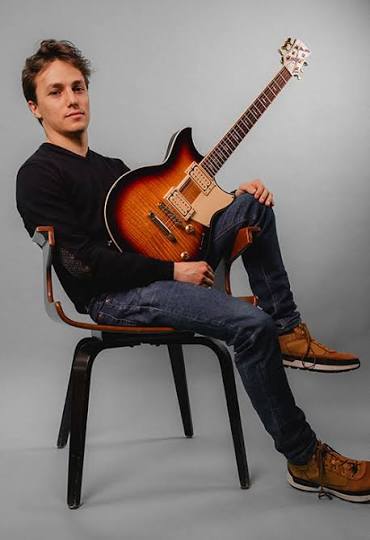
Every once in a while a guitarist comes along that makes even seasoned players stop and ask, "How is he doing that?" Matteo Mancuso is one of those players.
Every once in a while a guitarist comes along that makes even seasoned players stop and ask, "How is he doing that?" Matteo Mancuso is one of those players.
The first thing that grabs your attention isn't just his speed or technical ability — it's his touch. While many modern virtuosos rely heavily on picks and sweeping techniques, Mancuso has built his reputation around a fingerstyle approach that feels almost impossible. The result is a level of articulation, dynamics, and control that sounds more like a fusion of guitar, piano, and violin than traditional electric guitar playing.
A New Kind Of Virtuoso
What makes Matteo special isn't simply that he can play difficult music. Plenty of players can. It's that he makes incredibly complex passages sound musical. Whether he's diving into jazz fusion, rock, blues, or progressive territory, there's always a sense of melody behind the technique.
Pure fingerstyle electric technique — no pick required.
Classical-level right-hand independence applied to fusion vocabulary.
A singing, vocal-like phrasing that prioritizes melody over flash.
Dynamic control that makes the guitar sound like a hybrid of piano and violin.
The Influences You Can Hear
His influences are easy to hear. You can catch shades of Allan Holdsworth, Al Di Meola, Frank Gambale, and even hints of Steve Vai and Joe Satriani throughout his playing. Yet somehow the final result sounds uniquely Matteo Mancuso.
How the Technique Actually Works
Want Matteo Mancuso’s Tone?
Tell ToneMD what gear you own and get a full signal chain with real numbered settings for this tone.
Included with Premium
Mancuso plays with thumb and fingers, using a right-hand approach closer to classical or flamenco than to anything in rock. That single decision changes everything downstream. Instead of a pick alternating across strings, he has four independent attack points, which lets him play string-skipping lines, wide-interval arpeggios, and simultaneous voices without the awkward crossings that limit pick-based players.
It also changes the tone at the source. Flesh and nail produce a rounder transient than a plastic pick, so his clean sound is warm and vocal even when the notes are flying. There's very little gain in his rig by shred standards — the articulation comes from the hand, not from compression, and the dynamics survive because nothing is squashing them.
The trade-off is real: fingerstyle at that speed demands nail maintenance, right-hand independence built over years, and a completely different practice regime. It isn't a shortcut around picking technique. It's a parallel discipline that happens to be underexplored on the electric guitar.
“He's not just playing faster or cleaner than previous generations — he's approaching the instrument differently.”
Where the Vocabulary Comes From
Growing up around a guitar-playing father and a heavy diet of jazz, fusion, and classical repertoire shows in the note choice. His lines lean on altered dominants, chromatic approach notes, and fusion-standard superimpositions rather than blues-box shapes, which is why his playing can sound simultaneously familiar to jazz listeners and completely alien to rock ones.
What keeps it from becoming an exercise is the phrasing. He breathes. Lines start and stop in places that make melodic sense, and he leaves silence where a lot of technical players would keep going.
What Guitarists Can Take From Him
Two things translate immediately, even if you never abandon your pick. First, thumb-and-fingers playing on electric — start with simple arpeggios and let the right hand learn independence before adding speed. Second, dynamic range: play a phrase, then play it again at half the volume with the same accuracy. Most of us can't, and that gap is the reason his playing sounds like a different instrument.
Why He Matters For The Future Of Guitar
Perhaps the most exciting thing about Mancuso is what he represents for the future of guitar. At a time when many players wonder if guitar innovation has slowed down, he proves there are still entirely new approaches waiting to be discovered. He's not just playing faster or cleaner than previous generations — he's approaching the instrument differently.
Our Take
Our take? Matteo Mancuso is one of the most important guitarists to emerge in the last decade. Not because he's the fastest, the flashiest, or the most famous, but because he's genuinely pushing the instrument forward. That's something guitar players don't get to witness very often.
If you've never watched him play, do yourself a favor and spend ten minutes on YouTube. Just be prepared to question everything you thought you knew about guitar technique.
Essential viewing for any guitarist who wants a glimpse of where the instrument could be headed next.
- Yamaha Revstar Standard RSS20 Electric Guitar$899·Check on Amazon →
- Boss Katana-100 MkII Guitar Amplifier$379·Check on Amazon →
Some links are affiliate links — we may earn a small commission at no cost to you.
Experience-driven coverage, not algorithm bait.
- 20+ years of guitar playing experience
- Real-world retail experience at Guitar Center
- Thousands of hours testing guitars, amps, and pedals
- A community of 50,000+ guitar enthusiasts across platforms
- Partnerships with Fender, DistroKid, TrueFire, Card Chords, and Enya
- Editorial standards published openly — see how we test gear
The Modern Guitar Magazine. Delivered to your inbox.
No spam. No gimmicks. Just great guitar content — stories, tones, iconic solos, and honest gear takes. Every week.
Ask GP
3 free questions a dayStill curious? Ask GP about this story.
Your personal classic-rock and guitar guide — ask anything about Our Take On Matteo Mancuso.
Discussion (0)
Sign in to join the discussion.
Sign in to commentLoading comments…
Discover another guitar story
Swipe through our latest features, breaking news and iconic solos — one story at a time.
Open Swipe →More in Guitar Talk
The 10 Greatest Guitar Renditions of “The Star-Spangled Banner”
From Jimi Hendrix's controlled chaos at Woodstock to modern performances by H.E.R., Gary Clark Jr. and Jack White, these guitarists turned America's national anthem into something deeply personal.
Happy Birthday, Joe Perry: The Riff Machine Who Gave Aerosmith Its Swagger
Joe Perry turns 76 today. From the swampy grind of “Sweet Emotion” to the reunion that saved a band, this is the career of the guitarist who taught American hard rock how to strut.
History of the Riff: How Joe Satriani Made “Flying in a Blue Dream” Feel Weightless
An acoustic guitar in an unusual tuning, a stray broadcast and a melody that seems to hang in the air: inside the construction of Satriani’s 1989 masterpiece.