
The Guitar Plugged · Guitarist Index
Mark Knopfler
Dire Straits / solo
1977–present
Rock · Blues · Country
Fingerstyle electric playing so clean it became its own genre.
Main guitar
Fender Stratocaster (early), Pensa-Suhr and Schecter later
Signature sound
Bare-fingered Strat, neck-and-middle position, compressed and glassy
Era
1977–present
Influence
92 / 100
Genre
Rock / Blues / Country
Why they matter
Fingerstyle electric playing so clean it became its own genre.
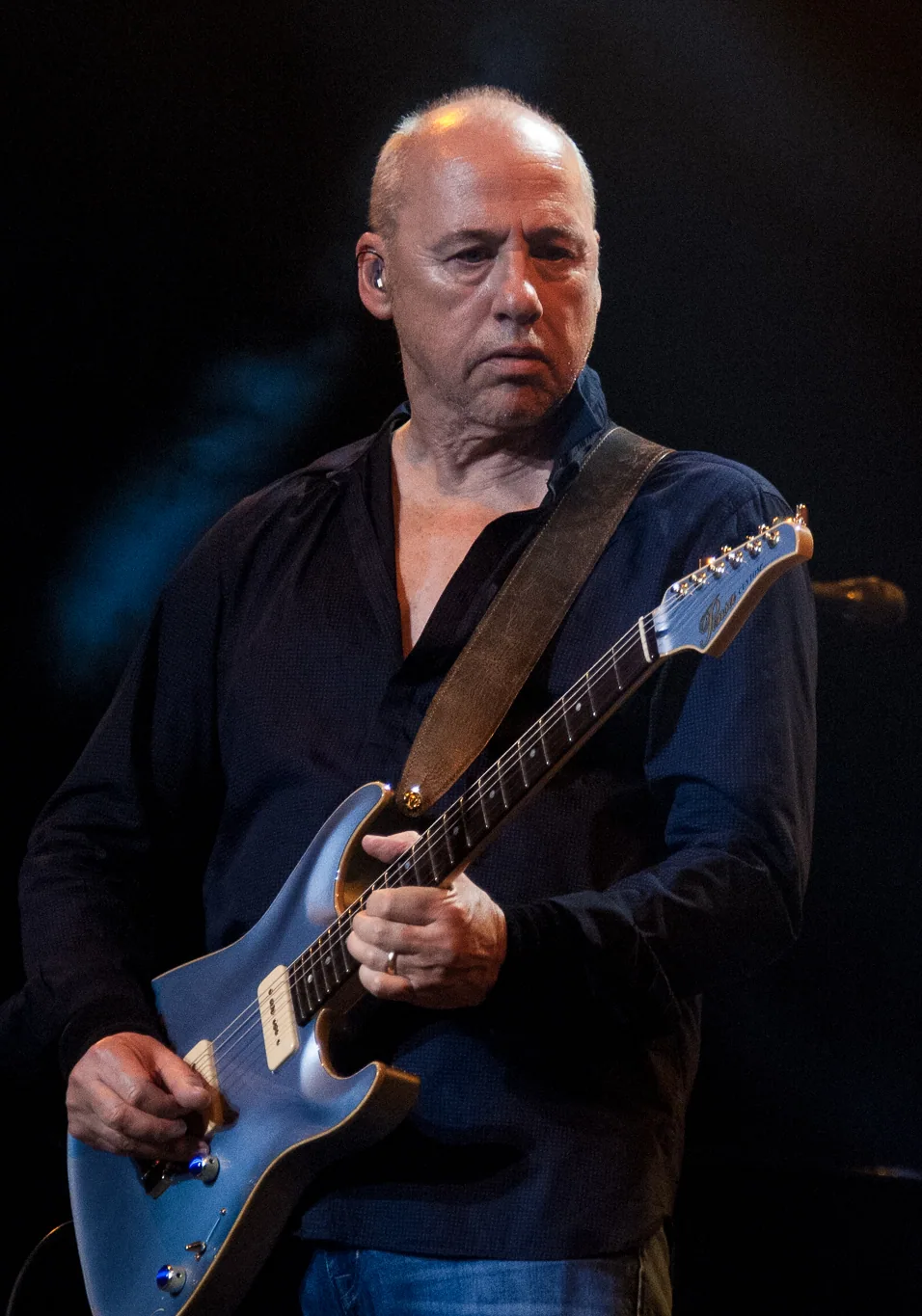
Knopfler plays electric guitar with his fingers, no pick, no nails, and that single decision defines everything about his sound: the attack is soft, the note separation is enormous, and he can play a bass note, a chord fragment and a melody in the same phrase.
'Sultans of Swing' introduced that voice in 1978 into a market dominated by punk and arena rock, and it worked precisely because it sounded like nothing else on radio. Later, 'Money for Nothing' proved he could produce a monstrous distorted tone as well — an accident of microphone placement he then spent years trying to reproduce live.
As a songwriter he moved steadily toward Celtic, country and folk material. The guitar playing stayed exactly as identifiable.
The sound
Bare-fingered Strat, neck-and-middle position, compressed and glassy
Sultans of Swing
Strat position 2 with just enough amp compression — the note separation is entirely down to bare fingers.
Money for Nothing
A famously accidental tone: a Les Paul into a Marshall captured with a partly displaced microphone, producing that wah-like nasal honk.
Brothers in Arms
Neck pickup, heavy reverb and long sustain — his most vocal, least busy playing.
Telegraph Road
A twelve-minute dynamic arc from near-clean arpeggios to full-throated lead without a tone change gimmick.
Recreate the sound
Want this tone on your rig?
ToneMD translates Mark Knopfler's sound into settings for the amp, modeler or plugin you already own.
Prescribe my tonePowered by ToneMD
Style & technique
How you recognise the playing
Bare-finger picking
Thumb and first two fingers on the strings — no pick, no nails — producing a rounded, percussive attack.
Position 2 Strat voicing
The neck-and-middle combination used almost as a default, giving that quacking, compressed clarity.
Simultaneous bass and melody
Independent thumb lines under lead phrases, borrowed from country and folk fingerstyle.
Rhythmic hesitation
Phrases that arrive slightly late and resolve early, giving his lines a conversational feel.
The rig
Instruments, amplification and effects
- 1961 Fender Stratocaster
- Pensa-Suhr MK1
- Schecter Telecaster and Stratocaster
- Gibson Les Paul (Money for Nothing)
- National Style O resonator
- Fender Vibrolux and Twin Reverb
- Marshall JTM45 (Money for Nothing)
- Soldano SLO-100 (later live)
- MXR Analog Delay
- Aphex Aural Exciter (early studio)
- Minimal pedalboard by design
- Fender single-coils
- EMG active pickups in the Pensa-Suhr
- No pick
- Compressor used sparingly to even out finger attack
Essential listening
Where to start
- 011978
Sultans of Swing
Dire Straits · Dire Straits
- 021980
Romeo and Juliet
Dire Straits · Making Movies
- 031982
Telegraph Road
Dire Straits · Love Over Gold
- 041985
Money for Nothing
Dire Straits · Brothers in Arms
- 051985
Brothers in Arms
Dire Straits · Brothers in Arms
- 062000
Sailing to Philadelphia
Mark Knopfler · Sailing to Philadelphia
Career landmarks
The moments that mattered
'Sultans of Swing'
A fingerstyle electric single that became a global hit in the middle of punk.
'Money for Nothing'
One of the most identifiable guitar tones ever recorded, and one of the hardest to reproduce.
Brothers in Arms
One of the first albums recorded fully digitally and a landmark for CD-era production.
The legacy
Lineage
Influenced by
Influenced
Adjacent players
More from the archive
The player who turned amplifier noise into a musical language.
The virtuoso who rewrote the vocabulary of rock guitar.
Session-hardened producer who built rock guitar as an architecture, not a solo.
The player who translated Chicago blues into British rock volume.
The restless technician who kept reinventing what an electric guitar could be.
The master of the long note — space, sustain and perfect note choice.