
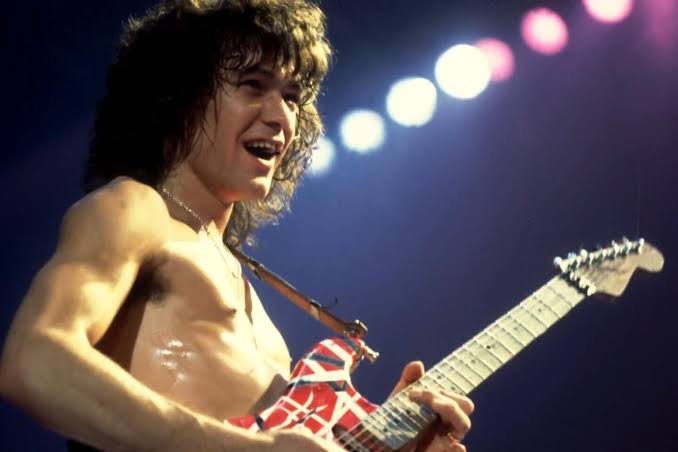
Eddie Van Halen: The Man Who Took the Electric Guitar Apart — and Rebuilt What It Could Be
From an immigrant kid learning piano by ear in Pasadena to the homemade guitar that changed an industry, the impossible sound of "Eruption," 5150, the Brown Sound and a legacy that still defines electric guitar: this is the complete story of Edward Van Halen.
There are guitarists who become famous. There are guitarists who become influential. And then, very occasionally, there is a guitarist who causes the instrument itself to change.
After Jimi Hendrix, the electric guitar had already been burned, bent, fed back, assaulted with a vibrato bar and pushed through amplifiers at volumes that turned distortion from an engineering problem into an artistic language.
Then Eddie Van Halen arrived. And somehow the guitar sounded new again.
Listen to the opening minutes of Van Halen's 1978 debut today and it can be difficult to reconstruct just how alien Eddie must have sounded to someone hearing him for the first time. There was no YouTube clip showing the technique. No slowed-down tutorial. No tablature posted five minutes after the record appeared. No bedroom guitarist uploading an "Eruption" cover before breakfast. There was simply this impossible sequence of sounds coming out of two speakers.
The distortion was huge, but strangely articulate. Harmonics screamed from places harmonics weren't supposed to exist. The vibrato bar seemed capable of liquefying notes without destroying the musical line. Chords were enormous. Rhythm guitar bounced rather than lumbered. And when Eddie's right hand suddenly appeared on the fretboard during "Eruption," thousands of guitarists effectively asked the same question: what is he doing?
The Rock & Roll Hall of Fame's description of Eddie is unusually appropriate: his playing changed the "vocabulary" of the electric guitar. Two-handed tapping existed before Van Halen, but Eddie transformed it into a highly visible, musically integrated language that generations of players would absorb.
But reducing Eddie Van Halen to tapping misses almost everything interesting about him. His greatest invention wasn't a lick. It was an approach.
If a guitar didn't do what he wanted, he modified it. If an amplifier didn't behave, he experimented with it. If conventional wiring was unnecessary, he stripped it away. If a vibrato system wouldn't stay in tune, he found another solution. If his bandmates didn't want keyboards in Van Halen, he built a studio and kept going. And if music theory told him one thing while his ears told him another, Eddie generally trusted his ears.
That instinct began long before there was a Frankenstrat. It began with a piano.
The $50, the piano and the family that started over
Edward Lodewijk Van Halen was born in Amsterdam on January 26, 1955. His father, Jan Van Halen, was a professional musician who played instruments including clarinet and saxophone. His mother, Eugenia, had been born in Indonesia. Eddie's older brother Alex had arrived two years earlier. In 1962 the family relocated to the United States and settled in Pasadena, California. Eddie later recalled arriving with very little money — and a piano.
That piano matters. Because before Eddie Van Halen became one of the defining guitarists of the 20th century, he was a pianist.
Eddie and Alex received classical piano instruction while growing up. Eddie became remarkably adept at learning music by listening and watching rather than reading notation. Accounts of his childhood describe him winning piano competitions despite never becoming a conventional sight-reader.
It is tempting to treat that as charming biographical trivia. It isn't. It may be one of the keys to understanding everything that came afterward.
Eddie learned music first as sound, not as information on paper. He absorbed intervals. He remembered movement. He reacted to rhythm. He recognised how notes felt against one another before worrying about what they were called.
Years later, that same mentality would appear everywhere in his guitar playing. Eddie frequently played sophisticated ideas without presenting them like exercises. His phrasing could jump between major and minor colours, open-string pedal tones, chromaticism, tapped arpeggios, blues phrases and violent harmonic squeals while somehow remaining unmistakably Eddie. The theory existed. But the ear appeared to arrive first.
Before Van Halen: the bands before the band
The mythology surrounding successful musicians often begins suspiciously close to the moment they became successful. Eddie's didn't. He and Alex had been forming bands since they were children.
The best-documented lineage begins with The Broken Combs, an elementary-school-era group dating to roughly 1964. Eddie later remembered playing piano while Alex played saxophone in that earliest incarnation. Later came The Trojan Rubber Company, followed by the names Genesis and Mammoth before the group ultimately became Van Halen. Some recollections of the brothers' formative years contain additional short-lived names and configurations, so building an absolutely definitive list from decades-old memories is difficult. But Broken Combs → Trojan Rubber Company → Genesis → Mammoth → Van Halen represents the clearest documented progression.
And even before that sequence was complete, something important happened: the Van Halen brothers switched instruments.
Eddie had gravitated toward drums while Alex had been playing guitar. Eddie reportedly used money from a paper route to help pay for the drums. But Alex started spending time on Eddie's kit and became increasingly capable behind it. Eventually the arrangement flipped. Alex became the drummer. Eddie took the guitar. One of rock's most important accidents had occurred.
Eric Clapton — particularly the Cream period — was a foundational influence. Jimmy Page was another important ingredient, especially the loose, dangerous quality Eddie admired. But Eddie absorbed those influences rather than remaining trapped inside them. Thousands of guitarists learned Clapton solos. Only one became Eddie Van Halen.
Mammoth: when Eddie was the singer
Before David Lee Roth became Van Halen's frontman, Eddie himself handled lead vocals in Mammoth while also playing guitar. Mark Stone played bass during an early version of the group; Alex was already where history wanted him, behind the drums.
David Lee Roth existed nearby in the same Pasadena ecosystem. His band, the Red Ball Jets, had something Mammoth needed — a PA system. Mammoth rented equipment from Roth before eventually bringing him into the band. Michael Anthony later replaced Stone on bass, completing the classic lineup.
The transition solved more than a logistical problem. Eddie no longer had to be the frontman. And David Lee Roth could become almost everything Eddie wasn't. Roth was spectacle; Eddie was often the smiling technician beside him. Roth commanded attention; Eddie frequently looked as though he had accidentally wandered onto the world's largest stage carrying a guitar and was simply delighted nobody had thrown him off yet. Roth sold the fantasy. Eddie supplied the impossible part.
The Pasadena laboratory
Before arenas, Van Halen played parties. Backyards. School events. Local halls. Clubs. Anywhere an audience existed.
The band's rise through Southern California mattered because those performances served as Eddie's laboratory. The guitar, amplifier, repertoire and stagecraft were all tested under working conditions. Van Halen eventually became part of the Los Angeles club circuit, appearing at venues including Gazzarri's, the Whisky a Go Go and the Starwood. Gene Simmons of Kiss became an early believer and helped produce demos, although that relationship did not immediately produce a record deal. Eventually producer Ted Templeman and Warner Bros. entered the picture.
By then, Eddie had already started solving a problem that would change guitar manufacturing. He wanted a guitar Fender didn't make. He wanted a guitar Gibson didn't make. So he made it himself.
Frankenstein: the most important parts guitar ever built
The Frankenstrat is now so recognisable that its paint scheme can obscure why the guitar mattered. Red. White. Black. Stripes. Instant Eddie. But the stripes are almost the least important thing about it.
The guitar represented an engineering question: why couldn't one electric guitar combine a Gibson-style humbucking sound with the feel, body shape and vibrato possibilities of a Stratocaster?
In a 1979 interview Eddie explained the idea plainly — he wanted the heavier Gibson-style sound but also wanted a Strat-style vibrato system, so he put a humbucker into a Strat-type guitar. Today that sounds obvious; walk into virtually any guitar shop and you'll see instruments built around exactly that formula. In the late 1970s it wasn't obvious. Eddie was helping establish the template that would become the Superstrat.
The Frankenstrat developed from aftermarket components associated with the Southern California hot-rodding scene, around builders and suppliers such as Wayne Charvel and Boogie Bodies. Accounts describe Eddie buying a cosmetically imperfect ash Strat-style body relatively cheaply and pairing it with a maple neck fitted with larger frets. Cosmetic perfection mattered less than whether the object could become the guitar in his head.
A guitar was not sacred. It was equipment. Drill it. Route it. Paint it. Replace the neck. Swap the pickup. Rip something out. Start again. Eddie treated guitar design the way a Southern California hot-rodder treated an engine bay: the manufacturer's original intent was merely the starting point.
Frankenstrat Anatomy
Tap any numbered point to explore what Eddie changed — and why he changed it.
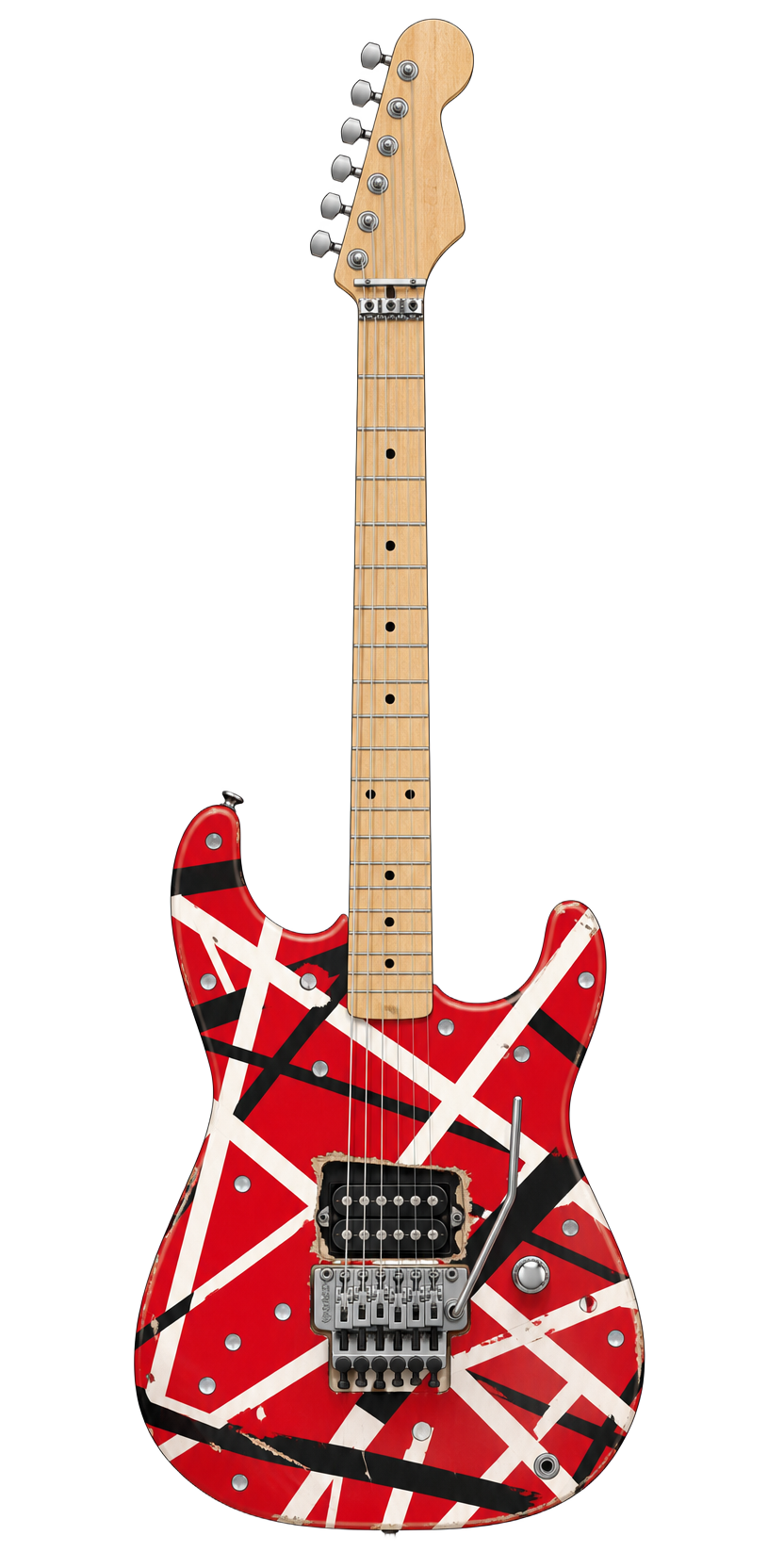
The Frankenstrat evolved continuously. This interactive diagram represents its most recognizable configuration; hardware, electronics and cosmetic details changed throughout its life.
Strat-style ash body
The foundation. A cosmetically imperfect Strat-type ash body, bought cheaply, gave Eddie the physical geometry and vibrato-friendly architecture he wanted. Looks were never the point — the shape was.
Original editorial illustration. The original Frankenstein was exhibited by The Metropolitan Museum of Art; the Smithsonian holds a Fender-built replica that Eddie played on the 2007–08 tour.
The functional wiring diagram
Instead of a complicated vintage schematic, look at how beautifully primitive Eddie's basic philosophy could be.
BRIDGE HUMBUCKER
       │
       ▼
  VOLUME POT
 ("TONE" knob)
       │
       ▼
  OUTPUT JACK
       │
       ▼
      AMP
That is part of the genius of Frankenstein. There are sophisticated aspects to Eddie's equipment history, but the guitar itself was not built around complexity for its own sake. It was built around removing things Eddie didn't need.
Why the humbucker sat at an angle
A Gibson-spaced humbucker and a Fender-style bridge weren't originally designed around exactly the same string spacing. Angling the pickup helped Eddie better align the pickup poles with the strings. Practical problem. Physical solution. That is the pattern.
Eddie also experimented with pickup potting to combat unwanted microphonic squeal at enormous stage volumes; wax potting stabilises components inside a pickup that can otherwise vibrate and behave like a microphone. The exact recipe matters far less than the mentality. Eddie wasn't waiting for the guitar industry to solve Eddie Van Halen's problems. He was solving them himself — sometimes elegantly, sometimes brutally, often both.
From black and white to red, white and black
The earliest iconic Frankenstein appearance was the black-and-white version associated with the first Van Halen era. The red arrived later; by 1979 the instrument had evolved into the red, white and black form now inseparable from Eddie's identity.
And the guitar never really became "finished." That may be the point. Frankenstein wasn't a model. It was a process. Necks changed. Pickups changed. Hardware changed. Paint changed. Parts appeared and disappeared. It was less like a Les Paul Burst preserved in amber and more like a race car rebuilt between events.
The Metropolitan Museum of Art later displayed the original Frankenstein as part of its Play It Loud exhibition, while the Smithsonian's collection contains a Fender-built Frankenstein replica that Eddie actually played during the 2007–08 Van Halen tour. That distinction is important: the Smithsonian instrument is not the original 1970s Frankie, but a painstaking replica that became an Eddie-played artifact in its own right. A homemade guitar assembled because one musician couldn't buy what he wanted had become a museum object. That might be the most Eddie Van Halen story imaginable.
The sound: the Brown Sound was never just an amp setting
This is where attempts to copy Eddie usually go wrong. Someone asks, "what were Eddie Van Halen's amp settings?" — as though there is a numerical combination capable of turning anyone into Eddie. There isn't.
Eddie's early sound involved the interaction of guitar, pickup, effects, amplifier, speakers, voltage, recording technique and — most importantly — Eddie. His famous early rig centred on a Marshall Super Lead–style amplifier pushed into substantial power-stage distortion. His effects arsenal included devices such as the MXR Phase 90, MXR Flanger, EQ and tape echo units including the Echoplex and Univox EC-80. A Variac was also associated with his manipulation of amplifier voltage.
But obsessing over component lists hides the musical result. Eddie's tone was not merely "high gain." It was remarkably dynamic. Hit a chord hard and the amplifier exploded. Back off and the sound breathed. The attack mattered. The volume control mattered. Pick angle mattered. Muting mattered. His hands mattered — a tremendous amount.
The Brown Sound, Block by Block
A representative early-EVH setup, not a definitive rig. Eddie's equipment changed constantly and several details remain disputed by gear historians. What follows is the shape of the chain, not a settings sheet.
- 01Frankenstrat / Ibanez Destroyer
Not every classic early tone came from the striped guitar.
- 02MXR Phase 90
The swirl on many of the earliest Van Halen leads.
- 03MXR 6-band EQ
Shaping and pushing the front end.
- 04MXR Flanger
The “Unchained” sound in one box.
- 05Echoplex / tape echo
Echoplex and Univox EC-80 units are both associated with the era.
- 06Marshall Super Lead
Power-stage distortion, not preamp gain — dynamics survive.
- 07Variac-era voltage experiments
Voltage manipulation is part of the mythology; the details are disputed.
- 08Speaker cabinet
Speaker breakup is a huge part of what listeners call the Brown Sound.
- 09Room + mics
The recording chain shaped the record as much as the amp did.
- 10Eddie's hands
Attack, pick angle, muting, volume-knob control. The part you cannot buy.
Build the Brown Sound on the gear you actually own
Eddie Van Halen is already selected. Choose the era you're chasing and the gear sitting in your room, and ToneMD will translate the chain into settings for your rig — including an honest accuracy estimate of what your equipment can and can't reach.
BUILD THIS TONE IN TONEIDTone Accuracy tells you how close your rig can realistically get, and explains the differences it can't close.
February 10, 1978: when "Eruption" changed the conversation
Van Halen's debut arrived in February 1978. And near the beginning of the album was an instrumental lasting less than two minutes.
It is difficult to imagine another guitar instrumental of comparable brevity producing such disproportionate consequences. "Eruption" didn't invent two-handed tapping — that distinction matters, because variations of tapping existed before Eddie. What Eddie did was make it explode into mainstream guitar consciousness.
He integrated tapping into a larger language involving hammer-ons, pull-offs, wide intervals, tremolo dives, harmonics, rhythmic displacement and a huge distorted sound — and delivered the entire thing with the casual physicality of someone showing friends a trick he'd figured out in the garage.
After "Eruption," tapping went from obscure technique to rite of passage. And then, eventually, cliché. That is what happens when an innovation becomes too successful. Rock guitar in the following decade was filled with players trying to solve Eddie's puzzle. Some copied the tapping. Some copied the striped guitars. Some copied the hot-rodded Strats, the Floyd Rose, the Marshall sound, the grin. Very few understood the rhythm guitar.
The part everybody copied wrong
Eddie Van Halen was an extraordinary soloist. He may have been an even more important rhythm guitarist.
Listen beneath David Lee Roth. Listen beneath Sammy Hagar. Listen to what happens between vocal lines. Eddie almost never seems content to simply strum the obvious chord. There are muted scratches, suspended notes, harmonics, chord fragments, slides, low-string punctuation, arpeggiated fills, open strings, micro-riffs and rhythmic accents. It can sound like two guitarists are present when there is only Eddie.
That is one reason early Van Halen sounds simultaneously enormous and open. He didn't need to fill every frequency. Alex and Michael Anthony had space. Eddie had space. And when the guitar moved, you noticed.
The other half of Eddie Van Halen: Alex
Trying to understand Eddie without Alex is nearly impossible. They didn't merely share DNA; they shared musical time. Alex's drumming and Eddie's guitar playing could lock together with the elasticity of musicians who had been communicating since childhood.

Eddie's rhythm playing swung. That word matters. Even at enormous volume, classic Van Halen rarely feels rigid. There is bounce, forward motion, a slightly mischievous sense that the groove is leaning somewhere. That feel separated Eddie from generations of technically spectacular players who could reproduce his notes but not his pulse. Technique can be transcribed. Feel is harder.
The first six albums
Van Halen — 1978
The debut established almost everything: "Runnin' with the Devil," "Eruption," "You Really Got Me," "Ain't Talkin' 'Bout Love," "Jamie's Cryin'," "I'm the One."

The album's importance isn't merely that Eddie played difficult guitar. It's that the difficult guitar lived inside memorable songs. That combination — virtuosity plus accessibility — is what made Eddie dangerous. If "Eruption" had been released by an obscure fusion guitarist between two eight-minute instrumentals, guitarists might have noticed. Instead it existed on an album full of songs teenagers wanted to blast at parties. The revolution had hooks.
Van Halen II — 1979
The second album proved the debut wasn't an accident. The guitar collection expanded. The visual mythology expanded. The Bumblebee — the black-and-yellow instrument famously pictured around this era — became another EVH icon. And Eddie kept developing the hybrid guitar concept the industry would soon chase aggressively.
Women and Children First — 1980
By the third album, Van Halen no longer sounded like musicians demonstrating what they could do. They sounded like a band certain that nobody else could do it quite the same way. "And the Cradle Will Rock…" also demonstrated something fans would increasingly need to understand: Eddie Van Halen was not exclusively a guitarist. Keyboards were part of his musical vocabulary too.
Fair Warning — 1981
For many serious Van Halen listeners, Fair Warning is where Eddie becomes almost frightening. Darker. Heavier. More experimental. "Mean Street" begins with one of Eddie's most extraordinary pieces of guitar theatre, a percussive introduction involving tapped harmonics that still sounds strange decades later. Then the riff arrives. If "Eruption" announced a new vocabulary, "Mean Street" showed Eddie was still adding words. "Unchained" delivered another immortal riff and one of the defining uses of his flanger sound. This is Eddie at his most menacing without losing groove.
“If the instrument couldn't do what he wanted, Eddie didn't lower the ambition. He changed the instrument.”
Diver Down — 1982
Often discussed through its abundance of cover songs, Diver Down still contains crucial Eddie moments. The record also illustrates the tension that increasingly existed between the guitarist's desire to explore and the commercial machine surrounding Van Halen. Eddie wanted more control. Soon he would literally build it.
5150: when Eddie built his own world
One of Eddie Van Halen's greatest pieces of equipment wasn't a guitar. It was a room.
Eddie constructed the 5150 studio at his home, and the importance of that decision is difficult to exaggerate. A commercial recording studio runs on a clock: time costs money, sessions end, other artists arrive. A home studio changes the equation. Eddie could experiment, leave equipment connected, come back later, build songs gradually and follow an idea without watching an hourly rate accumulate. The laboratory moved from the guitar bench into the recording environment.
1984
The album is called 1984. But the future was already inside it. "Jump" opens not with a Frankenstrat. It opens with synthesizer.
Eddie wrote and performed the famous keyboard part using an Oberheim synth. The song's keyboard-driven direction had generated resistance within the Van Halen camp, but Eddie continued pursuing it. That decision says more about him than another hundred stories about tapping. The easiest thing Eddie Van Halen could have done in the 1980s was remain Eddie Van Halen, Guitar Hero™. He didn't. He played keyboards. He wrote "Jump." And it became Van Halen's only No. 1 single on the Billboard Hot 100.
Meanwhile, "Panama" reminded everyone that Eddie hadn't suddenly abandoned the electric guitar. "Hot for Teacher" demonstrated the absurd chemistry between Eddie and Alex. "Drop Dead Legs" contained the kind of riff other bands would happily have built an entire career around. 1984 wasn't Eddie leaving guitar behind. It was Eddie refusing to let guitar heroism confine his musicianship.
"Beat It"
There is one Eddie Van Halen solo that belongs to neither the David Lee Roth era nor the Sammy Hagar era. It belongs to Michael Jackson.
Quincy Jones recruited Eddie to contribute to "Beat It" during the creation of Thriller. Eddie recorded the solo without charging for the session and also had a hand in reshaping the section beneath his guitar contribution.
The solo lasts only seconds. But it contains almost everything recognisable about Eddie: the attack, the drama, the tapping, the flash, the sense of a guitar being pushed almost physically over a cliff. And then it's gone. Millions of listeners who may never have purchased a Van Halen album heard Eddie erupt from the middle of the biggest pop phenomenon on Earth. Steve Lukather performed other guitar work on the track, but Eddie's solo became the moment everyone remembered. The perfect cameo. No introduction required.
David Lee Roth leaves — and the Hagar years
Following the enormous success of 1984, the classic Van Halen lineup fractured. David Lee Roth departed. For many rock bands, losing a frontman that recognisable would have ended the story. Van Halen hired Sammy Hagar. And somehow began another massive chapter.

Hagar changed the chemistry. That wasn't necessarily a defect — it was the point. His vocal range, guitar ability and songwriting instincts allowed Van Halen to become a somewhat different band.
The result was 5150 in 1986, including "Why Can't This Be Love," "Dreams," "Best of Both Worlds" and the title track. The keyboards that had once created tension were now fully integrated into Eddie's compositional identity; "Dreams" is almost unimaginable without them. But "5150" itself remains a reminder that Eddie could still construct guitar parts with an architectural sophistication far beyond flashy soloing.
Then came OU812 in 1988, For Unlawful Carnal Knowledge in 1991 and Balance in 1995. Van Halen with Hagar didn't merely survive. It became its own hugely successful era.
The evolution of Eddie's guitars
Frankenstein may be the most famous Eddie Van Halen guitar. It isn't the entire story. Far from it.
The Ibanez Destroyer. An Ibanez Destroyer became a critical instrument in Eddie's early recording arsenal, and its contribution to the first Van Halen album is an important reminder that not every classic Eddie tone came from the Frankenstrat. This is why recreating EVH based entirely on a photograph can mislead: the guitar visible onstage is not necessarily the guitar heard on every track.
The Bumblebee. The black-and-yellow striped guitar associated with Van Halen II became perhaps the second great visual expression of Eddie's striped concept, and part of the larger visual vocabulary of the emerging high-performance electric guitar.
The Kramer 5150. By the early-to-mid 1980s Eddie became closely associated with Kramer. The striped 5150 guitar represented another evolutionary step: the locking-tremolo, humbucker-driven hot-rod concept was no longer an eccentric homemade object. It was rapidly becoming the template for an industry, and Kramer's association with Eddie helped the company become a major force in the 1980s guitar market.
Look at the walls of almost any guitar store during that decade. Pointy headstocks. Locking tremolos. Bridge humbuckers. Fast necks. Minimal controls. High-output pickups. Strat-derived bodies optimised for aggressive rock guitar. The world had caught up to Frankenstein.
Ernie Ball Music Man. Eddie later collaborated with Ernie Ball Music Man on a signature instrument that represented a major philosophical shift. Instead of Eddie modifying an existing guitar into submission, a manufacturer could now build an instrument around Eddie from the beginning. Hardware, neck feel, pickups and ergonomics increasingly became parts of an integrated system rather than a pile of replacement parts.
Peavey and the 5150 amplifier. Eddie's relationship with Peavey produced the Wolfgang guitar and the 5150 amplifier, an amp lineage that would become massively important to hard rock and metal players. What began decades earlier as Eddie experimenting with Marshalls had evolved into Eddie helping develop amplification specifically around the needs of high-gain guitar music. The kid who couldn't buy the guitar he wanted was now helping companies build entire product categories around his preferences.
EVH. Eventually the EVH brand, developed in partnership with Fender, pushed the concept further: guitars, amplifiers, effects, accessories, Frankie-derived instruments, Wolfgang designs, 5150 amplification. The experiments Eddie once conducted in garages and workshops became an ecosystem. The Smithsonian's Eddie-played Frankenstein replica itself came through a partnership involving Fender, demonstrating how thoroughly the homemade object had entered institutional guitar history.
Eddie the inventor
There is a tendency to divide guitarists into categories. Player. Composer. Gearhead. Engineer. Producer. Eddie made those divisions look artificial.
He modified guitars because playing created design problems. He experimented with amplifiers because tone created electrical problems. He built 5150 because recording created logistical problems. He embraced locking tremolos because his vibrato technique created tuning problems. The inventions followed the music.
That distinction is crucial. Eddie wasn't accumulating technology for its own sake. He was trying to remove the obstacles between an idea and a sound.
Why the Frankenstrat matters more than its stripes
There may be no guitar more frequently copied aesthetically than Frankenstein. Ironically, copying its appearance misses its message. The lesson isn't paint your guitar red, white and black. The lesson is: why are you accepting a guitar that doesn't work the way you need it to?
Eddie didn't worship specifications. He interrogated them. Why three pickups? Why two tone knobs? Why this pickup? Why this bridge? Why this voltage? Why this neck? Why should Gibson sound and Fender ergonomics exist on opposite instruments? Those are design questions. The Frankenstrat was Eddie's answer.
The technique
Tapping. This will forever be the technique most closely associated with Eddie, but it only works musically because of what surrounds it. Eddie could create wide intervallic sequences difficult or impossible to articulate conventionally with one fretting hand; the right-hand finger effectively became an additional fretting-hand digit, letting patterns move across the neck with piano-like logic. That piano comparison matters. The child who learned music through a keyboard eventually began treating a guitar neck as though both hands belonged on the notes.
Legato. Hammer-ons and pull-offs gave Eddie enormous fluidity. Notes could pour from the instrument without every attack being explicitly picked — the slippery sensation separating Eddie from more rigid alternate-picked virtuosity.
Harmonics. Eddie seemed obsessed with finding hidden notes inside the guitar: natural harmonics, artificial harmonics, tapped harmonics, pinched squeals, open-string resonance. A normal note was often merely one possibility.
The whammy bar. Eddie used the vibrato bar as an expressive device rather than decoration — dives, screams, drops, shimmers, impossible pitch collapses. Because those techniques demanded more stable hardware, his playing style became directly connected to the rise of locking vibrato technology. Technique drove engineering; engineering enabled more extreme technique. The loop continued.
Rhythmic displacement. The hardest Eddie Van Halen lick to learn may not be a lick. It may be where he puts it. Players accustomed to thinking primarily in note sequences often discover that Eddie's phrasing feels strange when copied mechanically. He played around the beat, against the drums, inside the drums, sometimes almost like percussion. The guitarist and drummer had spent a lifetime together. That matters.
Gary Cherone, Wolfgang and the last years
After Hagar's initial departure and a brief, complicated reunion period with Roth, Van Halen recruited former Extreme singer Gary Cherone. Van Halen III arrived in 1998. Commercially and critically the era never reached the heights of the Roth or Hagar years — but viewed through the lens of Eddie's career, the album makes sense. He was still experimenting. Still unwilling to simply manufacture another old Van Halen record. Still moving. Cherone ultimately exited and Van Halen entered a more uncertain period.

Eddie's son Wolfgang eventually joined Van Halen on bass, replacing Michael Anthony for the band's later touring era. The symbolism was impossible to miss. Jan Van Halen had given music to Eddie and Alex. Eddie and Alex built Van Halen. Now another Van Halen was onstage. The group reunited with David Lee Roth and toured extensively, later releasing A Different Kind of Truth in 2012 — the final Van Halen studio album. For Eddie, the late-period band therefore contained both his brother and his son. Van Halen had become what its name had always implied: a family story.
Eddie's health struggles became increasingly serious. He had dealt with cancer and other health issues over a long period and died on October 6, 2020, at age 65. Wolfgang announced his father's death publicly.
The reaction from musicians was immediate. But perhaps more revealing than celebrity tributes were the thousands upon thousands of ordinary guitar players posting photographs: striped guitars, 5150 amps, Wolfgangs, homemade Frankenstrats, old cassette tapes, the first guitar they bought because of Eddie, videos of the first tapping lick they ever learned. Eddie's legacy was visible because guitarists had been physically reproducing pieces of it for more than four decades.
What Eddie actually changed
Remove Eddie Van Halen from guitar history and the instrument still evolves. But it evolves differently.
The hot-rodded Strat movement existed around him, but Eddie became its most powerful advertisement. Tapping existed, but Eddie made millions of guitarists want to learn it. Locking tremolos would exist, but few players demonstrated their possibilities as spectacularly. High-gain amplifiers would evolve, but the 5150 lineage became one of the defining sounds of modern heavy guitar. Signature guitars existed, but Eddie approached instrument collaboration with the perspective of someone who had been hacking apart guitars since the 1970s. Home studios existed, but 5150 gave Eddie creative autonomy at a critical moment.
And none of that accounts for the most important thing. The songs.
The Songs Every Guitar Player Should Hear
The obvious one — and still astonishing, not because it is difficult but because it sounds like discovery.
Three notes can establish an identity. The delayed, palm-muted opening is almost ridiculously simple compared with "Eruption." That's precisely the point.
A riff does not need complexity to sound enormous. It needs authority. Few riffs have more — and the flanger is half the signature.
Tone, groove and arrangement. The riff moves because Eddie moves; strip out the rhythm and the notes mean surprisingly little.
Alex begins, then Eddie enters, and for several minutes the distinction between rhythm section and lead guitar almost stops mattering.
Experimental tapped-harmonic theatre followed by crushing rhythm guitar — the most accurate miniature portrait of Eddie's musicianship.
An Oberheim synth line from a guitar hero, and Van Halen's only No. 1 on the Billboard Hot 100.
Seconds long, unpaid, and still the moment everyone remembers from the biggest pop record on Earth.
Proof that Eddie could build guitar parts with architectural sophistication far beyond flashy soloing.
The kind of riff other bands would happily have built an entire career around, buried in the middle of a blockbuster.
The smile
There is another element of Eddie's influence that doesn't appear on tablature: the smile. Photographs of virtuosos often emphasise seriousness, concentration, mystique. Eddie frequently looked delighted. Even while playing something that would send thousands of guitarists home wondering whether they should quit, Eddie could look like a kid who had just discovered that pushing one button made the entire machine explode.
That joy matters. Because underneath the gear mythology and technique worship, Eddie Van Halen made the electric guitar look unbelievably fun. Not respectable. Not academic. Not untouchable. Fun. That may have inspired as many players as "Eruption."
The great paradox
Millions of people tried to copy Eddie. And Eddie's entire career was built on refusing to simply accept what already existed. That's the paradox. The most Eddie Van Halen thing a guitarist can do is probably stop trying to become Eddie Van Halen. Find the sound you can't buy. Find the technique you need. Modify the equipment. Ignore the rule that isn't helping. Trust your ear. Build something ugly if ugly works. And play the hell out of it.
Frankenstrat: then and now
Today, Frankenstein is simultaneously a historic instrument, a museum object, a commercial guitar, a symbol, a paint scheme, a DIY project, a piece of intellectual property — and perhaps the most recognisable homemade electric guitar ever created.
The Metropolitan Museum considered the original significant enough to exhibit alongside celebrated instruments connected to artists including Jimi Hendrix, Eric Clapton, Jerry Garcia and Stevie Ray Vaughan. Think about how strange that journey is. A young musician wanted Gibson power and Fender functionality in the same guitar. So he started cutting. Decades later, the result belonged in an art museum.
The Eddie Van Halen effect
Before Eddie, a Strat was generally a Strat and a Les Paul was generally a Les Paul. After Eddie, an entire generation began asking: what if we change it?
That question eventually produced an industry. Charvel. Jackson. Kramer. Ibanez. ESP. And countless others benefited from the demand for faster, hotter, more aggressively engineered guitars. Eddie wasn't solely responsible for every development in that movement, but his visibility helped turn the hot-rodded Strat concept into a dominant language of 1980s rock guitar. The Superstrat wasn't merely a shape. It represented a change in ownership: the guitarist — not the manufacturer — would decide what the guitar was supposed to be.
Eddie wasn't a shredder
At least, not in the way the word eventually came to be used. Yes, he could play extraordinarily fast. Yes, his technique influenced nearly every shred guitarist who followed. But Eddie's compositions weren't exercises designed to support solos. He wrote riffs, hooks, songs, keyboard parts, arrangements, production ideas, textures. Even the Rock Hall's description of his virtuosity emphasises not only speed but control and melodic feel.
That is why Eddie survived his imitators. Once tapping became normal, Eddie still sounded like Eddie. Once everybody owned a locking tremolo, Eddie still sounded like Eddie. Once every guitar store contained hot-rodded Strat-style instruments, Eddie still sounded like Eddie. Because the equipment was never the identity. The musician was.
The final Frankenstrat diagram
              FRANKENSTRAT

        ┌────────────────────┐
        │      CURIOSITY     │
        │                    │
        │   ┌────────────┐   │
        │   │ EXPERIMENT │   │
        │   └────────────┘   │
        │                    │
        │   FUNCTION > RULES │
        │                    │
        │   FAILURE          │
        │       ↓            │
        │   MODIFY           │
        │       ↓            │
        │   TRY AGAIN        │
        │                    │
        │       SOUND        │
        └────────────────────┘
Because that is the real Frankenstrat schematic.
The legacy
Eddie Van Halen didn't invent the electric guitar. He didn't invent distortion, humbuckers, the Stratocaster, tapping or the locking tremolo. What he did may be more interesting. He took existing ideas that weren't quite serving his imagination, combined them differently, pushed them further and made the results impossible for the rest of the world to ignore.
That's innovation. Not creating from nothing. Seeing possibilities nobody else has assembled in quite the same way.
The Rock Hall inducted Van Halen in 2007, and museums later preserved Eddie-related instruments as artifacts of American musical history. But Eddie's most important museum is considerably larger. Walk into a guitar shop and look at the wall. Find an HSS guitar. Find a bridge humbucker. Find a locking tremolo. Find a high-gain amplifier. Find a striped guitar. Find an MXR Phase 90. Find a 5150. Then go home, open YouTube and search for guitar tapping, for "Eruption," for "Brown Sound," for "build a Frankenstrat." More than four decades after Van Halen's debut, guitarists are still trying to understand what happened. That is influence.
There is an old temptation when discussing virtuosos to make them supernatural. Eddie Van Halen deserves something better. The extraordinary thing isn't that Eddie arrived knowing how to do all of this.
He experimented. He practised. He listened. He broke things. He rebuilt them. He followed sounds. He changed equipment. He ignored conventions. And he remained curious.
The Frankenstein guitar is therefore an unusually perfect monument to its creator. It isn't pristine. It isn't symmetrical. It isn't traditionally beautiful. Some parts look unfinished. Some parts aren't doing anything. There are holes, scratches, tape marks, paint, wires, mistakes, solutions, history.
And when Eddie Van Halen picked it up, it became one of the most consequential instruments in the history of rock guitar. Not because the guitar was perfect. Because Eddie knew what he wanted it to do — and when the instrument couldn't do it, he changed the instrument.
Hear it. Chase it. Build it.
Enter the tone you want, tell ToneMD the gear and pickups you actually own, and get a recipe built for your rig — full signal chain, real numbered settings and step-by-step instructions for your exact amp or modeler.
Open ToneMDSubscription required · $4.99/month or $49.99/year · Cancel anytime
Frequently Asked Questions
- Did Eddie Van Halen invent two-handed tapping?
- No. Variations of tapping existed before Van Halen. What Eddie did was integrate it into a complete musical language and make it visible enough that millions of guitarists wanted to learn it after hearing "Eruption" in 1978.
- What was the Frankenstrat?
- A homemade parts guitar: a cheap, cosmetically imperfect ash Strat-style body, a maple neck with larger frets and a Gibson-style bridge humbucker, with the electronics stripped back to a single working volume control wearing a knob marked TONE. Its specification changed constantly throughout its life.
- Is the Frankenstrat in the Smithsonian?
- The Smithsonian holds a Fender-built Frankenstein replica that Eddie played on the 2007–08 Van Halen tour. The original Frankenstein was displayed by The Metropolitan Museum of Art as part of its Play It Loud exhibition.
- What amp did Eddie Van Halen use for the Brown Sound?
- His famous early sound centred on a Marshall Super Lead–style amplifier driven hard into power-stage distortion, with MXR Phase 90, MXR Flanger, EQ and tape echo in the chain, plus Variac-era voltage experimentation. The exact rig changed and several details remain disputed, which is why there is no single settings sheet that produces the tone.
- Can I get an Eddie Van Halen tone on a modeler?
- Yes, within limits. ToneMD translates the target era — Van Halen I, Fair Warning, 1984, 5150 and later — into settings for the specific unit you own, and gives you an honest Tone Accuracy estimate of what your gear can and can't reach.
Sources & further reading
- 1.Rock & Roll Hall of Fame — Van Halen inductee profile
- 2.The Metropolitan Museum of Art — Play It Loud: Instruments of Rock & Roll
- 3.Smithsonian National Museum of American History — Eddie Van Halen's Frankenstein replica
Experience-driven coverage, not algorithm bait.
- 20+ years of guitar playing experience
- Real-world retail experience at Guitar Center
- Thousands of hours testing guitars, amps, and pedals
- A community of 50,000+ guitar enthusiasts across platforms
- Partnerships with Fender, DistroKid, TrueFire, Card Chords, and Enya
- Editorial standards published openly — see how we test gear
The Modern Guitar Magazine. Delivered to your inbox.
No spam. No gimmicks. Just great guitar content — stories, tones, iconic solos, and honest gear takes. Every week.
Ask GP
3 free questions a dayStill curious? Ask GP about this story.
Your personal classic-rock and guitar guide — ask anything about Eddie Van Halen.
Discussion (0)
Sign in to join the discussion.
Sign in to commentLoading comments…
Discover another guitar story
Swipe through our latest features, breaking news and iconic solos — one story at a time.
Open Swipe →More in Guitar Talk
The 10 Greatest Guitar Renditions of “The Star-Spangled Banner”
From Jimi Hendrix's controlled chaos at Woodstock to modern performances by H.E.R., Gary Clark Jr. and Jack White, these guitarists turned America's national anthem into something deeply personal.
Happy Birthday, Joe Perry: The Riff Machine Who Gave Aerosmith Its Swagger
Joe Perry turns 76 today. From the swampy grind of “Sweet Emotion” to the reunion that saved a band, this is the career of the guitarist who taught American hard rock how to strut.
History of the Riff: How Joe Satriani Made “Flying in a Blue Dream” Feel Weightless
An acoustic guitar in an unusual tuning, a stray broadcast and a melody that seems to hang in the air: inside the construction of Satriani’s 1989 masterpiece.