History of the Riff: Chuck Berry's "Johnny B. Goode," the Intro That Taught Rock Guitar to Talk
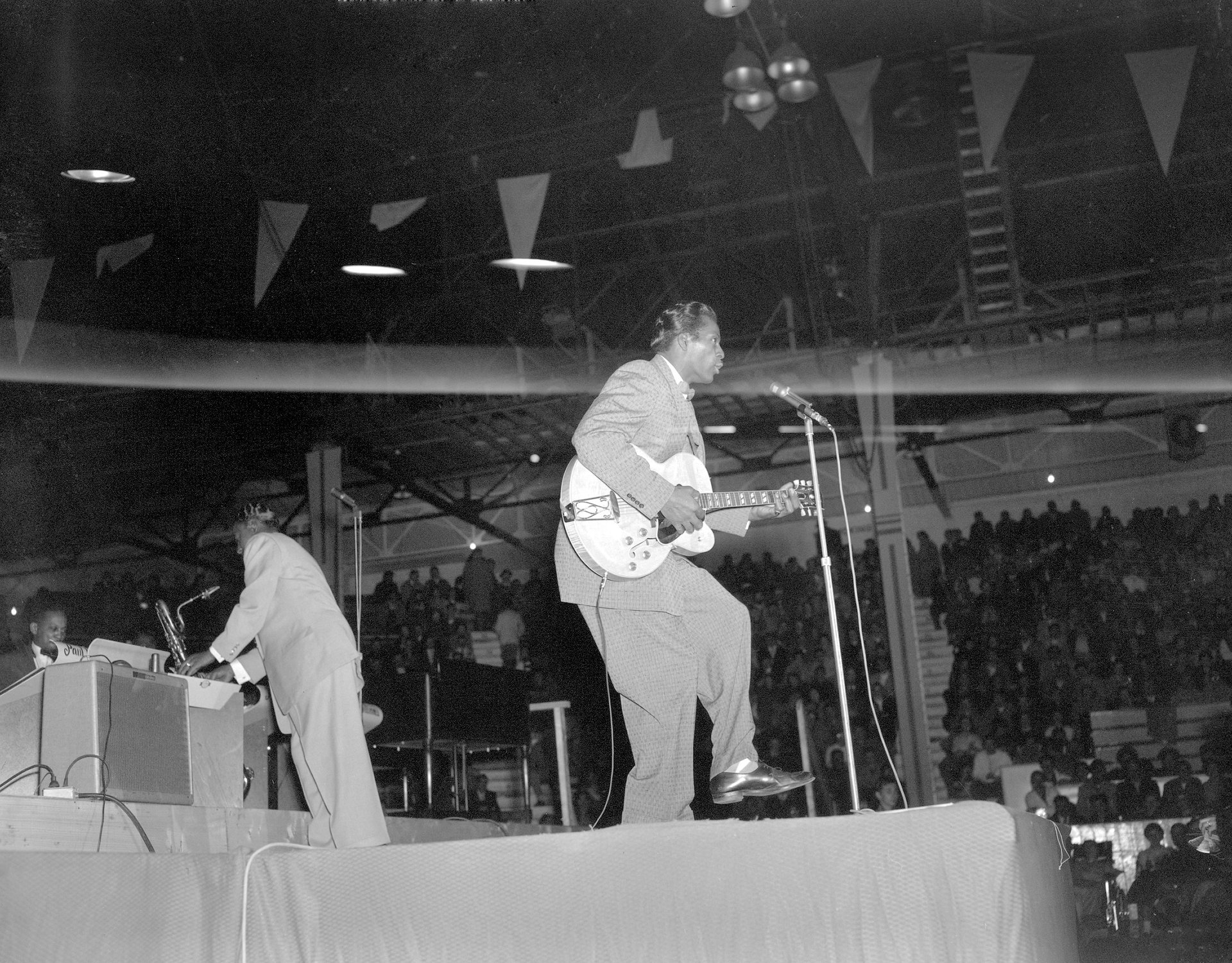
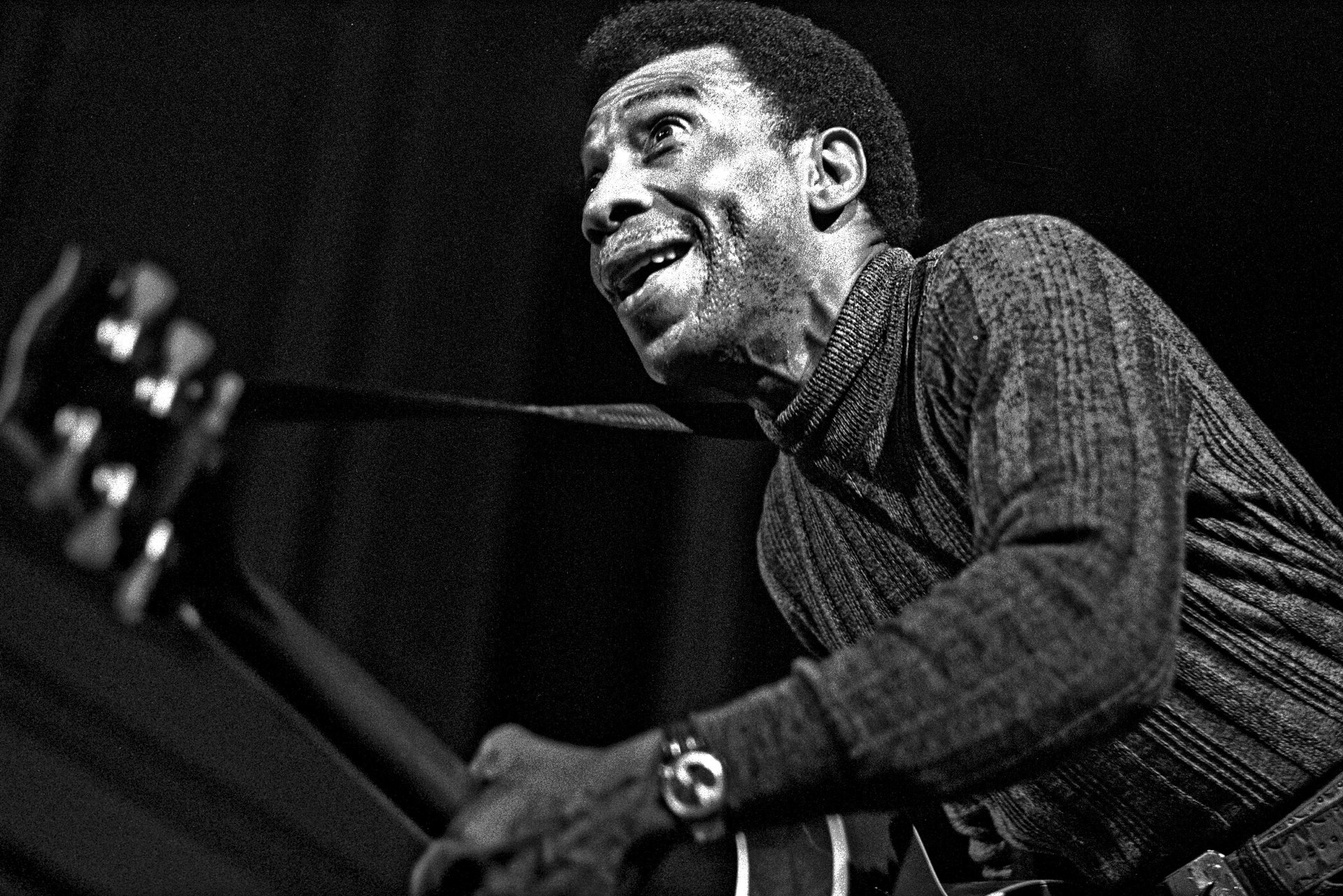
Chuck Berry onstage at the Edmonton Gardens in Alberta during "The Biggest Show of Stars for '57" tour, the year before he cut "Johnny B. Goode."
Chuck Berry would have turned 100 today. Here's how a 1946 Carl Hogan lick, T-Bone Walker's slurs and one January day at Chess Records became the intro every rock guitarist learns first.
At its heart it's two strings, one finger, and a slide up a half step. That's the core of the most famous intro in rock and roll. The Johnny B. Goode riff lasts a few seconds, and it's been the first real lead lick for more guitar players than anyone could count. It's also the only rock and roll song bolted to the side of two spacecraft now drifting out past the edge of the solar system.
Chuck Berry would have turned 100 today, Sunday, October 18, 2026. So this History of the Riff entry goes back to the start: a 1946 jump-blues record, a street sign in St. Louis, one January day at Chess Records in Chicago, and a piece of music that kept turning up everywhere from the White House to a fake Time cover on Saturday Night Live.
Berry himself would want us to say this first: the riff wasn't born out of nothing. He told you where he got it.
"Ain't Nothing New Under the Sun": Where the Riff Came From
Carl Hogan and Louis Jordan, 1946
Before Chuck Berry, there was Louis Jordan, the saxophone-playing bandleader whose Tympany Five ruled the 1940s R&B charts with jump blues: tight, swinging, funny, and built to make people dance. On Jordan's 1946 record "Ain't That Just Like a Woman (They'll Do It Every Time)," guitarist Carl Hogan opens the song with a single-note figure that anybody who knows "Johnny B. Goode" will recognize in about two seconds.
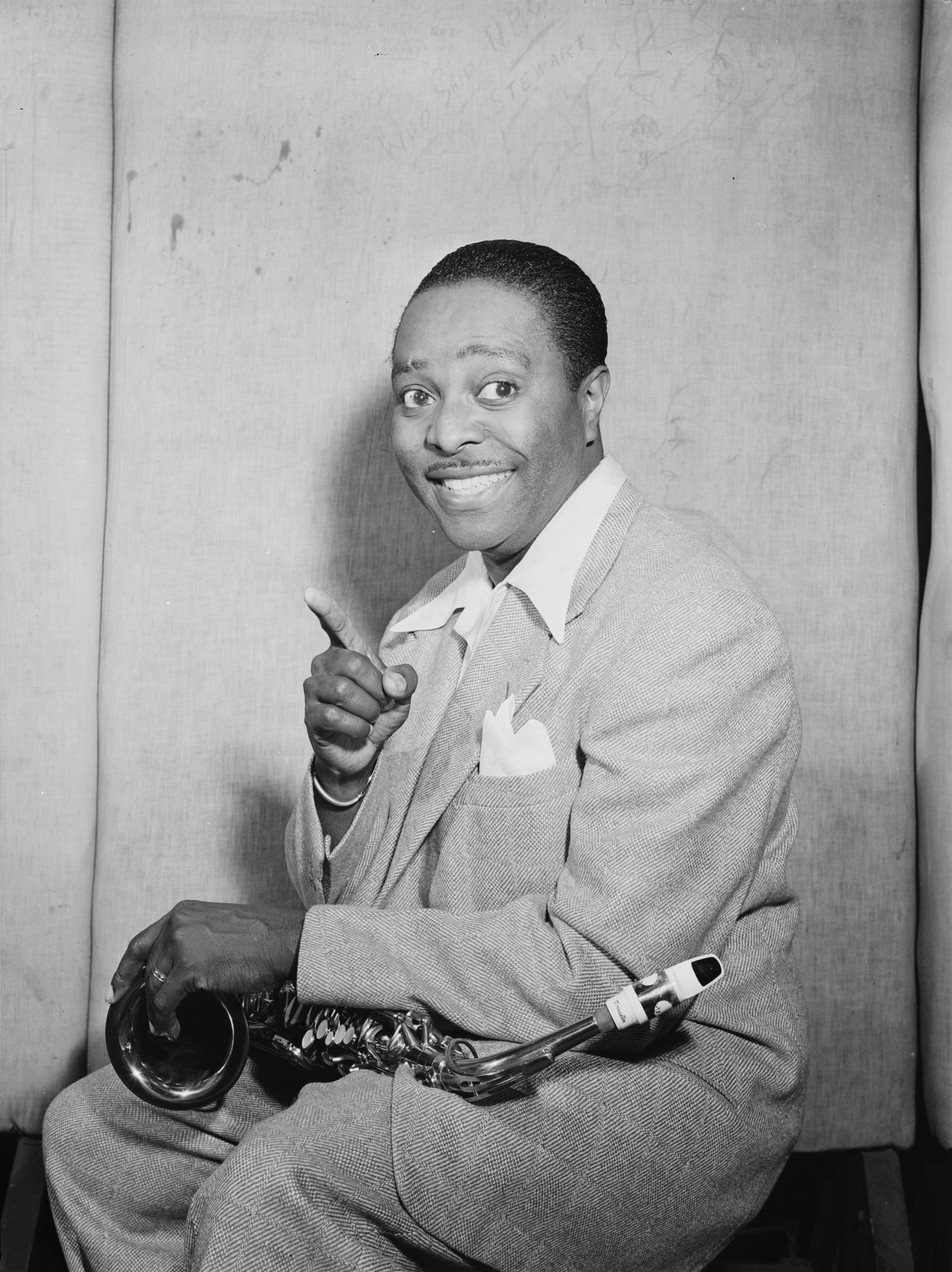
Public domain. Photo: William P. Gottlieb, Library of Congress Music Division (gottlieb.04721).
Hogan isn't a household name. He'd played guitar and bass in St. Louis-area orchestras before joining Jordan, at first as a fill-in bassist, and he recorded with the Tympany Five until 1949. He died in St. Louis in 1977. But that 1946 intro is the seed of everything in this story.
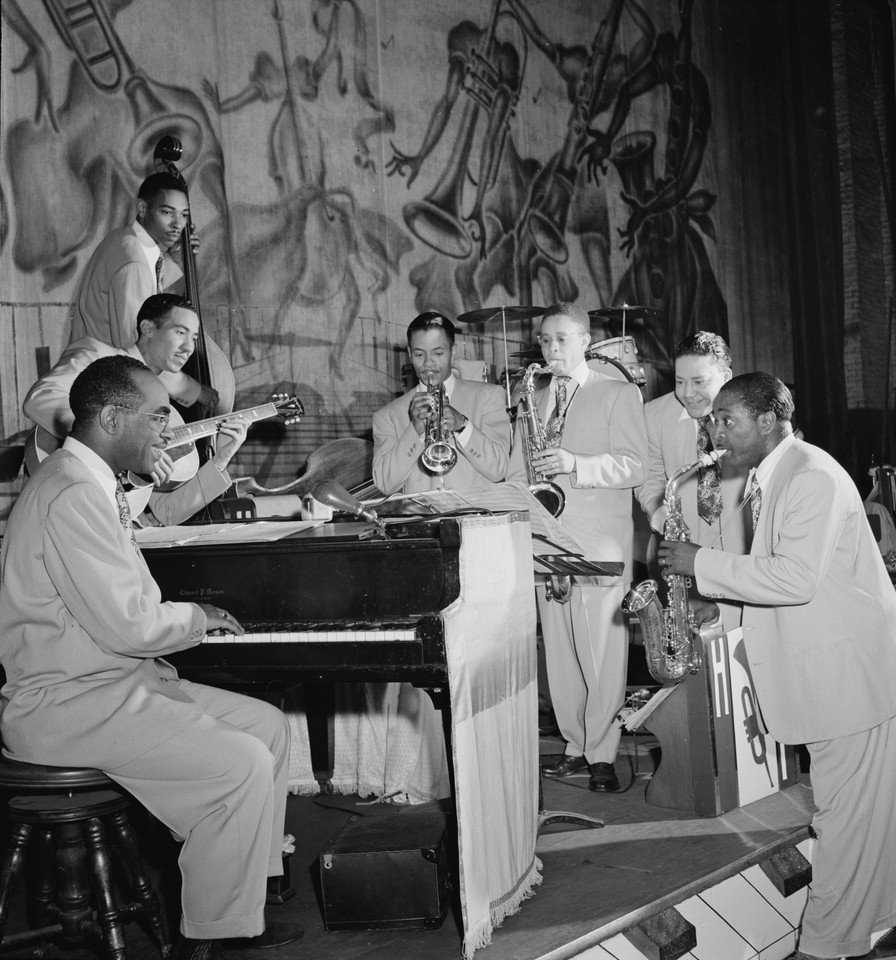
Public domain. Photo: William P. Gottlieb, Library of Congress Music Division (gottlieb.04751).
Berry never hid it. In Taylor Hackford's 1987 documentary Chuck Berry: Hail! Hail! Rock 'n' Roll, he scat-sang the lick and then explained it:
"They say 'That's a Chuck Berry song' ... Well, the first time I heard that was in one of Carl Hogan's riffs in Louis Jordan's band. We have T-Bone Walker, I love T-Bone Walker's slurs and his blues; so put a little Carl Hogan, a little T-Bone Walker and a little Charlie Christian ... together: look what a span of people that you will please. And that's what I did in 'Johnny B. Goode,' 'Roll Over Beethoven.' ... If you can call it my music, but there's nothing new under the sun."
(Transcriptions of that clip vary slightly, word for word. That's the version in the film's published dialogue.)
What Berry Actually Changed
If he borrowed the notes, what made it his? The Library of Congress, in its National Recording Registry essay on "Roll Over Beethoven," puts it plainly: Berry's twist on Hogan's riff "was to play it on two strings rather than one and add in slurs," techniques he picked up from T-Bone Walker and from Walker disciple Goree Carter, whose 1949 record "Rock Awhile" the essay also names as a direct influence on "Roll Over Beethoven," on Berry's double-string technique, and on his overdriven tone.
That's the whole trick, and it's a big one. Hogan's line is a horn-style phrase played on guitar. Berry's version is a guitar phrase that could only come from a guitar: two notes struck at once, bent and slid so they ring and rub together, played loud enough to bark. It turns a polite jump-blues fill into something that sounds like an engine starting.
He'd already tested the idea. "Roll Over Beethoven" (1956) opens with a close cousin of the same lick. "Johnny B. Goode" is where he perfected it.
T-Bone Walker and Charlie Christian
The other two names Berry dropped matter too. T-Bone Walker was the template for the electric blues guitarist as a front man: horn-like single-note lines, slurred bends, and showmanship, including playing behind his head. Berry borrowed both riffs and stage moves from him. Charlie Christian, the jazz guitarist who made the amplified guitar a solo voice in Benny Goodman's groups around 1939 to 1941, showed that an electric guitar could carry the melody instead of chugging in the rhythm section. (Berry's line in the film calls Christian "the guitarist in Tommy Dorsey's band." Christian is famous for his work with Benny Goodman, not Dorsey, so that's one for the slip-of-the-tongue file.)
Put those three together and you get Berry's formula: Hogan's phrase, Walker's slurs and swagger, Christian's idea that the guitar gets to lead.
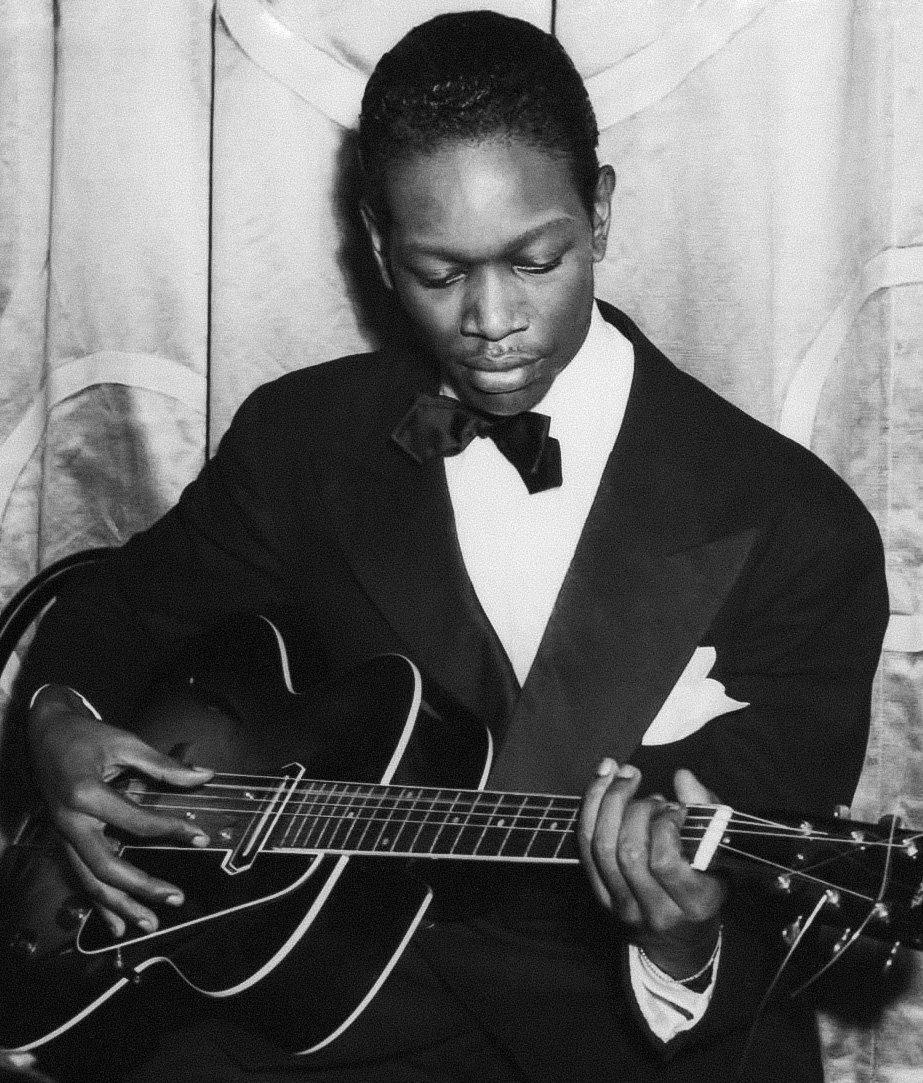
Public domain (per Commons; published in DownBeat, Dec. 1, 1939). Photo: Charles B. Nadell.
The Boy From Goode Avenue
The song is about a country boy from down near New Orleans who can't read or write well but plays guitar "just like ringing a bell," and who might one day see his name in lights. It's one of the first rock songs about becoming a rock star, written before that was really a career anyone had.
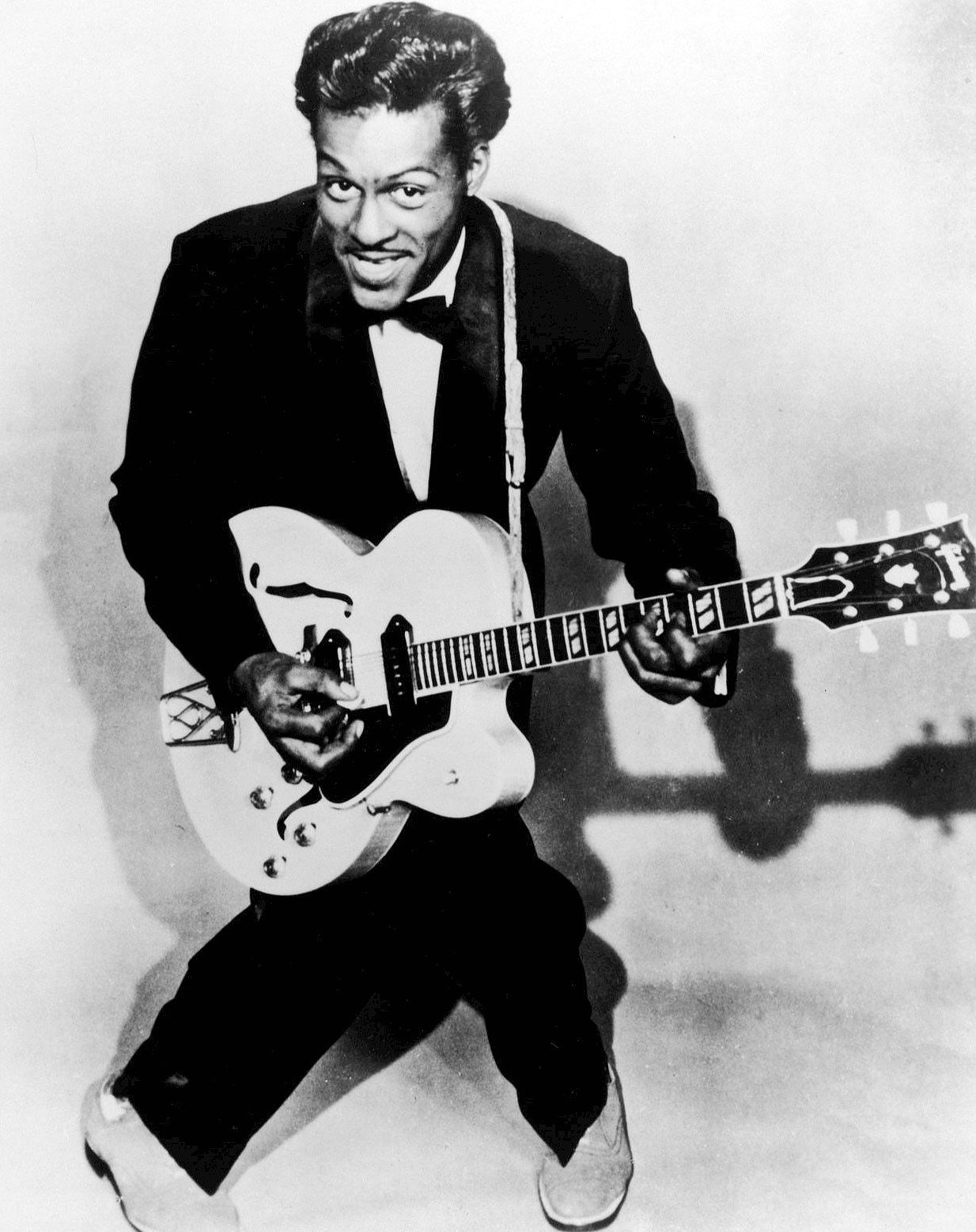
Public domain (per Commons file page). Universal Attractions publicity photo.
Berry said the song was partly autobiographical. The title gives it away: he was born at 2520 Goode Avenue in St. Louis. He also said the original lyric called Johnny a "colored boy," and that he changed it to "country boy" so radio would play it. That one-word change tells you a lot about what a Black artist had to think about to get on the air in the 1950s.
There's a second person inside the song, too. Berry's longtime pianist, Johnnie Johnson, was part of the original inspiration. The song was reportedly a nod to how Johnson acted when he'd been drinking. Over time, the song became mostly about Berry himself. Berry wrote it in 1955, the year "Maybellene" made him a star, and didn't cut it until nearly three years later.
January 6, 1958: One Day at Chess
The Room and the Band
Berry recorded "Johnny B. Goode" on January 6, 1958, at Chess Records in Chicago, with Leonard and Phil Chess producing. The Chuck Berry collectors' database lists the session at the Chess studio at 2120 South Michigan Avenue, the building where Muddy Waters, Howlin' Wolf, and later the Rolling Stones also cut records. (The UCSB Discography of American Historical Recordings, working from Michel Ruppli's Chess discography, logs the master as February 1958. Most references, including the Chuck Berry Database, go with January 6.)
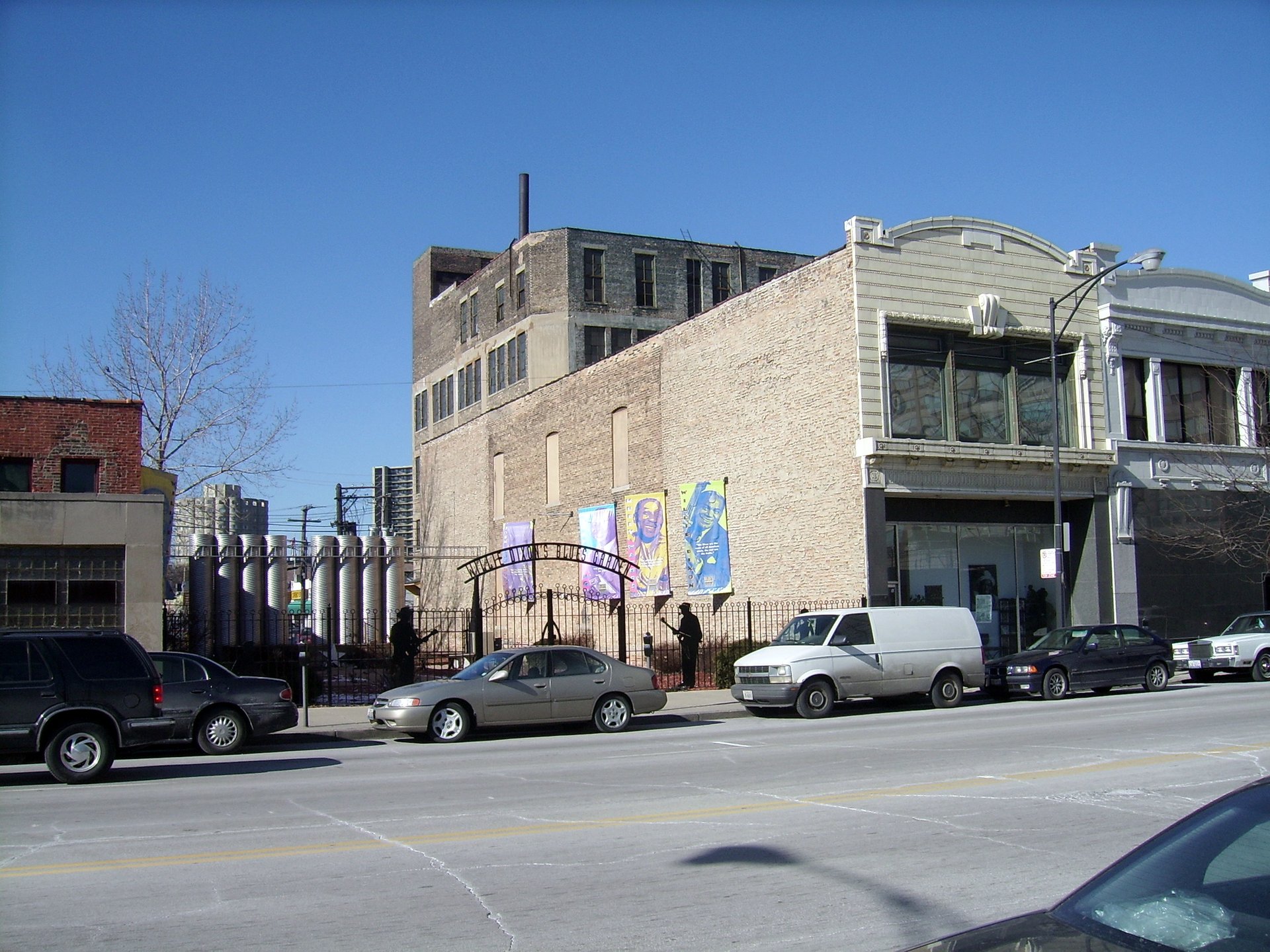
The band:
- Chuck Berry, guitar and vocals
- Lafayette Leake, piano
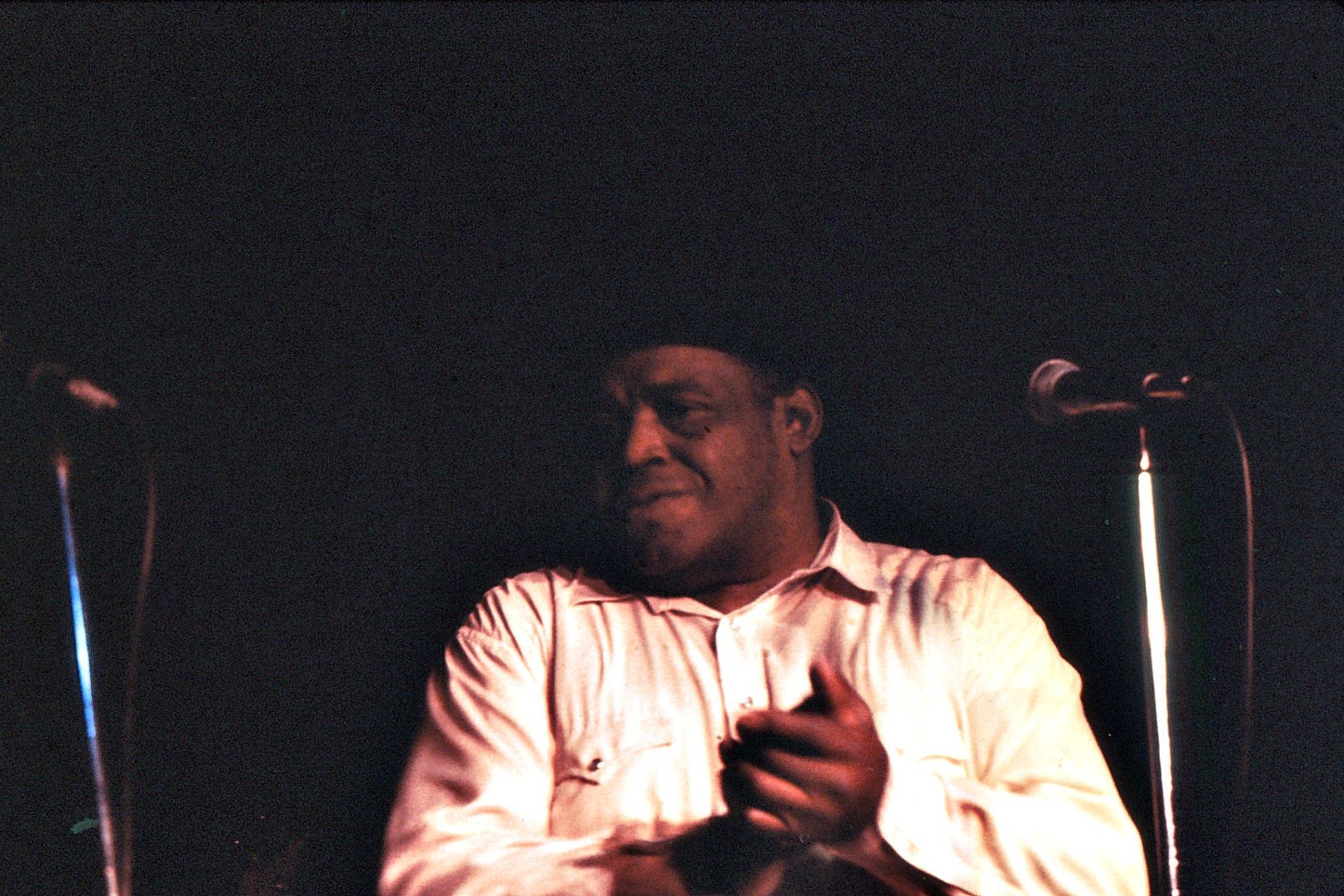
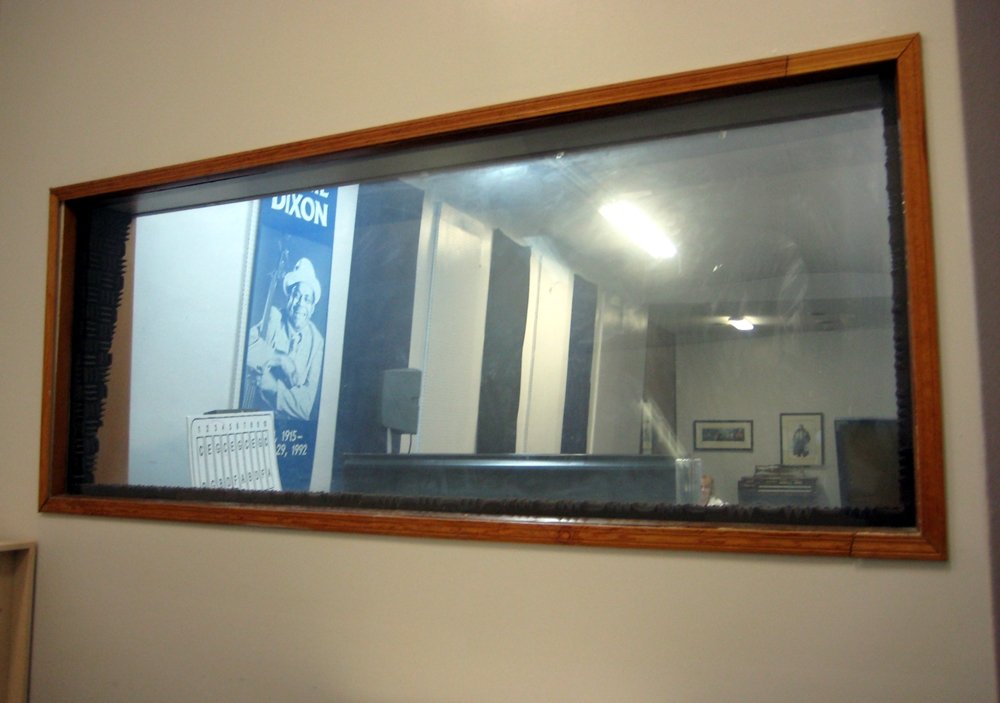
- Willie Dixon, upright bass
- Fred Below, drums
Here's a detail that trips up a lot of retellings: Johnnie Johnson, the pianist the song was partly about, isn't on it. Leake, a Chess session regular, played the piano on this one, and on "Rock and Roll Music." Dixon was the Chess house bassist, producer, and songwriter behind half the Chicago blues canon. Below was the drummer who'd anchored Little Walter's band. In other words, Berry walked into that room backed by some of the best blues players in Chicago.
Straight Guitar, Swinging Band
Listen closely to the record and you'll hear the thing that makes it work. Below and Leake are swinging, with that loping, shuffled feel of Chicago blues and jump bands. Berry's guitar isn't. His eighth notes are mostly straight, even, and driving.
That collision is a big part of why "Johnny B. Goode" sounds like the hinge between two eras. The rhythm section is looking back at 1940s R&B. The guitar is looking ahead to the straight-eighth rock that would take over in the 1960s. Play the intro with a heavy swing and it sounds like a blues lick. Play it straight over a shuffle, the way Berry did, and it sounds like rock and roll.
Release and Chart Run
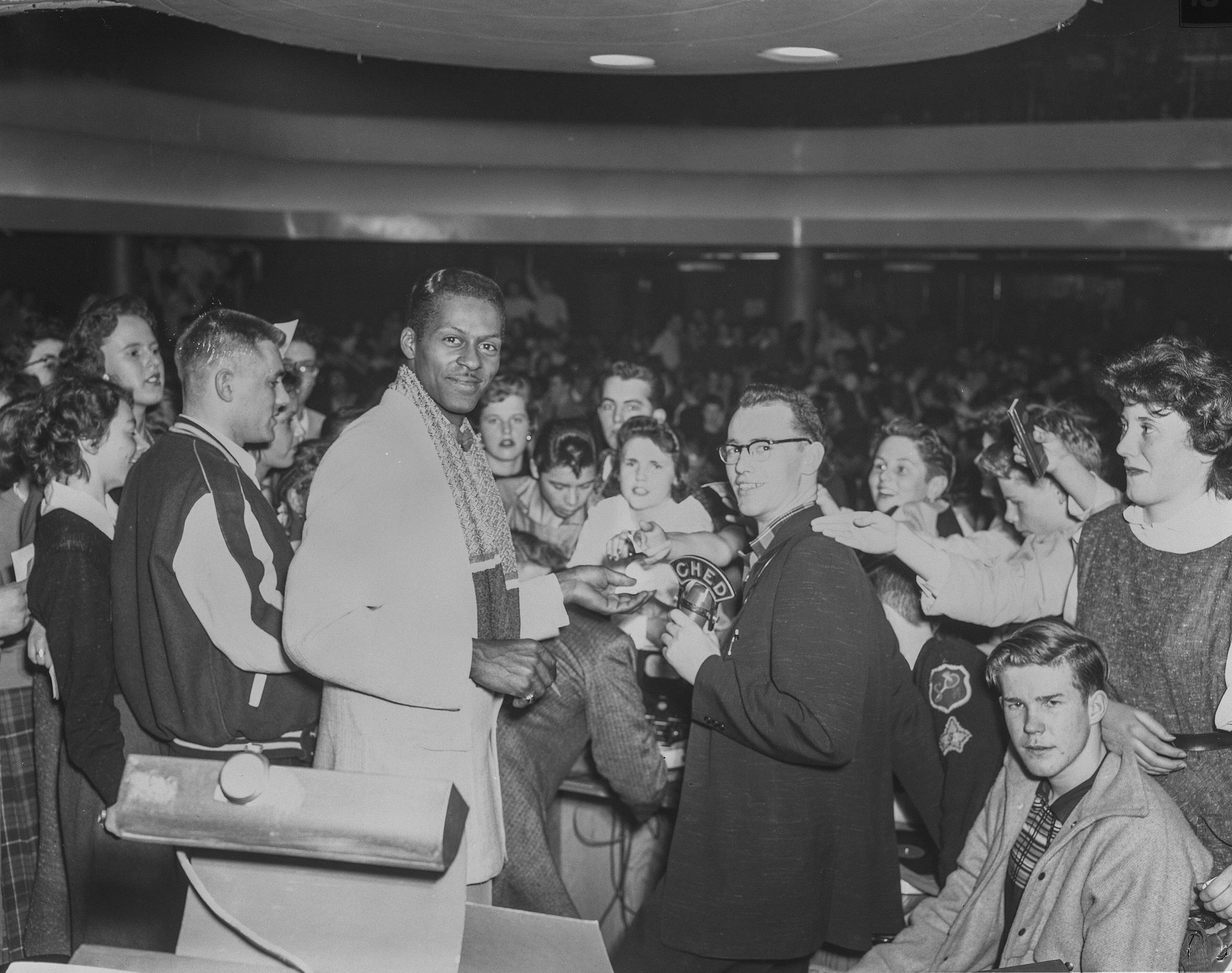
Chess released it on March 31, 1958, as Chess 1691, backed with "Around and Around." It reached No. 2 on Billboard's R&B chart and No. 8 on Billboard's main pop chart, the one that turned into the Hot 100 a few months later. It wasn't even Berry's biggest hit. His only No. 1 pop single came years later with the novelty song "My Ding-a-Ling" in 1972. But no record he made has outlived this one.
No known copyright restrictions. Provincial Archives of Alberta (RP166/6) via Wikimedia Commons.
Inside the Riff: What Your Hands Are Doing
Key, Shape, and the Famous Double Stop
The original is in B-flat, which surprises a lot of players who learned it in A or another "guitar key." Guitar teachers who transcribe it closely agree on the anatomy:
- The pickup: a quick run in B-flat major pentatonic leading into the first big chord-like hit.
- The double stop: two notes on the top two strings, a fourth apart (F on the B string and B-flat on the high E, both at the 6th fret), hit over and over for a full bar. Many players slide into it from a fret below.
- The descent: a line that mixes the major and minor pentatonic sounds. The money move is a hammer-on on the G string from the 6th fret to the 7th, which takes the minor third (D-flat) up to the major third (D). That half-step "smile" is pure Chuck Berry.
- More double stops lower on the neck, including the same F and B-flat pair moved to the A and D strings, before the band kicks in.
Plenty of guitar teachers have mapped this note for note, so we won't print a full tab here. But if you want the short version of why it sounds the way it does, it's this: the double stops make one guitar sound like two horns, and the minor-to-major third rub gives it the blues without the gloom.
The Piano-Keys Question
Keith Richards, who idolized Berry and organized the 1986 Hail! Hail! concerts, has pointed out that a lot of Berry's songs sit in keys like B-flat and E-flat, which are friendlier to a piano than a guitar. His theory was that Berry built so much of his music alongside Johnnie Johnson's piano that the songs grew up in piano keys.
That idea fed into a real dispute. In November 2000, Johnson sued Berry, arguing he deserved co-writing credit and royalties on dozens of songs, including "Roll Over Beethoven" and "Sweet Little Sixteen." The case was dismissed because too much time had passed since the songs were written. It never settled who wrote what, and the people who were in the room have told it differently. What's not in dispute is that Johnson's playing shaped Berry's early sound, and that "Johnny B. Goode" itself was recorded without him.
How to Play It Like Berry, Not Just Like the Tab
A few practical notes for anyone working it up:
- Play it in B-flat at least once. You'll feel why the shapes sit where they do, and you'll stop fighting the original record when you play along.
- Keep your eighths straight. The band swings; you don't. That's the whole tension.
- Let the double stops ring and rub. Berry's notes aren't clean and separate. Barring the top two strings with one finger and hitting them hard is the sound.
- Push the amp, not a pedal. The LOC essay credits Berry's overdriven tone to the Goree Carter influence, and on the records it sounds like a hollow-body pushed hard rather than a distortion box. A clean amp turned up to the edge of breakup gets you closer than any fuzz.
- Go easy on vibrato. Berry's attack is in the pick hand. The phrasing is rhythmic and percussive, not singing.
The Gear: What We Know and What We Don't
Berry is tied to one guitar more than any other in the 1950s: the Gibson ES-350T. Gibson introduced it in 1955 as one of its first thinline hollow-bodies, a slimmer version of the ES-350 jazz box, with a laminated maple body. It was built for jazz and dance-band players. Berry made it the first rock and roll guitar.
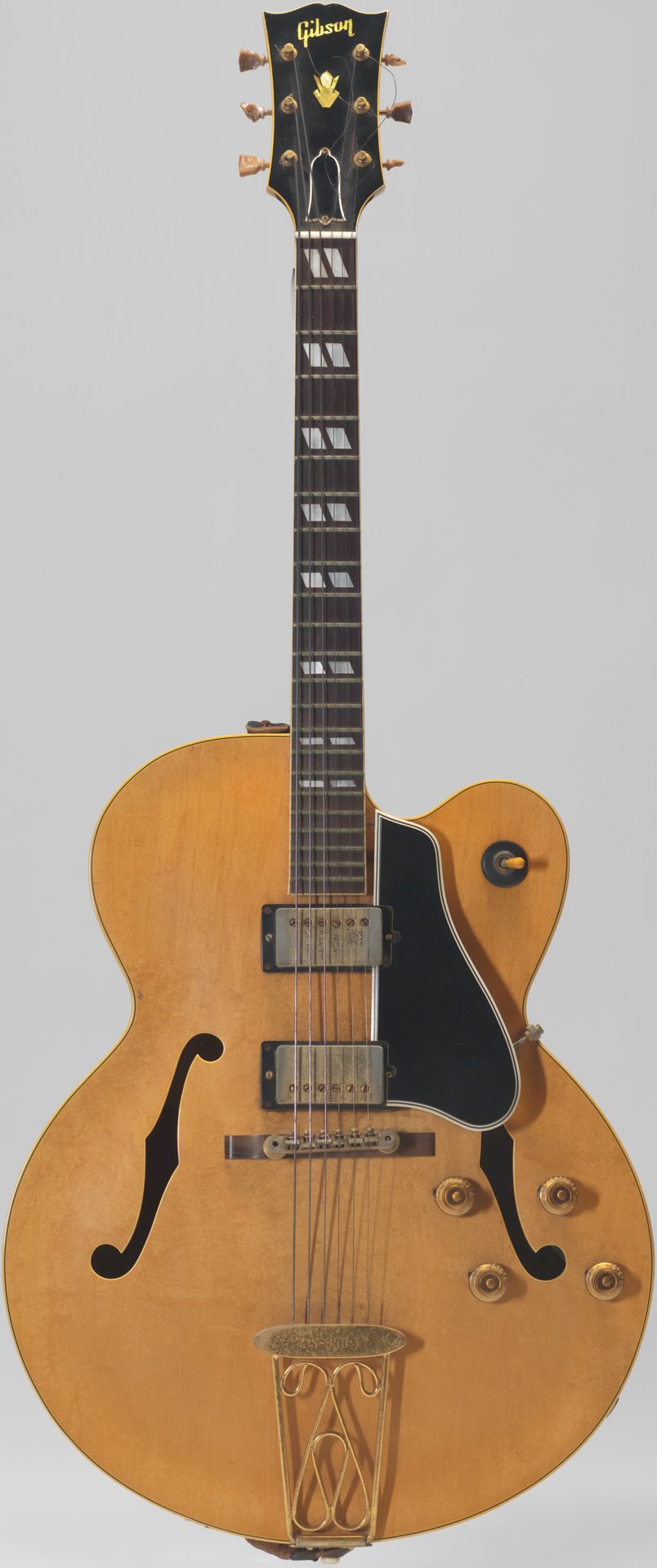
Two of his ES-350Ts are documented in public collections. One, nicknamed "Maybellene," is in the Smithsonian, which released a photo of it into the public domain. Another, a circa-1958 ES-350T with serial number A29125, lent by Joe Edwards of St. Louis, greeted visitors at the entrance to the Metropolitan Museum of Art's 2019 exhibit Play It Loud: Instruments of Rock & Roll.

What we couldn't confirm is which guitar, or which amp, Berry played on January 6, 1958. Some lessons and tone guides state it as fact. None of the primary sources we found do. So we'll just say this: the ES-350T is the guitar most associated with Berry's Chess years, and when Eric Clapton played the Hail! Hail! shows in 1986, he chose an ES-350T, the same model Berry used on his early recordings. Berry himself played a Gibson ES-355 that night, the luxury version of the ES-335, which he'd favored on his 1970s tours.
Where the Riff Went Next
Into Movies and Everyone's Setlist
Berry played it himself on screen in the 1959 film Go, Johnny, Go!, and wrote a sequel, "Bye Bye Johnny," in 1960. Then the covers came, from just about every genre:
- Buck Owens took it to No. 1 on Billboard's country chart in 1969.
- Jimi Hendrix had a posthumous UK hit with a live version from Hendrix in the West (1972).
- The Grateful Dead reportedly played it at least 287 times.
- The Sex Pistols, Elton John, Peter Tosh, and Judas Priest all recorded it, which is about as wide a spread as one song can get.
The point isn't that the song is easy to cover. It's that the intro is a password. Play those first two seconds in any bar, in any country, and the room knows exactly what's happening.
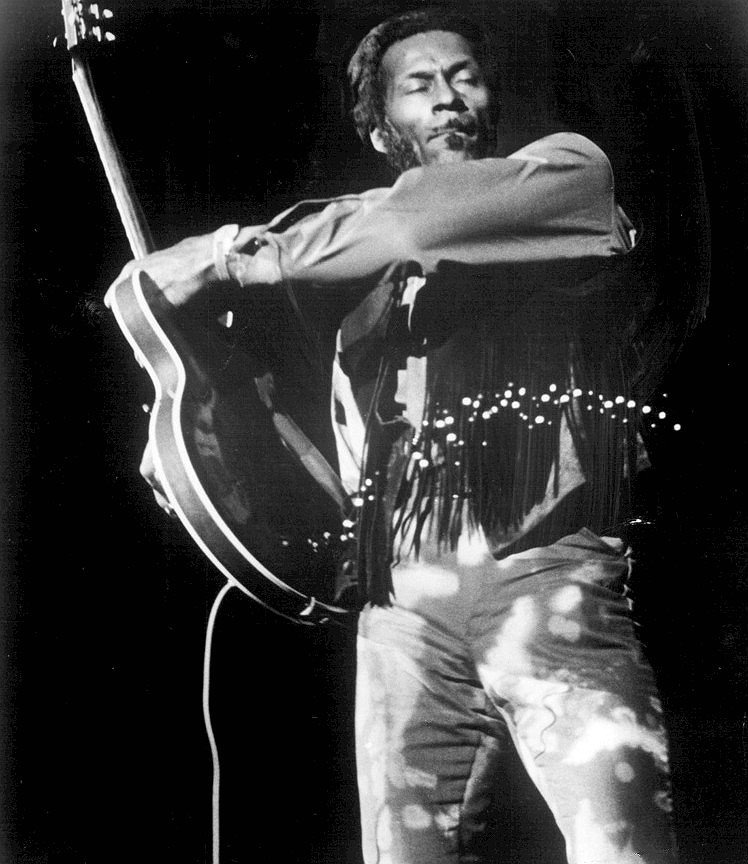
Public domain (per Commons file page). Tour promotional photo.
Back to the Future's Joke Within a Joke
In 1985, Back to the Future gave the riff a second life with a whole new generation. Marty McFly takes the stage at a 1955 high school dance with a cherry-red Gibson ES-345 and plays "Johnny B. Goode." Then the bandleader, Marvin Berry, calls his cousin Chuck and holds the phone up to the stage so he can hear "that new sound you're looking for." The song inspires its own creation. It's a great gag.
Guitar nerds have had fun with it for decades. The ES-345 didn't come out until 1958, so Marty's guitar was from the future too. Michael J. Fox learned to play the part on camera, but the vocals were sung by Mark Campbell and the guitar was recorded by session player Tim May. In a 2023 interview reported by Guitar World, May said he cut it on a Valley Arts S-style guitar with a Floyd Rose, not a Gibson at all, because the brief was to run from "Chuck Berry '50s-style to the current," meaning the Van Halen-style tapping and dive-bombing at the end. Fox said he worked in a Pete Townshend windmill, a Hendrix behind-the-back move, and a Chuck Berry duckwalk.
Off the Planet
In 1977, NASA launched Voyager 1 and Voyager 2, each carrying a gold-plated copper record of Earth's sounds and music for anyone, or anything, that might find it. "Johnny B. Goode" is on it, and it's the only rock and roll song there.
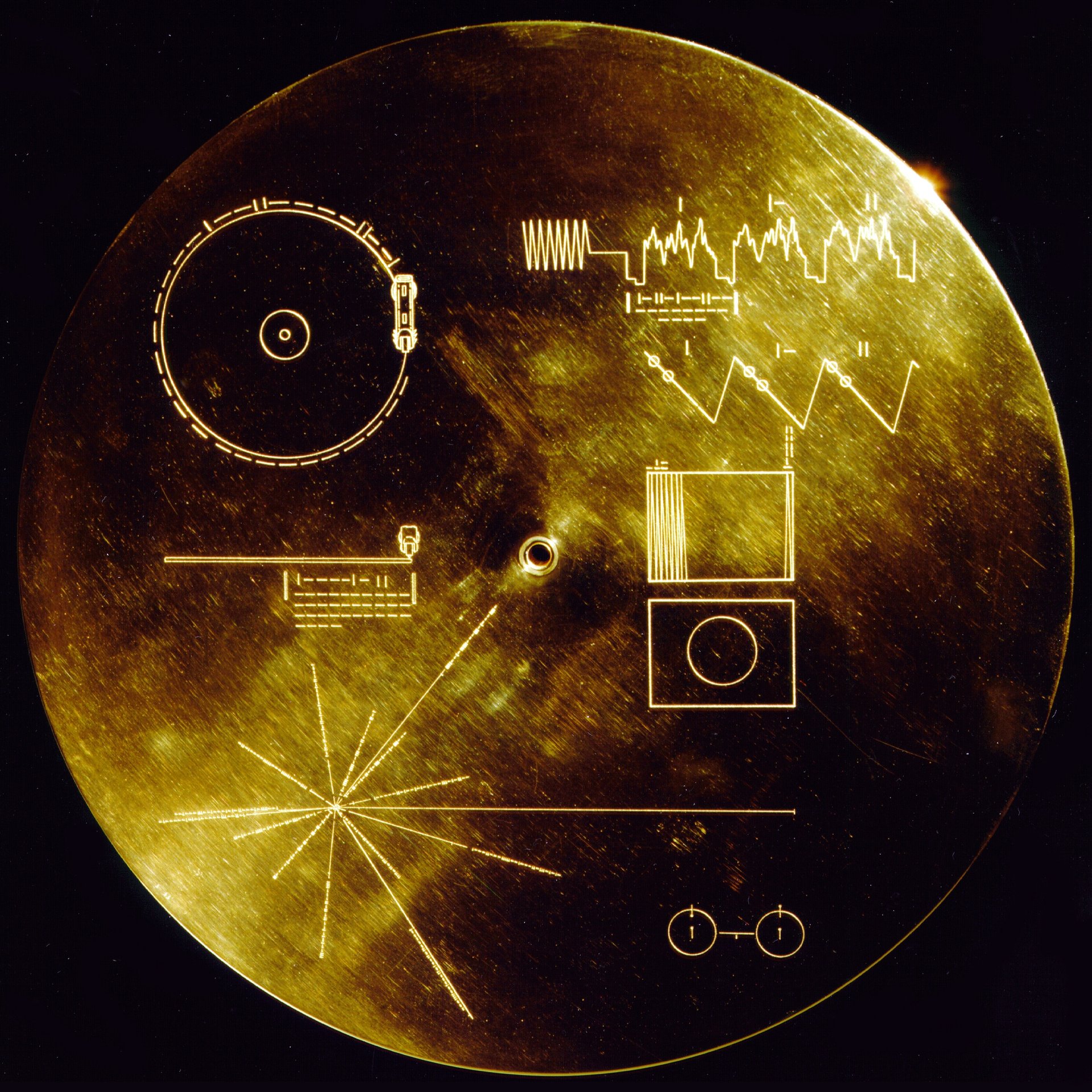
It almost wasn't. According to the record's producer, Timothy Ferris, quoted in Smithsonian, Carl Sagan had to warm up to the idea first. Then he defended it against the folklorist Alan Lomax, who argued rock was adolescent. Ferris recalled Sagan's reply: "There are a lot of adolescents on the planet."
On April 22, 1978, Saturday Night Live gave the story its best punchline. In a "Next Week in Review" sketch, Steve Martin played a psychic named Cocuwa who predicted that Time magazine would reveal the first message from an alien civilization. He held up the mock cover. It read: "Send More Chuck Berry."
The Honors
The song keeps collecting them. When the Rock and Roll Hall of Fame held its first induction ceremony on January 23, 1986, Berry was in the first class and played "Johnny B. Goode" backed by Bruce Springsteen and the E Street Band. The Grammy Hall of Fame inducted the record in 1999. Rolling Stone ranked it No. 1 on its 2008 list of the 100 Greatest Guitar Songs of All Time. In 2020, the International Astronomical Union named a crater on Mercury after Berry. And in June 2026, CBS News put the song on its list of 250 essential American songs from the past 250 years.
Why This Riff Still Matters
Lots of riffs are famous. This one is foundational, and the difference is that you can hear its DNA in nearly everything that came after it. Keith Richards built a career on it. The Beatles and the Beach Boys reworked Berry's music in their early years. Ted Nugent put it bluntly: "If you don't know every Chuck Berry lick, you can't play rock guitar." Joe Perry, writing in tribute, said kids were still playing "the same three chords, trying to play in that same style," and that if you turned the guitars up, you got punk rock.
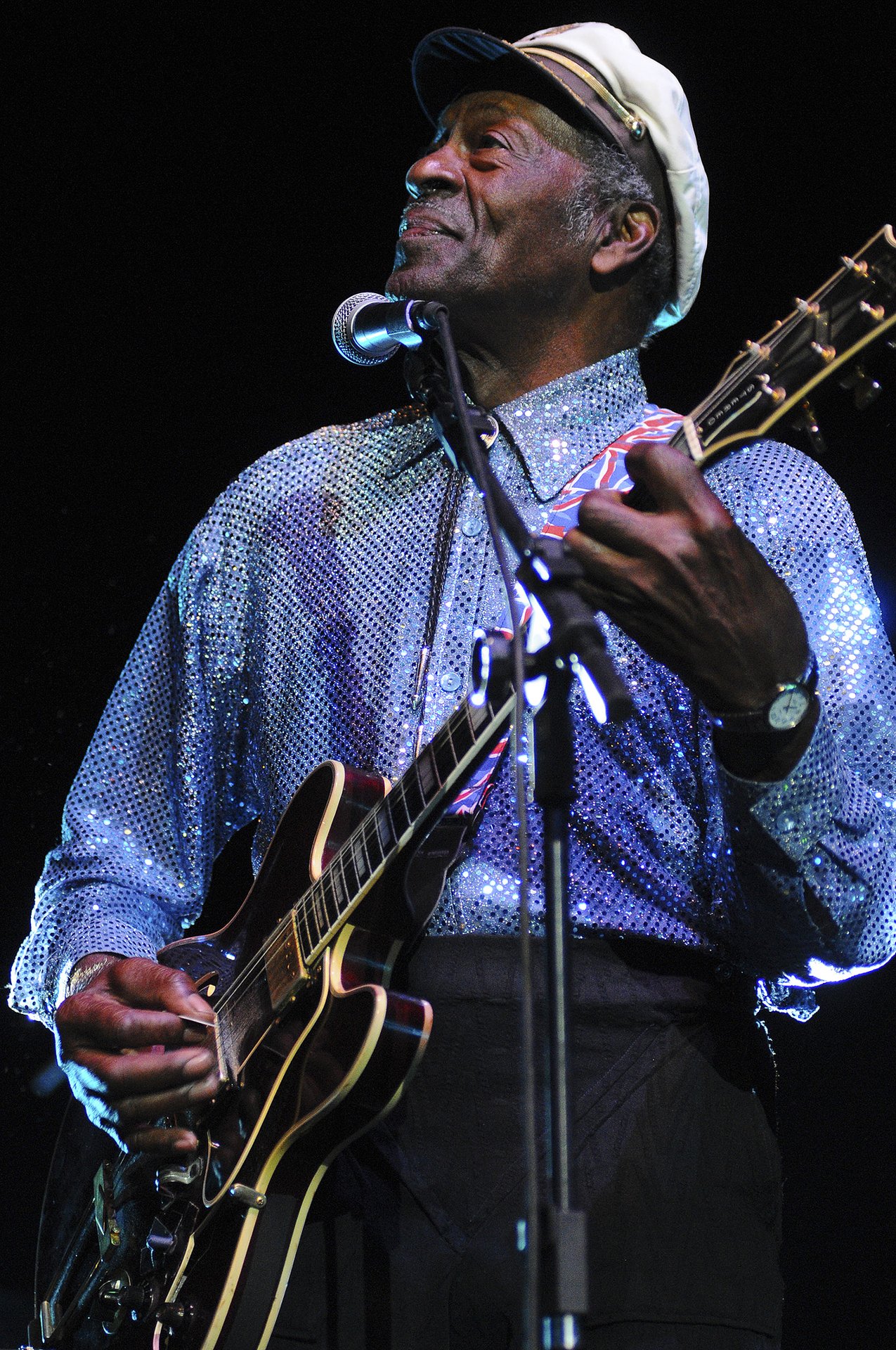
The riff also carries an honest lesson about where music comes from. Berry took a 1946 lick from a sideman most people never heard of, mixed it with T-Bone Walker's slurs and Charlie Christian's ambition, played it on two strings instead of one, and then told everyone exactly where he got it. "Ain't nothing new under the sun" isn't false modesty. It's a description of how the guitar has always worked: you learn what came before, then you change one thing so much that it becomes yours.
Berry's own life is part of the story too, and not all of it is pretty. He was sent to a reformatory as a teenager for armed robbery. He served about a year and a half in federal prison in the early 1960s after a Mann Act conviction involving a 14-year-old girl, and 120 days in 1979 for tax evasion. He also had a reputation as a difficult, contract-first performer. None of that changes what the music did. But a centennial is a good time to remember that the man who wrote rock's first great origin story was a complicated person, not a statue.
The Takeaway
If you play guitar and you've never sat down with the original "Johnny B. Goode" in B-flat, do it this weekend for Berry's 100th birthday. Learn the double stop and the hammer-on, keep your eighths straight while the record swings, and push your amp until it barks. Then go put on Louis Jordan's "Ain't That Just Like a Woman" and listen to Carl Hogan play the first draft. You'll hear 12 years of music history in two intros, and you'll understand why that one little lick is now flying somewhere past the edge of the solar system.
**What was the first riff you ever learned, and was it this one? Tell us in Guitar Talk, and check out our Top 25 Guitar Riffs of All Time.**
Keep Reading
- Time Machine: Chess Records Cuts Chuck Berry's "Johnny B. Goode" (1958), the same session written up as a 1958 news report
- History of the Riff: The Kinks, "You Really Got Me"
- History of the Riff: Link Wray, "Rumble"
- 20 Easy Guitar Riffs That Sound Hard
Sources
- Chuck Berry: Hail! Hail! Rock 'n' Roll (dir. Taylor Hackford, 1987), Berry's Carl Hogan / T-Bone Walker / Charlie Christian remarks (published dialogue via IMDb quotes; same quote verified by the Chuck Berry Collectors Blog, crlf.de).
- Library of Congress, National Recording Registry essay, "Roll Over Beethoven" — Chuck Berry (1956): https://www.loc.gov/static/programs/national-recording-preservation-board/documents/RollOverBeethoven.pdf
- Chuck Berry Database, session of Jan. 6, 1958: https://www.crlf.de/ChuckBerry/cbdb/session/11-1958-01-06%2000:00:00.html
- UCSB Discography of American Historical Recordings, Chess matrix 8633: http://adp.library.ucsb.edu/index.php/matrix/refer/2000475029
- Wikipedia: "Johnny B. Goode," "Chuck Berry," "Carl Hogan," "Lafayette Leake," "Johnnie Johnson (musician)," "Gibson ES-350T," "Hail! Hail! Rock 'n' Roll"
- Smithsonian, "What Is on Voyager's Golden Record?" (Ferris/Sagan/Lomax; SNL sketch): https://www.smithsonianmag.com/science-nature/what-is-on-voyagers-golden-record-73063839/
- NASA Science, "The Voyagers in Popular Culture": https://science.nasa.gov/missions/the-voyagers-in-popular-culture/
- Guitar World (Oct. 6, 2023), Tim May on the Back to the Future recording: https://www.guitarworld.com/news/back-to-the-future-johnny-b-goode-recorded-on-strat-copy
- Rolling Stone, Back to the Future "Johnny B. Goode" scene (Tim May / Mark Campbell): https://www.rollingstone.com/tv-movies/tv-movie-news/back-to-the-future-michael-j-fox-johnny-b-goode-860576/
- Riff anatomy cross-checked against Macri School of Music ("Double Stops for Guitar Pt. 2") and Marty Schwartz's Johnny B. Goode lesson.
Experience-driven coverage, not algorithm bait.
- 20+ years of guitar playing experience
- Real-world retail experience at Guitar Center
- Thousands of hours testing guitars, amps, and pedals
- A community of 50,000+ guitar enthusiasts across platforms
- Partnerships with Fender, DistroKid, TrueFire, Card Chords, and Enya
- Editorial standards published openly — see how we test gear
The Modern Guitar Magazine. Delivered to your inbox.
No spam. No gimmicks. Just great guitar content — stories, tones, iconic solos, and honest gear takes. Every week.
Ask GP
3 free questions a dayStill curious? Ask GP about this story.
Your personal classic-rock and guitar guide — ask anything about Chuck Berry's "Johnny B. Goode,".
Discussion (0)
Sign in to join the discussion.
Sign in to commentLoading comments…
Discover another guitar story
Swipe through our latest features, breaking news and iconic solos — one story at a time.
Open Swipe →More in Guitar Talk
History of the Riff: Black Sabbath's "Iron Man" — A Lumbering Monster, a Factory Accident, and Doom's Walking Template
After Smoke on the Water turned four notes into guitar-shop folklore, Tony Iommi's Iron Man riff showed how a slow, blues-stained figure — born in a rehearsal room over Bill Ward's boom — could invent metal's sense of weight, space, and riff-as-character.
Remembering Eddie Van Halen: Six Years On, the Guitar Still Speaks His Language
Six years on, guitar shops still sound a little like Eddie Van Halen. This Guitar Talk feature is for players — what he left us that we still use every time we plug in.
Robin Trower: The Man Who Turned the Strat Into Weather
He played on the albums that came after a hit everyone knows. Then he left, made one record that rewired how a generation heard the Stratocaster, and spent the next fifty years refining it. A look at Robin Trower's career, his rig and why he still matters at 81.