
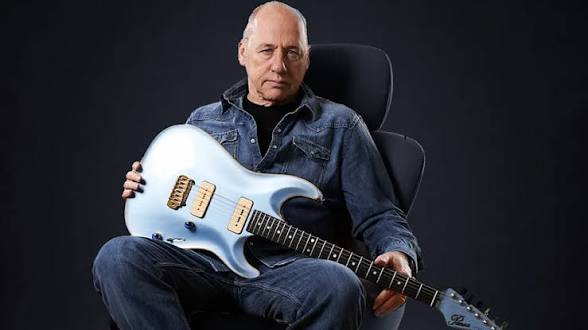
Mark Knopfler at 77: Why Playing the Right Notes Still Won't Make You Sound Like Him
Mark Knopfler turns 77 today, and his playing remains one of the hardest things in rock to imitate. Not because the notes are difficult — because almost none of what makes it sound like him is written down.
Mark Knopfler was born in Glasgow on 12 August 1949, which makes today his 77th birthday. That is the timely part, and it is the least interesting part. The interesting part is a problem that has frustrated guitarists for nearly fifty years: you can learn every note of a Knopfler part correctly, play it cleanly, at tempo, on the right guitar, through the right amp — and still sound almost nothing like him.
This is not a mystique argument. It is a mechanical one. Almost everything that identifies Knopfler as Knopfler happens in the space between the string and the pickup, and none of it appears in notation.
The picking hand is the real starting point
The usual shorthand is that Knopfler doesn't use a pick. That is true of most of his best-known electric work, and it is also close to useless as advice. Plenty of players have put the pick down and sounded no more like him than they did before.
What actually matters is what the right hand is doing once the pick is gone. Knopfler's approach is a fingerstyle technique adapted to electric guitar rather than borrowed wholesale from classical or folk playing. The thumb handles bass notes and drives the low strings; the index and middle fingers carry the melodic material, often alternating in a way that gives consecutive notes slightly different weight and colour. On many phrases the ring finger joins in for chord fragments and double-stops.
That distribution of labour is the first hidden variable. A pick produces a single, consistent attack: the same plastic edge, the same angle, the same transient on every note. Fingers do not. The flesh of the thumb sounds different from the tip of the index finger, and the index sounds different from the middle. When a line is spread across those fingers, every note arrives with a slightly different envelope. Played with a pick, the same line is uniform. That uniformity is the tell.
The second variable is attack depth. Knopfler's playing is full of notes plucked hard enough to pull the string away from the fretboard and let it snap back — a percussive, almost slapped articulation that a pick cannot easily reproduce — sitting next to notes so soft they barely register as more than a breath. The same phrase can contain both. That range is not an effect. It is the instrument.
The third is what he doesn't let ring. Fingers are also mutes. A right hand already resting on the strings can stop a note the instant it has served its purpose, and Knopfler's parts are full of short, clipped notes surrounded by silence rather than sustained ones bleeding into each other. Much of the rhythmic snap in his playing comes from notes ending on time, not starting on time.
Play a simple three-note phrase and deliberately assign each note to a different finger — thumb, index, middle. Play it again with a pick. The notes are identical. The two versions do not sound like the same guitarist. That gap is the subject of this entire article.
Dynamics matter as much as notes
Ask most guitarists to play a phrase louder and they reach for a volume control. Knopfler's playing is a long argument for doing it with your hand instead.
Listen to how much the level moves inside a single Dire Straits phrase without any change at the amp. The opening of a line is often deliberately understated so the note in the middle of the bar can land. Accents fall on specific notes rather than on the strong beats a metronome would suggest, which is a large part of why his lines feel spoken rather than counted.
This is also why his clean tones survive so much compression. A compressor squashes the difference between loud and quiet notes; if your playing has no dynamic range to begin with, compression flattens it into something lifeless. Knopfler puts so much variation into the attack that even a heavily compressed signal retains shape. Players who copy the pedalboard and not the hand get the polish without the movement, and wonder why it sounds sterile.
Silence is part of the same system. There is a great deal of nothing in his playing — gaps between phrases that most guitarists would fill instinctively. Those gaps do two things: they make the next entry sound louder without it being louder, and they give the band's rhythm section room to be heard, which is why Dire Straits records sound spacious even when a lot is going on.
Phrasing: blues vocabulary, country manners
Knopfler's melodic language sits at a junction that was unusual for a British rock guitarist in 1977. The blues is obviously there in the bends and the note choices. But the mechanics — the slides into chord tones, the rolling double-stops, the way lines resolve onto notes that spell out the underlying chord rather than the scale — belong at least as much to country and rockabilly playing.
A few habits recur across his catalogue:
Chord-tone targeting. Lines tend to arrive somewhere specific. Rather than running a scale over a progression, phrases land on notes that define the chord underneath them, which is why his solos sound like they were written even when they were not.
Slides instead of picks. A large number of his notes are not attacked at all; they are slid into from below or above, so the note appears without a transient. Combined with fingerstyle attack, this is a major reason his playing sounds vocal.
Want Mark Knopfler’s Tone?
Tell ToneMD what gear you own and get a full signal chain with real numbered settings for this tone.
Included with Premium
Restrained vibrato. His vibrato is generally narrow and applied late in a note rather than immediately. Wide, immediate vibrato is a blues-rock signature; late, controlled vibrato reads as country and as singing.
Double-stops. Two-note fragments in thirds and sixths, common in country and in 1950s rock and roll, appear constantly — and fingerstyle lets him voice each note of the pair at a different volume, which a pick cannot do.
Repetition with variation. He will repeat a figure two or three times and change one thing: the accent, the ending, the dynamic. The repetition builds expectation; the small change pays it off.
Note economy. There are fast passages in his playing, but they are bursts inside phrases rather than continuous streams. The fast parts sound fast because the surrounding parts are not.
We've broken down the melodic architecture of this kind of playing more generally in The Anatomy of a Perfect Guitar Solo, and specifically in our Sultans of Swing solo masterclass.
Where to hear it
A handful of recordings demonstrate the points above better than a hundred would.
“Sultans of Swing” (1978) is the clearest example of the picking hand as an instrument in its own right. The closing solo is fast, but its speed is organised into speech-like bursts, and every note carries a slightly different attack because different fingers are producing them.
“Some guitarists are defined by which notes they choose. Knopfler is defined by how those notes leave the string.”
“Romeo and Juliet” (1980) shows the other extreme: a National-style resonator in an open tuning, almost no distortion to hide behind, and phrasing so exposed that any inconsistency in the right hand would be audible. It isn't.
“Telegraph Road” (1982) is a study in long-form dynamics. The guitar spends most of fourteen minutes deliberately not peaking, which is the only reason the ending has anywhere to go.
“Money for Nothing” (1985) is the outlier everybody quotes — a dirty, honking tone built partly from a microphone placement nobody planned. Even here the attack is fingerstyle, which is why the riff blooms rather than clicks. We told that story in full in The History of the Riff: “Money for Nothing”.
“Brothers in Arms” (1985) is the dynamics lesson in its purest form: a solo built almost entirely from sustained, softly attacked notes, where the loudest thing in the phrase is often a single bend.
Gear, era by era
Knopfler has never had one rig, and treating his sound as a single recipe is the fastest way to miss it.
Late 1970s — the Strat years. The first two Dire Straits albums are Stratocaster records, most famously a red early-1960s Fender, into clean Fender amplification. The pickup selections favour the in-between and middle positions, but the defining variable is the absence of pick attack rather than the guitar.
Early 1980s — Schecter. Around the Making Movies and Love Over Gold period he moved largely to Schecter's Strat-style instruments, which offered hotter pickups and a slightly thicker voice than a vintage Fender while keeping the same basic character.
Mid 1980s — Les Paul and Pensa. The Brothers in Arms era brought a Gibson Les Paul into the picture for the heavier material, and Rudy Pensa's New York-built Strat-style guitars — the Pensa-Suhr instruments, later Pensa — became a mainstay of the big-tour rig alongside Soldano amplification for the higher-gain sounds.
Acoustic and resonator, throughout. National resonator guitars run right through his catalogue and are part of his public image; a National is on the cover of Brothers in Arms. They matter technically too, because a resonator punishes an inconsistent right hand.
Solo career. From Golden Heart in 1996 onward the palette widened considerably — more acoustic instruments, more Les Paul, more Pensa, and amplification chosen for clarity rather than gain.
If you want to translate any of these tonal targets onto the guitar, pickups, amp or modeler you actually own, our ToneMD tool will do the mapping — and our full Tone Decoded: Mark Knopfler breakdown covers the signal chain in detail.
[MEMBERS_CTA]
The bigger point
There is a category of guitarist whose identity lives in note choice — the players you recognise because of the intervals, the scales, the harmonic decisions. And there is a category whose identity lives almost entirely in articulation: what happens in the first fifteen milliseconds of a note, and in the moment it stops.
Knopfler belongs firmly in the second group, and it is a much harder group to join. Note choice can be transcribed and learned. Articulation has to be built, slowly, by a player who has decided what they want notes to sound like and then spent decades enforcing it.
That is also the encouraging part. You are never going to be Mark Knopfler, and copying him note for note will not get you closer. But the mechanism that made him unmistakable is available to anyone willing to pay attention to their picking hand.
5 things guitarists can learn from Mark Knopfler
1. Control dynamics before you add gain. Distortion compresses. If you can't make a clean phrase move between quiet and loud with your hands alone, gain will hide the problem rather than solve it. Practise one phrase at three deliberate volume levels without touching the amp.

2. Make your accents intentional. Most players accent by accident, usually on downbeats. Choose the note in each phrase that matters and make it clearly louder than its neighbours. Then move the accent somewhere unexpected and hear how differently the same notes read.
3. Use silence as part of the phrase. Record yourself playing a solo, then play the same solo again with a third of the notes removed. The second version is usually better. Learn where notes were ending, not just where they started.
4. Let the picking hand shape the tone. Before you change pickups, change where and how you attack the string — closer to the neck, closer to the bridge, with flesh, with nail, with the side of the thumb. The tonal range available from the right hand alone is wider than most pedalboards.
5. Build an articulation you can recognise. Pick one thing — a specific vibrato width, a way of sliding into notes, a habit of muting — and use it deliberately until it becomes automatic. Recognisability comes from consistency, not from novelty.
At 77, Knopfler remains one of the few electric guitarists whose sound is genuinely difficult to fake, and the reason is almost comically simple: the most important part of his playing is a physical habit, and habits can't be downloaded.
Frequently Asked Questions
- How old is Mark Knopfler in 2026?
- Mark Knopfler was born on 12 August 1949 in Glasgow, so he turns 77 on 12 August 2026.
- Does Mark Knopfler use a pick?
- On most of his well-known electric work he plays fingerstyle, using his thumb for bass notes and index and middle fingers for melodic lines. Simply putting a pick down, however, does not reproduce his sound — the technique is about which finger plays which note and how hard.
- What guitar did Mark Knopfler use on Sultans of Swing?
- The early Dire Straits recordings are Stratocaster records, most famously an early-1960s red Fender Strat played fingerstyle into clean Fender amplification.
- Why is Mark Knopfler's guitar tone so hard to copy?
- Because most of it is produced by the picking hand. Finger attack, muting, dynamic range and note endings are not captured in notation or in a gear list, so a player can reproduce the notes and the rig exactly and still miss the sound.
- What is Mark Knopfler's guitar style called?
- It is usually described as fingerstyle electric guitar, combining blues phrasing with country and rockabilly mechanics such as double-stops, chord-tone targeting and slides.
Sources & further reading
Experience-driven coverage, not algorithm bait.
- 20+ years of guitar playing experience
- Real-world retail experience at Guitar Center
- Thousands of hours testing guitars, amps, and pedals
- A community of 50,000+ guitar enthusiasts across platforms
- Partnerships with Fender, DistroKid, TrueFire, Card Chords, and Enya
- Editorial standards published openly — see how we test gear
The Modern Guitar Magazine. Delivered to your inbox.
No spam. No gimmicks. Just great guitar content — stories, tones, iconic solos, and honest gear takes. Every week.
Ask GP
3 free questions a dayStill curious? Ask GP about this story.
Your personal classic-rock and guitar guide — ask anything about Mark Knopfler at 77.
Discussion (0)
Sign in to join the discussion.
Sign in to commentLoading comments…
Discover another guitar story
Swipe through our latest features, breaking news and iconic solos — one story at a time.
Open Swipe →More in Guitar Talk
The 10 Greatest Guitar Renditions of “The Star-Spangled Banner”
From Jimi Hendrix's controlled chaos at Woodstock to modern performances by H.E.R., Gary Clark Jr. and Jack White, these guitarists turned America's national anthem into something deeply personal.
Happy Birthday, Joe Perry: The Riff Machine Who Gave Aerosmith Its Swagger
Joe Perry turns 76 today. From the swampy grind of “Sweet Emotion” to the reunion that saved a band, this is the career of the guitarist who taught American hard rock how to strut.
History of the Riff: How Joe Satriani Made “Flying in a Blue Dream” Feel Weightless
An acoustic guitar in an unusual tuning, a stray broadcast and a melody that seems to hang in the air: inside the construction of Satriani’s 1989 masterpiece.